Naguib Mahfouz Cairo: A Literary History Guide to His City
Mahfouz set 33 novels in Cairo's medieval alleys. He was stabbed in the neck there in 1994. The café where he held court for 40 years still serves his table.

Quick Facts
- Best time to visit
- October through March for cooler walking temperatures. Ramadan evenings offer the most atmospheric version of the quarter but require adjusting your schedule around Iftar.
- Entrance fee
- Naguib Mahfouz Museum: EGP 100 (approx $2 USD). The literary walk itself is free. Fishawi's coffeehouse: no cover charge, tea EGP 25-40.
- Opening hours
- Museum: roughly 10am-4pm Sunday to Thursday, call to confirm. Fishawi's: open daily, best before 9am or after 9pm. Khan el-Khalili market: daily 9am-11pm.
- How to get there
- Metro Line 2 to El-Ataba (EGP 10), then 15-minute walk or tuk-tuk EGP 20-30. Uber from Downtown EGP 60-80. Taxi from Zamalek EGP 100-130 negotiated in advance.
- Time needed
- Full day: literary walk 4-5 hours, museum 90 minutes, meals and coffeehouse time on top. Do not schedule this as a half-day.
- Cost range
- EGP 300-600 for a full day including transport, museum entry, local meals, and coffee. Private guide adds EGP 600-900 and is recommended.
Quick Facts
Best time to visit: October through March, when the Khan el-Khalili alleys are cool enough to walk slowly and the café terraces are bearable past noon.
Entrance fees: The Naguib Mahfouz Museum (housed in a restored Mamluk-era building in Gamaliya) charges EGP 100 (approx $2 USD). The Naguib Mahfouz Café at the Mena House is a different animal entirely, covered below. Most of the literary walk is free: you are walking streets, not entering sites.
Opening hours: The museum keeps irregular hours, roughly 10am to 4pm Sunday through Thursday. Call ahead: 02-2590-7242. The café at Khan el-Khalili (operated by the Oberoi group adjacent to the old quarter) is open daily 12pm to midnight.
How to get there: Take the Cairo Metro Line 2 to El-Ataba station (EGP 10, approx $0.20). From there, the walk to Khan el-Khalili is 15 minutes through the Muski market, or a tuk-tuk for EGP 20-30. Uber from Downtown runs EGP 60-80. Taxis negotiated in advance from Zamalek cost EGP 100-130.
Time needed: The literary walk, done properly, takes four to five hours. The museum alone is ninety minutes. Combine with a lunch stop and you have filled a full day without trying.
Cost range: EGP 300-600 for a full day including transport, museum, lunch at a local fuul shop, and coffee at Fishawi's. The tourist-facing Naguib Mahfouz Café will run EGP 400-700 for a meal for two.
---
Why This Place Matters
Naguib Mahfouz won the Nobel Prize for Literature in 1988. He was the first Arab writer to do so, and the Swedish Academy's citation named Cairo itself as a co-protagonist of his work. This is not metaphor. He wrote the same streets into thirty-three novels across sixty years, and the geography is so precise that scholars have mapped his fictional alleys onto real ones and found them matching within twenty meters.
He was born in 1911 in Gamaliya, a quarter of Islamic Cairo that had been continuously inhabited since the Fatimid Caliphate established Cairo in 969 AD. The Fatimids built Al-Azhar mosque and the Al-Hakim mosque within walking distance of the street where Mahfouz spent his first twelve years. When his family moved to Abbasiyya, he kept returning. The medieval city was his subject and his obsession for the rest of a life that lasted until 2006.
What makes this literary geography significant beyond literary tourism is the particular density of Cairo's Gamaliya quarter. The streets Mahfouz wrote are not reconstructed heritage zones. They are working neighborhoods where perfume merchants, coppersmiths, and spice sellers operate in the same physical footprint their predecessors occupied during the Mamluk sultanate of the fourteenth century. You are not visiting a preserved past. You are walking a continuous present that happens to be very old.
The 1994 stabbing, which left him with nerve damage that ended his ability to write by hand and forced him to dictate his final works, happened on a street corner in Agouza, not in the medieval quarter. A young man who had not read the books but had heard that Mahfouz was an apostate drove a knife into the author's neck. Mahfouz survived and lived another twelve years. He never fully recovered the use of his right hand.
---
The Gamaliya Quarter: Reading the Streets He Wrote
Start at Bab el-Futuh, the northern gate of Fatimid Cairo, built in 1087 by the Armenian general Badr al-Jamali, who served the Fatimid caliph as vizier and effectively ran the empire. The gates were constructed from stone transported from earlier Roman fortifications at Babylon, the old fortress district of what is now Old Cairo, six kilometers south. Stand at Bab el-Futuh and you are looking at a gate built from the ruins of Rome, guarding a Fatimid city, in a street Mahfouz described in his Cairo Trilogy as the place where his character Kamal walked on Friday mornings.
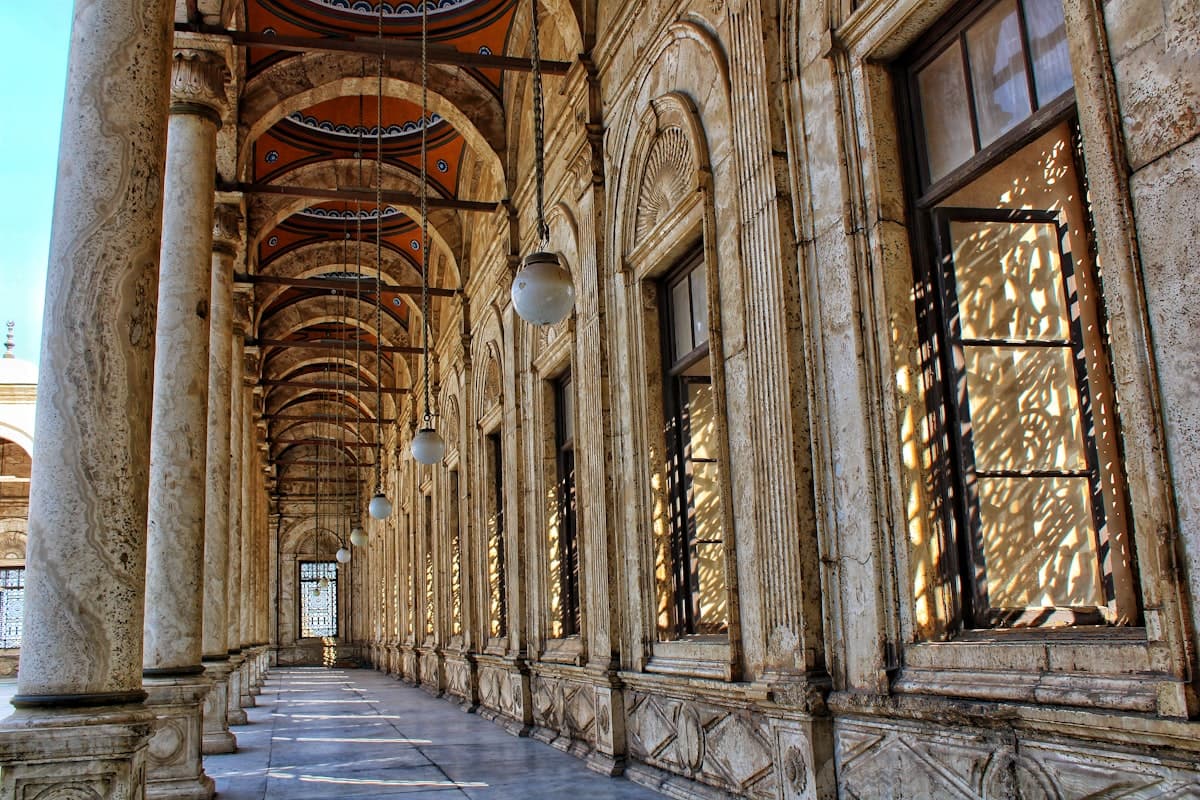
The Trilogy, published between 1956 and 1957, follows three generations of a merchant family from the same Gamaliya neighborhood. It sold modestly in Arabic until the Nobel Prize triggered translation into dozens of languages. Sales in English alone reached over a million copies. Walk south from Bab el-Futuh along Muizz Street and you are inside the novel's world. The street was the main artery of medieval Cairo, and along it you will find the Qalawun complex, built between 1284 and 1285 by the Mamluk sultan whose name it bears. The complex includes a hospital, a madrassa, and a mausoleum, and its corridor is perhaps the finest medieval interior in Cairo: a long, cool passageway tiled in marble with geometric screens that filter light into patterns across the floor.
Mahfouz knew this corridor. He wrote characters standing in it. Nobody on a standard Cairo tour stops long enough to stand still inside it and let that register.
Fishawi's Coffeehouse: Ninety Hours a Week for Decades
Fishawi's has been open continuously since 1773, making it older than the United States. That is the fact most visitors are told. What they are not told is why that matters to a Mahfouz itinerary specifically.
Mahfouz held court at Fishawi's for approximately four decades. He came on Thursday evenings, and later on other evenings as his fame grew, and sat at a specific corner table to talk with writers, journalists, politicians, and students. These were not casual visits. They were the intellectual equivalent of a weekly salon, and some of the most significant literary and political conversations in twentieth-century Egypt happened at that table over glasses of mint tea.
The coffeehouse is in a covered alley off the main Khan el-Khalili market square. It smells of aged wood and shisha tobacco and, in the early morning before the tourists arrive, of strong coffee and damp stone. The shisha pipes lined against the wall are original nineteenth-century brass. The mirrors are foxed with age. Come at 9am, before the tour groups, and you will find old men playing backgammon in near-silence. This is the actual Fishawi's. The Fishawi's at 11am is a performance for visitors.
There is no charge to sit at Fishawi's. A tea costs EGP 25-40. A shisha costs EGP 80-120. Nobody will rush you.
---
The Novels as Navigation: Which Books to Read Before You Come
You do not need to have read Mahfouz before arriving in Cairo. But if you want the streets to speak, three books will do it.
Palace Walk, the first volume of the Cairo Trilogy, is set in Gamaliya during the British Occupation and the 1919 Revolution. The geography is exact enough to use as a walking map. The protagonist Al-Sayyid Ahmad Abd al-Jawad is a merchant who presents a pious face to his family and spends his evenings drinking and singing with entertainers in the coffeehouses near the Khan. This tension between public religion and private pleasure is not a literary device. It is an observation about a particular Cairo social type that Mahfouz knew from childhood.
Midaq Alley, published in 1947, is set in a real alley off Khan el-Khalili. The alley still exists. It is called Zuqaq al-Midaq and runs off the main market street. It is about twelve meters long and three meters wide. Mahfouz describes it as having been forgotten by time, which was accurate in 1947 and remains partially accurate now. A small plaque marks it. Most visitors photograph the plaque and leave. The correct response is to stand at the end of the alley and read the opening paragraph of the novel aloud, because the description is still recognizable.
Children of Gebelawi, published in 1959, caused Mahfouz the most trouble of his career. It is an allegory of religious history, with characters representing Adam, Moses, Jesus, and Muhammad. Al-Azhar university declared it blasphemous. It was banned in Egypt until 2006 and is widely credited as the pretext that motivated the 1994 attack. It was published in Beirut and smuggled into Egypt for decades. If you can find an English copy, read it before you visit Al-Azhar, two hundred meters from Mahfouz's childhood home.
---
The Connections: What Else These Streets Carry
The Gamaliya quarter that Mahfouz wrote is not only his subject. It is the same neighborhood where, in 1798, Napoleon Bonaparte established his Institut d'Égypte after invading Egypt, quartering his scholars in Mamluk mansions and beginning the systematic study of ancient Egypt that produced the Description de l'Égypte. That twenty-three-volume survey, completed in 1828, triggered the modern Western obsession with Pharaonic civilization and eventually produced the Egyptian Antiquities Service, modern Egyptology, and the tourist infrastructure you are now moving through.
Two streets from Fishawi's is the Mosque of Al-Hakim, built between 990 and 1013 AD by the Fatimid caliph who declared himself divine and whose rule included ordering the destruction of the Church of the Holy Sepulchre in Jerusalem in 1009. The mosque was restored in the 1980s by the Dawoodi Bohra, a Shia Muslim sect based in India, who did the work as an act of devotion. It is a building that connects Fatimid Cairo, Jerusalem, the Crusades, and modern South Asian Islam. It is also fifty meters from the Mahfouz Museum and almost nobody visiting for literary reasons goes inside.
The layering is the point. Cairo's Islamic quarter is not one historical period. It is a accumulation of twenty distinct political regimes, each of which left its mark on the same compressed geography. Mahfouz spent his career writing characters who carried all of that without knowing it. You will be in a better position than most of his characters because you can look up and read the inscriptions on the buildings they lived beside.
---
Common Mistakes
Visiting Fishawi's at the wrong hour. Between 10am and 7pm, Fishawi's is tour-group territory. The atmosphere you are imagining does not exist during those hours. Come before 9am or after 9pm.
Eating at the Naguib Mahfouz Café in Khan el-Khalili. This is the contrarian take: the restaurant named after him is operated by the Oberoi hotel group, charges hotel prices, and has no meaningful connection to Mahfouz beyond the use of his name. He never ate there. It opened in 1988, the year of his Nobel Prize, as a commercial venture. The food is adequate Egyptian-continental and costs five to seven times what you will pay at a local restaurant. Spend that money at Koshary El Tahrir on Tahrir Square instead, where a full meal costs EGP 50-80 and the koshary is genuinely one of the best in the city.
Skipping the Qalawun Complex interior. Most people walk past the entrance because there is no sign in English and the doorway looks like it might be private. It is open. Go in. The corridor is the thing.
Buying a Mahfouz novel in Khan el-Khalili. The copies sold to tourists in the market are frequently pirated editions with translation errors. Get a Penguin Modern Classics edition before you arrive, or from the Diwan bookshop in Zamalek (26 July Street, Zamalek, open 9am to 11pm), which stocks reliable translations and has knowledgeable staff.
Treating this as a half-day excursion. The Gamaliya literary walk done at the pace it deserves takes a full day. People who schedule three hours come back wishing they had cleared their afternoon.
Going during Ramadan without adjusting expectations. During Ramadan, the quarter transforms. Fishawi's operates until 3am, the streets fill after Iftar, and the social texture Mahfouz wrote about, the street life and the communal noise, is more present than at any other time of year. If you can visit during Ramadan evenings, do it. If you had planned a quiet morning walk, revise.
Relying on a standard city tour to cover this. No group tour covers Mahfouz adequately. They stop at Fishawi's for twelve minutes and move on. Book a private guide who works specifically in Islamic Cairo. Expect to pay EGP 600-900 for a half-day. It is worth it.
---
Practical Tips
Wear shoes you can walk in for five hours on uneven stone. The alleys of Gamaliya have been paved and repaved across centuries and the surfaces are genuinely difficult in heels or thin-soled shoes.
Bring cash in small denominations. The vendors in Khan el-Khalili prefer it, the museum requires it, and Fishawi's does not run card machines reliably.
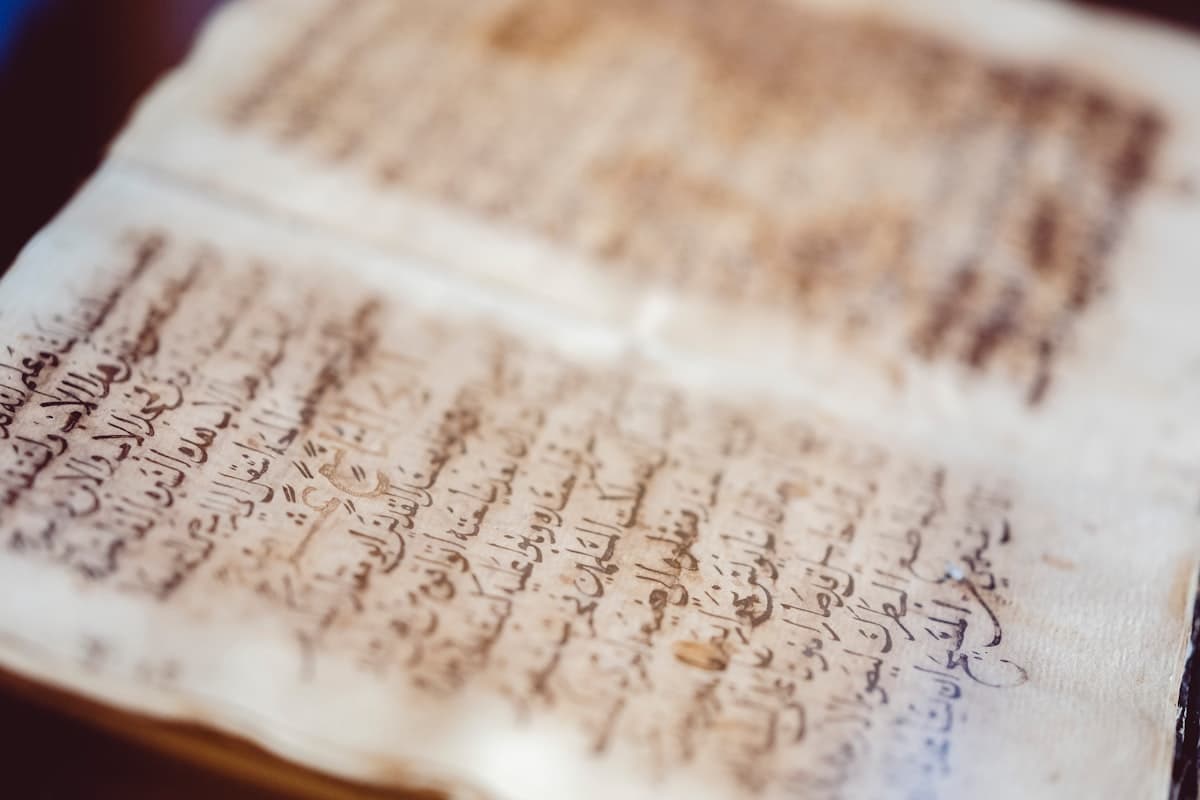
The Naguib Mahfouz Museum is genuinely small and genuinely overlooked. It displays manuscripts, photographs, his Nobel medal replica, and personal objects from his desk. A guide is available at no extra cost. Ask for one. The guide in residence as of the last visit knows the timeline of the 1994 attack and its aftermath in detail that no published account fully covers.
For the literary walk, the best companion text is not a guidebook. It is the opening fifty pages of Palace Walk, read the night before. The geography in those pages is Gamaliya in the 1910s and you will recognize it the next morning.
Frequently Asked Questions
The Weekly Dispatch
More on Egypt, every Friday.
Cultural depth and places most guides never mention.
No spam. Unsubscribe anytime.