Naguib Mahfouz Cairo Literary History Guide: The City He Wrote
Mahfouz set 34 novels in Cairo's medieval alleys yet was stabbed in the neck by a man who had never read a word he wrote. The city is still processing both facts.

Quick Facts
- Best time to visit
- October through March. Winter light in the old city is exceptional and the heat does not punish slow walking. Avoid Friday midday when Jummah prayers make the streets around al-Azhar impassable.
- Entrance fee
- Naguib Mahfouz Museum: free (donation expected). Fishawi's Cafe: no entry fee, tea EGP 40 to 60. Al-Azhar Mosque: free for Muslims, free for non-Muslims with modest dress. Qalawun complex: free.
- Opening hours
- Naguib Mahfouz Museum: approximately 10am to 4pm Saturday through Thursday, verify by phone. Khan el-Khalili: daily 9am to midnight. Al-Muizz Street monuments: generally 9am to 5pm.
- How to get there
- Metro Line 1 to Mubarak Station (EGP 8), then microbus or tuk-tuk to Hussein Square (EGP 10 to 15). Taxi from Downtown Cairo EGP 50 to 80. Uber available and recommended in heavy traffic.
- Time needed
- 3 hours minimum for the core literary walk. Full day if combining with al-Azhar, Coptic Cairo, or the northern gates at Bab el-Futuh and Bab el-Nasr.
- Cost range
- Budget EGP 300 to 600 per day including transport, tea, and street food. Mid-range EGP 800 to 1,500 including lunch at a restaurant near Hussein Square.
Quick Facts
Best time to visit: October through March, when Khan el-Khalili is cool enough to linger and the light in the old city is low and amber by 4pm.
Entrance fees: The Naguib Mahfouz Museum in the Gamaliya district is currently free to enter, though a small donation to the custodians is expected. The Naguib Mahfouz Cafe at Khan el-Khalili charges no entry; a coffee and shisha run approximately EGP 150 to 250 (roughly $3 to $5 USD).
Opening hours: The museum keeps irregular hours, typically 10am to 4pm Saturday through Thursday. Verify by phone before visiting: +20 2 2590 8211. Khan el-Khalili itself operates daily from roughly 9am to midnight.
How to get there: From Tahrir Square, take the Cairo Metro Line 1 to Mubarak Station (EGP 8), then a microbus or tuk-tuk to Hussein Square for roughly EGP 10 to 15. Taxis from Downtown run EGP 50 to 80. Uber is available and more reliable in traffic.
Time needed: Half a day for the literary walk alone. A full day if you are combining it with al-Azhar Mosque, the Coptic Museum, and the old walls of Fatimid Cairo.
Cost range: Budget EGP 300 to 600 per day for this neighborhood. Mid-range EGP 800 to 1,500 including lunch at a sit-down restaurant near Hussein.
---
Naguib Mahfouz was awarded the Nobel Prize for Literature in 1988. He was the first Arabic-language writer to win it. The Swedish Academy's announcement was broadcast on Egyptian radio, and the following morning, a fruit vendor in the medieval alley of al-Gamaliya reportedly told his customers: "Our son won." The vendor had not read the books either, but Cairo understood on instinct that the prize was about the city as much as the man.
This is where you start: not at a museum, not at a plaque, but at the understanding that Mahfouz did not write about Cairo's old city so much as he transcribed it. The alleys of al-Gamaliya, the coffeehouses of Hussein, the medieval gate of Bab el-Futuh, the cries of vendors at Khan el-Khalili: these appear in his Cairo Trilogy with the precision of a surveyor's map. Walk this neighborhood with those novels in hand and the sensation is less like literary tourism and more like navigating with a document that happens to be one hundred thousand words long.
Why This Place Matters
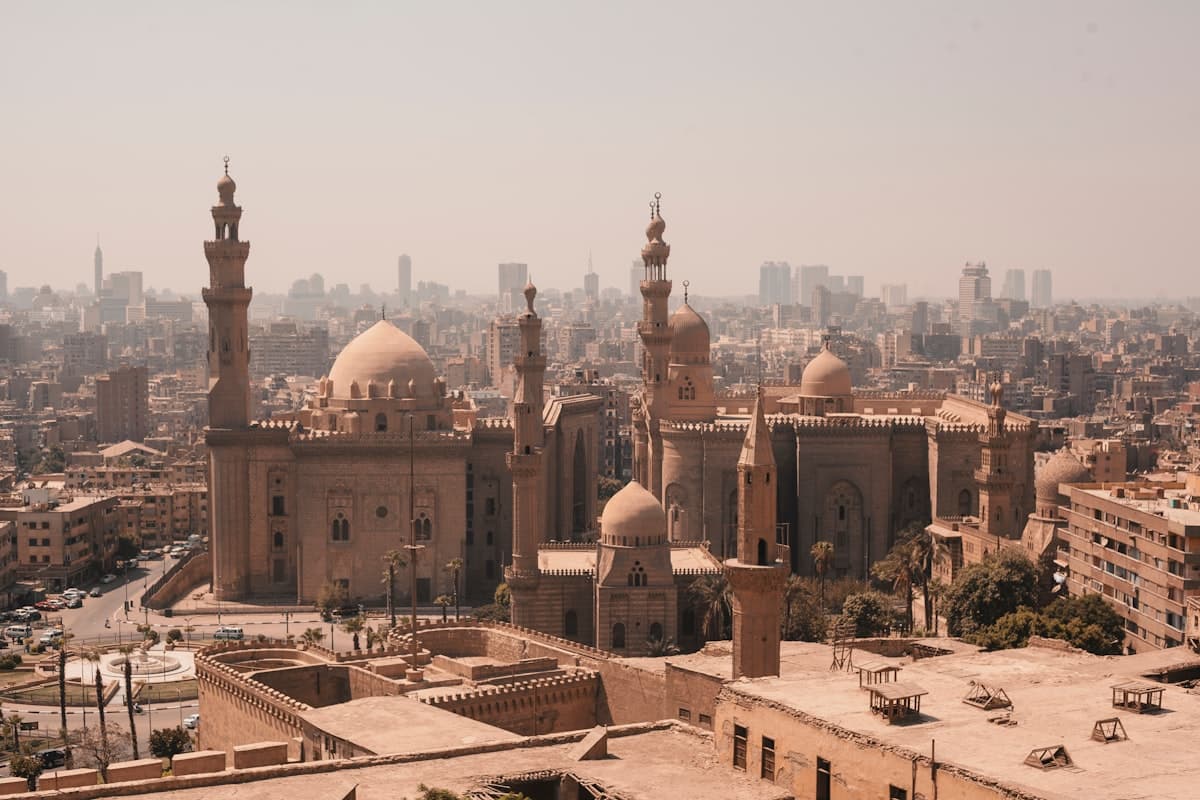
Mahfouz was born in 1911 in the al-Gamaliya district, in the shadow of the Fatimid walls that had enclosed medieval Cairo since 970 CE. He left the neighborhood at twelve when his family moved to the modern suburb of Abbasiya, but he never stopped returning in fiction. By his own account, al-Gamaliya was not a backdrop; it was a character. His Cairo Trilogy, published across three volumes between 1956 and 1957, follows three generations of the Abd al-Jawad family through a house on the fictional al-Nahhasin alley, a street that maps almost exactly onto the real Bayn al-Qasrayn, one of the main arteries of Fatimid Cairo.
Here is what most visitors do not know: Bayn al-Qasrayn means "between the two palaces." The palaces in question were the twin Fatimid royal complexes that once flanked the street, each large enough to house a full court. They were demolished in the twelfth century. Mahfouz set his most celebrated family saga on a street whose very name is a record of absence, of things that were enormous and are now entirely gone. That is not an accident. The whole trilogy is about the erosion of certainty: domestic, religious, political.
The Naguib Mahfouz Cairo literary history that most guides present is simply "he wrote about the old city." The truer version is that he wrote about what happens to a civilization when modernity arrives faster than belief systems can adapt, using the architecture of medieval Cairo as the fixed coordinate against which everything human is shown to be shifting.
The Neighborhoods He Mapped
Begin on al-Muizz Street, the medieval spine of Fatimid Cairo and one of the most densely layered urban corridors in the world. Within 800 meters you pass the Mosque of al-Hakim, begun in 990 CE and restored by the Dawoodi Bohra community of India in the 1980s (a fact that itself tells you something about the reach of Ismaili networks across centuries). You pass the madrasa and mausoleum of Sultan Barquq, the first Circassian Mamluk sultan, who came to power in 1382 after a career that began when he was sold as a slave in the markets of the Black Sea. You pass the Qalawun complex, built between 1284 and 1285, whose hospital, the Bimaristan, was so advanced that it treated patients with music therapy.
Mahfouz walked all of this. His characters walk it in the novels. The patriarch al-Sayyid Ahmad Abd al-Jawad moves through these streets at night, to the coffeehouses, to the women, to the friends, while his family sleeps behind locked doors. The contrast between the public life of the street and the private life of the house is the engine of the trilogy, and it is also a precise observation about how medieval Cairo actually functioned: the street was male, public, performative; the house was female, private, sealed.
When you reach Hussein Square, you are at the emotional center of Mahfouz's Cairo. The square fronts the mosque that supposedly holds the head of Hussein, grandson of the Prophet, killed at the Battle of Karbala in 680 CE. It is one of the most sacred sites in Sunni Egypt, though its intense devotion has always carried a Shia emotional register that orthodox institutions find complicated. On Mawlid celebrations, tens of thousands press into this square. The sound is not like a concert. It is more like a city exhaling.
The Coffeehouse as Archive
Do not skip the coffeehouses. This is the one instruction that matters more than any museum ticket.
Mahfouz spent every morning for decades at a series of Cairo coffeehouses, most famously the Fishawi Cafe in Khan el-Khalili, which has operated continuously for over 200 years and has possibly changed its decor less than any establishment in the city. He would arrive at the same hour, sit at roughly the same table, and talk. The talking was the work. His novels were built from conversation, from the way Cairenes argued about religion and politics and sex and money in the semi-public space of the ahwa, where the waiter knew your name and the backgammon pieces clicked like a second language.
The Naguib Mahfouz Cafe, which is actually a more upscale restaurant opened in his honor near Khan el-Khalili, is fine but somewhat beside the point. Fishawi's is the real address. Go in the morning, before the tourists arrive. Order tea, not coffee, because the tea is better. Watch the light come through the old mirrors. The mirrors have been there since before Egypt's independence. They have reflected more Cairo history than any official monument.
In 1994, Mahfouz was attacked outside his home in Agouza by a young man who stabbed him in the neck. The attacker, and the men who sent him, were motivated by a religious edict against Mahfouz's 1959 novel "Children of Gebelawi," which allegorized the Abrahamic prophets as characters in a Cairo alley. The novel had been banned in Egypt since its serialization in al-Ahram newspaper; the ban was not lifted until 2006, two years before Mahfouz died, and even then quietly. The attacker later admitted he had not read the book.
Mahfouz survived, though the nerve damage to his right hand ended his ability to write longhand. He dictated for the remaining fourteen years of his life.
The Connections
No part of this walk exists in isolation. The Fatimid walls you see at Bab el-Futuh and Bab el-Nasr, the two medieval gates that still stand at the northern end of al-Muizz Street, were built in 1087 CE by an Armenian Christian general named Badr al-Jamali, who served the Fatimid Caliph al-Mustansir. The gates are carved with inscriptions in Arabic praising an Ismaili Shia dynasty, designed by a Christian Armenian, built by workers whose origins are unrecorded. This is medieval Cairo in miniature: a city assembled from everywhere, belonging entirely to itself.
The Coptic history is three kilometers south at the Hanging Church and the Church of St. Sergius, which sits above a crypt that Coptic tradition holds was the resting place of the Holy Family during their flight into Egypt. The Jewish history is at the Ben Ezra Synagogue next door, where the Cairo Geniza was discovered in 1896: a repository of approximately 300,000 manuscript fragments spanning a thousand years, including business letters, poetry, marriage contracts, and shopping lists, that has rewritten scholarly understanding of medieval Mediterranean commerce. Mahfouz knew this landscape. His characters pass through it without always knowing what they are passing.
The modern connection runs through al-Azhar University, founded in 972 CE and therefore the oldest continuously operating university in the world (Bologna, which claims the title in European tradition, was founded in 1088). Al-Azhar's relationship with the Egyptian state, with Mahfouz's work, with the religious authorities who condemned "Children of Gebelawi," is a thread that runs directly from the Fatimid period to the present without breaking.
Common Mistakes
Visiting Khan el-Khalili first. Khan el-Khalili is a medieval market that became a tourist market and is now mainly a place where Egyptian souvenirs made in Chinese factories are sold in medieval-looking stalls. The real craft economy has moved. Go to Khan el-Khalili for Fishawi's and the Hussein Mosque. Do not go to shop.
Skipping the northern gates. Bab el-Futuh and Bab el-Nasr are ten minutes north of Hussein Square and almost nobody goes there. You can walk inside the walls and along the top of the ramparts. The view over the Fatimid city from the top of Bab el-Nasr is the best free thing in Islamic Cairo and it is nearly always empty.
Taking a guided tour of the literary sites. The organized literary tours of Cairo average EGP 800 to 1,200 per person and cover ground you can cover alone with a copy of "Palace Walk" and an afternoon. The guides add context, but they also move at group speed, which means you will not get to sit long enough at Fishawi's for the place to actually do anything to you.
Treating the Naguib Mahfouz Cafe as a literary pilgrimage site. It is a restaurant named after a writer, not a place he frequented. The food is adequate and the prices are tourist-calibrated. Eat at one of the small fuul and falafel places on the side streets near al-Azhar instead, for a quarter of the price and actual Cairo flavor.
Reading none of the books before you go. The neighborhood is navigable without Mahfouz. It is a different experience with him. You do not need all three volumes of the Cairo Trilogy. Read the first hundred pages of "Palace Walk" on the flight and you will arrive already oriented.
Visiting on a Friday midday. Jummah prayers at Hussein Mosque draw enormous crowds. The streets around al-Azhar become impassable. Unless you want to witness that specifically, which is worth doing once, arrive on a weekday morning.
Practical Tips
Dress conservatively in this neighborhood. This is not performative caution: al-Gamaliya is a working religious district, not a tourist zone that happens to contain mosques. Women should have a scarf accessible. Men in shorts will be stared at, not in hostility but in genuine confusion about what you are thinking.
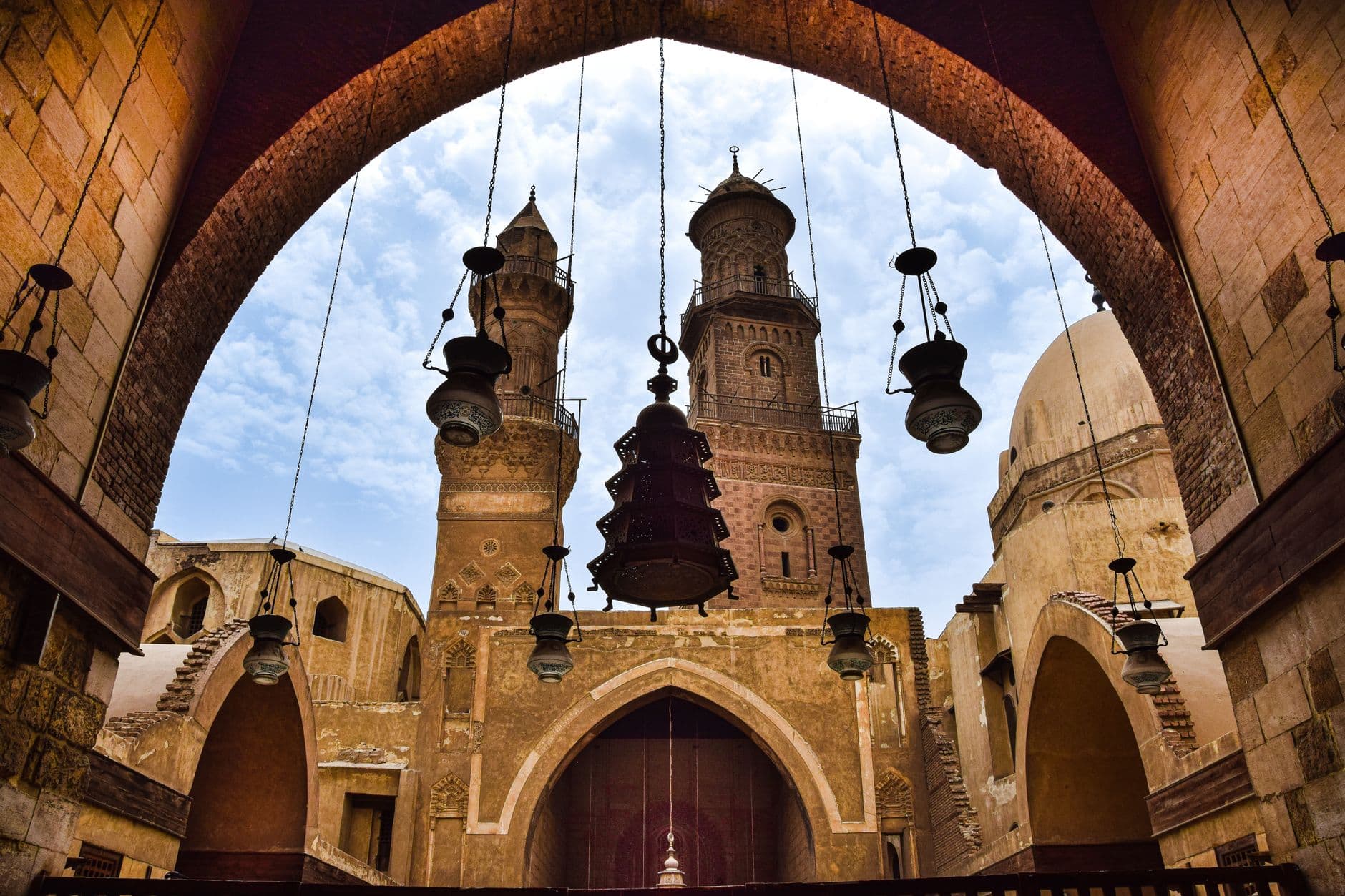
The best photograph of the entire walk is from inside the courtyard of the Qalawun complex, looking up at the dome above the mausoleum. It is almost always uncrowded before 10am. Entry is free.
Bring cash. The old city operates almost entirely in EGP and very few places accept cards. ATMs are available near Hussein Square but they run out on Fridays.
If you want to buy a copy of Mahfouz in Arabic or English, try Lehnert and Landrock on Sherif Street in Downtown, one of Cairo's few remaining serious bookshops, rather than the tourist stalls. The selection is better and the price is honest.
The literary walk from Bab el-Futuh to Hussein Square, done properly with stops, takes about three hours. Add al-Azhar and the Ghouri complex and you need four. The coffeehouses are not optional. They are where Mahfouz actually lived.
Frequently Asked Questions
The Weekly Dispatch
More on Egypt, every Friday.
Cultural depth and places most guides never mention.
No spam. Unsubscribe anytime.