Naguib Mahfouz Cairo Literary History Guide: Walking the City He Wrote
Mahfouz set 34 novels in Cairo's alleys. He was stabbed in the neck at 82 for a book he wrote 30 years earlier. The city that tried to silence him still carries his voice in every coffeehouse.

Quick Facts
- Best time to visit
- October through March. Cairo winters are mild and the medieval district is walkable without heat exhaustion. Ramadan evenings are also worth experiencing: Fishawi's runs 24 hours and the neighborhood is at its most theatrically alive.
- Entrance fee
- Naguib Mahfouz Museum: EGP 60 (approx $1.20 USD). Bab Zuweila minarets: EGP 60 (approx $1.20 USD). Fishawi's coffeehouse and local ahawi: EGP 20 to EGP 80 for tea and shisha. The walk itself is free.
- Opening hours
- Naguib Mahfouz Museum: Saturday to Thursday, 9am to 4pm, closed Friday. Naguib Mahfouz Café: daily noon to midnight. Fishawi's: daily, effectively continuous, 24 hours during Ramadan.
- How to get there
- Metro Line 2 to El-Ataba station (EGP 10), then 15-minute walk or EGP 15 tuk-tuk into Gamaliya. Taxi from Downtown Cairo: EGP 40 to EGP 80. Taxi from Zamalek or Dokki: EGP 80 to EGP 130.
- Time needed
- Half a day for the core walk including the museum and Fishawi's. A full day if you intend to climb Bab Zuweila, browse the tentmakers' market, and have a proper lunch at the Mahfouz Café.
- Cost range
- Budget day (metro, museum, local ahwa, street food): EGP 150 to EGP 250. Mid-range day (taxi, museum, lunch at Mahfouz Café, Bab Zuweila): EGP 500 to EGP 900.
Quick Facts
Best time to visit: October through March, when Khan el-Khalili is bearable before noon and the coffeehouse terraces fill with afternoon light rather than savage heat.
Entrance fees: Naguib Mahfouz Museum (Gamaliya district): currently EGP 60 (approx $1.20 USD). The Naguib Mahfouz Café in Khan el-Khalili: no entry fee, food and drinks range EGP 80 to EGP 350. Most of the literary walk is free, the city itself being the exhibit.
Opening hours: The Mahfouz Museum opens Saturday through Thursday, 9am to 4pm, closed Fridays. The Naguib Mahfouz Café operates daily from noon to midnight.
How to get there: Taxi from Downtown Cairo to Khan el-Khalili runs EGP 40 to EGP 80 depending on traffic and your negotiating patience. The metro to El-Ataba station (Line 2) costs EGP 10, then a 15-minute walk through the Muski market. A tuk-tuk from El-Ataba to the heart of Gamaliya runs EGP 15.
Time needed: Half a day for the core walk. A full day if you intend to sit, eat, and read somewhere he actually sat and ate.
Cost range: EGP 200 to EGP 500 for a full day including transport, the museum, lunch at the Mahfouz Café, and coffee at Fishawi's.
---
Naguib Mahfouz wrote the same square kilometer of Cairo for sixty years. When he won the Nobel Prize for Literature in 1988, the first Arab writer ever to do so, the Egyptian government was reportedly surprised. His publishers in Cairo had been treating his work as a local curiosity. Oslo understood what Cairo had been taking for granted.
This is a guide to the Cairo he built in words and the Cairo that shaped those words. It is also a guide to the stabbing, the censorship, the coffeehouses, and the question of what it means that the city's most celebrated novelist spent the last decade of his life nearly deaf and nearly blind, dictating stories into a tape recorder because his hands shook too badly to write.
Why This Place Matters: The City as Literature
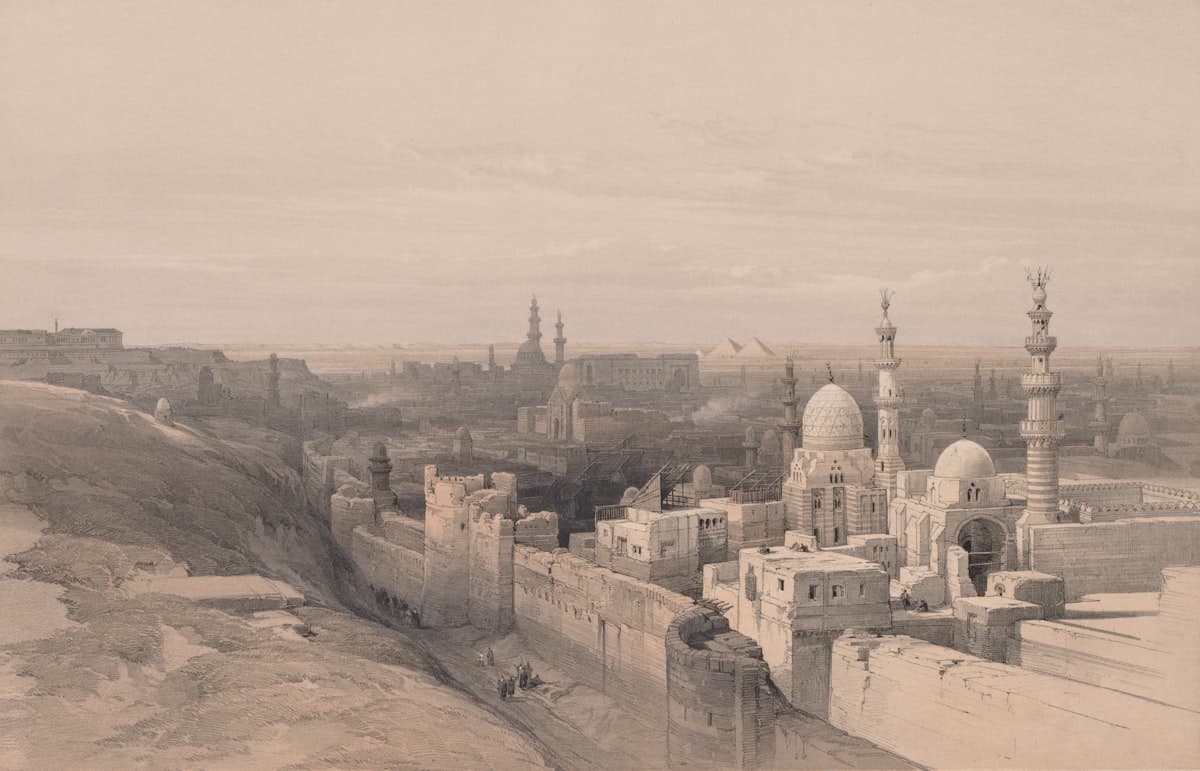
The Gamaliya district, where Mahfouz was born in 1911 and where he set the Cairo Trilogy, is one of the oldest continuously inhabited urban neighborhoods on earth. The street grid beneath it follows a Fatimid plan from 969 CE, when the caliph al-Mu'izz founded Cairo as a royal enclosure. Beneath that Fatimid grid are Roman fortifications. Beneath those, a Pharaonic canal that once fed water from the Nile to the eastern settlements is thought to run.
Mahfouz grew up in a merchant family in a neighborhood where this layering was visible in everyday life: a mosque built into a Coptic chapel built into a Roman structure built over something older. His fiction absorbed this quality. The Cairo Trilogy, published between 1956 and 1957, follows three generations of a merchant family through three distinct Egyptian political eras. It does not feel like historical fiction because Mahfouz does not write history as costume. He writes it as furniture, as smell, as the particular quality of light through a wooden mashrabiya screen.
When you walk al-Muizz Street now, the longest surviving medieval Islamic street in the world at roughly one kilometer, you are walking the same axis that the Trilogy's patriarch, al-Sayyid Ahmad Abd al-Jawad, walked to his shop each morning. The Qalawun complex, built in 1285 by the Mamluk sultan Qalawun, a man who rose from Mongol slave to the most powerful ruler in the Islamic world, stands along this route. Mahfouz would have seen it daily as a boy. It appears in his work as scenery so ordinary it barely warrants description. That familiarity is the point.
The Coffeehouses: Where He Actually Worked
Mahfouz famously wrote in coffeehouses rather than at a desk. From the 1940s onward, he maintained a schedule that became almost liturgical: government job in the morning (he worked for decades in the Ministry of Culture and various cultural bodies), coffeehouse in the afternoon, writing late into the night. The idea of the tortured-recluse writer did not apply to him. He needed the noise, the argument, the particular social texture of men playing backgammon and debating politics and religion loudly enough that a novelist could not help but absorb dialogue.
Fishawi's Coffeehouse in Khan el-Khalili is the place most associated with him, and for once the association is genuine rather than commercial. Mahfouz sat here for decades. The coffeehouse has operated continuously since 1773, making it older than the United States and older than most of the architectural history most tourists come to Cairo to see. During Ramadan, when it runs 24 hours, it becomes exactly the kind of human theater Mahfouz spent his life transcribing.
The problem with Fishawi's now is the tourist markup. Coffee that costs EGP 25 in a local ahwa around the corner costs EGP 80 here. The waiters have developed the habit of assuming foreign visitors want the English-language menu with the inflated prices. Ask for the Arabic menu, or simply order tea and shisha and refuse the laminated card.
The Naguib Mahfouz Café, run by the Oberoi group and built into a restored Khan el-Khalili building, is a different category of experience. It is expensive by Egyptian standards, pleasant by international ones, and honest about what it is: a restaurant for tourists who want to eat well in a beautiful space while nodding to a writer they may have read in translation. The food is genuinely good. The walls are hung with photographs of Mahfouz. This is not where he worked; it is where people who read his work come to imagine him working.
The Assassination Attempt That Changed Everything
On October 14, 1994, a man named Mohammed Naguib stopped Mahfouz outside his friend's apartment in Agouza and stabbed him in the right side of the neck. Mahfouz was 82. He survived. The attacker was a member of an Islamist cell who believed Mahfouz had insulted Islam with his 1959 novel "Children of Gebelawi," a novel that reimagines the Abrahamic prophets as characters in an allegorical Cairo neighborhood. The book had been banned in Egypt since 1959. It was not published in Egypt until 2006, three years after Mahfouz's death.
The irony that makes this specifically Egyptian rather than universally tragic: the attacker had not read the novel. He acted on the judgment of a religious authority who had also not read it, or at least claimed not to have read it. Mahfouz had written the book 35 years before the attack. He had been careful and conciliatory in the years between, even issuing statements designed to appease critics. None of it mattered. The nerve damage from the stabbing made writing by hand impossible for the remaining thirteen years of his life.
He still published. He dictated short stories to a tape recorder, relying on memory because his eyesight had also deteriorated severely. Thirty-one new stories appeared after the attack. This is the fact about Mahfouz that Egyptians mention with a particular kind of pride: not just that he survived, but that he kept working.
The Museum and the Neighborhood
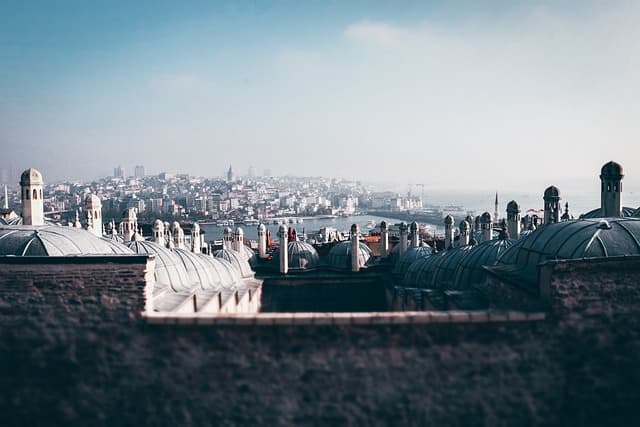
The Naguib Mahfouz Museum in Gamaliya is small, under-visited, and worth your time precisely because it is not polished. It occupies a building in the neighborhood where he grew up, and the collection includes photographs, manuscripts, personal correspondence, and the kind of handwritten notes that make you understand how a novelist thinks. Captions are in Arabic and English. The staff are often enthusiastic in a way that suggests they do not see many visitors who have actually read the man.
The real museum is outside the door. Walk north from the museum toward Bab el-Futuh, one of the Fatimid gates built in 1087 that still marks the northern edge of what was once the walled royal city. Walk south toward Bab Zuweila, the southern gate built in the same era, from whose towers the Mamluk sultans once hanged the heads of enemies and where the Ottoman Sultan Selim I had the last Mamluk sultan, Tuman Bay, executed by hanging in 1517. Between these two gates, along al-Muizz Street, Mahfouz's Cairo is still physically present in a way that has nothing to do with plaques or tourism infrastructure.
The spice market, the copper-beaters, the tentmakers' market just beyond Bab Zuweila: these are working commercial districts that have operated in roughly the same form since the medieval period. The noise and smell here, cumin and burning charcoal and diesel and something floral from a perfume stall, is the sensory base of the Trilogy. Mahfouz did not invent this atmosphere. He transcribed it.
The Connections: One Writer, Many Egypts
Mahfouz wrote during the British occupation, the 1952 revolution that brought Nasser to power, the Nasser era, the Sadat era, and the Mubarak era. His relationship with each government was complicated in ways that illuminate Egyptian political culture more precisely than any history textbook.
Nasser's government banned "Children of Gebelawi" while simultaneously celebrating Mahfouz as a national cultural asset. Sadat released some of the censorship pressure, and Mahfouz became more openly experimental. The Nobel Prize arrived during Mubarak's tenure, and the government's response was to take partial credit while doing essentially nothing to expand translations or promote his work abroad.
The Coptic connection is less discussed but real. Mahfouz wrote Coptic Egyptian characters with the same grounded specificity he brought to Muslim characters, neither exoticizing nor erasing the Christian community that has lived in this part of Cairo for seventeen centuries. The Hanging Church in Old Cairo, built over a Roman gatehouse in the 4th century, represents a strand of Egyptian history that Mahfouz understood as continuous with his own: a different faith on the same soil, shaped by the same Nile, the same dust, the same political cycles.
The specifically literary connection most visitors miss: Mahfouz admired Proust explicitly and said so in interviews. "In Search of Lost Time" influenced the structure of the Cairo Trilogy in ways that are visible when you read both. A French novel about memory and bourgeois Paris shaped the most important Arabic novel about memory and merchant Cairo. The history of world literature is full of these crosspollinations. Mahfouz is one of the most legible examples.
Common Mistakes
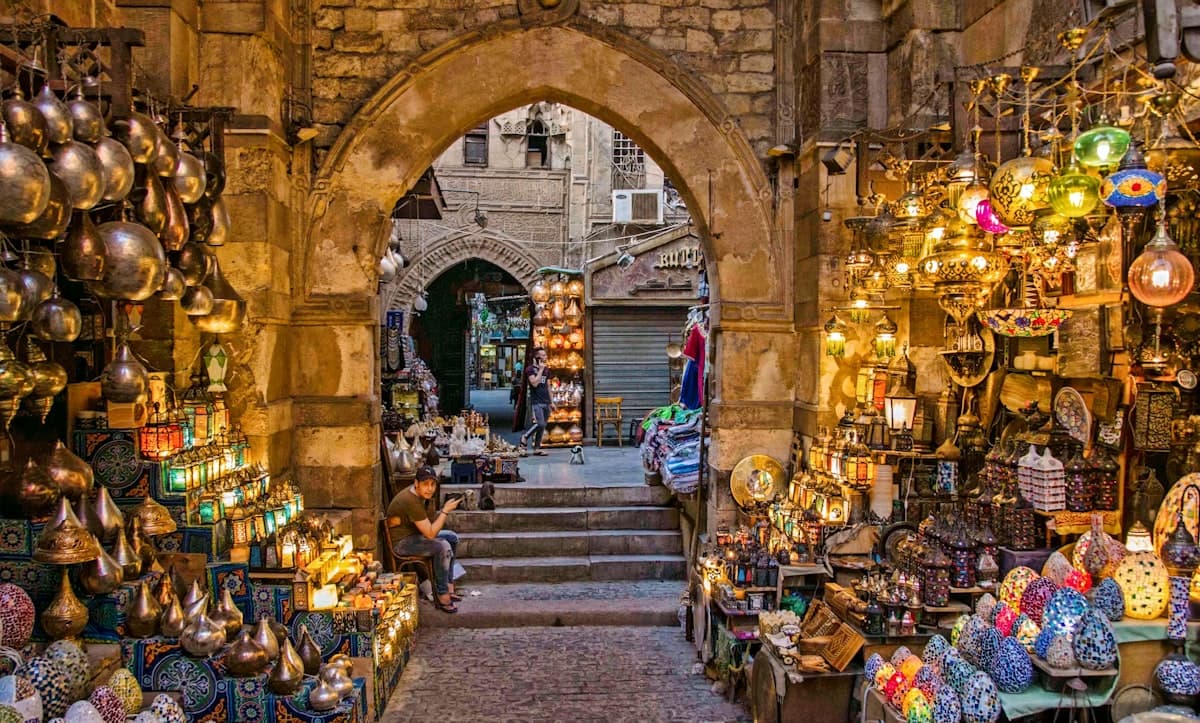
Skipping the actual neighborhood in favor of the café. The Naguib Mahfouz Café is fine, but spending two hours there without walking al-Muizz Street is like going to Alexandria to eat at a seafood restaurant and skipping the sea. The street costs nothing and contains everything.
Visiting Khan el-Khalili between 11am and 4pm in summer. The heat is physically punishing and the crowds make the narrow alleys genuinely unpleasant. Arrive by 9am or after 6pm. The evening light is better anyway.
Buying the tourist-oriented "Mahfouz biography" sold near the museum. There is one slim volume, sold near the entrance, that is hagiography rather than biography, thin on actual literary analysis and heavy on nationalist pride. Fetch a copy of Roger Allen's introduction to the Trilogy, or read the Nobel lecture Mahfouz could not deliver in person (he sent his daughter to read it) before you go.
The sound and light show at the Citadel is not relevant to this literary walk but is worth addressing anyway: do not do it. EGP 300 for colored lights on stones you can see properly in daylight tells you nothing. Spend that money on dinner in the Gamaliya district instead.
Expecting the museum to tell you why Mahfouz matters. The museum is archival rather than interpretive. Read at least the first hundred pages of "Palace Walk" before visiting. The neighborhood will make more sense, the photographs will feel more specific, and you will understand what you are looking at.
Assuming the coffeehouse culture is gone. It is not. The ahawi (coffeehouses) on the side streets off al-Muizz are full of Egyptian men doing exactly what men did when Mahfouz was absorbing it all in the 1930s and 1940s. You can sit in one for EGP 20. You will not be turned away. You will be an object of mild curiosity rather than predatory commerce.
Missing Bab Zuweila. You can climb the minarets for EGP 60. The view north along al-Muizz Street shows you the entire axis of medieval Cairo at once. This is the city Mahfouz held in his head for sixty years, rendered as rooflines and minarets and market stalls below. It is the best orienting moment on the entire walk.
Practical Tips
Dress modestly. Not because anyone will stop you at the door, but because the Gamaliya district is a working, conservative neighborhood and visible comfort for you means visible respect for the people who actually live there. Women: shoulders and knees covered. Men: shorts are fine, but long trousers will reduce the ambient attention.
Bring cash. The museum, the local coffeehouses, the small bookstalls: none take cards. An ATM at the El-Ataba metro station works reliably. Withdraw before you head into the market district.
Buy Arabic editions. The bookstalls near Bab Zuweila sell Arabic paperback editions of Mahfouz's novels for EGP 30 to EGP 80. Even if you cannot read Arabic, buying a Cairo Trilogy paperback printed in Cairo and reading it on your hotel terrace that night is a different experience from reading the Anchor Books translation you brought from home. Both are good. Do both.
The Naguib Mahfouz literary history of Cairo rewards a return visit. The first time you walk al-Muizz Street you are navigating. The second time, after you have read more of the work, you are recognizing. This distinction matters. The city does not give itself up on a single pass, which is something Mahfouz would have recognized as one of its better qualities.
Frequently Asked Questions
The Weekly Dispatch
More on Egypt, every Friday.
Cultural depth and places most guides never mention.
No spam. Unsubscribe anytime.