Naguib Mahfouz's Cairo: A Literary History Guide to His City
Mahfouz won the Nobel Prize in 1988. His Egyptian publisher had already rejected him once. The Cairo he wrote about is still there, if you know which alley to enter.

Quick Facts
- Best time to visit
- October to March, when daytime temperatures in Cairo are 15-25°C and walking the medieval lanes for several hours is physically comfortable. Avoid July and August, when the same walk at 38°C becomes punishing.
- Entrance fee
- Naguib Mahfouz Museum: EGP 100 (approx $2 USD), students EGP 50. El-Fishawy café: free entry, coffee EGP 60-120. Gamaliya walking circuit: free.
- Opening hours
- El-Fishawy: 24 hours daily. Naguib Mahfouz Museum: Saturday to Thursday 10am to 6pm, closed Friday. Khan el-Khalili shops: roughly 9am to midnight.
- How to get there
- Metro Line 3 to Al-Hussein station, EGP 10-15. Taxi or ride-share from Downtown Cairo EGP 40-70 (15-25 min). On foot from the Citadel: 25 minutes north through Gamaliya, which is the recommended approach.
- Time needed
- Half a day for core literary sites. Full day if combining Gamaliya walk, El-Fishawy, the Mahfouz Museum, Sharia al-Muizz monuments, and the Nile corniche in Agouza.
- Cost range
- Budget EGP 400-700 per day covering café, museum, street food, and metro. Mid-range EGP 1,200-2,000 adding a sit-down lunch and a local guide for the morning walk.
Naguib Mahfouz's Cairo: A Literary History Guide to His City
In 1994, a man stabbed Naguib Mahfouz in the neck outside his home in Agouza. Mahfouz was 82 years old, had won the Nobel Prize in Literature six years earlier, and had been targeted by Islamist extremists who claimed to have been offended by a novel he wrote in 1959. The attacker had never read the novel. Neither had the cleric who issued the fatwa against it. Mahfouz survived, though the nerve damage left him unable to write for months. He dictated his final stories to a friend. He died in 2006 at age 94, having published 34 novels, more than 350 short stories, and countless essays, almost all of them set within a few square kilometers of central Cairo. The city did not dedicate a single street to him until 2011.
This is a guide to that city: the coffeehouses, the medieval alleys, the river-facing apartments, the ahwas where he held court for decades. It is also a guide to understanding why Mahfouz matters beyond his Nobel citation, and why Cairo, which he described as both prison and paradise, still carries the imprint of a man who spent nearly a century watching it change.
Quick Facts
Best Time to Visit: October through March, when Cairo is cool enough to walk the narrow lanes of Islamic Cairo and Khan el-Khalili without the punishing summer heat pressing you into doorways.
Entrance Fees: El-Fishawy Café: Free to enter, coffee EGP 60-120 (approx $1.25-2.50 USD) Naguib Mahfouz Museum, Khan el-Khalili: EGP 100 (approx $2 USD), students EGP 50 Al-Hussein Mosque area: Free access to the square, closed to non-Muslims for prayer interiors Gamaliya district walking tour (self-guided): Free
Opening Hours: El-Fishawy Café: Open 24 hours, daily Naguib Mahfouz Museum: Saturday to Thursday, 10am to 6pm; closed Friday Khan el-Khalili bazaar: Shops open roughly 9am to midnight; mornings are far quieter
How to Get There: Metro to Al-Hussein station (Line 3, EGP 10-15 depending on zone), then a 7-minute walk into Khan el-Khalili Taxi or ride-share from Downtown Cairo (Wust el-Balad): EGP 40-70, roughly 15-25 minutes depending on traffic On foot from the Citadel: 25 minutes north through the Gamaliya district, which is the correct way to arrive if you want context
Time Needed: Half a day minimum for the core literary sites. A full day if you intend to sit at El-Fishawy, read a chapter of the Cairo Trilogy, eat lunch at the Naguib Mahfouz restaurant on Sikket el-Badestan, and walk the length of Gamaliya.
Cost Range: Budget EGP 400-700 per day for this itinerary, mid-range EGP 1,200-2,000 if you add a sit-down lunch and a guide.
Why Mahfouz Matters, and Why Cairo Is the Point
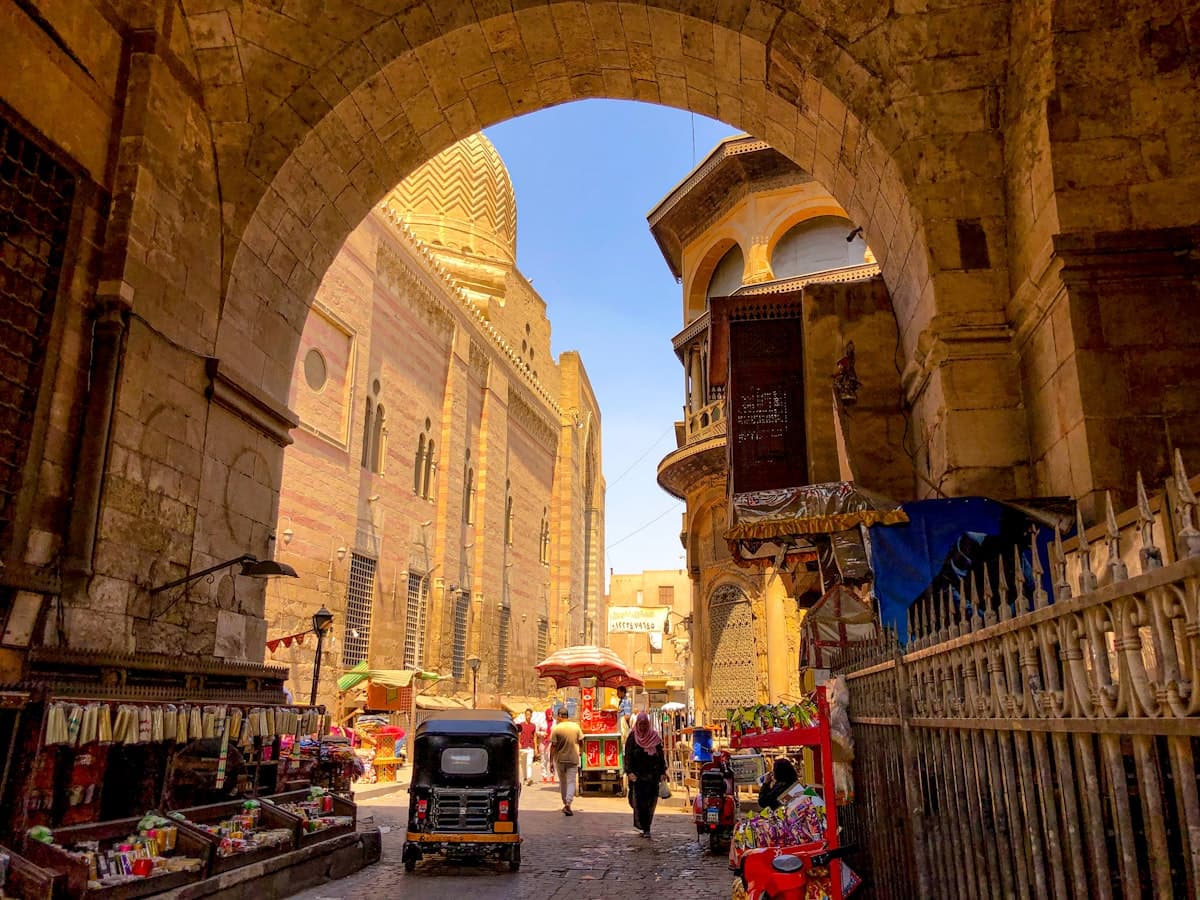
Most visitors arrive at Mahfouz through the Nobel Prize, which is a reasonable entry point but a misleading one. The Nobel committee cited his work for "an Arabian narrative art that applies to all mankind." What they meant, more specifically, is that Mahfouz did for Cairo what Dickens did for London and Balzac did for Paris: he turned a city into a moral universe, with specific streets carrying the weight of specific arguments about class, religion, gender, and power.
His Cairo Trilogy, published between 1956 and 1957, follows three generations of a merchant family in the al-Gamaliya district of Islamic Cairo between 1917 and 1944. The patriarch, al-Sayyid Ahmad Abd al-Jawad, lives on a street that still exists, runs a shop that still has analogues in Khan el-Khalili, and worships at a mosque you can visit this afternoon. The trilogy runs to nearly 1,500 pages. In Egypt it is still taught in schools, quoted in political arguments, and cited in conversations about whether Egyptian society has actually changed since the British occupation.
The district where most of this unfolds, Gamaliya, sits on land that has been continuously inhabited since the Fatimid caliph al-Muizz founded the city of Cairo in 969 CE. The street called al-Muizz li-Din Allah al-Fatimi, which runs through the heart of Mahfouz's literary geography, is lined with Fatimid, Ayyubid, Mamluk, and Ottoman monuments so densely packed that UNESCO designated it an open-air museum. Mahfouz grew up in a house two minutes from this street. He never really left it, even when his body did.
Walking Gamaliya: The Neighborhood Behind the Novels
Enter from the south, from the direction of the Citadel, and walk north on Sharia al-Muizz. This is not the direction most visitors take, because tour buses deposit people at Khan el-Khalili and send them south. Go against the current.
The first thing you notice is the light. The medieval city was built with streets narrow enough to provide shade in summer but wide enough for two loaded camels to pass. The result, in the 21st century, is a perpetual filtered half-light that makes afternoon feel like early evening and gives the stone a color that shifts between honey and ash. Mahfouz describes this light constantly. In Palace Walk, the first novel of the trilogy, the protagonist looks down from a rooftop and watches the street below with the detached attention of someone who has memorized it so completely that any deviation reads as catastrophe.
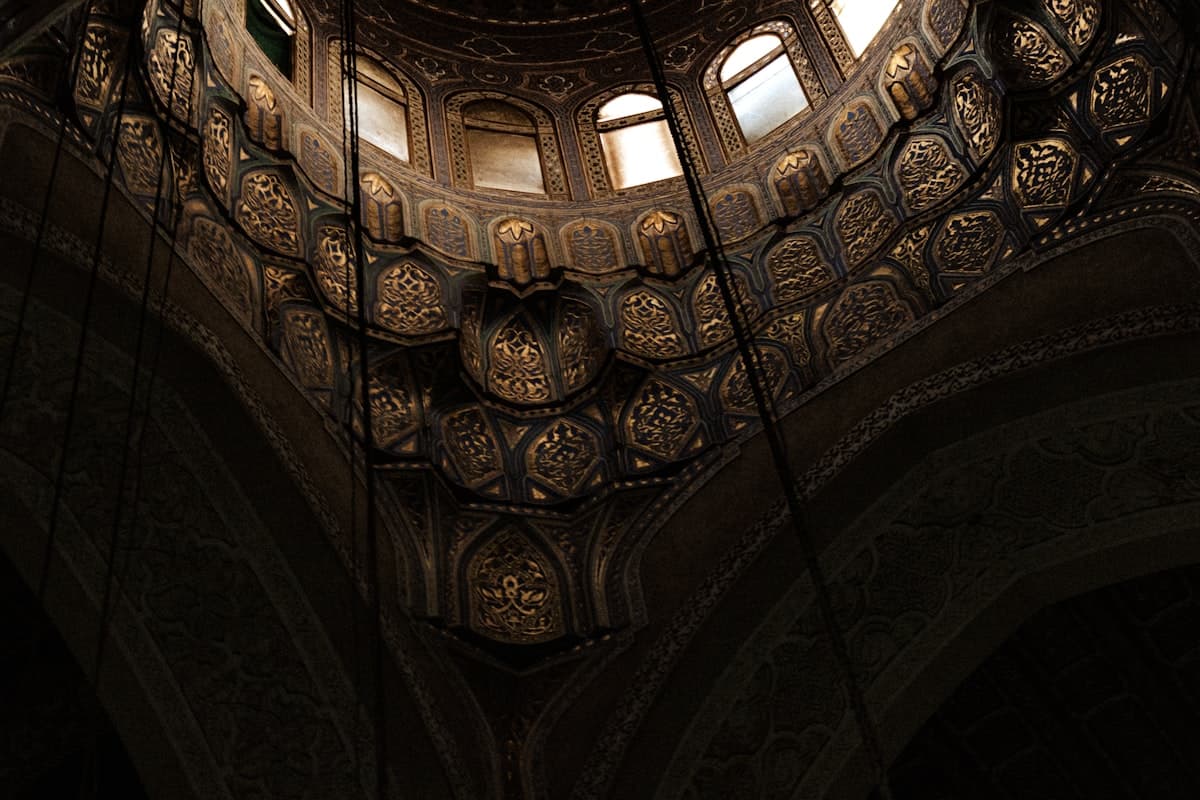
At the complex of Sultan Qalawun, stop. This mausoleum, madrasa, and hospital complex was completed in 1285. The hospital, the Bimaristan al-Mansuri, treated up to 4,000 patients a day at its peak, charged no fees regardless of the patient's religion or origin, and was staffed by doctors who were paid regular salaries rather than fees, making it one of the first institutionalized free public hospitals in the medieval world. It operated for seven centuries. The building now functions partly as a storage facility for the Egyptian Ministry of Antiquities. The carved stucco in the mausoleum interior is extraordinary and almost nobody is there when you arrive.
Mahfouz set scenes near these monuments without ever treating them as backdrop. In his work, the Qalawun complex is simply the street, the same way Parisians don't think of Notre-Dame as a tourist site when they pass it on the way to the market. This is what his fiction did for the medieval city: it made it domestic again.
El-Fishawy and the Culture of the Ahwa
El-Fishawy Café, tucked into a narrow passage off the main Khan el-Khalili square, has been open continuously since 1773. This is not a claim most Cairo coffeehouses can make, and El-Fishawy earned its longevity partly through location, partly through the specific quality of its tea, and partly because Naguib Mahfouz sat here for decades.
For much of his adult life, Mahfouz held a weekly gathering at El-Fishawy, or in the years when his health or fame made that difficult, at the nearby Casino Qasr el-Nil and later at the Marriott Hotel in Zamalek. These gatherings, called salon nights in Egyptian literary circles, were where Cairo's intellectuals argued about Nasser, about the 1967 defeat by Israel, about Sadat's peace with Israel in 1979, about Islamic extremism. Mahfouz did not lecture. He listened, drank tea, smoked his pipe in later years, and occasionally asked a question that ended the argument.
El-Fishawy itself is worth an hour of sitting, not for the coffee, which is fine but not exceptional, and not for the food, which is limited, but for the room. The walls are covered in antique mirrors, some of them original 18th-century Venetian glass brought up the Nile when Cairo's elites were importing European luxury goods. The mirrors are slightly warped, which means you see yourself fragmented and repeated at angles that don't quite line up. It is an accidental but perfect metaphor for the self-watching quality of Mahfouz's fiction.
Skip the Naguib Mahfouz restaurant on Sikket el-Badestan if you are on a budget. It is a respectable operation serving Egyptian standards at international prices, around EGP 400-700 per person for a full meal, and is aimed squarely at tourists who want to say they ate somewhere associated with the Nobel laureate. The association is primarily commercial. The food is not worth the price relative to what you can find fifty meters away in the market.
The Connections: From Fatimid to Nobel
The neighborhood Mahfouz was born into in 1911 had already been a center of Cairene intellectual and commercial life for nearly a thousand years. The Fatimids built Cairo in 969 as a private royal city, separate from the working-class settlements at Fustat to the south. Within two centuries it had absorbed its surroundings and become the largest city in Africa and the Middle East, with a population that historians estimate at around 500,000, comparable to contemporary Constantinople.
The al-Azhar mosque, founded in 970 CE and converted into a university in 988 CE, sits two minutes from El-Fishawy. Al-Azhar is the oldest continuously operating university in the world, predating the University of Bologna by over a century. Mahfouz's characters move in and out of its orbit constantly, educated there, challenged by its rulings, constrained and sustained by its authority. When Islamist extremists targeted Mahfouz in 1994, they were operating in the same theological geography that al-Azhar has presided over for a millennium. The fatwa against his 1959 novel "Children of Gebelawi" was issued by a cleric who based his condemnation on the novel's allegorical treatment of the Abrahamic prophets. Al-Azhar did not officially condemn the novel but declined to defend it.
The Mamluk architecture that lines Sharia al-Muizz connects Mahfouz's Cairo to an older story of displaced men building permanence. The Mamluks were enslaved soldiers, mostly Circassian and Turkic, who seized power in Egypt in 1250 by assassinating the last Ayyubid sultan. They ruled for two and a half centuries and built more than any dynasty before them in Cairo, partly because men with uncertain origins often build with particular ferocity. Mahfouz understood this dynamic. His male characters are frequently engaged in the construction of authority in spaces they don't fully own.
Common Mistakes
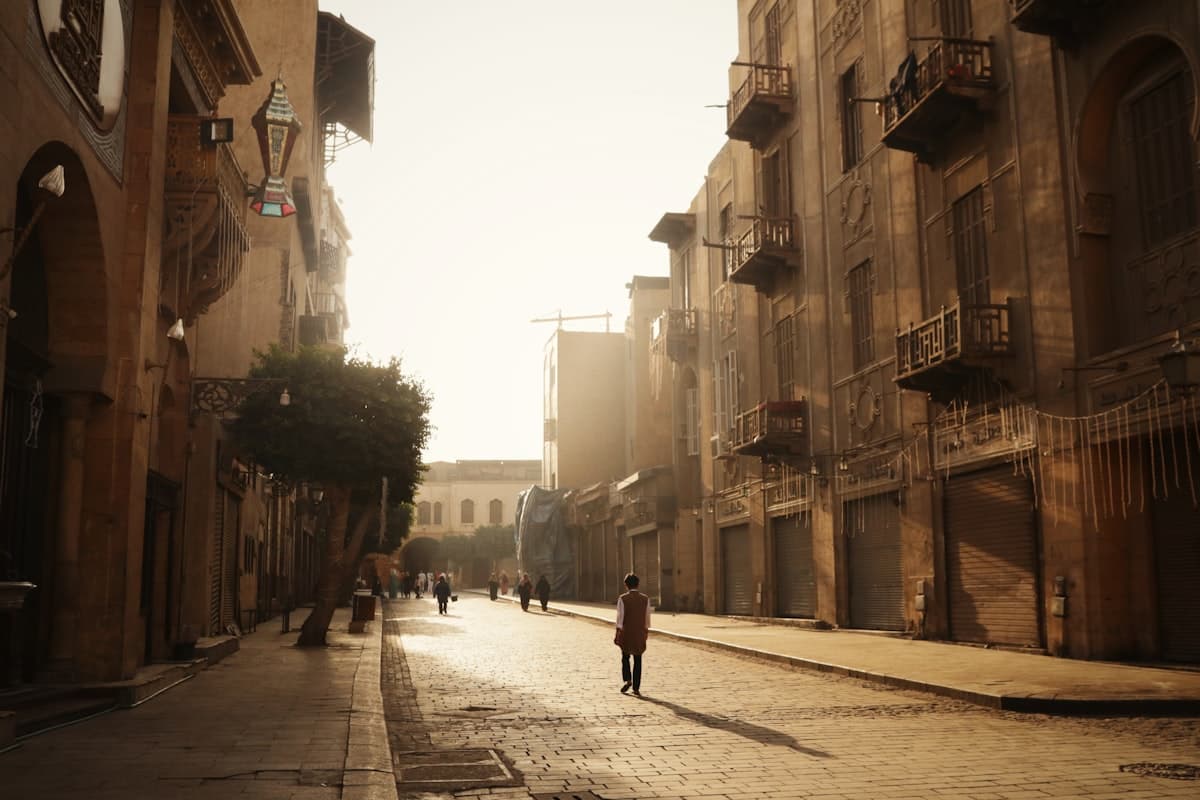
Starting at Khan el-Khalili instead of walking through Gamaliya first. The bazaar is a commercial district built for selling things. It tells you almost nothing about the neighborhood Mahfouz wrote about. Walk north from the Citadel through Gamaliya, let the medieval city accumulate around you, and arrive at El-Fishawy as if you lived here. The café makes more sense as a destination when you have earned it.
Buying the tourist edition of the Cairo Trilogy. The Anchor Books edition translated by William Maynard Hutchins, Lorne Kenny, and Olive Kenny is the standard English translation and is genuinely good. The versions sold at Khan el-Khalili stalls are often pirated, poorly printed, and occasionally missing pages. Order before you arrive, or buy from Diwan Books in Zamalek, the best English-language bookshop in Cairo.
Going to El-Fishawy between 11am and 3pm on weekends. This is when tour groups fill every table and the noise makes sustained thought impossible. Go before 9am, when the night workers are still there and the mirrors still have the quality of early light, or after 10pm, when it becomes itself again.
Treating the Naguib Mahfouz Museum as a major destination. It is a small apartment containing personal effects, photographs, and first editions. It is moving if you already love the work and flat if you don't. Visit it last, as a coda, not as an orientation point.
Skipping the sound and light show at the Citadel and feeling guilty about it. You should skip it. It costs EGP 350 and narrates Egyptian history in the way a PowerPoint presentation narrates Egyptian history: technically accurate, experientially inert. Spend the money on a long afternoon at El-Fishawy and read ten pages of Palace Walk instead.
Assuming the literary Cairo of the novels is fully gone. This is the mistake of despairing too quickly. The streets have motorbikes now instead of donkeys, and the shop signs are in fluorescent plastic instead of carved wood, but the spatial logic of Gamaliya is almost unchanged from the Fatimid grid. The claustrophobic intimacy that Mahfouz describes, neighbors who know everything, streets that function as living rooms, the muezzin call arriving from three directions at once, all of it is still operational.
Not reading at least 50 pages before you arrive. Any 50 pages of the Cairo Trilogy will do. The first chapter of Palace Walk sets the scene better than any guide, including this one.
Practical Tips
Dress conservatively in Gamaliya. This is not a religious requirement imposed on visitors but a social one: the neighborhood is predominantly working-class and devout, and arriving in shorts and a sleeveless shirt marks you as someone who hasn't thought about where they are. Long trousers and covered shoulders are sufficient.
Hire a local guide for the first morning if this is your first time in Islamic Cairo. The alleys in the Gamaliya district do not behave like a grid and the signage is inconsistent. A knowledgeable guide costs around EGP 400-600 for a three-hour walk and will save you an hour of disoriented wandering. Ask your hotel to recommend someone specific rather than accepting whoever approaches you at the Khan el-Khalili entrance, where guides earn commissions from shops.
Bring cash in small denominations. Most of the cafés, small museums, and street food vendors in this area do not accept cards. An ATM at the Arab African International Bank is located near the Sayyidna al-Hussein mosque.
The best photograph of the Gamaliya district that most visitors miss is taken from the roof terrace of the Wikala of Sultan Qaytbay, a 15th-century merchant caravanserai that sometimes allows access to its upper floor. Ask at the ground floor office. The view north along the medieval street, with minarets at four different heights and laundry stretched between them, is precisely the view Mahfouz's characters would have recognized.
For the full Naguib Mahfouz Cairo literary history experience, end the day at the Nile in Agouza, near where Mahfouz lived in his later years. Sit at a café on the corniche as the river goes dark and the opposite bank of Giza lights up. He did this too, in the years when his body would allow it. The river is unchanged in a way that almost nothing else in Cairo is.
Frequently Asked Questions
The Weekly Dispatch
More on Egypt, every Friday.
Cultural depth and places most guides never mention.
No spam. Unsubscribe anytime.