Nasser, the Suez Canal, and Egypt's History of Defiance
In 1956, Nasser nationalized a canal built by 1.5 million Egyptian forced laborers who were never paid. The West called it theft. Egyptians called it overdue.

Quick Facts
- Best time to visit
- October through April. Summer temperatures exceed 40°C with minimal shade infrastructure for visitors. Winter light is sharp and the canal cities are pleasant to walk.
- Entrance fee
- Ismailia Museum: EGP 100 (approx $2 USD). Port Said National Museum: EGP 80 (approx $1.50 USD). Canal-side promenade and public viewpoints: free.
- Opening hours
- Ismailia Museum: Tuesday to Sunday, 9am to 4pm, closed Monday. Port Said National Museum: Tuesday to Sunday, 9am to 5pm.
- How to get there
- Service taxi from Cairo Turgoman terminal to Ismailia: EGP 60 to 80, approx 90 minutes. Bus from Abboud terminal: EGP 45, approx 2 hours. Private car hire from Cairo: EGP 900 to 1,400 for the day.
- Time needed
- 3 to 4 hours for Ismailia alone. Full day for Ismailia plus Port Said with a driver. Overnight recommended if adding Suez city war memorial sites.
- Cost range
- Budget EGP 400 to 700 per day including transport, entry fees, and food. Mid-range EGP 1,200 to 2,000 with private driver and hotel in Ismailia.
Nasser, the Suez Canal, and Egypt's History of Defiance
In 1869, the Khedive Ismail threw the most expensive party in Egyptian history to celebrate the opening of the Suez Canal. He invited Empress Eugénie of France, Emperor Franz Joseph of Austria, and virtually every crowned head in Europe. He commissioned Giuseppe Verdi to write an opera for the occasion. Verdi declined. Ismail got the Cairo Opera House built instead, had it finished in six months, and performed Rigoletto there anyway. The canal itself had cost Egypt approximately 120,000 lives to build, most of them corvée laborers, meaning workers who were not paid, who were conscripted from their villages and marched north to dig in conditions that killed them. That is the founding story of the Suez Canal. Not engineering triumph. Debt, death, and a party the hosts could not afford.
Eighty-seven years later, on July 26, 1956, Gamal Abdel Nasser stood in Alexandria's Manshiyya Square and nationalized that canal in a speech that lasted four hours. He said the word "Lesseps" twenty-eight times. Each time he said it, Egyptian army units moved to occupy canal company offices along the entire 193-kilometer length of the waterway. The word was a code. Ferdinand de Lesseps, the French diplomat who had extracted the original concession from a naive Egyptian ruler, became the signal for the most consequential act of decolonization in modern Arab history. This is what a Nasser and Suez Canal Egypt history guide is actually about: not a waterway, but a reckoning.
---
Quick Facts
Best time to visit: October through April. The canal cities of Ismailia, Port Said, and Suez sit in the desert corridor between Sinai and the Delta. Summer temperatures hit 40°C and the cities offer almost no shade tourism infrastructure. Winter light along the canal is sharp and photogenic, and Ismailia's gardens are in bloom.
Entrance fees: The Ismailia Museum (covering canal history and regional archaeology) charges EGP 100 (approx $2 USD). The Suez Canal Authority Museum in Ismailia is free. Port Said's National Museum charges EGP 80 (approx $1.50 USD). Most canal-side public areas, including the observation points in Ismailia, are free.
Opening hours: Ismailia Museum: Tuesday through Sunday, 9am to 4pm, closed Monday. Port Said National Museum: Tuesday through Sunday, 9am to 5pm. The canal itself is observable from public corniche areas at any hour.
How to get there: From Cairo, service taxis to Ismailia leave from the Turgoman terminal and take roughly 90 minutes, costing EGP 60 to 80 per seat. The Cairo to Ismailia bus from Abboud terminal costs EGP 45 and takes two hours. To Port Said, buses from Abboud run frequently and cost EGP 65, taking around two and a half hours. Renting a private car from Cairo for a full canal day costs EGP 900 to 1,400 depending on negotiation.
Time needed: Ismailia alone warrants three to four hours. A full canal history circuit covering Ismailia, the Suez Canal Authority viewpoint, and a drive to Port Said takes a full day. Adding the Suez city war memorial sites requires an overnight.
Cost range: Budget EGP 400 to 700 per day including transport, food, and entry fees. Mid-range EGP 1,200 to 2,000 with a private driver and a decent hotel in Ismailia.
---
Why This Place Matters
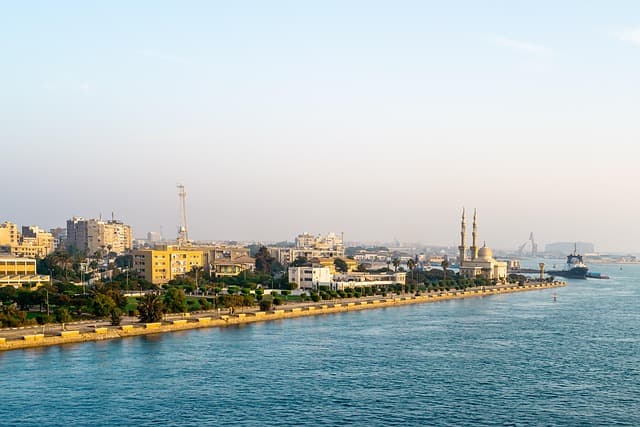
The Suez Canal is 193 kilometers long and 24 meters deep at its shallowest point. It connects the Mediterranean to the Red Sea, eliminating the need to sail around the Cape of Good Hope, cutting the Europe-to-Asia shipping route by approximately 7,000 kilometers. Every year, roughly 19,000 ships transit through it, carrying about 12 to 15 percent of global trade. When a single container ship, the Ever Given, ran aground sideways across the canal for six days in March 2021, it cost the global economy an estimated $9.6 billion. That single number tells you what the canal means to the world economy.
But the canal's significance to Egypt is not economic. It is psychological, and it begins with how the canal was extracted from Egypt in the first place.
In 1854, Ferdinand de Lesseps persuaded the Egyptian ruler Said Pasha to grant a concession allowing a French company to build and operate the canal for 99 years, keeping 74 percent of the profits. Egypt would provide the land and the labor. Egypt received 15 percent of profits and a debt burden that would eventually force the sale of its shares to Britain in 1875, because Khedive Ismail needed the money. By 1882, Egypt was under British military occupation, partly to protect British canal interests. The canal that Egypt's forced laborers dug with their hands was, within a generation, the primary justification for Egypt's colonial subjugation. When Nasser nationalized it in 1956, he was not just seizing an asset. He was reversing a century of compounded humiliation.
The Nasser and Suez Canal story also changed the global order in ways most visitors never connect. The Suez Crisis of 1956 was the moment the United States publicly broke with Britain and France, forcing them to withdraw their invasion force and accept Egyptian sovereignty. It was the event that definitively ended British imperial power. Nasser became the most popular political figure in the Arab world, a status he held until the 1967 war with Israel destroyed it.
---
Ismailia: The Canal's Living Archive
Ismailia is the city the Suez Canal Company built for itself. It sits at the midpoint of the canal, beside Lake Timsah, and it was designed to be a European enclave: wide avenues, bougainvillea-covered villas, a sweet water canal running parallel to the main waterway, and a company headquarters that functioned as a private government.
The Suez Canal Authority Building, which you can photograph from the outside and partially visit, still operates as the administrative heart of the canal. The original company building dates from the 1860s and was the place where, on the night of July 26, 1956, Egyptian officers walked in and told the European managers to leave. They did, within hours.
The Ismailia Museum is the most undervisited canal history site in Egypt. It holds not just canal-era documents and photographs but also Pharaonic and Greco-Roman artifacts from the region, including objects from Tell el-Maskhuta, an ancient city in Wadi Tumilat that may be the biblical Pithom, one of the cities the Book of Exodus says the Israelites built under Egyptian bondage. The connection is not incidental: the geography of forced labor in Egypt runs in a single corridor from the Old Kingdom through the 19th century. The canal's corvée workers were conscripted through the same administrative logic that built the pyramids. The museum holds both stories in adjacent rooms and almost no one notices.
The city's residential area, particularly the neighborhood around Mohamed Ali Quay along the lake, preserves remarkable colonial-era architecture. These were the villas of canal company managers, almost entirely French and British in the 19th century. After 1956, they were redistributed to Egyptian canal workers and their families. Some are still occupied. Some are decaying. Walk the streets here and you are inside the physical history of decolonization.
---
Port Said and the Edges of War
Port Said sits at the northern mouth of the canal, where it meets the Mediterranean. It was founded in 1859 simultaneously with the beginning of canal construction and named after Said Pasha, the ruler who signed away Egypt's rights. In November 1956, British and French paratroopers landed here in what they called Operation Musketeer, an invasion launched to retake the canal after nationalization. They were stopped not by Egyptian military resistance, which was overwhelmed within days, but by American diplomatic pressure and a Soviet nuclear threat. The ceasefire came after 41 kilometers of canal had been occupied. The statue of Ferdinand de Lesseps that stood at the canal's Mediterranean entrance was torn down by Egyptians in 1956 and never rebuilt. The empty plinth stood for decades before it was quietly removed.
The Port Said National Museum covers the 1956 war in detail that most non-Egyptian visitors find disorienting, because the story they know, if they know it at all, is about Cold War geopolitics. The Egyptian version is about a city that was bombed and occupied, where civilians were killed, and where resistance fighters held buildings while European governments discussed their strategic interests. Both versions are true. The museum tells one of them with photographs that are not easy to look at.
Port Said also has a monument to the 1973 October War, when Egyptian forces crossed the canal in a military operation that has no parallel for engineering audacity. On October 6, 1973, Egyptian army units used high-pressure water cannons to breach Israeli sand fortifications on the eastern bank, a method devised by an engineer named Baki Zaki Youssef who noticed that the sand berms were structurally vulnerable to water pressure. Within hours, the supposedly impregnable Bar-Lev Line, which Israeli military planners had estimated would take 24 hours to breach even under optimal conditions, had been destroyed. Hundreds of thousands of Egyptian soldiers crossed into Sinai within the first day. The October War is the event that made the 1979 peace treaty with Israel politically possible for Sadat. The canal crossing made the war. Water cannon made the crossing.
---
The Connections
The Suez Canal sits in a corridor that has been a transit route since at least the 18th Dynasty. Thutmose III moved armies through here toward Canaan. The ancient Egyptians dug a precursor canal, sometimes called the Canal of the Pharaohs, connecting the Nile Delta to the Red Sea via the Bitter Lakes. It was functional at various points in ancient, Persian, Ptolemaic, and Roman periods and was finally abandoned around the 8th century CE. Nasser knew this history. When he nationalized the canal, he explicitly invoked it in his speech: Egypt was reclaiming what Egypt had always owned.
The canal's construction also remade Egyptian demography. The corvée labor system it required caused significant rural disruption in Upper Egypt, where men were conscripted away from farming communities. This contributed to the economic instability of the Khedival period that made Egypt vulnerable to European debt bondage and eventually British occupation. The canal did not just connect seas. It connected Egypt's ancient labor extraction economy to its modern colonial experience in a straight line.
And the Soviet involvement in 1956, when Khrushchev threatened Britain and France with nuclear strikes if they did not withdraw, led directly to the Soviet-Egyptian relationship that funded the Aswan High Dam. The dam displaced 90,000 Nubian people from their ancestral lands and flooded ancient sites under Lake Nasser. The canal crisis made the dam alliance possible. The dam made the flooding of Nubia inevitable. These are not separate stories.
---
Common Mistakes
Treating this as a day trip from Cairo without planning. The canal cities are connected, and hitting only Ismailia misses the Port Said war context entirely. If you have one day, choose Ismailia for depth. If you have two, add Port Said. Do not try to do both in one rushed day from Cairo.
Skipping the Ismailia Museum because it looks small. It holds the most specific canal-history documentation accessible to the public, including photographs from the 1869 opening ceremony and the 1956 nationalization period. Small museums in Egypt are frequently better than large ones because they have not been stripped for Cairo collections.
Booking a "canal cruise" expecting to see canal history. The tourist boats on Lake Timsah in Ismailia are pleasant but they are lake boats. They tell you nothing about the canal's history and cost EGP 150 to 300 for an hour of looking at water. The public canal viewpoints in Ismailia, where you can watch actual container ships pass at very close range, are free and infinitely more interesting.
Going to Suez city expecting something to see. Suez is a working industrial port city and its history museum is poorly maintained and difficult to find. Unless you have a specific interest in the 1967 to 1973 war years, when the city was largely evacuated and became a front line, Suez does not reward tourism the way Ismailia and Port Said do.
Expecting the Egyptian narrative of 1956 to match what you read at home. It will not. This is not a mistake the place is making. Arrive ready to sit with two genuinely different accounts of the same events.
The Nasser museum in Cairo, at his mausoleum complex in Manshiyya, is worth mentioning here as a skip. The mausoleum itself is architecturally significant, but the small museum attached to it was last meaningfully updated in the 1980s and presents hagiography rather than history. The Ismailia materials give you a more grounded picture of what the canal crisis actually involved.
---
Practical Tips
Ismailia is the right base if you are spending more than one day. The Mercure Ismailia Hotel, on Lake Timsah, is the most comfortable option at roughly EGP 2,200 to 3,000 per night and has direct canal-adjacent views. Budget guesthouses in the city center run EGP 400 to 700.
Bring a Arabic-speaking guide or hire a local fixer if you want access to the Suez Canal Authority's observation areas, which are not always open to walk-in visitors. The canal authority does run occasional organized viewings for groups.
The best free experience in the region is sitting at the canal-side promenade in Ismailia in the late afternoon and watching supertankers the size of apartment blocks pass so close you feel displaced by them. The scale is genuinely difficult to process. Bring water and go in October through March.
Food in Ismailia is canal-city good: fresh fish from Lake Timsah, decent koshary, and the specific Delta-adjacent food culture that includes dishes you will not find in Cairo restaurants. The restaurants along the lake corniche are reasonably priced, EGP 150 to 350 per person with fish.
Photography of canal infrastructure, including the authority buildings and operational zones, is technically restricted. Photograph the passing ships and the public areas freely. Do not point cameras at authority facilities directly.
Frequently Asked Questions
The Weekly Dispatch
More on Egypt, every Friday.
Cultural depth and places most guides never mention.
No spam. Unsubscribe anytime.