Pharaonic Egypt History Guide for Travelers Who Want More
Pharaonic civilization lasted 3,000 years. Rome lasted 500. Most travelers see three sites. Here is what those sites are actually telling you.

Quick Facts
- Best time to visit
- October to February. Temperatures in Upper Egypt are manageable (20-28°C). Avoid July and August, when Luxor regularly reaches 45°C and outdoor sites become genuinely unsafe in midday hours.
- Entrance fee
- Giza complex EGP 450 ($9), Great Pyramid interior EGP 600 extra ($12). Karnak EGP 450 ($9). Valley of the Kings EGP 360 for 3 tombs ($7), Seti I tomb EGP 1,200 extra ($24). Egyptian Museum EGP 450 ($9), Royal Mummies Hall EGP 600 extra ($12).
- Opening hours
- Most outdoor sites daily 6am to 5pm (winter), 6am to 4pm (summer). Egyptian Museum 9am to 5pm daily. Grand Egyptian Museum hours vary, confirm at gem.gov.eg before visiting.
- How to get there
- Cairo: fly into Cairo International Airport, metro or taxi to city center (EGP 100-300). Cairo to Luxor: overnight train EGP 800-1,200 ($16-24) or flight EGP 1,500-3,000 ($30-60). Luxor to Aswan: train EGP 200-400 ($4-8). Within Luxor: taxi EGP 50-150 per trip.
- Time needed
- Cairo sites: 3 full days minimum. Luxor East and West Banks: 4 days. Aswan with Abu Simbel: 2 days. Complete pharaonic circuit: 10 days minimum.
- Cost range
- Budget (trains, local restaurants, shared transport): EGP 1,200-2,000 per day ($24-40). Mid-range (private guides, 3-star hotels, A/C transport): EGP 4,000-8,000 per day ($80-160).
The workers who built the Great Pyramid were not slaves. We know this because their graffiti survives. One crew called themselves "Friends of Khufu." Another called themselves "Drunkards of Menkaure." They were paid laborers, organized into gangs with nicknames, who received wages in bread, beer, and onions, and who were buried with honor near the monuments they constructed. The entire slave-labor narrative, which has dominated Western imagination since Herodotus invented it around 450 BC, is wrong. Pharaonic Egypt is full of corrections like this.
This pharaonic Egypt history guide exists because most travelers arrive with a version of Egypt assembled from Hollywood, the Book of Exodus, and whatever a cruise director said between Luxor and Aswan. The corrections are not minor. They change what you see when you stand in front of the monuments.
Quick Facts
Best time to visit: October through February. Temperatures in Upper Egypt drop to manageable levels (20-25°C in Luxor, cooler in Aswan). July and August are genuinely dangerous in the south, with Luxor regularly reaching 45°C.
Key entrance fees (approximate, subject to revision): Giza Pyramid Complex: EGP 450 (approx $9 USD). Interior of Great Pyramid: additional EGP 600 ($12). Solar Boat Museum: EGP 100 ($2). Karnak Temple: EGP 450 ($9). Luxor Temple: EGP 360 ($7). Valley of the Kings: EGP 360 ($7) for three tombs. Tutankhamun's tomb: additional EGP 500 ($10). KV17 (Seti I): additional EGP 1,200 ($24), and worth it. Egyptian Museum, Cairo: EGP 450 ($9). Royal Mummies Hall: additional EGP 600 ($12).
Opening hours: Most sites open daily 6am to 5pm in winter, closing at 4pm in summer. The Egyptian Museum opens 9am to 5pm. Always verify at egypt.travel before visiting.
Getting there: Cairo to Luxor by overnight train (roughly 10 hours) costs EGP 800-1,200 ($16-24) in first class sleeper. Flying takes one hour and costs EGP 1,500-3,000 ($30-60) with EgyptAir. Aswan is a further 3 hours from Luxor by train (EGP 200-400, $4-8). Local taxis within Luxor run EGP 50-150 per trip ($1-3).
Time needed: Cairo sites alone require three full days minimum. Luxor requires two days for the East Bank, two for the West Bank. Aswan and Abu Simbel add another two. A serious pharaonic Egypt circuit demands at least ten days.
Cost range: Budget travelers using trains and local restaurants: EGP 1,200-2,000 per day ($24-40). Mid-range with private guides and decent hotels: EGP 4,000-8,000 ($80-160).
Why Pharaonic Civilization Demands a Different Framework
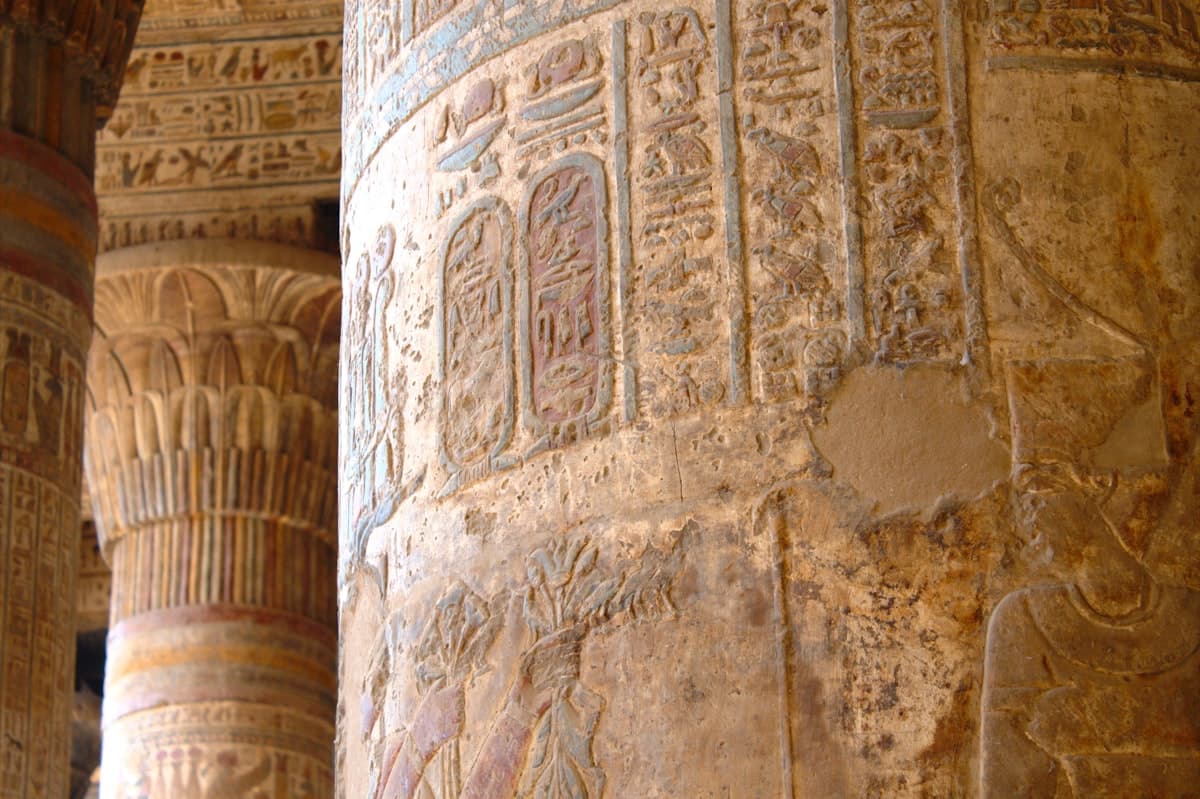
The civilization you are about to encounter lasted approximately 3,000 years, from the unification of Upper and Lower Egypt around 3100 BC to the death of Cleopatra VII in 30 BC. To put that in proportion: the distance in time between Cleopatra and us is roughly equal to the distance between Cleopatra and the first pharaoh. She was closer to us than to Narmer.
This means that when you stand at Karnak Temple and notice that different sections look architecturally inconsistent, you are noticing real time. Karnak was under continuous construction from around 2055 BC to 30 BC. Pharaohs 2,000 years apart added to it. When Ramesses II inscribed his name over the reliefs of Horemheb, that was already ancient history being edited. The Egyptians practiced what scholars call "damnatio memoriae" selectively, not erasing the past but continuously rewriting it to legitimize the present.
A specific example most visitors miss: the obelisks of Hatshepsut at Karnak were deliberately walled in by her successor Thutmose III, not destroyed. This used to be interpreted as hatred. Egyptologists now believe he was preventing her divine power from escaping the temple while technically preserving her monuments intact. The logic is deeply Egyptian: you do not erase power, you contain it.
The Sites Most Travelers Misread
The Pyramids of Giza
The Sphinx was not built by Khufu. The evidence now strongly supports Khafre, whose pyramid sits directly behind it and whose face the monument almost certainly bears. But the Sphinx's body may predate Khafre's reign. Geological analysis of the erosion patterns, conducted by Robert Schoch of Boston University in the early 1990s, suggested the body shows water erosion consistent with heavy rainfall, which last occurred in the Nile Valley around 7000-5000 BC. The Egyptological establishment disputes this. The argument is ongoing. You can look at the body and make your own assessment.
What almost no visitor knows: the Giza plateau was not a necropolis in the modern sense. It was an active ritual landscape connected to the living city of Memphis by a processional causeway. The valley temples at the base of each pyramid were functioning temples for decades after the pharaohs were buried. Workers' villages have been excavated showing breweries, bakeries, and medical facilities. The site fed thousands of people. This was an economy, not just a monument.
The interior of the Great Pyramid (the Khufu entry ticket is separate and worth buying) contains exactly nothing except the sarcophagus and the corbelled architecture. There is no treasure. There never was. But the King's Chamber at the top of the Grand Gallery, where you crouch in heat and near-darkness, with granite blocks fitted so precisely that a piece of paper cannot slide between them, is one of the more disorienting spaces on earth.
Luxor: The World's Largest Open-Air Museum Is Not What You Think It Is
Luxor was ancient Thebes. For much of the New Kingdom period (roughly 1550-1070 BC), it was the most powerful city in the world. The temples you walk through were not tourist attractions or historical curiosities: they were functional machines for maintaining cosmic order. Karnak, specifically, was the administrative and theological center of Egypt. Its High Priests eventually became powerful enough to effectively rule Upper Egypt in parallel with the pharaoh.
The hypostyle hall at Karnak contains 134 columns, the largest of which are 23 meters tall and require six people to link arms around them. They were painted in colors that have largely faded: red, blue, gold, green. The reliefs you see in low gray stone were once as vivid as a market stall. Closing your eyes and imagining color onto them is not an act of imagination. It is an act of historical accuracy.
Luxor Temple, connected to Karnak by the Avenue of Sphinxes (recently restored after excavation through the modern city), has something extraordinary in its inner sanctuary: a Roman painting. The Romans converted the inner shrine into a chapel and painted over the Pharaonic reliefs. The paint is still there. You can see Pharaonic red ochre figures beneath flaking Roman pigment. Three civilizations in one wall.
The Valley of the Kings: The Mathematics of Access
Sixty-three tombs, most tourists see two or three. Your standard ticket covers any three tombs except those requiring supplemental fees. The tombs most visitors queue for: Tutankhamun, Ramesses II, Ramesses VI. Tutankhamun's tomb is the smallest royal tomb in the valley and was only found because it was buried under the debris of Ramesses VI's construction. It is historically significant. It is not visually impressive.
The tombs worth seeking out: KV17 (Seti I) has reliefs considered the finest in the valley, painted with a delicacy that looks almost Greek. KV34 (Thutmose III) requires climbing a near-vertical staircase on a metal ladder to reach a chamber covered in 3,000-year-old illustrated papyrus text, the Amduat, which is a map of the underworld written in a form that was meant only for the dead king to read. KV62 (Tutankhamun) costs extra, and your time is better spent in Seti I's tomb.
The Connections That Guide Books Leave Out
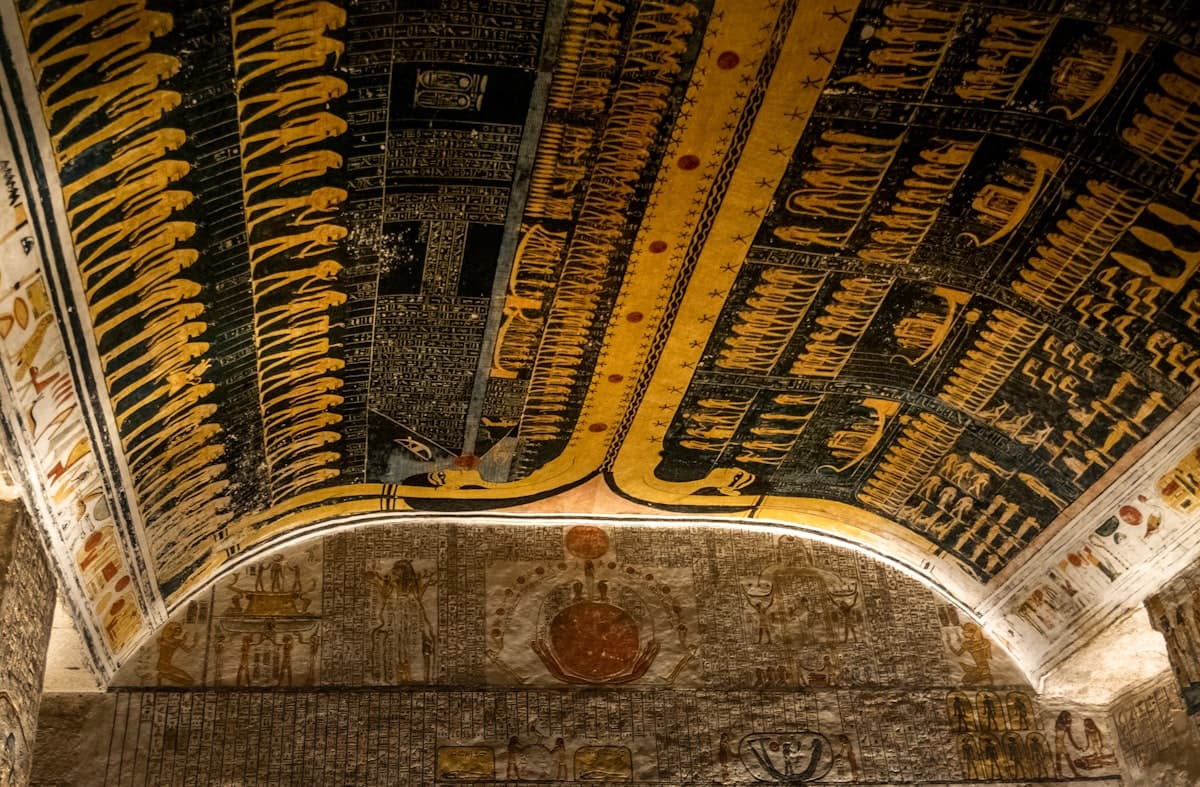
Pharaonic Egypt did not end cleanly with the last pharaoh. It dissolved slowly into Greco-Roman Egypt, then into Coptic Egypt, then into Islamic Egypt, and its DNA is in everything that followed.
The Coptic Christian cross, with its distinctive looped top, is derived from the ancient Egyptian ankh symbol. The Copts themselves are the most direct genetic and cultural descendants of the Pharaonic Egyptians, and the Coptic language, still used in church liturgy, is the final form of the ancient Egyptian language written in Greek letters. When you attend a Coptic service in Cairo's Hanging Church, the priest is using a language with roots reaching back to hieroglyphic texts.
In Cairo's Islamic district, the Mosque of Amr ibn al-As, the first mosque built in Africa (around 641 AD), stands very close to the ancient city of Memphis. The stone used to build medieval Cairo's great mosques came partly from the outer casing of the Giza pyramids, which is why those pyramids are now bare limestone rather than the polished white Tura limestone that originally covered them. Ibn Tulun Mosque (completed 879 AD) sits above a Pharaonic mound that was itself a Roman fortification. Nothing was built on empty ground.
The Nile inundation, which the entire Pharaonic agricultural and religious calendar was built around, was ended in 1970 when the Aswan High Dam sealed it off. Temple Abu Simbel was physically cut from the cliffside and raised 65 meters to save it from the rising waters of Lake Nasser, in one of the most expensive UNESCO operations ever conducted. The temples still exist. The civilization that made them meaningful exists in fragments.
Common Mistakes
Treating Cairo and Luxor as equivalent destinations requiring equal time. Cairo is where you understand the civilization intellectually, through the Egyptian Museum and Memphis. Luxor is where you understand it physically. Give Luxor more days.
Booking the sound and light show at Karnak. It costs EGP 500-650 and narrates facts you will already know after reading any basic guide. The temples at dawn, before the tour groups arrive, are infinitely more affecting, and they cost nothing beyond the standard entrance fee.
Skipping Memphis and Saqqara in favor of Giza only. Memphis was the capital for much of Pharaonic history. Saqqara contains the Step Pyramid, the world's first large stone structure (built around 2650 BC by the architect Imhotep, who was later deified), and the Pyramid Texts, the oldest religious literature ever discovered. The crowds at Saqqara are a fraction of Giza. This is not logic. Go to Saqqara.
Hiring guides at the gate. Unofficial guides at most major sites range from inadequate to actively misleading. Book a licensed Egyptologist guide through a reputable agency before you arrive. The Egyptian Tourist Authority website maintains a register.
Photographing inside tombs where it is prohibited. Some tombs permit photography without flash; many prohibit it entirely. The prohibition exists because camera flash accelerates pigment degradation. Inspectors do fine tourists caught violating this. More importantly, the reliefs these rules protect are 3,000 years old. They survived this long.
Ignoring Upper Egypt entirely. Most package tours cover Cairo and Luxor. Aswan is slower, quieter, and contains the Temple of Khnum at Esna (recently reopened after restoration), the Temple of Kom Ombo built simultaneously for two gods with two complete mirrored sanctuaries, and access to Abu Simbel, where Ramesses II built a temple so precisely oriented that the sun illuminates the inner sanctuary exactly on October 22 and February 22 each year. That precision was intentional. We are still not entirely sure how it was calculated.
Underestimating the Egyptian Museum. The new Grand Egyptian Museum near Giza has taken many headline artifacts. But the old Egyptian Museum in Tahrir Square still holds 120,000 objects, including the complete Tutankhamun collection and the Royal Mummies Hall. The building itself, completed in 1902, is a Pharaonic artifact of the colonial imagination. Spend at least half a day here.
Practical Tips
Arrive at every site as close to opening time as possible. Tour buses from Nile cruises typically arrive at Luxor's East Bank temples between 9am and 11am. You want to be leaving as they arrive.
Water is non-negotiable. Carry at least 2 liters when visiting any outdoor site between March and October. The heat at Giza and the Valley of the Kings is serious, not scenic.
Dress for conservative settings while also managing heat: lightweight cotton long sleeves work for both temples and mosques. Women are not required to cover hair at Pharaonic sites, but are expected to in mosques.
Haggling is standard with taxis, souvenir vendors, and felucca operators. Prices at official ticket booths are fixed and displayed. If someone tells you the ticket price has changed, verify at the window yourself before paying anyone.
Cash remains king at most sites. ATMs exist in Luxor and Cairo city centers. Carry small bills. Tipping (baksheesh) is genuinely part of the service economy, not optional: EGP 20-50 per service is appropriate for guards who open side rooms, restroom attendants, and hotel staff.
If you are serious about understanding Pharaonic Egypt, read John Romer's "A History of Ancient Egypt" before you go, or pick up Egyptologist Toby Wilkinson's "The Rise and Fall of Ancient Egypt." The monuments will read differently when you understand the political crises, droughts, and succession wars that produced them.
Frequently Asked Questions
The Weekly Dispatch
More on Egypt, every Friday.
Cultural depth and places most guides never mention.
No spam. Unsubscribe anytime.