Ptolemaic Egypt History: The Traveler's Guide to Alexandria
The Ptolemies ruled Egypt for 275 years and not one of them learned to speak Egyptian until Cleopatra VII. Their Alexandria still exists. You just have to know where to dig.

Quick Facts
- Best time to visit
- October to April. Mediterranean winters are mild (14 to 20°C), crowds are local rather than tourist-heavy, and the city functions at its normal pace. Avoid July and August when Cairo families fill every Corniche-facing room.
- Entrance fee
- Kom el-Shoqafa EGP 180 (approx $3.50 USD). Pompey's Pillar and Serapeum EGP 180 (approx $3.50 USD). Alexandria National Museum EGP 160 (approx $3 USD). Bibliotheca Alexandrina exhibitions EGP 200 (approx $4 USD) for foreigners.
- Opening hours
- Most archaeological sites daily 9am to 5pm. Bibliotheca Alexandrina Sunday to Thursday 10am to 7pm, Saturday 12pm to 4pm, closed Fridays. Hours can shift during Ramadan.
- How to get there
- From Cairo: Spanish Train (Talgo) from Ramses Station, 2.5 hours, EGP 200 to 350. Regular train also available, 3 to 4 hours, EGP 60 to 100. Within Alexandria: shared microbus EGP 5 to 10 per journey. Full-day private taxi for Ptolemaic site circuit EGP 600 to 900.
- Time needed
- Two full days minimum. Three days if adding underwater diving and deeper museum time. One day if arriving from Cairo is possible but not recommended.
- Cost range
- Budget EGP 800 to 1,200 per day including guesthouse accommodation in Anfushi. Mid-range EGP 2,000 to 3,500 per day with Corniche hotel and private guide.
Quick Facts
Best time to visit: October through April. Alexandria's Mediterranean climate means summer (June to August) is humid and crowded with Egyptian vacationers from Cairo. Spring and autumn give you manageable temperatures and thinner crowds at key sites.
Entrance fees: Bibliotheca Alexandrina permanent exhibitions: EGP 100 (approx $2 USD) for Egyptians, EGP 200 (approx $4 USD) for foreigners Kom el-Shoqafa Catacombs: EGP 180 (approx $3.50 USD) Pompey's Pillar and Serapeum site: EGP 180 (approx $3.50 USD) Alexandria National Museum: EGP 160 (approx $3 USD) Graeco-Roman Museum (when open after restoration): EGP 100 (approx $2 USD)
Opening hours: Most sites daily 9am to 5pm. The Bibliotheca Alexandrina is open Sunday through Thursday 10am to 7pm, Saturday 12pm to 4pm, closed Fridays.
How to get there: From Cairo, the air-conditioned Spanish Train (Talgo) takes 2.5 hours from Ramses Station and costs EGP 200 to 350 depending on class. Shared microbuses between sites within Alexandria cost EGP 5 to 10. A private taxi for a full day of Ptolemaic sites runs EGP 600 to 900.
Time needed: Three days minimum to engage seriously with Ptolemaic Alexandria. Two days is possible but rushed. One day means you will see surfaces only.
Cost range: Budget EGP 800 to 1,200 per day including accommodation in Anfushi. Mid-range EGP 2,000 to 3,500 per day staying near the Corniche.
---
Why This Place Matters
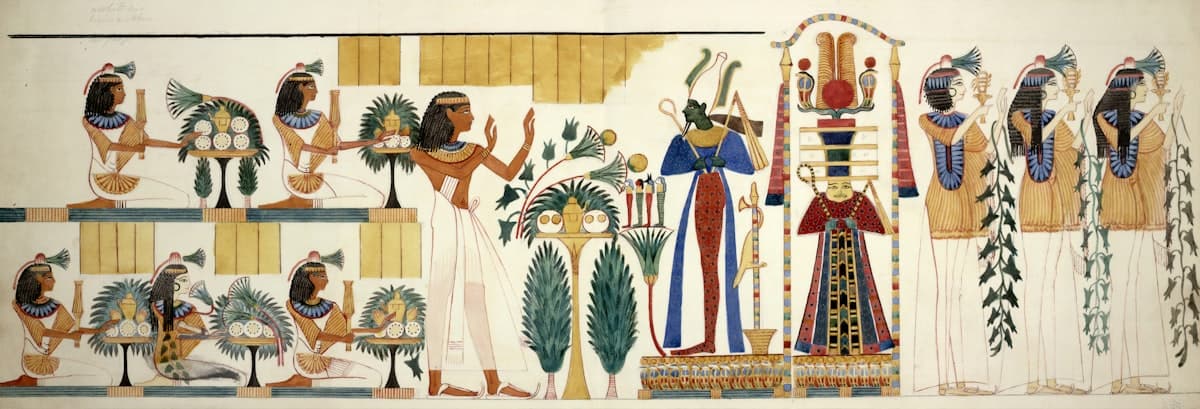
When Alexander the Great founded Alexandria in 331 BC, he chose a site so precisely that the city's main east-west artery aligned with sunrise on his birthday. He never saw the finished city. He died in Babylon eight years later, and his body was eventually brought to Alexandria and displayed in a glass sarcophagus in a mausoleum that remained one of the Mediterranean world's great tourist attractions for six centuries. Nobody knows exactly where that tomb is today. It is almost certainly under modern Alexandria, possibly beneath the Latin cemetery near the Nabi Daniel mosque, which is why every few years someone with a ground-penetrating radar scanner gets a permit and everyone holds their breath.
This is the essential quality of Ptolemaic Alexandria for the serious traveler: it is an absence that shapes everything. The greatest library ever assembled, the Museion that housed it, the Pharos lighthouse that stood 135 meters tall and was visible 47 kilometers out to sea, the Serapeum with its underground labyrinth of book storage, the palace quarter that occupied a third of the city. All of it is either underwater, built over, or simply gone. What remains is stranger and more interesting than a conventional ruin: a Ptolemaic layer compressed into everything the city became afterward.
The Ptolemies, a Macedonian dynasty that ruled from 305 to 30 BC, invented something genuinely new in Alexandria. They built a city that was simultaneously Greek in its intellectual culture, Egyptian in its religious architecture, and Jewish in a third of its population. The Great Synagogue of Alexandria, destroyed in the Roman period, was reportedly so large that a man standing on a raised platform had to signal with a cloth when the congregation should say Amen, because those at the back could not hear the prayers being said at the front.
---
What Ptolemaic Alexandria Actually Looked Like
The city Alexander designed and the Ptolemies built followed a grid plan drafted by Dinocrates of Rhodes, with two main arteries 30 meters wide, wider than most contemporary European streets. The Canopic Way ran east to west for seven kilometers; the Street of the Soma ran north to south past Alexander's tomb. The royal quarter, the Brucheion, occupied the northeastern peninsula and included palaces, gardens, the Museion, and the harbor's private islands.
Today the Corniche road runs roughly along the line of the ancient harbor. The water in front of you, if you stand at the eastern harbor near the Bibliotheca Alexandrina, covers the submerged ruins of the royal quarter, which sank in a series of earthquakes between the 4th and 8th centuries AD. Since 1996, the French underwater archaeologist Franck Goddio and his team have been mapping these ruins. They have identified sphinxes, colossal statues, the foundation stones of the palace, and what may be the remains of the temple of Isis. None of this is visible to the ordinary visitor, which is the honest truth about Ptolemaic Alexandria: the best of it requires a submarine.
What you can see above ground tells a more layered story. The Serapeum hill, now occupied by Pompey's Pillar and a scatter of ruins, was once the site of the daughter library of the great Bibliotheca, a temple complex so large it had underground tunnels used to store scrolls in controlled humidity conditions. Pompey's Pillar itself, a 26.85-meter-tall column of red Aswan granite erected in 297 AD to honor the Emperor Diocletian, has nothing to do with Pompey. The name stuck because medieval travelers saw a great column and assumed it marked where Pompey was killed. It sits on a platform over a complex of subterranean galleries where Ptolemaic priests stored sacred Apis bulls.
---
Kom el-Shoqafa and the Synthesis You Weren't Taught
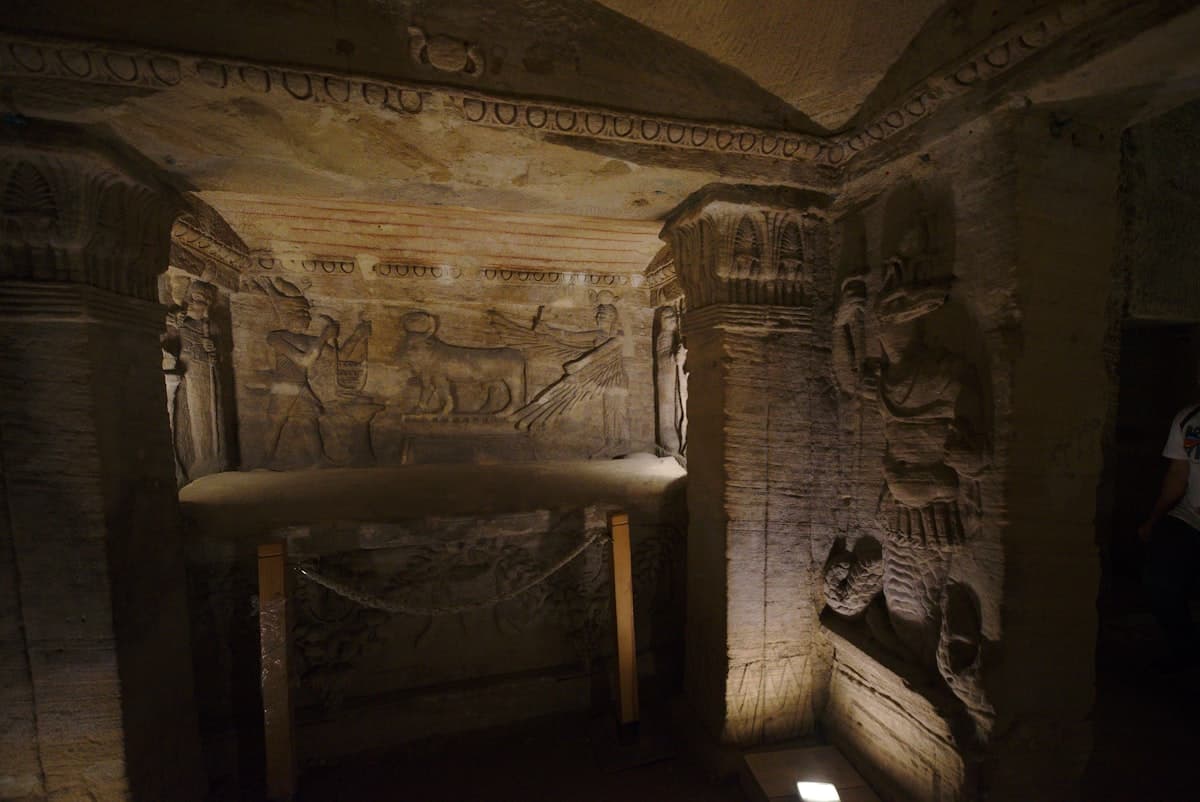
The most genuinely remarkable Ptolemaic-era site in Alexandria is not widely understood for what it is. The Catacombs of Kom el-Shoqafa, discovered in 1900 when a donkey fell through the ground, are a second-century AD burial complex that shows in physical form what three centuries of Ptolemaic cultural policy actually produced in the population of Alexandria.
Descend the spiral staircase cut through the rock and you arrive at a triclinium, a Roman dining room where families held burial feasts. Descend further and you enter a sanctuary whose decoration is fully Egyptian in iconography: Anubis, Thoth, Osiris, the weighing of the heart. But the figures executing these Egyptian rituals are wearing Roman military armor. The hieroglyphs carved on the walls are decorative rather than functional. The artists who made this place knew the visual language of Egyptian religion but not its written language. They were probably Greek-speaking Alexandrians who wanted to bury their dead in the Egyptian manner because it had become, after three centuries of Ptolemaic rule, simply the Alexandrian manner.
This is what the Ptolemaic history traveler guide cannot give you from a text alone: the visceral strangeness of standing in a room that is simultaneously Roman, Greek, and Egyptian, that predates Christianity by only a century, and that was sealed and forgotten until a donkey stumbled. The smell is cold limestone and something older than that. The light from your phone illuminates painted faces that have not been in sunlight since before the Council of Nicaea.
---
The Connections
Alexandria's Ptolemaic layer does not end with the Ptolemies. The city they built became the intellectual capital of early Christianity precisely because of the infrastructure they created. The Catechetical School of Alexandria, which produced Origen and Clement and shaped Christian theology more than any other single institution outside Jerusalem, operated in a city that still had Ptolemaic papyrus workshops, Ptolemaic translation traditions, and a Jewish community that had already translated the Hebrew Bible into Greek (the Septuagint) in the 3rd century BC. That translation, produced in Alexandria under Ptolemy II's patronage, is the version of the Old Testament most early Christians actually read.
The Islamic conquest of 641 AD did not erase this. The Arab geographer al-Idrisi, writing in the 12th century, described Alexandria's Ptolemaic monuments with specific measurements, suggesting some were still visible. The Mamluk sultans later rebuilt the Pharos lighthouse's remains as the Qaitbay Citadel in 1477, using stones from the fallen lighthouse itself. If you visit Qaitbay today, you can find granite blocks in the walls with traces of ancient Egyptian carving: reused stone from Ptolemaic and earlier structures, compressed into a 15th-century Ottoman-era fortress on the exact coordinates of one of the Seven Wonders of the World.
The Alexandria National Museum, housed in a renovated Italian palazzo on Tariq al-Hurriya (the ancient Canopic Way), curates this layering deliberately. Its basement holds Pharaonic objects, its ground floor Graeco-Roman pieces, its upper floor Islamic and modern work. Walk the floors in sequence and you are walking the sediment layers of the same city.
---
Common Mistakes
Skipping the Alexandria National Museum for the Graeco-Roman Museum. The Graeco-Roman Museum has been under restoration for years and its opening dates have been delayed repeatedly. At time of writing, access is limited and the collection is partially displayed. The National Museum has a strong Ptolemaic section that is consistently accessible and well-lit. Do not build your itinerary around a museum that may be closed when you arrive.
Treating Pompey's Pillar as a five-minute stop. Most visitors photograph the column and leave in under twenty minutes. The underground Ptolemaic galleries beneath the site, including the niches where Apis bull mummies were stored, take another thirty to forty minutes and are far more interesting than the pillar itself. Ask the site guard to show you the underground section. It is included in the ticket.
Booking the boat to see the underwater ruins without researching first. Several operators offer "underwater archaeology" tours in the eastern harbor. Most are glass-bottom boat rides with minimal connection to the actual mapped ruins. The only legitimate way to see the submerged royal quarter is through organized dive programs with proper archaeological orientation. The glass-bottom boats cost EGP 200 to 400 and are not worth it.
Going to the Bibliotheca Alexandrina expecting ancient manuscripts. The modern library opened in 2002 and holds no Ptolemaic documents whatsoever. It is architecturally interesting (the slanted disk roof designed by Snohetta, inscribed with letters from 120 scripts) and the antiquities museum inside has genuine Ptolemaic objects. But visitors who come expecting the ancient library leave confused. Adjust expectations before you buy the ticket.
The contrarian take: skip the Citadel of Qaitbay if your time is limited. Every Alexandria itinerary includes Qaitbay. It is on the Corniche, it photographs well, and it sits on the Pharos site. But the interior exhibits are sparse, the historical interpretation is minimal, and the connection to the Ptolemaic lighthouse requires considerable imagination because almost nothing visible confirms it. If you have two days and must choose, spend that two hours instead at Kom el-Shoqafa and the Serapeum. You will come away understanding more.
Visiting in August. Alexandrians themselves know the city in summer is a different place: every Cairo family with a beach apartment moves here from June through September, accommodation prices double, and the Corniche becomes impassable on weekend evenings. The sites are fine year-round, but the experience of the city, which matters for understanding Ptolemaic Alexandria as a living urban tradition, is severely diminished.
---
Practical Tips
Arrive at Kom el-Shoqafa when it opens at 9am. By 11am the single spiral staircase creates a bottleneck and the lower chambers become crowded. The site has no climate control underground and the temperature difference between surface and catacombs is noticeable. Bring a light layer.
Hire a single guide for the whole day rather than using site-by-site guides. A good Alexandrian guide, costing EGP 800 to 1,200 for a full day, will connect the Ptolemaic thread across multiple sites in a way that individual site guides, who tend to limit context to their own location, cannot. The Egyptian Tourist Authority maintains a list of licensed guides; ask your accommodation to recommend someone who specializes in the Graeco-Roman period specifically.
For photography inside Kom el-Shoqafa, bring a phone with strong low-light capability. Flash photography is permitted but bounces badly off the limestone. The deeper chambers are dark enough that a small torch improves your experience significantly.
The underwater archaeology dives run by the European Institute for Underwater Archaeology (IEASM) in partnership with Egyptian authorities are not consistently open to tourists, but it is worth contacting them directly if this is your primary interest. Recreational diving in the eastern harbor to see the submerged statues is possible through licensed Alexandria dive operators; Orca Dive Club is well-established and has Ptolemaic site dive packages.
Do not leave Alexandria without spending an evening in the Anfushi neighborhood, the old Ottoman-era quarter near the western harbor. The grid of streets there follows a Ptolemaic street plan and the fish restaurants on the harbor have been occupying approximately the same commercial function since the city was built. This is not metaphor. It is archaeology of use.
Frequently Asked Questions
The Weekly Dispatch
More on Egypt, every Friday.
Cultural depth and places most guides never mention.
No spam. Unsubscribe anytime.