Nile Cruise from Luxor to Aswan: The Full Cultural Guide
The 200km stretch of Nile between Luxor and Aswan contains more intact ancient temples per kilometer than anywhere else on earth. Most cruise passengers see five. There are fourteen.

Quick Facts
- Best time to visit
- October to February. November is ideal: warm on deck, manageable at temple sites by midday. Avoid July and August when temperatures regularly exceed 45°C in Aswan and 42°C in Luxor.
- Entrance fee
- Karnak EGP 450 ($15 USD), Edfu EGP 350 ($11.50 USD), Philae EGP 350 ($11.50 USD) plus EGP 150 motorboat, Kom Ombo EGP 180 ($6 USD), Esna EGP 180 ($6 USD). Student discounts of 50% available with valid ID.
- Opening hours
- Most temples open daily 6am to 5pm (summer) and 6am to 6pm (winter October to April). Philae last boat departure approximately 4:30pm.
- How to get there
- Fly Cairo to Luxor from EGP 900 one way (approx $30 USD, 1 hour). Sleeper train Cairo to Luxor EGP 700 to 1,200 ($23 to $40 USD), 9 to 11 hours. Most cruise operators provide airport or station transfers. Return flight from Aswan to Cairo from EGP 950.
- Time needed
- Minimum 4 days on the water for major temples. 7 days recommended for independent exploration and secondary sites. Add 1 to 2 days in Luxor before boarding and 1 day in Aswan after docking.
- Cost range
- Budget cruise EGP 3,500 to 5,000 per person full board. Mid-range EGP 8,000 to 18,000. Premium heritage vessels from EGP 45,000. Add EGP 1,500 to 2,000 for temple entries and EGP 500 to 800 for tips and independent transport.
Quick Facts
Route: Luxor to Aswan (approximately 200km south along the Nile)
Cruise duration: 3 nights/4 days (standard), 7 nights/8 days (extended)
Typical cabin cost: Budget boats from EGP 3,500 per person (approx $115 USD) for a 4-day cruise including full board. Mid-range from EGP 8,000 (approx $265 USD). Five-star heritage vessels such as the Steam Ship Sudan from EGP 45,000 (approx $1,480 USD).
Temple entrance fees: Karnak EGP 450 ($15 USD), Valley of the Kings EGP 450 ($15 USD), Edfu Temple EGP 350 ($11.50 USD), Kom Ombo EGP 180 ($6 USD), Philae Temple EGP 350 ($11.50 USD). Students with valid ID receive 50% discount at most sites.
Best time to travel: October to February. The Nile corridor runs hot for most of the year. In July and August, Aswan regularly exceeds 45°C, and Luxor is not far behind. November is the sweet spot: warm enough to sit on deck at dusk, cool enough to walk temple courtyards at midday without suffering.
How to get there: Fly into Luxor International Airport from Cairo (from EGP 900 one way, approx $30 USD, around 1 hour). Train from Cairo to Luxor takes 9 to 11 hours; sleeper trains cost EGP 700 to 1,200 ($23 to $40 USD) and are reliable enough if you book through the Egyptian National Railways website in advance. Most cruise operators meet you at the airport or station.
Time needed: The 4-day cruise is the minimum to see the major temples with any depth. Seven days allows you to slow down and actually absorb what you are looking at.
Cost range: Budget EGP 3,500 to 5,000 per person for the cruise. Mid-range EGP 8,000 to 18,000. Add EGP 1,500 to 2,000 for temple entry across the full route.
---
Why This Stretch of River Matters
Here is the fact that reframes everything about a Nile cruise from Luxor to Aswan: you are traveling through what was ancient Egypt's heartland, not its periphery. Luxor was Thebes, the most powerful city in the world for nearly five centuries. The pharaohs who built the temples along this corridor were not decorating a river. They were constructing a theological argument in stone, one that ran from the Karnak complex in the north to the island of Philae in the south, linking the birth of the sun at Luxor with its death and resurrection at Aswan.
The river itself was the argument. The Egyptians called it Iteru, simply "the river," because no other designation was necessary. Everything grew from it, literally. The black silt deposited by the annual inundation is the reason Egypt could sustain a civilization for three thousand years in the middle of a desert. The temples you will visit were not built beside the Nile by coincidence. They were built beside the Nile because the Nile was divine, and the temples were its punctuation.
What most cruise passengers do not know is that this 200km stretch remained a functioning sacred corridor well into the Christian era. The Temple of Philae at Aswan was the last pagan temple to operate in the Roman Empire, conducting Isis rituals until the Emperor Justinian forcibly closed it in 550 AD, centuries after the rest of the classical world had converted. The priests who ran it had maintained an unbroken ritual tradition dating back over a thousand years.
---
What You Will Actually See: Temple by Temple
Karnak and Luxor: The Starting Point
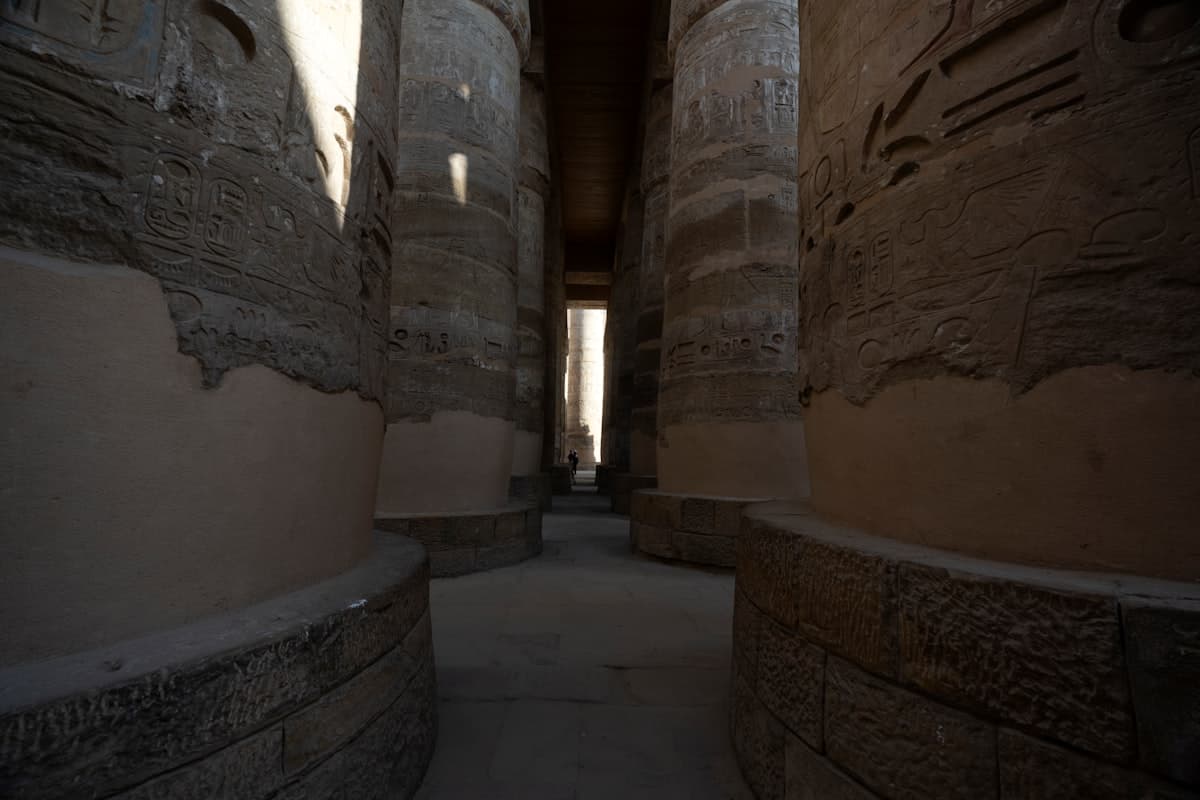
Before your boat leaves the dock, spend a full day at Karnak. Not half a day. Not a quick morning visit before boarding. Karnak is the largest religious complex ever built by any civilization on earth, covering 2 square kilometers, built and expanded by thirty different pharaohs over approximately 2,000 years. The Hypostyle Hall alone contains 134 sandstone columns, the tallest of which reaches 21 meters. When Ramesses II added his name to walls already covered in his predecessors' carvings, he was not being disrespectful. He was inserting himself into a conversation that had been going on for centuries.
At dusk, walk south to Luxor Temple, which is connected to Karnak by the Avenue of Sphinxes, a 3km processional road lined with 1,350 sphinx statues that was fully excavated and restored only in 2021. The mosque of Abu Haggag sits inside Luxor Temple's first courtyard, built on top of the accumulated debris of centuries that had raised the floor level by nearly 15 meters. The mosque's congregation has been praying there since the 13th century, and they will politely but firmly tell you that the temple around them is the interesting part, not them.
Esna: The Temple Nobody Budgets Time For
The boat stops at Esna to navigate the lock, a process that can take one to three hours depending on river traffic. Most cruise operators treat this as dead time. It is not. Walk ten minutes from the dock and you reach the Temple of Khnum, a god with the head of a ram who was believed to fashion human souls on a potter's wheel. The temple is mostly buried, with only the hypostyle hall excavated, but that hall contains something extraordinary: the most recent hieroglyphic inscription ever found anywhere in Egypt, carved in 394 AD, when the rest of the Mediterranean was already Christian and the empire was beginning to fracture. An Italian archaeological team completed a major restoration here in 2018, and the painted ceiling, a deep astronomical blue covered in stars and zodiac symbols, is one of the most intact examples of late-period temple painting in existence. Entry costs EGP 180 (approx $6 USD). Almost nobody on the standard cruise stops.
Edfu: The Best-Preserved Temple in Egypt
Edfu is not the most famous temple on this route. It is the best. Dedicated to Horus, the falcon-headed god of kingship, it was begun by Ptolemy III in 237 BC and completed by Ptolemy XII, Cleopatra's father, in 57 BC, meaning the entire structure was built during Egypt's Greek period, three centuries after the last native Egyptian pharaoh. The Ptolemies built it in deliberate imitation of New Kingdom style, copying architectural forms that were already a thousand years old, because they understood that ruling Egypt required speaking Egypt's visual language.
The result is a paradox: the most intact pharaonic temple standing is also one of the youngest. Its preservation is owed partly to the fact that early Christian communities buried it under sand and debris to suppress its pagan associations, inadvertently protecting its painted walls for two millennia. You can still read every inscription. Stand in the sanctuary and look at the granite naos, the innermost shrine, dating to the reign of Nectanebo I in the 4th century BC. It is older than the temple that surrounds it, moved here and incorporated into the new building because it was considered too sacred to discard.
Kom Ombo: The Temple That Proves Egypt Was Practical
Kom Ombo is the only temple in Egypt dedicated simultaneously to two different gods, Sobek the crocodile god and Horus the Elder, each with his own sanctuary, his own axis, his own symmetrical half of the building. Scholars debate whether this dual dedication reflects a theological compromise between rival priesthoods or a political accommodation between competing cities. The answer is probably both.
What most visitors walk past without stopping: the nilometer inside the complex, a graduated shaft cut into the bedrock to measure the Nile's annual flood levels. The Egyptians used nilometers to calculate tax rates. A high flood meant a good harvest meant higher taxes. A low flood meant potential famine meant tax relief. This is the first known example of a government using empirical measurement to set fiscal policy, and it is sitting in a crocodile temple on the Nile, unannounced, next to a display of mummified crocodiles that the adjacent museum presents with rather more enthusiasm.
Aswan and Philae: Where the River Changes
Aswan is where the Nile stops being Egyptian agricultural flatland and becomes Nubian granite. The landscape shifts entirely: pink and black rock outcroppings, Nubian villages painted in ochre and cobalt blue, the First Cataract where the river breaks over exposed granite in shallow rapids. The city itself has a different tempo from Luxor, quieter, more African in its architecture and culture, with a Nubian population that was forcibly relocated when the High Dam flooded their ancestral lands in the 1960s.
The Temple of Philae is the final stop on most Nile cruise itineraries from Luxor to Aswan, and it justifies everything that came before it. Dedicated to Isis, the goddess of magic and resurrection, it was dismantled block by block between 1972 and 1980 by UNESCO engineers and reassembled on the island of Agilkia after the original island of Philae was permanently submerged by Lake Nasser. You reach it by motorboat from the Shellal dock, EGP 150 per person round trip. At night, a sound and light show runs for EGP 350 and adds nothing to your understanding of the site. Skip it. Read what you have already learned from this route, and sit instead with the fact that a goddess of resurrection had her temple physically resurrected by modern engineers who used the same principles of precise stone documentation that the ancient builders would have recognized.
---
The Connections: What Runs Beneath Everything
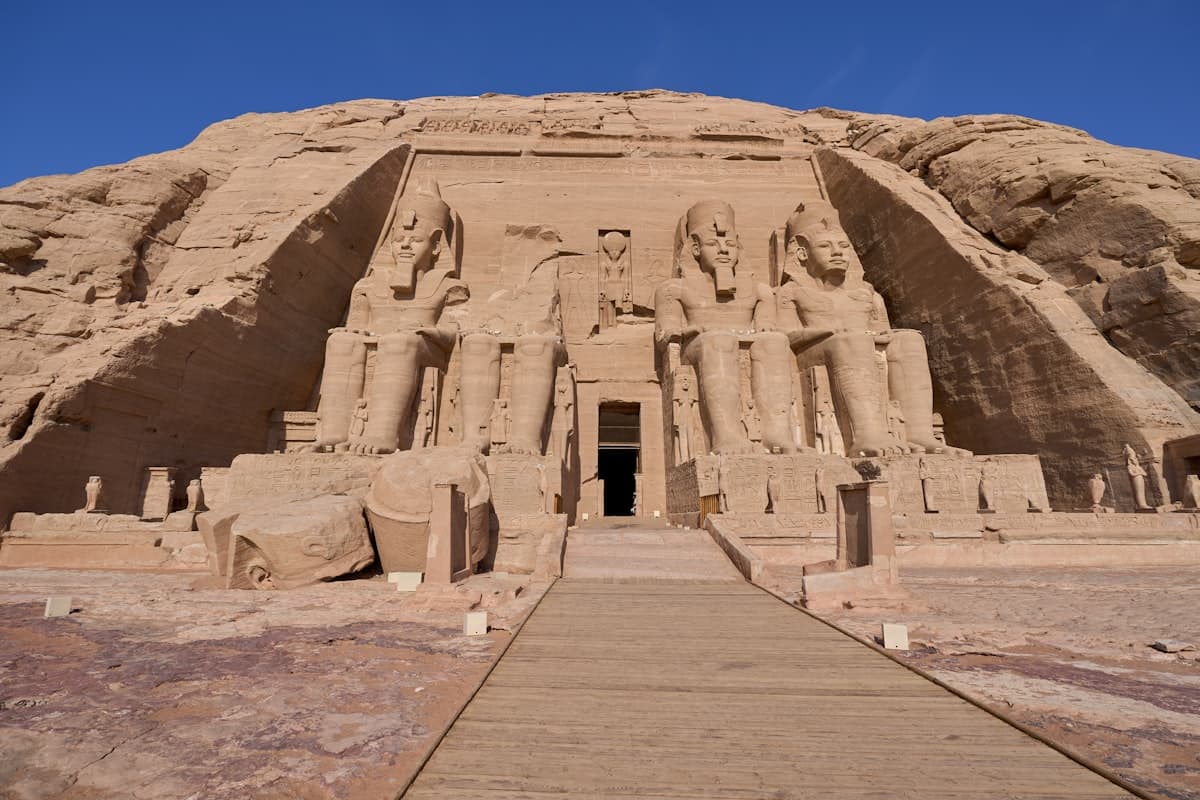
The temples along this route are not monuments to individual pharaohs. They are nodes in a connected theological system, and they were designed to be experienced as a journey. The ancient Egyptians called the journey from Luxor to Aswan a pilgrimage route, and the festivals that moved between these temples involved the physical transportation of divine statues by boat, a sacred flotilla on the same river you are now sailing.
The Coptic Christianity that absorbed Egypt after Rome converted did not erase this riverine sacred geography. It redirected it. The Monastery of Saint Simeon near Aswan, built in the 7th century on the west bank above a Pharaonic quarry, was one of the largest Christian monasteries in Africa, housing at its peak around 300 monks. It was abandoned in the 12th century after repeated raids by the Muslim military leader Saladin's brother, who was simultaneously negotiating alliances with Crusader states and dismantling Christian institutions in Upper Egypt. The monastery's ruins are a 30-minute walk or camel ride from the Aswan corniche, entry EGP 80, and almost nobody on a standard cruise sees them.
The Nubian question is the one modern connection most cruise operators do not raise. The construction of the Aswan High Dam between 1960 and 1970 flooded approximately 550km of the Nile Valley and displaced around 100,000 Nubian people from their ancestral lands in both Egypt and Sudan. Nubian villages in the Aswan area, particularly on Elephantine Island and on the west bank, preserve a culture, language, and architectural tradition that is distinct from Arab Egyptian culture. The brightly painted houses, the matrilineal family structures, the Nubian language which has no connection to Arabic: these are not ethnographic curiosities. They are the surviving evidence of a civilization as old as pharaonic Egypt that has been systematically marginalized in Egyptian national narrative.
---
Common Mistakes
Booking the cheapest possible boat without checking its itinerary. Budget cruise boats often run the route in reverse, Aswan to Luxor, which means you arrive at Karnak exhausted after four days on the water instead of fresh. Confirm direction before booking.
Joining every group excursion the boat organizes. Cruise operators run group temple visits at 8am with fifty other passengers and a guide who is managing logistics, not providing depth. For Edfu and Kom Ombo, the boat docks for several hours. Walk to the temples independently, hire a local guide at the entrance for EGP 150 to 200, and you will have the experience you came for.
Taking the sound and light show at Karnak. It costs EGP 350, runs for 75 minutes, uses dramatic narration that has not been updated since the 1990s, and illuminates perhaps a quarter of the complex. The Temple of Karnak at night without the show, when the late tour groups have left and the site is quiet, is available if you time your visit to the last entry window. The silence and the scale do more than the narration.
Ignoring Esna entirely. Every cruise stops at the Esna lock. Almost no cruise operator makes Esna's temple part of the itinerary. Walk there yourself during the lock wait. EGP 180 and ten minutes on foot buys you one of the most surprising painted temple ceilings in Egypt.
Spending money on felucca rides at Aswan when you need the time for Philae and the Nubian villages. A felucca ride sounds essential. It is pleasant, but it takes two to three hours and delivers you back to your starting point. The west bank of Aswan, which contains the Monastery of Saint Simeon, the Tombs of the Nobles, and the Aga Khan Mausoleum, requires those same hours to reach properly. Choose.
Skipping the Egyptian Museum in Cairo before the cruise. The temples along this route contain inscriptions and objects that make far more sense if you have already seen the physical artifacts in Cairo. The mummy of Ramesses II, who is present in name and image at nearly every temple on this route, is in Cairo. See him first.
Assuming that four days is enough if you are a slow looker. The standard 4-day Nile cruise from Luxor to Aswan was designed for people who want an overview. If you are the kind of traveler who reads every inscription panel and asks questions the guide cannot answer, book seven days or add independent days in Luxor and Aswan at each end.
---
Practical Tips
The best cruise boats sell out three to six months in advance for the October to February season. If you are traveling in November or December, book by August at the latest.
Bring cash in Egyptian pounds for temple entries, independent guides, and tips. Most boats accept credit cards for the cruise itself, but the moment you step ashore, cash is essential. ATMs in Luxor are reliable. Aswan has fewer options.
Sun protection is not optional. The temples are open-air environments and the Nile Valley reflects light off the water and the limestone. A hat with full brim, SPF 50 sunscreen, and a long-sleeved linen shirt will make the difference between a functional day and a ruined one.
For independent travel to temples not on your boat's itinerary, negotiate with local drivers rather than using the boat's excursion desk. A private taxi for a half-day around Aswan costs EGP 300 to 500 and gives you full control over your time. The boat excursion desk charges three to four times that for less flexibility.
The crew of any Nile cruise boat are almost always from the villages along the river, often from Upper Egyptian families that have worked the Nile for generations. Tipping is customary and expected: EGP 100 to 200 per person per day, distributed at the end of the trip, goes further than it sounds and means a great deal.
Frequently Asked Questions
The Weekly Dispatch
More on Egypt, every Friday.
Cultural depth and places most guides never mention.
No spam. Unsubscribe anytime.