Alexandria's Italian Community: History, Streets & Vanishing World
At its peak, Alexandria had 100,000 Italians. Today, fewer than 200 remain. The city they built is still standing. Most Egyptians walk past it every day without knowing.

Audio Guide: Alexandria's Italian Community: History, Streets & Vanishing World
Quick Facts
- Best time to visit
- October to April. Lower humidity, clearer light on the neoclassical facades, and far smaller crowds than the summer domestic tourism peak.
- Entrance fee
- Most exterior sites and the Cathedral of St. Catherine are free. Alexandria National Museum: EGP 100 (approx $2 USD), students EGP 50. Italian Cultural Institute events: free to low cost.
- Opening hours
- Cathedral of St. Catherine: daily 8am to 5pm, Sunday Mass at 10am. Alexandria National Museum: Saturday to Thursday, 9am to 4:30pm. Italian Cultural Institute: weekdays roughly 9am to 2pm, with evening events.
- How to get there
- Talgo or Express train from Cairo Ramses Station: EGP 85 to 180, approximately 2.5 hours. From Alexandria Misr Station, taxi to Raml Station: EGP 30 to 50. Within central Alexandria, walking is the best option for the Italian-era sites.
- Time needed
- Half day for the focused walk. Full day if adding the Alexandria National Museum, the Cavafy Museum, and the Italian Catholic cemetery on Sharia Abu Qir.
- Cost range
- Budget EGP 300 to 600 per day covering transport, museum entry, and meals at local restaurants. Mid-range EGP 1,200 to 2,000 adds a cosmopolitan-era hotel and a longer sit-down lunch.
Quick Facts
Best time to visit: October to April, when Alexandria's Mediterranean humidity drops and the light on the neoclassical facades is clear rather than bleached.
Entrance fees: Most sites are free to walk or enter: the Catholic Cathedral of St. Catherine (free), the Greek Orthodox Patriarchate area (free to observe exteriors), Alliance Française (free entry to cultural events). The Alexandria National Museum, which holds cosmopolitan-era artifacts, charges EGP 100 (approx $2 USD) for adults.
Opening hours: The Cathedral of St. Catherine is open daily roughly 8am to 5pm, with Mass on Sundays at 10am in Arabic and Italian. The Alexandria National Museum is open Saturday to Thursday, 9am to 4:30pm.
Getting there: From Cairo, take the air-conditioned Spanish Train (Talgo) or the regular Express from Ramses Station: EGP 85 to 180 depending on class, two and a half hours. From Alexandria's Misr Station, take a taxi to Raml Station in the city center for EGP 30 to 50. The Italian quarter was concentrated around Raml, Ibrahimiyya, and the eastern harbor streets.
Time needed: Half a day for the focused walk. A full day if you add the National Museum, the Cavafy Museum, and a long lunch at one of the old Greek-Italian patisseries that still survives on Saad Zaghloul Square.
Cost range: Budget EGP 300 to 600 per day. Mid-range EGP 1,200 to 2,000, which gets you a decent lunch and an actual hotel from the cosmopolitan era.
---
At the moment Egypt's cotton economy peaked in the 1920s, the city of Alexandria was home to roughly 100,000 Italians. They were the second-largest European community in a city that was arguably more Mediterranean than Arab, more polyglot than colonial, and more interested in making money and eating well than in questions of national identity. Today, fewer than 200 Italians remain. The palazzos they built along the Corniche are now government ministries, private schools, or simply crumbling. The cafés where they read Futurist manifestos and argued about Mussolini have become mobile phone shops. But if you know what you are looking for, the city they made is still legible in the stone.
This is a guide to reading it.
Why This Place Matters
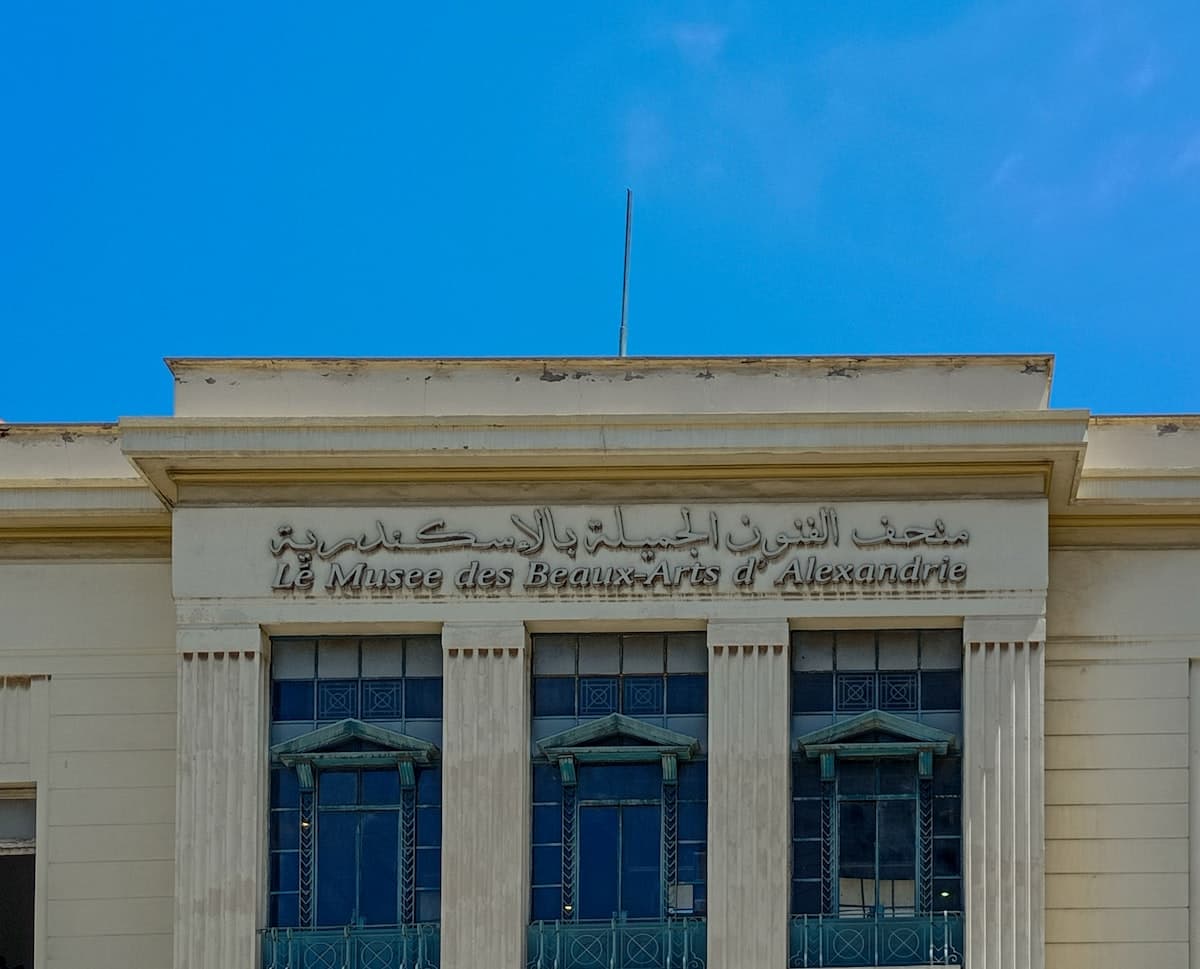
The story of the Italian community in Alexandria is not a colonial story in the conventional sense. Italy never colonized Egypt. Italians came to Alexandria as traders, architects, engineers, financiers, and artists, beginning seriously in the 1850s when the Suez Canal construction and the Egyptian cotton boom created a cosmopolitan city almost by accident. By 1907, the Italian community numbered around 24,000. By the 1920s, some estimates put it above 60,000, though census figures vary depending on how you count second-generation families with mixed origins.
What they built was extraordinary. The Bourse, the Cotton Exchange, the neoclassical apartment buildings of Ibrahimiyya, the Art Deco cinemas along Fouad Street, now Horreya Avenue, and the Catholic churches that still stand in Mancheyya: all of these bear Italian fingerprints, many of them literally. The architect Antonio Lasciac, born in Gorizia in what is now Slovenia, served as Chief Architect of the Egyptian Khedivial court and designed buildings across Cairo and Alexandria that blended Italian neoclassicism with Mamluk ornament in ways that remain architecturally distinctive today. His work was not imitation; it was a genuine synthesis.
The fact that complicates any simple narrative: many of the Italian families who settled in Alexandria had been there for four or five generations by the time Nasser's nationalization decrees of 1956 and 1961 forced them to leave. They were not colonists in transit. They were Alexandrians who happened to hold Italian passports.
The Streets They Left Behind
Start at Raml Station, the old tram terminus that has been the social center of Alexandria's European quarter since the tram lines were built in the 1890s, largely with French and Belgian capital but Italian engineering and labor. The square itself is not beautiful now: too much traffic, too many competing signs. But look at the upper floors of the buildings around you. The proportions are Milanese. The ironwork balconies follow patterns from Naples and Genoa.
Walk south on Saad Zaghloul Street toward the square named for the Egyptian nationalist leader, and stop at Pastroudis. This café has been serving Alexandrians since 1923. During the cosmopolitan period, it was the meeting point for the city's Greek, Italian, and Jewish literary circles. Constantine Cavafy, the Greek poet who is arguably the greatest writer Alexandria ever produced, drank coffee here. So did Giuseppe Ungaretti, the Italian Modernist poet who was actually born in Alexandria in 1888 and spent his formative years in the city before moving to Rome. Ungaretti is claimed by Italian literature as a founding Modernist voice. He is rarely mentioned in the Italian community Alexandria Egypt history and tourism literature because his story does not fit the colonial narrative of Europeans visiting and departing. He was, in a precise and important sense, Alexandrian.
From Saad Zaghloul Square, walk north toward the Corniche and then east along the seafront. The Villa Aghion, now the Italian Cultural Institute, sits on Sharia Batashnin near the harbor. This is perhaps the most intact piece of Italian cosmopolitan architecture in the city: a 1920s palazzo with a garden that backs onto the sea, which has operated continuously as an Italian cultural institution even through the years when the broader community was being expelled. The Institute runs language classes, film screenings, and cultural events. It is not a museum. It is a living institution, which makes it more interesting than a museum.
The Church That Outlasted the Community
The Cathedral of St. Catherine of Alexandria, on Midan Orabi, was consecrated in 1833 and rebuilt and expanded through the nineteenth century as the Italian Catholic community grew. At its height, this was one of the most prosperous Catholic congregations in Africa, funded by cotton merchants and Canal Company shareholders. The interior holds marble brought from Carrara, the same quarry that supplied Michelangelo's workshop. The congregation today is tiny, primarily Egyptian Catholics and a handful of expats. Sunday Mass is said in both Arabic and Italian, a linguistic arrangement that tells you everything about who remains and who they are trying to remember.
What most visitors miss: the cemetery attached to the church complex, and the larger Italian Catholic cemetery in the eastern part of the city. The gravestones document the community's history more precisely than any museum. Families who arrived in the 1860s, who raised children and grandchildren and great-grandchildren here, and who were gone by 1965. The inscriptions switch between Italian and Arabic depending on the generation. The dates of death cluster around the nationalization waves: 1956, 1961, 1964. Reading the cemetery is reading the political history of Egypt through a single community's disappearance.
The Nationalization That Ended Everything
In 1956, following the Suez Crisis, Nasser nationalized the Suez Canal Company and then began a broader program of nationalizing foreign-owned businesses and property. The Italian community, like the Greek and Jewish communities, faced a choice: become Egyptian citizens and remain, or leave and lose everything. Most left. The Alexandria National Museum now holds some of what was confiscated from the villas and offices of the departing cosmopolitan families: furniture, silverware, documents, photographs. The collection is not labeled in a way that tells this story clearly, which is itself a curatorial choice worth thinking about.
Between 1956 and 1964, the Italian population of Alexandria fell from approximately 30,000 to under 3,000. By the 1980s, it was in the hundreds. The writer André Aciman, who grew up in Alexandria in a Jewish family and left in 1965, described the experience in his memoir "Out of Egypt" as living in a city that was simultaneously intimate and already departed. The Italians experienced the same thing, largely without the literary record.
The Connections
The Italian presence in Alexandria was not the first time the city had been defined by people who were neither Egyptian by origin nor colonial by intention. Alexandria was founded by Alexander the Great in 331 BC as a deliberately polyglot city: its famous Library was designed to collect the knowledge of every civilization, not to impose Greek knowledge on others. The Ptolemies, the Greek dynasty who ruled Egypt for three centuries after Alexander, created a city where Greek, Egyptian, Jewish, and eventually Roman identities overlapped in exactly the kind of productive, uncomfortable, commercially driven way that the Italian community would reproduce two millennia later.
The physical layers are real and locatable. The site of the ancient Brucheion, the royal quarter of Ptolemaic Alexandria, sits beneath the streets of the modern eastern harbor district, where many of the Italian-era buildings stand. When the Cotton Exchange was being built in the early 1900s, workers found Ptolemaic-era foundations. The archaeologist Jean-Yves Empereur has been mapping the underwater archaeology of the eastern harbor since the 1990s and has documented hundreds of Ptolemaic and Roman artifacts, including sections of the ancient lighthouse platform, lying in the water beneath where Italian merchant ships once anchored.
The Cavafy Museum, in the apartment where the Greek poet lived until his death in 1933, is three streets from the main Italian quarter. Cavafy wrote about Alexandria's Ptolemaic period obsessively, using the ancient polyglot city as a way of talking about the modern one. His poems are set in 50 BC and they describe the 1920s. Nobody who cares about the Italian community Alexandria Egypt history and cultural memory should skip this museum.
Common Mistakes
Expecting visible markers. Almost none of the Italian-era buildings are labeled as such. You need a map and some architectural literacy, or a guide who specializes in the cosmopolitan period. The Alexandria Preservation Trust occasionally runs walking tours: worth checking before you arrive.
Visiting only the National Museum without the streets. The museum is fine. The EGP 100 entry is worth it for the overview. But the museum's cosmopolitan-era collection is thin and under-explained. The streets teach you more.
Taking the horse-carriage tour of downtown Alexandria. Drivers will tell you the carriage route covers the historic center. It covers traffic. You will see nothing useful and pay EGP 150 to 300 for the experience. Walk instead.
Assuming the Italian community history is a European history separate from Egyptian history. The most important thing to understand about the cosmopolitan Alexandrians, Italian, Greek, Jewish, Levantine, is that their story is Egyptian history. The cotton economy that funded their palazzos was grown by Egyptian farmers in the Delta under conditions that were exploitative. The architecture that looks beautiful to us now was paid for by systems that enriched the Mediterranean families and impoverished the rural Egyptians who worked the land. You can appreciate the buildings and hold that fact simultaneously.
Eating at the tourist restaurants near the Corniche. Expensive, mediocre, aimed at domestic tourism. Walk to Mohamed Ahmed on Sharia Shakour Saad for ful and ta'meya at EGP 20 to 40 per person. The cosmopolitan Alexandrians ate Egyptian food alongside their pasta. So should you.
Skipping the eastern cemeteries. The Italian Catholic cemetery on Sharia Abu Qir is rarely visited by tourists and is genuinely moving. It is also architecturally significant: the funerary monuments trace the transition from nineteenth-century Italian neo-Gothic to Art Deco, reflecting exactly the same stylistic evolution happening in Milan and Turin at the same time.
Booking a guided tour focused on pharaonic Alexandria. The pharaonic presence in Alexandria is real but thin: Alexander had just founded the city, and the deep pharaonic heartland is in Upper Egypt. Guides who sell Alexandria as a pharaonic site are selling you Cairo's story in the wrong city. Alexandria's real archaeology is Ptolemaic, Roman, and cosmopolitan.
Practical Tips
The best months are October through March. Alexandria in July and August is hot and crowded with Egyptian domestic tourism: the Corniche becomes a promenade for families from Cairo escaping the heat, the hotels are full, and the city loses the slightly melancholy quality that suits its cosmopolitan history perfectly. October has lower humidity, clearer light on the neoclassical stone, and half the crowds.
Arrange a walking tour in advance through the Alexandria Preservation Trust or through a Cairo-based guide specializing in the cosmopolitan period. Khaled Fahmy, the Egyptian historian who has written seriously about Alexandria's social history, has participated in public education programs in the city. His work is worth reading before you arrive: specifically his essay on the 1882 Alexandria riots, which targeted the cosmopolitan communities and mark an early moment in the tension between Egyptian nationalism and the immigrant trading classes.
Bring cash. Most of the places worth visiting, the cafés, the smaller churches, the cemetery, do not take cards.
Speak some Italian at the Italian Cultural Institute. If you arrive during a cultural event, you will meet the small group of Italo-Egyptians and Italian expats who maintain the community's presence in the city. They are interesting people with specific knowledge of which families stayed, which houses still belong to descendants, and which stories the official histories miss.
If you are in Alexandria on a Sunday morning, attend Mass at St. Catherine's Cathedral at 10am. The congregation is small, the church is cool and quiet, and the experience of hearing Arabic and Italian said in the same liturgy in a building funded by long-departed cotton merchants is unlike anything available in a museum.
Frequently Asked Questions
The Weekly Dispatch
More on Egypt, every Friday.
Cultural depth and places most guides never mention.
No spam. Unsubscribe anytime.