British Colonial Egypt: A Field Guide to What Actually Remains
Britain occupied Egypt for 72 years but never admitted it. The sites they left behind are stranger, and more honest, than any official history.

Quick Facts
- Best time to visit
- October through April. Colonial sites are street-level architecture explored on foot, and Cairo heat above 35C makes extended walking genuinely unpleasant. November and March offer the best combination of cool temperatures and long daylight hours.
- Entrance fee
- Egyptian Museum EGP 450 (approx $9 USD), students EGP 225. Manial Palace EGP 200 (approx $4 USD). Abdeen Palace EGP 150 (approx $3 USD). Cavafy Museum Alexandria EGP 40 (approx $1 USD). Most colonial facades and neighborhoods are free.
- Opening hours
- Egyptian Museum daily 9am to 5pm. Manial Palace daily 9am to 5pm. Downtown Cairo streets accessible at all hours, best visited 7am to 9am before traffic.
- How to get there
- Cairo Metro Line 1, Sadat station, for Tahrir Square and Egyptian Museum. Taxis from Cairo Airport to Downtown EGP 200 to 300 ($4 to 6 USD). Intercity bus from Turgoman station to Alexandria EGP 75, to Ismailia EGP 40, to Port Said EGP 90.
- Time needed
- Two full days for Cairo's colonial layer minimum. One separate day for Alexandria. Half day for Ismailia. The Canal Zone sites require an overnight stay to do properly.
- Cost range
- Budget EGP 600 to 900 per day including transport, entry fees, and meals. The colonial sites themselves are among the cheapest in Egypt to visit.
Quick Facts
Best time to visit: October through April. Cairo's colonial-era buildings are best seen on foot, and walking Cairo in July is a medical problem, not a preference.
Entrance fees: Most colonial-era sites are streets, neighborhoods, and facades you can see for free. The Egyptian Museum (which holds artifacts from the British excavation era) costs EGP 450 (approx $9 USD), students EGP 225. The Manial Palace Museum on Rhoda Island costs EGP 200 (approx $4 USD). The Abdeen Palace Museum complex costs EGP 150 (approx $3 USD).
Opening hours: Egyptian Museum daily 9am to 5pm. Manial Palace daily 9am to 5pm. Downtown Cairo's colonial facades are always accessible.
How to get there: Cairo Metro Line 1 stops at Sadat station, which puts you at Tahrir Square and within walking distance of the Egyptian Museum, the old Shepheard's Hotel site, and most of Downtown's colonial grid. A taxi from Cairo Airport to Downtown costs approximately EGP 200 to 300 ($4 to 6 USD). The Manial Palace is a 20-minute taxi ride from Tahrir, roughly EGP 50.
Time needed: Two full days minimum to do justice to Cairo's colonial layer. Alexandria's colonial remnants warrant a separate day trip.
Cost range: Budget EGP 600 to 900 per day including transport and entry fees. The most revealing sites cost nothing.
---
Britain never officially colonized Egypt. This is the first thing to understand. From 1882 until 1952, Egypt was occupied, administered, and economically controlled by the British Empire. But in every diplomatic document, Egypt remained technically part of the Ottoman Empire, then a nominal protectorate, then a nominally independent kingdom. Britain maintained this legal fiction for 70 years because admitting the occupation would have required explaining it. The sites left behind carry that same doubleness: grand in ambition, contradictory in meaning, and largely unread by the visitors who walk past them every day.
Why This Place Matters
The British arrived on September 13, 1882, when General Wolseley's forces defeated Urabi Pasha's army at the Battle of Tel el-Kebir in a 35-minute engagement that decided the next seven decades of Egyptian history. What followed was not a colonial administration in the traditional sense. The Consul-General, a post held by Evelyn Baring, Lord Cromer, from 1883 to 1907, held no formal government title in Egypt. He was simply the man who ran everything.
Cromer's Egypt is the Egypt whose physical traces you are looking for. He reorganized Egyptian finances, rebuilt the irrigation system, and oversaw the construction of the first Aswan Dam, completed in 1902. He also wrote a book called "Modern Egypt" in which he argued, without apparent irony, that Egyptians were racially incapable of self-governance. The dam he commissioned now sits beneath Lake Nasser, flooded by its own successor. The book is still in print.
Understanding British Egypt colonial history sites requires accepting that the occupation did not produce monuments to itself. It produced infrastructure, institutions, and a city layout. The British left Cairo a working railway system, a cotton export economy that benefited Lancashire more than the Nile Delta, and a downtown neighborhood designed to look like Paris. Egypt got the grid. Britain got the cotton.
Downtown Cairo: The Colonial City You Walk Through Without Knowing
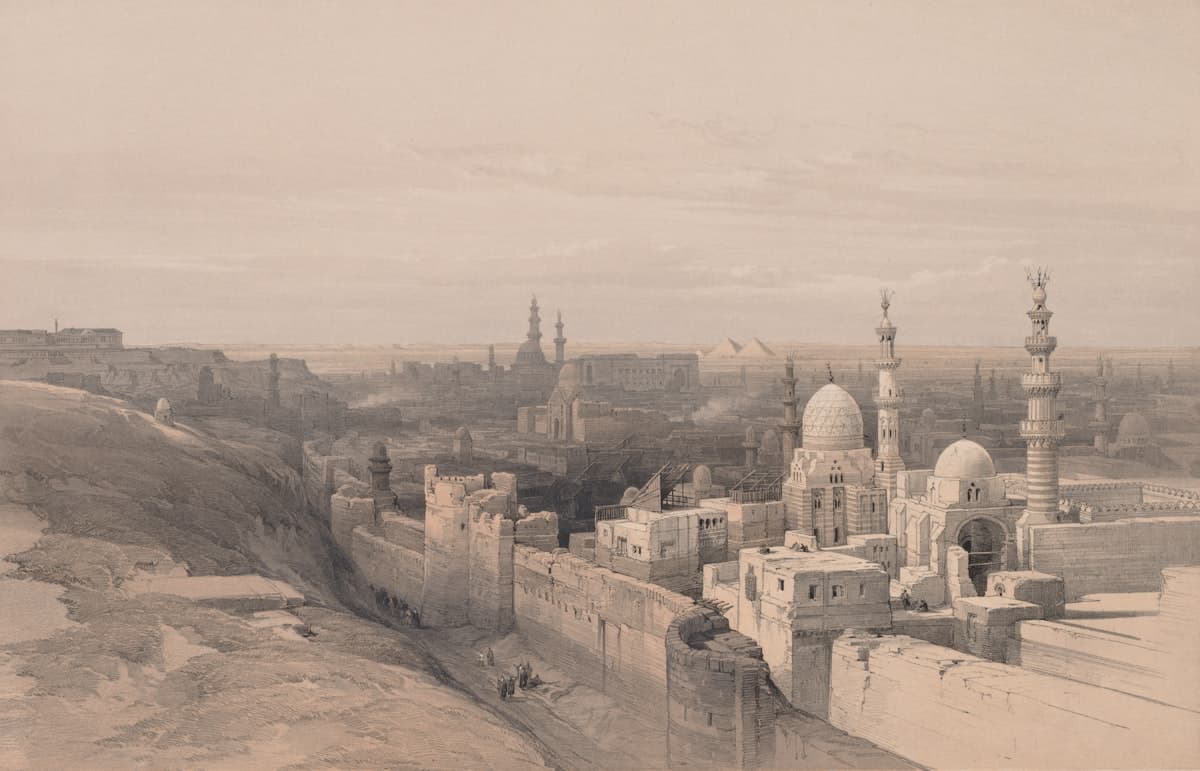
Khedive Ismail commissioned the Europeanization of Cairo's downtown in the 1860s, before the British arrived, modeling it explicitly on Haussmann's Paris. But the British occupation filled that grid with institutions that turned a cosmopolitan fantasy into an administrative reality. The buildings you see on Talaat Harb Street, Qasr el-Nil Street, and the blocks surrounding Tahrir Square are largely a product of the 1880s to 1940s, built in eclectic styles that mixed Beaux-Arts with Orientalist detail to produce something that exists nowhere else on earth.
The building at 1 Qasr el-Nil Street was the headquarters of Thomas Cook and Son, whose steamship monopoly on Nile tourism was granted by the British administration and which operated as a quasi-official extension of imperial soft power. Cook's transported not just tourists but troops: the company ran the Nile logistics for Kitchener's Sudan campaign of 1896 to 1898, the same campaign that ended with the Battle of Omdurman and Britain's effective control of the entire Nile valley.
The old Shepheard's Hotel site at Ibrahim Pasha Street is now an unremarkable building, but the original hotel, burned during the Cairo Fire of January 1952, was the social headquarters of British Egypt. Every significant imperial figure from Napoleon Bonaparte (who stayed in the building that preceded it) to Winston Churchill passed through. The burning of Shepheard's, along with 750 other establishments, by Egyptian crowds on January 26, 1952, six months before the revolution that ended the monarchy, was not random. It was a specific targeting of the architecture of occupation.
Walk these streets at 7am before the traffic arrives. The quality of the light on the stone facades, the wrought-iron balconies, the faded French lettering on older shop signs: this is what a layered city looks like when it is still half-asleep.
The Egyptian Museum and the Archaeology of Control
The Egyptian Museum on Tahrir Square was designed by the French architect Marcel Dourgnon, who won an international competition in 1895, and opened in 1902. This is the same year as the first Aswan Dam. Both projects represent the British-administered modernization of Egypt, and both had the same fundamental character: they organized and extracted Egyptian resources, one in water, one in antiquities, for purposes that were never primarily Egyptian.
The system of excavation permits in place during the British period operated on what was called partage: foreign expeditions funded the digs and kept a portion of what they found. This is why a granite head of Amenhotep III is in the British Museum and why the contents of Tutankhamun's tomb are in Cairo. Howard Carter discovered Tutankhamun's tomb in 1922 under a concession held by Lord Carnarvon. When the Egyptian government, under pressure from nationalist sentiment, refused partage on the Tutankhamun finds, it marked a turning point in who owned Egyptian history.
Inside the museum, Room 3 on the ground floor holds the Narmer Palette, dated to approximately 3100 BC and considered the earliest historical document in the world. Most visitors walk past it because it is small and there is a mummy in the next room. Spend twenty minutes with it. The rest of the museum will make more sense.
The Egyptian Museum's new replacement, the Grand Egyptian Museum near Giza, opened its main galleries in 2023. The old Tahrir building remains open and is, frankly, the better experience. Its chaos is honest. History is not organized.
Alexandria: The Colonial Palimpsest
Alexandria is where the British colonial layer sits most visibly over the oldest layers of the city. The Cecil Hotel on the Corniche, built in 1929, was used by British intelligence during the Second World War. The writer Lawrence Durrell, who set his Alexandria Quartet in the city's cosmopolitan colonial twilight, worked nearby as a press attache for the British government. The Quartet describes a city of Greek cotton merchants, Jewish financiers, British administrators, and Egyptian servants: a portrait of colonial Alexandria so precise that Egyptian critics have spent decades arguing about whether Durrell saw the city or only saw the foreigners in it.
The Bibliotheca Alexandrina, opened in 2002 on the presumed site of the ancient Library, is worth visiting for the architecture alone. But the more revealing colonial-era site is the Cavafy Museum on Sharm el-Sheikh Street, the apartment where the Greek-Egyptian poet Constantine Cavafy lived until his death in 1933. Cavafy worked as a clerk in the Egyptian Irrigation Service, a British-administered department, for thirty years. His poetry mourns the Hellenistic world while being written in the middle of a British one. The museum is small, quiet, and almost always empty.
The Jewish Cemeteries of Alexandria, accessible with advance arrangement through the Jewish community office, contain the graves of families who built much of the colonial city's commercial infrastructure and who were expelled or pressured to leave between 1948 and 1967. This is the part of British Egypt's story that does not appear in official histories: the communities that flourished under cosmopolitan colonial Cairo and were dismantled by the nationalism that ended the occupation.
The Connections
The British occupation did not arrive in a vacuum, and it did not leave one either. The Qasr el-Aini Hospital in Cairo, now Egypt's primary public teaching hospital, was founded by the physician Clot Bey under Muhammad Ali in 1837, became part of the British-administered public health system after 1882, and trained the generation of Egyptian doctors who staffed the country's postcolonial health system. One building, four regimes, continuous function.
The Aswan Low Dam, completed under British administration in 1902 and raised twice, in 1912 and 1934, created the reservoir that flooded the Temple of Philae seasonally for decades. The temple's statues were partially underwater for portions of every year until the dam was replaced by the High Dam, built with Soviet funding between 1960 and 1970, which flooded the entire site permanently. Philae was moved stone by stone to Agilkia Island by a UNESCO operation completed in 1980. The colonial dam's consequence was solved by Cold War politics and international archaeology. Egypt as a country is a series of these overlapping causes and consequences.
The Gezira Sporting Club on Zamalek Island was established in 1882, the same year as the occupation, as a recreational facility for British officers. It is still operating, still prestigious, and its membership list has simply changed nationalities. Egyptian elite society now occupies the polo fields and squash courts built for imperial administrators. This is either irony or continuity, depending on where you stand.
Common Mistakes
Treating this as a single-site itinerary. There is no British Egypt museum, no colonial history quarter with a ticket booth. This is a layer of a city, encountered by walking, reading facades, and knowing what you are looking at. Visitors who try to book a tour specifically around colonial history will find very few options and mostly poor ones.
Paying for a guided tour of Downtown Cairo. The colonial architecture of Downtown is a walking neighborhood. A guide is not what you need. What you need is a copy of Samir Raafat's "Cairo: The Glory Years" and two hours on foot. The book costs EGP 150 at Diwan bookshop on Bahgat Ali Street in Zamalek and is worth five guided tours.
Visiting the Alexandria National Museum instead of the smaller sites. The Alexandria National Museum costs EGP 180 and presents a standard chronological Egyptian history narrative that does not engage seriously with the colonial period at all. The Cavafy Museum costs EGP 40 and tells you more about what colonial Alexandria actually felt like than any official museum in the city.
Taking the Nile Corniche tourist boats while in Cairo. They cost between EGP 200 and 350, last an hour, and show you nothing you cannot see from the Qasr el-Nil Bridge for free. Skip them entirely.
Assuming the 1952 revolution ended British influence immediately. Britain maintained military bases in the Canal Zone until 1956, when Nasser nationalized the Suez Canal and Britain, France, and Israel launched a military operation to retake it. The United States and Soviet Union both pressured Britain to withdraw. This is the moment that ended British Egypt, not 1952. The Suez Crisis sites, including the Canal cities of Ismailia and Port Said, are almost never included in British Egypt colonial history site guides, and they should be. Port Said's colonial-era waterfront is the place where the occupation actually ended.
Ignoring Ismailia. Ismailia, founded in 1863 as the administrative headquarters of the Suez Canal Company, contains some of the best-preserved colonial-era residential architecture in Egypt. The Museum of the Suez Canal City costs EGP 80 and is genuinely interesting. It is two hours from Cairo by road and almost entirely unvisited by foreign travelers.
Practical Tips
The best single day for understanding British Cairo in sequence: start at the Egyptian Museum when it opens at 9am, spend ninety minutes and find the Narmer Palette and the Tutankhamun rooms. Walk from Tahrir Square north along Qasr el-Nil Street to Talaat Harb Square. Have coffee at Cafe Riche on Talaat Harb Street, which opened in 1908 and served as a meeting point for Egyptian nationalist intellectuals, including some who were being watched by British intelligence. Walk south to the old Shepheard's site. Take a taxi to Zamalek and walk through the residential streets to the Gezira Sporting Club exterior and then to Diwan bookshop.
For Alexandria, take the 8am Intercity bus from Turgoman station in Cairo, which costs EGP 75 and takes two and a half hours. This is faster than the train for most departures and significantly cheaper than a taxi. Spend the morning at the Corniche and the Cavafy Museum, the afternoon at the Jewish cemetery or the old cotton exchange building on Mena Street, and take the 5pm bus back.
Photography of the colonial facades is unrestricted on public streets. The Egyptian Museum charges EGP 50 for a camera permit inside, which is worth paying.
Frequently Asked Questions
The Weekly Dispatch
More on Egypt, every Friday.
Cultural depth and places most guides never mention.
No spam. Unsubscribe anytime.