British Colonial Egypt: A Guide to the Sites That Shaped Modern Cairo
Britain occupied Egypt for 72 years without ever officially calling it a colony. The buildings they left behind are still in use. Most Egyptians walk past them daily without a second look.

Quick Facts
- Best time to visit
- October to April. Spring and autumn offer the most comfortable temperatures for extended urban walking. Summer (June to August) is genuinely difficult for outdoor colonial neighborhood exploration in Cairo.
- Entrance fee
- Egyptian Museum EGP 450 (approx $9 USD), students EGP 225. Abdeen Palace Museum EGP 300 (approx $6 USD). Fort Qaitbay Alexandria EGP 100 (approx $2 USD). Ismailia Canal Museum EGP 60 (approx $1.20 USD). British cemeteries Alexandria and Cairo: free.
- Opening hours
- Egyptian Museum daily 9am to 5pm. Abdeen Palace Museum Saturday to Thursday 9am to 3pm, closed Friday. Fort Qaitbay daily 9am to 5pm. Ismailia Canal Museum Sunday to Thursday 9am to 3pm.
- How to get there
- Cairo metro to Tahrir Square EGP 10. Taxi within Cairo EGP 30 to 80. Cairo to Alexandria by air-conditioned train from Ramses Station EGP 85 to 180 depending on class, roughly 2.5 hours. Cairo to Ismailia bus from Turgoman Station EGP 55, approximately 90 minutes.
- Time needed
- Two full days for Cairo colonial sites. One day for Alexandria. One day for Ismailia. Three to four days covers the full British Egypt colonial history sites comprehensively.
- Cost range
- Budget EGP 600 to 900 per day covering transport, entry fees, and basic meals. Mid-range EGP 1,800 to 2,800 per day with specialist guiding included.
Britain occupied Egypt from 1882 to 1954, longer than it held India as a formal colony, yet it never once declared Egypt a colony. It was always a "protectorate," a "sphere of influence," a "temporary arrangement." The paperwork was always provisional. The architecture, on the other hand, was built to last centuries.
What remains of that occupation is not confined to a single museum or a heritage quarter. It is folded into the fabric of Cairo, Alexandria, and the canal cities in ways that most visitors, and many Egyptians, do not immediately recognize. The Egyptian Museum in Tahrir Square, the Abdeen Palace, the Shepheard's Hotel site, the old Qasr al-Nil barracks, the Suez Canal Authority buildings in Ismailia: these are not colonial ruins. They are functioning institutions, government offices, and city landmarks still shaping Egyptian life. Understanding them requires understanding why Britain came, what it wanted, and what it left behind when it was finally forced to leave.
This guide to British Egypt colonial history sites is organized around that understanding. It is not a monuments tour. It is an argument about how colonialism works, told through buildings that are still standing.
Quick Facts
Best time to visit: October to April, when Cairo and Alexandria temperatures sit between 15°C and 25°C. Summer heat above 38°C makes extended street-level exploration of colonial-era neighborhoods genuinely unpleasant.
Entrance fees: The Egyptian Museum (Tahrir): EGP 450 (approx $9 USD), students EGP 225. Abdeen Palace Museum: EGP 300 (approx $6 USD). Manial Palace, Cairo: EGP 200 (approx $4 USD). Alexandria National Museum (housed in a former Italian merchant's colonial-era villa): EGP 150 (approx $3 USD). Most colonial-era neighborhood walks are free.
Opening hours: Egyptian Museum daily 9am to 5pm. Abdeen Palace Museum Saturday to Thursday 9am to 3pm, closed Friday. Manial Palace daily 9am to 4pm.
How to get there: The Egyptian Museum is a five-minute walk from Tahrir Square metro station (Line 1 or Line 2, EGP 10 flat fare anywhere). For Abdeen Palace, take a taxi from Tahrir, roughly EGP 30 to 50. For Alexandria, the Spanish-built air-conditioned trains from Ramses Station cost EGP 85 to 180 depending on class. The Cairo to Ismailia bus from Turgoman Station costs EGP 55 and takes about 90 minutes.
Time needed: Two days minimum for Cairo's colonial layer. Add one day for Alexandria, one day for Ismailia if the Canal specifically interests you.
Cost range: Budget EGP 600 to 900 per day including transport and entry fees. Mid-range EGP 1,800 to 2,800 per day with a guide.
Why This Place Matters
Britain came to Egypt in 1882 not for the pharaohs but for the Suez Canal, which had opened in 1869 and immediately became the most strategically important waterway on earth. When the Egyptian Khedive Ismail ran out of money financing that canal and other modernization projects, he sold Egypt's shares in the Canal Company to Britain for £4 million. When Egyptian army officers under Ahmed Urabi revolted against foreign control in 1882, Britain shelled Alexandria and sent in 40,000 troops. The whole operation took six weeks. The plan, stated publicly by Prime Minister Gladstone, was to stabilize things and leave within a year or two.
They stayed 72 years.
The man who actually ran Egypt for most of that period was Evelyn Baring, later Lord Cromer, who served as British Agent and Consul-General from 1883 to 1907. Cromer held no official Egyptian government position. He had no formal constitutional authority. He was, on paper, merely a diplomat. In practice, he controlled every significant appointment, every budget decision, and every policy direction of a theoretically independent Egyptian government. This arrangement, power without accountability, is the defining characteristic of informal empire, and Egypt is one of its clearest examples anywhere in the world.
The sites this history left behind are therefore not typical colonial monuments. There is no triumphant statue of Cromer on a plinth in Cairo, at least not anymore. What remains is more interesting: the infrastructure of control, the architecture of administration, the buildings where cotton was weighed and judicial decisions were made and telegrams were sent to London. Understanding what these buildings were for tells you more about how empire actually functions than any battlefield monument could.
Cairo: The Colonial City Within the City
Khedivial Cairo, the grid of broad Haussman-style boulevards west of the old Islamic city, was begun by Ismail in the 1860s to make Cairo look like Paris. The British then administered it for 70 years, filled it with their institutions, and left it essentially intact. Today it is called Downtown Cairo or Wust el-Balad, and it is one of the most underappreciated urban environments in the world.
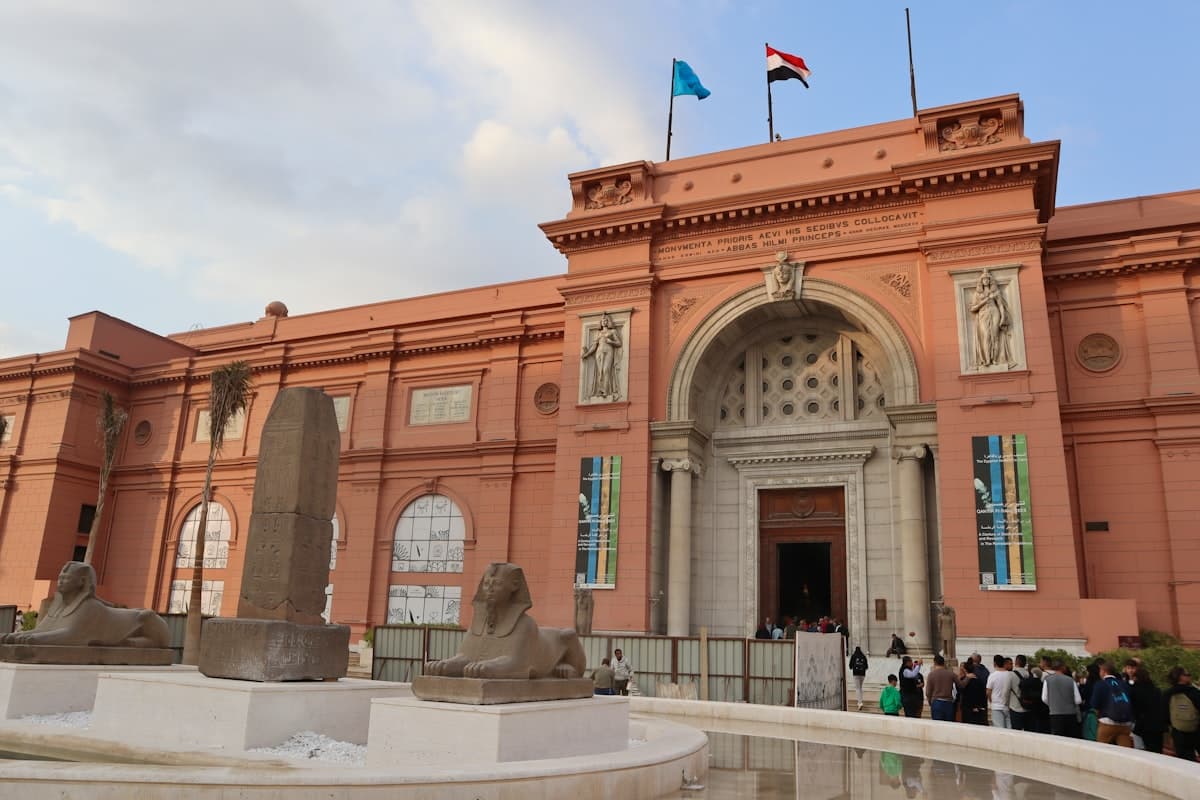
Start at Tahrir Square. The Egyptian Museum, opened in 1902 and designed by French architect Marcel Dourgnon after an international competition, contains 170,000 objects including the contents of Tutankhamun's tomb. What most visitors do not know is that the building was constructed partly as a political statement: Egypt's antiquities, which had been hemorrhaging to European museums for decades, were finally to be kept in Egypt. Britain simultaneously used the museum's foundation as evidence of its own civilizing mission. The building is, simultaneously, an act of Egyptian cultural nationalism and a product of colonial patronage. It holds both truths at once.
Walk north from Tahrir along Qasr al-Nil Street. The street is named after the Qasr al-Nil barracks, which stood where the Nile Hilton and the Arab League building now stand. The barracks housed British troops from 1882 until 1947, when public pressure following the 1946 Cairo riots forced their evacuation. The building was demolished in 1960. Nothing marks what stood there. The absence is itself a form of history.
On Talaat Harb Square, look at the building now housing a mix of shops and offices above the old Groppi café. Groppi was a Swiss confectioner who opened his café here in 1924 and it became the social center of colonial Cairo, frequented by British officers, Egyptian aristocracy, and European diplomats in roughly equal measure. It served as a kind of neutral ground where the hierarchies of colonialism temporarily relaxed over imported chocolate. It is now half-closed and architecturally neglected, which is either a tragedy or a reasonable outcome depending on your perspective.
Abdeen Palace and the Architecture of Ambiguous Power
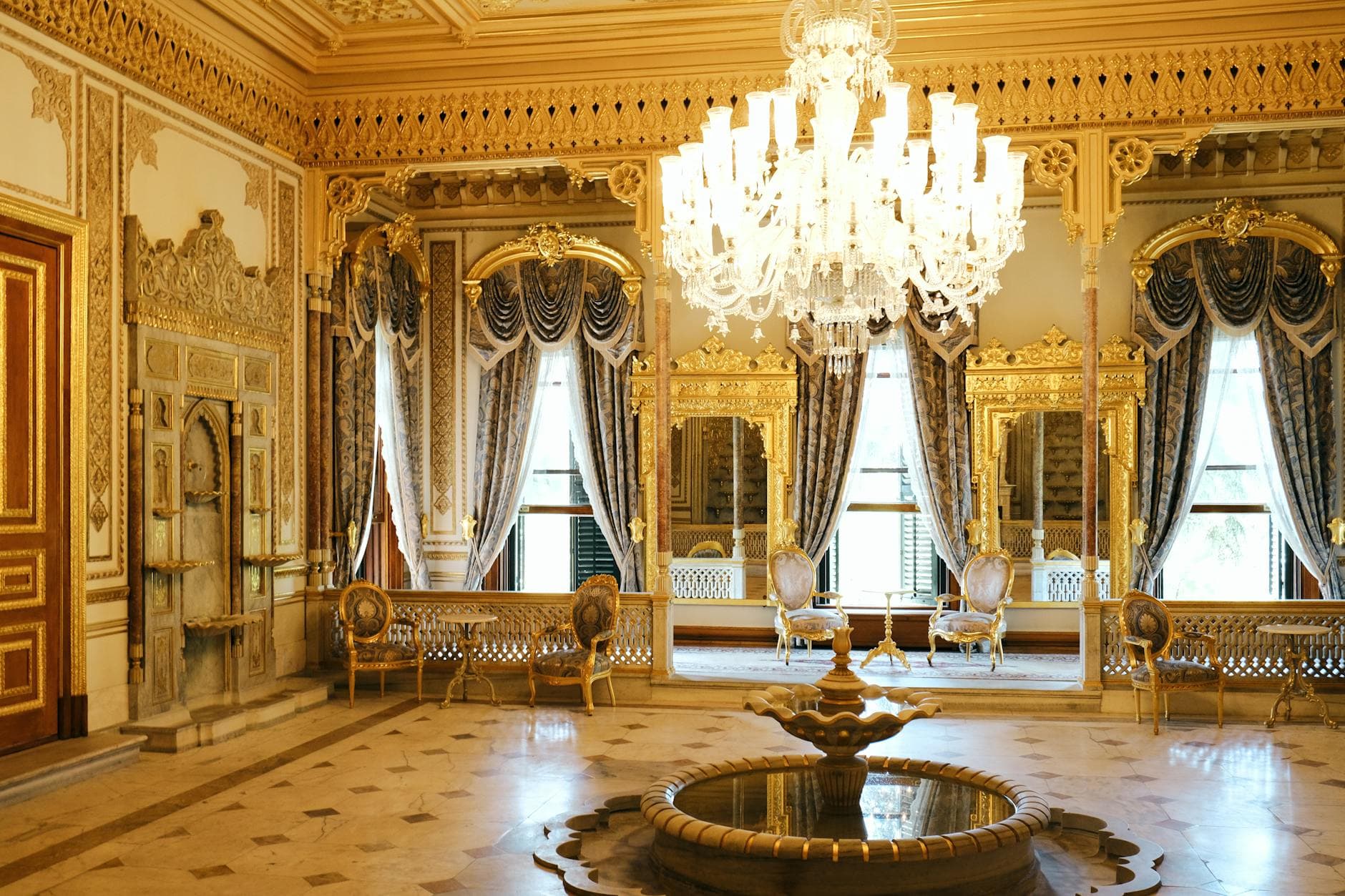
Abdeen Palace, about 800 meters east of Tahrir, was the official residence of the Egyptian Khedives and later the Kings from 1874. The British used it as the symbolic center of the government they controlled without formally controlling. In February 1942, British Ambassador Sir Miles Lampson surrounded the palace with tanks and armored cars and presented King Farouk with an ultimatum: appoint a pro-British prime minister or abdicate. Farouk complied within hours. The incident, known as the Abdeen Palace Incident, was never forgotten by Egyptian nationalists and is considered one of the humiliations that made the 1952 revolution psychologically inevitable.
The palace is now partly a museum. The weapons collection on the ground floor is genuinely interesting. The state rooms are preserved with their original 19th-century European furniture. There are almost never more than a dozen other visitors. Entry is EGP 300.
Alexandria: Where the British Actually Lived
If Cairo was the administrative capital of British Egypt, Alexandria was where the British presence felt most comfortable and most permanent. The city had been cosmopolitan since Alexander founded it in 331 BC, and by the early 20th century it was home to around 100,000 Europeans: Greeks, Italians, Jews, Syrians, Armenians, French, and perhaps 25,000 British. These communities had their own schools, their own clubs, their own cemeteries.
The British cemetery in Alexandria, on Midan Victoria, contains graves from the 1880s through the 1950s. The inscriptions are worth reading slowly. You will find soldiers who died of disease in 1882, merchants who lived in the city for 40 years, and children whose entire short lives were spent in a country their parents considered temporary posting. The cemetery is rarely visited and almost never mentioned in guides to Alexandria. A caretaker is usually on site. There is no entrance fee.
The Corniche along Alexandria's seafront was widened and formalized under British administration in the early 1900s. The Cecil Hotel, opened in 1929, hosted Winston Churchill, Field Marshal Montgomery, and the wartime intelligence community that used Alexandria as a base during the North Africa campaign. Somerset Maugham supposedly wrote part of a novel there. The hotel has been renovated repeatedly and now operates under the Sofitel brand. Its terrace bar, overlooking the Mediterranean, is worth the price of a coffee for the view and the knowledge of what conversations once happened in those chairs.
The Fort of Qaitbay, built by the Mamluk Sultan in 1477 on the exact site of the ancient Lighthouse of Alexandria, one of the Seven Wonders, was used by British forces as a military installation after 1882. The fort itself is far older than the British period, but the artillery emplacements the British added in the 1880s are still visible. The British shelling of Alexandria in 1882 began from warships positioned almost exactly where tourist feluccas now drift on summer afternoons.
Ismailia and the Canal: The Reason for All of It
Ismailia, 120 kilometers northeast of Cairo, exists entirely because of the Suez Canal. Ferdinand de Lesseps founded the city in 1863 as the headquarters of the Suez Canal Company, and it retains more intact colonial-era architecture than anywhere else in Egypt. The Garden City neighborhood of Ismailia, with its wide tree-lined streets and late 19th-century European villas, looks disorienting: it could be a provincial French city, except that it is surrounded by desert and the Canal runs through the middle of it.
The Suez Canal Authority building and museum contain documents, maps, and engineering artifacts from the Canal's construction and the various crises around its ownership. The 1956 nationalization by Nasser, which ended British influence in Egypt permanently, is represented here with considerable Egyptian satisfaction. Entry is modest and the museum is rarely crowded. The house of Ferdinand de Lesseps, the French engineer who built the Canal, is preserved on the lake shore. The British moved into his offices when they arrived in 1882. They considered this perfectly natural.
The Connections
The colonial layer in Egypt sits on top of everything that came before it and bleeds into everything that came after. The Egyptian Museum was funded partly by the same cotton revenues that Britain extracted through its control of Egyptian agricultural policy, a policy that shifted Egyptian farming almost entirely to cotton for export, reducing food crop production to the point where Egypt was importing wheat by the 1890s. The building that celebrates Egyptian civilization was built on the proceeds of an economic system designed to benefit British textile mills in Manchester.
The Abdeen Palace Incident of 1942 radicalized a generation of young Egyptian army officers, including a 24-year-old named Gamal Abdel Nasser, who was stationed near Cairo at the time. The humiliation he felt watching Farouk capitulate to British tanks directly shaped his political worldview and, ten years later, the 1952 revolution. The revolution ended the monarchy, expelled British military personnel, and set up the nationalization of the Canal in 1956. That nationalization triggered the Suez Crisis, in which Britain, France, and Israel invaded Egypt, were forced to withdraw under American and Soviet pressure, and effectively ended Britain's status as a global imperial power. The through-line from the 1882 occupation to the 1956 Suez Crisis is essentially a single continuous story.
The Coptic and Islamic cities of Cairo, largely untouched by British urban planning, exist in a different visual and spatial register from the Khedivial grid. Walk 20 minutes east from Tahrir into Khan el-Khalili and you have moved not just between neighborhoods but between entirely different concepts of how a city should be organized and what public space is for.
Common Mistakes
Treating this as a monuments tour. Unlike pharaonic Egypt, the British colonial period did not produce dramatic standalone monuments. If you arrive expecting a single colonial museum that explains everything, you will be confused and disappointed. This history is legible in streets, neighborhoods, administrative buildings, and the spaces between things. It requires walking and looking carefully.
Skipping Ismailia. Almost every Egypt itinerary ignores it. It is the only place where you can understand the Canal as a physical and urban reality rather than a political abstraction, and its preserved colonial neighborhood is genuinely unlike anywhere else in the country. The 90-minute bus ride from Cairo costs EGP 55 and is absolutely worth it.
The sound and light show at anything. Every colonial-era site in Cairo that offers a sound and light experience charges EGP 250 to 400 for a narration that could be summarized in four minutes. None of them pass the fact test. Skip all of them.
Expecting Egyptians to frame this history the way a British museum would. Egyptian guides, museum labels, and public monuments present the colonial period through the lens of the resistance and revolution that ended it. This is not bias. It is a different, equally valid, perspective on the same events. Bring your own knowledge and be prepared to hear the story from the other end.
Missing the cemeteries. The British cemeteries in Alexandria and in Cairo's New Quarter are extraordinary primary sources. The individual graves tell you who actually came and what happened to them. They are almost never on any itinerary and they are always open.
Over-scheduling the Egyptian Museum. Three hours gets you the Tutankhamun galleries and a reasonable survey. Five hours is too long without a specific research purpose. The Grand Egyptian Museum in Giza now holds the most significant Tutankhamun collection. If you have only one museum day, go there instead.
Assuming the architecture is obviously British. Most colonial-era buildings in Cairo were designed by French, Italian, or Egyptian architects working within European eclectic styles. Identifying what is specifically "British" about a building often requires knowing who commissioned it and why, not looking at the facade. A good guide who specializes in Khedivial Cairo is worth every piaster.
Practical Tips
Book a specialist guide for at least one half-day. General guides do pharaonic history confidently and colonial history vaguely. Look specifically for guides who list Khedivial Cairo or modern Egyptian history as a specialty. Expect to pay EGP 800 to 1,500 for a half-day.
The Downtown Cairo colonial walking circuit from Tahrir to Abdeen and back takes about three hours at a comfortable pace. Do it on a Thursday or Friday morning before 10am when traffic is manageable and the light on the 19th-century facades is at its best.
In Alexandria, stay in or near the Corniche. The colonial neighborhoods are walkable from any hotel on the seafront. The city is significantly less crowded than Cairo and significantly cheaper.
Carry small bills. Most site entry desks struggle to change large EGP notes, particularly at less-visited sites like Ismailia's Canal Museum.
Photography inside Abdeen Palace requires a separate photography permit, usually EGP 50, which the ticket desk does not always volunteer. Ask before assuming photography is included.
The Zamalek neighborhood of Cairo, on Gezira Island, was the primary residential district for British officials and continues to have excellent cafes and bookshops. The Cairo Marriott hotel is built around the original Gezira Palace, constructed in 1869 for Empress Eugénie to visit for the opening of the Suez Canal. The original reception rooms are still intact inside the hotel lobby. You do not need to be a guest to walk through them.
Frequently Asked Questions
The Weekly Dispatch
More on Egypt, every Friday.
Cultural depth and places most guides never mention.
No spam. Unsubscribe anytime.