British Colonial Egypt: A Guide to the Sites That Tell the Real Story
Britain occupied Egypt in 1882 claiming it would leave in a few years. It stayed 74. The buildings are still here, and most Egyptians walk past them every day without a second glance.

Quick Facts
- Best time to visit
- October through March. Colonial neighborhoods require walking and Cairo's summer heat makes sustained street exploration from noon onward impractical. Winter mornings offer good light for architecture and comfortable temperatures.
- Entrance fee
- Most colonial-era streets and exteriors are free. Egyptian Museum EGP 450 (approx. $9 USD), students EGP 225. Manial Palace EGP 200 (approx. $4 USD). Abdeen Palace Museum EGP 100 (approx. $2 USD). Ismailia Museum EGP 80 (approx. $1.60 USD). Windsor Hotel bar accessible to non-guests for the price of a drink.
- Opening hours
- Egyptian Museum daily 9am to 5pm. Manial Palace daily 9am to 5pm. Abdeen Palace varies, confirm locally. Street neighborhoods accessible at all hours, best visited 7am to 10am on Fridays.
- How to get there
- Cairo Metro Line 1 to Sadat Station for Tahrir and Egyptian Museum. Uber or Careem to Garden City from central Cairo: EGP 30 to 60. Taxi to Heliopolis: EGP 80 to 120. Train from Cairo Ramses to Ismailia: EGP 30 to 80, approximately 2 hours.
- Time needed
- Garden City and downtown combined: 3 to 4 hours on foot. Heliopolis alone: half a day. Full colonial Cairo itinerary across multiple neighborhoods: 2 days. Ismailia day trip: add a third day.
- Cost range
- Budget EGP 400 to 700 per day covering transport, key museum entries, and street food. Mid-range EGP 1,500 to 2,500 per day including a private guide, sit-down meals, and accommodation with period character.
Britain told Egypt it was only staying temporarily. That was in 1882. The occupation lasted until 1956, when Nasser nationalised the Suez Canal and the last British troops finally left the Canal Zone. Seventy-four years of 'temporary'. The architecture, the bureaucratic logic, the garden suburbs, the Gezira Sporting Club with its polo ground: all of it is still here, either repurposed, decaying gracefully, or so thoroughly absorbed into Egyptian daily life that nobody thinks of it as foreign anymore. That absorption is the most interesting thing about British colonial Cairo. It did not disappear. It became Egyptian.
Quick Facts
Best time to visit: October through March. Cairo's colonial-era neighborhoods are best explored on foot, and summer heat above 38°C makes that genuinely difficult. Garden City and Zamalek have tree cover that helps; Heliopolis less so.
Entrance fees: Most colonial-era buildings are on public streets and cost nothing to observe from outside. The Egyptian Museum (which occupies a building commissioned during the Khedival period, completed 1902) charges EGP 450 (approx. $9 USD), students EGP 225. The Manial Palace on Rhoda Island, a Khedival-era complex reflecting the same transitional period, charges EGP 200 (approx. $4 USD). The Abdeen Palace Museum charges EGP 100 (approx. $2 USD) for select halls.
Opening hours: Street neighborhoods are accessible at all times. The Egyptian Museum opens daily 9am to 5pm. Manial Palace opens daily 9am to 5pm. Abdeen opens select days; confirm locally as hours shift.
How to get there: Cairo Metro Line 1 stops at Sadat Station for Tahrir and the Egyptian Museum. Zamalek and Garden City are best reached by taxi or ride-share (Uber or Careem, roughly EGP 30 to 60 from central Cairo). Heliopolis is accessible via Metro Line 3 (Alf Maskan or Hesham Barakat stations) or taxi from downtown for around EGP 80 to 120.
Time needed: A serious colonial-era walking tour of Garden City and downtown takes 3 to 4 hours. Add Zamalek and you need a full day. Heliopolis alone warrants half a day. Spread it across two days if you want to read buildings properly.
Cost range: Budget EGP 400 to 700 per day covering transport, museum entry, and street food. Mid-range EGP 1,500 to 2,500 per day if you add sit-down meals in period restaurants.
Why This Place Matters
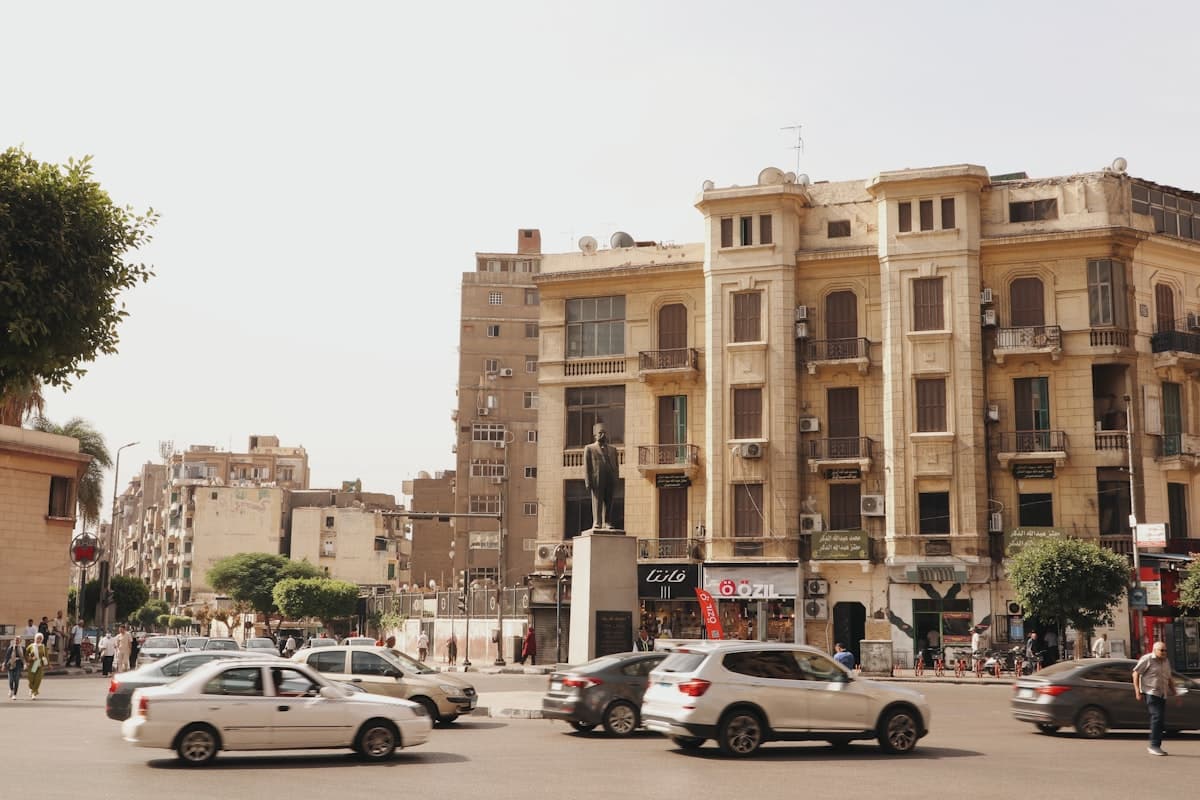
The British occupation of Egypt is routinely framed as a chapter with a clean start and a clean end. The reality is messier and more interesting. Britain did not colonise a blank canvas. It colonised a country that had spent the previous eighty years under Khedival rule, itself a semi-autonomous Ottoman project financed by European debt. When Khedive Ismail began building modern Cairo in the 1860s, he explicitly modelled it on Haussmann's Paris. He wanted boulevards, opera houses, European-style residential districts. He got them, and went so deeply into debt doing so that by 1879 Egypt's finances were under joint Anglo-French control. The British military occupation of 1882 was, in part, the logical end of a financial takeover that had started years earlier.
This matters for understanding what you are looking at when you walk through Garden City or downtown Cairo. The broad avenues, the neo-Islamic facades on European-plan buildings, the administrative quarter near the Nile: these were not imposed on Egypt by Britain. They were already being built by Egyptians and European contractors working for Egyptian rulers. Britain arrived and continued the project, accelerated parts of it, redirected its profits, and added its own institutional layer. Disentangling what is Khedival and what is colonial and what is simply European-influenced is the actual intellectual work of exploring these sites.
One specific consequence worth knowing: the 1906 Dinshaway Incident, in which British officers went pigeon shooting near a village in the Delta and a confrontation led to the hanging of four Egyptian farmers and the flogging of others, is widely credited by Egyptian historians as the moment that crystallised a genuine nationalist movement. The incident produced Mustafa Kamil, produced the first major anti-British press campaign, and is taught in every Egyptian school. There is no monument to it in Cairo's tourist circuit. That absence is itself a fact about whose history gets commemorated.
Garden City and the Architecture of Control
Garden City was designed specifically to house the British Agency, the de facto power center of the occupation, and the senior colonial officials who ran it. Lord Cromer, who governed Egypt as Consul-General from 1883 to 1907 with a level of authority that made the Khedive largely ceremonial, operated from what is now the British Embassy compound on the Corniche. The neighborhood was planned in the early 1900s by an Egyptian developer named Boghos Nubar (son of the Prime Minister) in collaboration with a Belgian engineer, using curved streets specifically designed to be disorienting to anyone unfamiliar with them. Security through confusion, built into the urban plan.
Walking Garden City today, you will find villas in various states of repair, many converted to embassies or NGO offices. The curved streets still work as intended: you will get mildly lost. What most visitors miss is that the neighborhood sits directly on the bank of the Nile at a point where the British chose to construct their most important institutional buildings precisely because the river provided a psychological and physical boundary. The same logic governed where the Pharaohs placed their administrative temples. The Nile as power marker is a constant across four thousand years of Egyptian urban planning.
The Semiramis Hotel, originally opened in 1907 and for decades the social center of British Cairo, still stands at the Garden City Corniche as the Semiramis InterContinental. Its original guest list included Agatha Christie (who set parts of her plotting here), Winston Churchill, and Theodore Roosevelt. The building you see now is a 1980s replacement of the original structure, which is the kind of thing nobody tells you and which makes the visit considerably less interesting. Note it and move on.
Downtown Cairo: The Khedival Layer and What Britain Added
Khedive Ismail's downtown Cairo, the area now called Wust el-Balad, was designed between 1863 and 1879. It was built by Egyptians, financed by European banks, designed by European architects, and inhabited by a mixed population of Egyptian elites, Levantine merchants, and European expatriates. When Britain arrived, it did not need to build a colonial capital because one was already half-built. What it added was the institutional infrastructure of administration: post offices, telegraph offices, barracks, the expansion of the rail network, and the reorientation of the Egyptian economy toward cotton exports that served British textile mills in Lancashire.
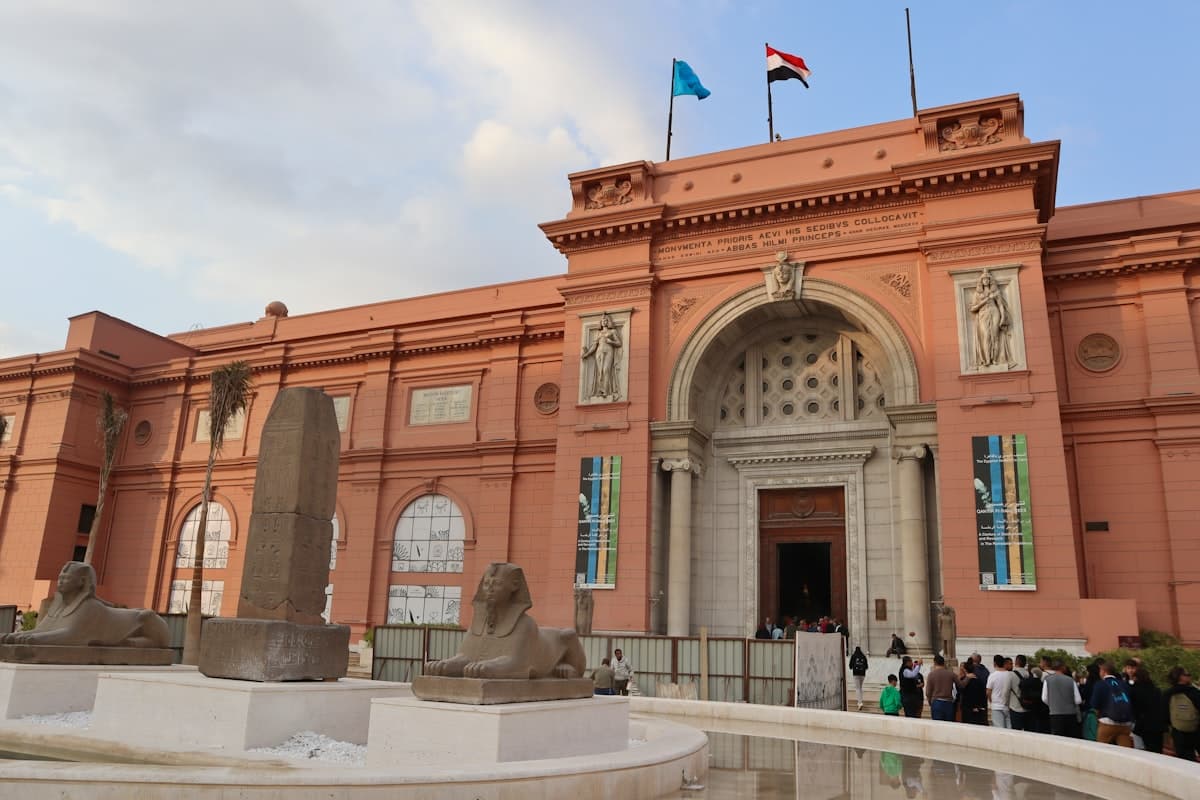
The building that most directly embodies this layering is the Egyptian Museum on Tahrir Square. The current building, a pink neo-classical structure completed in 1902, was designed by the French architect Marcel Dourgnon following an international competition. It was commissioned under Khedive Abbas II, during the British occupation, using European architectural vocabulary, to house Egyptian antiquities that Egyptian and European archaeologists had been excavating in competitive partnership and rivalry. The entire enterprise is a collaboration nobody fully controls and nobody can cleanly claim. There are approximately 170,000 objects in the building. The permanent display holds perhaps 50,000 of them. The rest are in the basement in a storage situation that Egyptian curators have been trying to resolve for forty years.
On Talaat Harb Street, the central artery of Khedival Cairo, look at the upper floors of buildings rather than the ground-floor shops. The bones of a self-consciously European city are visible above the Arabic signage and the street-level commerce. The facade of the old Cicurel department store, which opened in 1909 and was one of the great retail institutions of cosmopolitan Cairo before being nationalised in 1961, is still there. The building now houses a different retailer. The ironwork balconies are original.
Heliopolis: A Company Town Built on Desert
Of all the colonial-era urban projects in Egypt, Heliopolis is the most specific in its ambition and the most undervisited by people following a standard British colonial Egypt history sites guide. It was not actually built by the British. It was built between 1905 and 1910 by a Belgian baron named Édouard Empain, who obtained a 99-year concession from the Egyptian government to build a new city on the desert northeast of Cairo, connected to downtown by a tramline he also built and owned. The entire enterprise was a private real estate speculation disguised as urban planning.
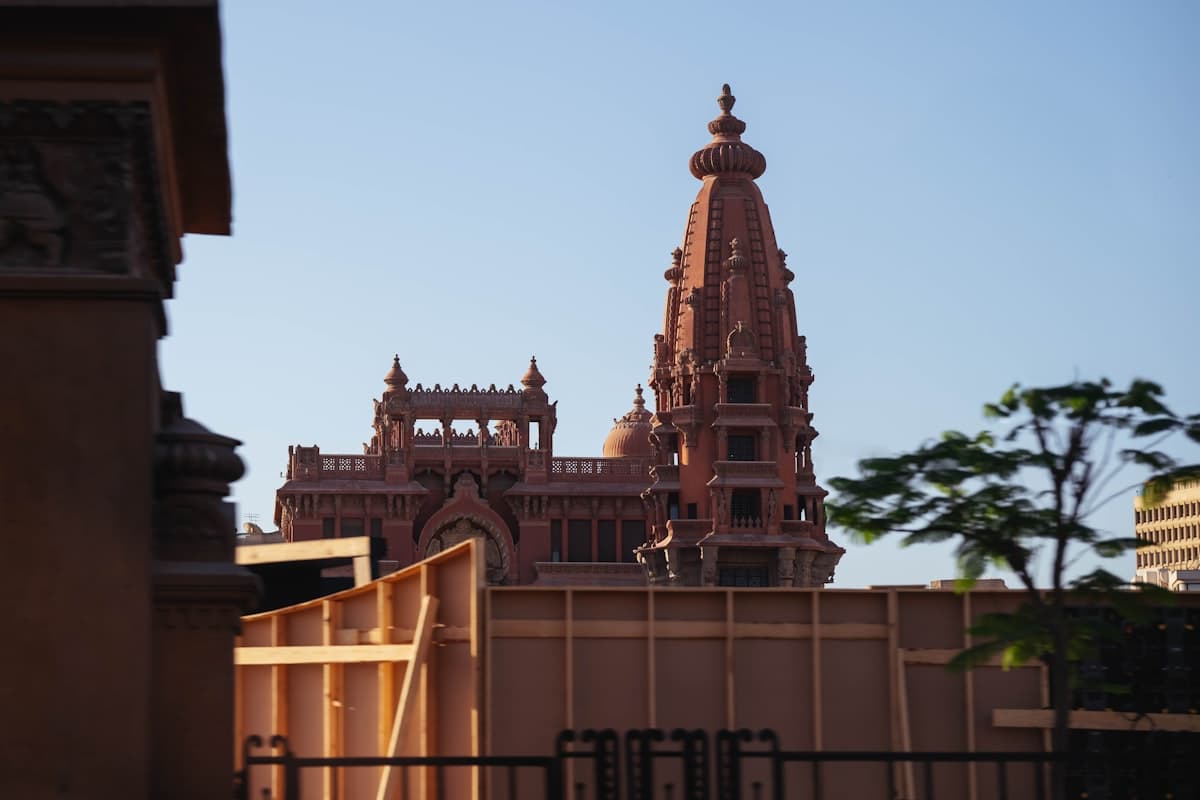
Empain built himself a palace in the district now called Heliopolis that is one of the most improbable structures in Egypt: a Hindu-Baroque fantasy of carved sandstone with elephant heads on the facade, spiral external staircases, and a roofline that suggests a fever dream combining Angkor Wat with a Loire Valley chateau. The Empain Villa, as it is known, has been under restoration for years. You can view the exterior; access to the interior has been intermittent. Check current status before making it a primary destination.
What Heliopolis tells you about the colonial period is that 'British Egypt' was never a monolithic project. Belgian capital, French architecture, Levantine contractors, Egyptian labor, British political oversight: the occupation was a chaotic collaboration of European commercial interests operating under a British military umbrella. The tramlines Empain built eventually connected to a system that became the Metro. His 99-year concession lapsed in 2004 and the Egyptian state reclaimed the infrastructure. The math on that is exact and clarifying.
The Connections
The sites of British colonial Cairo do not make sense in isolation from what came before them, and the before goes deep. The Qasr el-Nil Barracks, where British troops were garrisoned from 1882, stood on the Nile bank where a Mamluk palace had stood, which was itself built on foundations from the Fatimid period. When the barracks were demolished in 1946, the site became Tahrir Square, whose name means Liberation Square, a name given in 1952 after the revolution that ended the monarchy. The liberation the name celebrates is not specifically from Britain; it is from the entire sequence of foreign-influenced rule. On that square sits the Egyptian Museum, built by the French during British rule, containing objects excavated under Ottoman-era concessions granted to European missions.
The Suez Canal, which precipitated the British occupation and whose nationalisation ended it, was designed by a Frenchman (Ferdinand de Lesseps), built using Egyptian corvée labor that killed tens of thousands of workers, financed by French and Egyptian capital, and then purchased in controlling share by the British government in 1875 from a Khedive who needed cash urgently. The British bought the shares not to control Egypt but to control the route to India. Egypt's political fate was an acceptable side effect of a logistics calculation about the British empire's eastern half.
If you visit Ismailia, the canal city built specifically to administer de Lesseps's project, you will find a small but serious museum with original maps and contracts, and an entire neighborhood of early 20th century villas that housed the Suez Canal Company's European employees. The houses still stand. Many are inhabited. The Ismailia Museum charges EGP 80 (approx. $1.60 USD) and receives almost no international visitors. It is two hours from Cairo by road or rail and it is the most direct way to understand the economic mechanism the British were actually defending.
Common Mistakes
Treating 'colonial Cairo' and 'Khedival Cairo' as synonyms. Most of the downtown architecture predates the British occupation. Calling it 'colonial' flattens a more complicated story about Egyptian modernisation that was already underway.
Taking the Nile Corniche walk as a colonial-era experience. The current Corniche road was built in the 1950s and 1960s. It destroyed several blocks of genuinely historic waterfront. What you see along it today is largely post-independence construction.
Paying for the sound and light show at any site while exploring colonial history. There is no sound and light show for colonial Cairo, which is accurate, because the tour operators have not figured out how to make it nostalgic without causing a diplomatic incident. This gap in the entertainment industry is one of the few things about Egyptian tourism worth being grateful for.
The Gezira Sporting Club as a tourist destination. Several travel pieces suggest visiting the Gezira Sporting Club, the institution founded in 1882 for British officers on Zamalek island, as a colonial history experience. It is a members' club. Non-members can access it for day fees (around EGP 250 to 400), but you will see a pleasant sports facility used by Cairo's upper middle class, not a preserved colonial institution. The polo ground is gone. The historical resonance has been thoroughly diluted by a century of Egyptian membership. It is not worth the entry cost for the historical content it now delivers.
Skipping Ismailia in favor of a second day in Cairo. The canal cities, particularly Ismailia and Port Said, are where the economic logic of the occupation is physically present in a way that Cairo's repurposed villas cannot match. Port Said has a substantial neighborhood of colonial-era buildings around the harbor front, a functioning canal, and a museum (EGP 60, approx. $1.20 USD) with original canal company documents. This is more directly connected to the British colonial Egypt history sites story than most of what gets promoted in Cairo.
Not reading the plaques. Cairo's older neighborhoods have Arabic and sometimes bilingual plaques on significant buildings that most foreign visitors cannot read and do not stop to photograph for later translation. A phone camera and Google Translate will convert these into real information. Several Garden City villas have plaques identifying their original British occupants by name and title. This is primary source material sitting on street corners.
Expecting the National Military Museum at the Citadel to cover this period honestly. It covers the 1952 revolution and Egyptian military history through an explicitly nationalist lens, which is its right and its function. What it does not provide is a balanced account of the occupation period. Go, it is worth your EGP 100 (approx. $2 USD), but supplement it with reading rather than treating it as the authoritative colonial history narrative.
Practical Tips
The best single day for exploring colonial-era downtown Cairo is Friday morning, when the business district is quiet and you can stand in the middle of streets that are gridlocked on weekdays. The light is good from 7am to 10am before the haze builds.
Hire a local guide who specializes in architectural history rather than ancient history. Most of Cairo's licensed guides focus on Pharaonic and Islamic sites, and several are excellent. For colonial and Khedival Cairo specifically, look for guides affiliated with the Megawra Built Environment Collective or the Cairo Urban Initiatives Platform, both of which have run public walking tours and have researchers who know this material properly.
Bring water and flat shoes. Garden City's streets are mostly uneven stone and broken concrete. The same applies to older Heliopolis streets.
For accommodation with period character, the Shepheard's Hotel on the Corniche is a post-independence rebuild of the original, which burned in the 1952 Cairo Fire. The name and location are historic; the building is not. The Windsor Hotel near Bab el-Louq, however, occupies a building that genuinely dates to the early 20th century, has kept much of its original interior, and charges mid-range prices (around EGP 800 to 1,200 per night). Its bar, which was the British Officers' Club before the revolution, still has the original fittings. It is not glamorous. It is real.
Frequently Asked Questions
The Weekly Dispatch
More on Egypt, every Friday.
Cultural depth and places most guides never mention.
No spam. Unsubscribe anytime.