British Colonial Egypt: History Sites Guide for Serious Travelers
Britain occupied Egypt for 72 years but never formally colonized it. That legal fiction shaped everything you see. Here is where the evidence still stands.

Quick Facts
- Best time to visit
- October to March. Cairo and Alexandria in summer regularly exceed 35°C, making extended outdoor walking through colonial neighborhoods genuinely exhausting. Spring can be dusty with khamsin winds in March and April.
- Entrance fee
- Most colonial neighborhoods free to walk. Egyptian Museum EGP 450 (approx $9 USD), students EGP 225. Abdeen Palace Museum EGP 100 (approx $2 USD). Alexandria National Museum EGP 120 (approx $2.50 USD).
- Opening hours
- Abdeen Palace Museum daily 9am to 5pm. Alexandria National Museum daily 9am to 4:30pm. Neighborhoods publicly accessible at all hours. Baron Palace exterior always visible, interior access variable.
- How to get there
- Cairo Metro Line 1, Sadat station for downtown and Abdeen. Taxi to Zamalek from Tahrir approximately EGP 40 to 60. Bus from Turgoman to Alexandria approximately EGP 80 to 120. Train from Ramses to Alexandria Misr station EGP 50 to 180 by class.
- Time needed
- Downtown Cairo colonial circuit 3 to 4 hours. Heliopolis separate excursion 2 to 3 hours. Full Alexandria colonial day 6 to 8 hours. Combining all meaningfully requires 3 days minimum.
- Cost range
- Budget EGP 600 to 900 per day including transport and entry fees. Mid-range EGP 1,800 to 3,000 per day including accommodation and restaurants.
Quick Facts
Best time to visit: October through March, when Cairo and Alexandria are cool enough to walk considerable distances between sites. Summer heat above 38°C makes outdoor colonial architecture genuinely punishing.
Entrance fees: Many colonial-era sites are public buildings, streets, or neighborhoods with no admission charge. The Egyptian Museum (where colonial-era collection politics are most visible) costs EGP 450 (approx $9 USD), students EGP 225. The Abdeen Palace Museum costs EGP 100 (approx $2 USD). The Alexandria National Museum, housed in a restored colonial-era Italianate villa, costs EGP 120 (approx $2.50 USD).
Opening hours: Abdeen Palace Museum, daily 9am to 5pm. Alexandria National Museum, daily 9am to 4:30pm. Colonial neighborhoods like Garden City, Zamalek, and Heliopolis are publicly accessible at all hours.
How to get there: Cairo Metro Line 1 stops at Sadat station for downtown colonial architecture and Abdeen. Zamalek is accessible by taxi from Tahrir for roughly EGP 40 to 60. For Alexandria, the Alexandria Desert Road bus from Cairo's Turgoman station runs frequently, cost approximately EGP 80 to 120 one way. Trains from Ramses Station to Alexandria Misr station cost EGP 50 to 180 depending on class.
Time needed: Downtown Cairo colonial circuit, 3 to 4 hours on foot. Heliopolis as a separate excursion, 2 to 3 hours. Alexandria colonial areas, a full day. Combining all sites meaningfully requires at least 3 days.
Cost range: Budget EGP 600 to 900 per day including transport and entry. Mid-range EGP 1,800 to 3,000 per day.
---
Britain occupied Egypt in 1882 after bombarding Alexandria from the sea. It never called Egypt a colony. For 40 years it called Egypt a "veiled protectorate," then from 1914 a protectorate outright, then from 1922 a nominally independent kingdom in which British advisors controlled the army, the treasury, the police, and the Suez Canal. This legal sleight of hand shaped everything: the architecture left behind is not the architecture of a declared empire but of a class of people who believed, and needed others to believe, that they were guests.
The result is stranger and more interesting than conventional colonial architecture anywhere else in Africa. Cairo's Garden City neighborhood, designed in 1905 by the Belgian urban planner José Antonio Boghdadi under British supervision, was built to feel like it had always been there. Its curved streets, which look organic, were in fact deliberately designed to prevent direct rifle fire from any point to any other. This was a neighborhood engineered for riot suppression while appearing to be an English garden suburb. You can still walk those curves today.
Why This Place Matters: 72 Years of Careful Disguise
The standard narrative of British Egypt treats 1882 to 1956 as a parenthesis between the Pharaohs and the Republic. This is wrong in ways that matter if you want to understand contemporary Cairo and Alexandria.
Every major Egyptian institution you encounter was either founded, restructured, or instrumentalized during the British period. The Egyptian Museum, which opened in its current building in 1902, was built specifically to consolidate antiquities that European collectors and expeditions had been removing from the country for a century. The building was designed to impress visiting dignitaries with the depth of Egyptian civilization, while the British Consul-General Evelyn Baring, Lord Cromer, simultaneously made it administratively impossible for Egyptian archaeologists to lead their own excavations until the 1920s. Cromer governed Egypt for 24 years without once learning Arabic.
The Suez Canal, completed in 1869 under Khedive Ismail using French engineering and Egyptian corvée labor (effectively forced labor of Egyptian peasants), was the direct cause of British occupation. When Khedive Ismail's debt to European creditors became unmanageable, Britain and France imposed a Dual Control over Egyptian finances in 1876. The Egyptian army revolted under Colonel Ahmed Urabi in 1882. Britain bombarded Alexandria, landed troops, defeated Urabi at the Battle of Tel el-Kebir in September 1882 in a battle that lasted 35 minutes and cost roughly 2,000 Egyptian lives, and never fully left.
The physical evidence of all of this is scattered across Cairo and Alexandria in ways that most standard tours of Egypt entirely ignore, because selling Pharaonic Egypt is more profitable than explaining the nineteenth and twentieth centuries.
Cairo: Reading the Colonial City
Downtown Cairo, the neighborhood Egyptians call Wust el-Balad, was built between the 1860s and 1930s in a deliberate program to make Cairo look and function like Paris. Khedive Ismail commissioned the Egyptian planner Ali Mubarak and the Haussmann-trained French architect Pierre Grand to lay out broad boulevards, and later British administrators accelerated the project. The result is a grid of neoclassical and Art Deco buildings that most visitors to the Egyptian Museum walk through without registering as planned colonial urbanism.
On Talaat Harb Street, look at the Cicurel department store building, now occupied by Omar Effendi, and the Bank Misr building designed by Antoine Lasciac, the Egyptian state architect from 1907 to 1914. Lasciac was Austrian. His predecessor was French. The point was not to exclude Egyptians from their own capital but to signal to European investors and diplomats that Cairo was a city they could trust, meaning a city that looked like theirs.
Garden City, immediately south of Tahrir Square, repays a slow walk. The British High Commission still occupies one of its largest plots, a physical continuity that most residents find quietly ironic. The curved streets, flanked by early-twentieth-century villas in various states of decay and renovation, were home to the British officials who managed the "veiled protectorate." At the height of occupation in the 1940s, Cairo's Gezira Club on Zamalek Island maintained a formal membership policy that excluded Egyptians from full membership until 1952. The club still exists. Egyptians now run it.
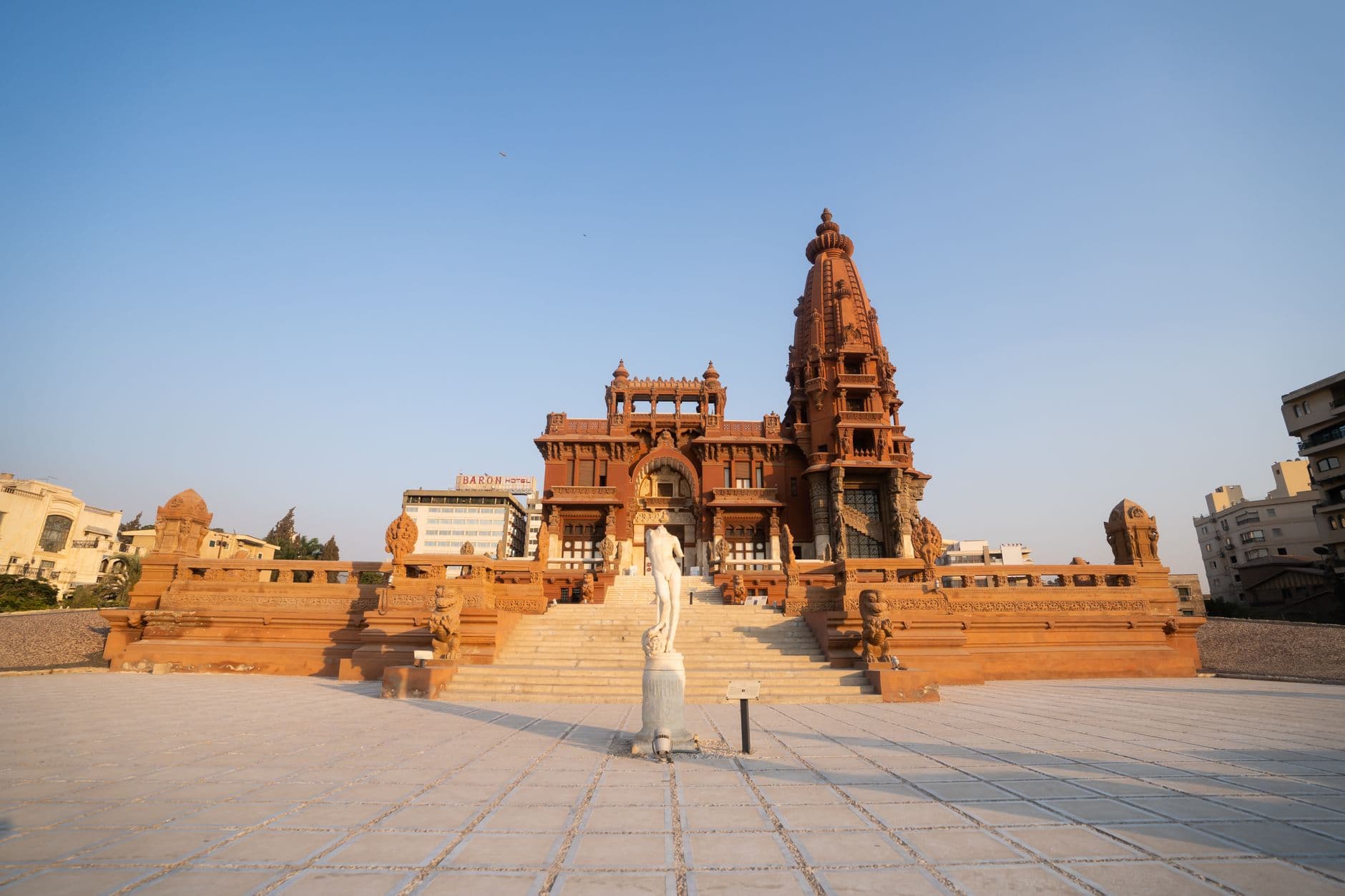
Heliopolis, 15 kilometers northeast of central Cairo, deserves its own visit. Baron Édouard Empain, a Belgian industrialist, built it from nothing beginning in 1907 as a private city for European residents and wealthy Egyptians willing to live European-style. He built it on desert land he purchased for almost nothing and sold back at enormous profit. The centerpiece of his personal estate was a Hindu-inspired palace, now called the Baron Palace, which he built in a deliberate eccentricity that was also a demonstration of the freedom that extraordinary wealth bought in colonial Egypt. The palace has been in various states of renovation since 2019, access is currently limited and irregular, but the exterior is publicly visible. The Basilica of Our Lady of the Sacred Heart in Heliopolis, built in 1925, is modeled directly on the Hagia Sophia in Istanbul, which is itself a historical joke of exactly the sort that colonial Egypt produced constantly: a Catholic church in a Muslim-majority Egyptian suburb, designed to look like the converted cathedral of a Christian empire that had become an Islamic one.
Alexandria: The City That Was Supposed to Be Europe
Alexandria before 1952 had a population that was roughly a third foreign nationals: Greeks, Italians, Jews, British, French, Armenians, Syrians. This was not accidental. The Capitulations, a series of legal agreements dating to Ottoman times that the British maintained and expanded, meant that foreign nationals in Egypt were exempt from Egyptian law and taxed at preferential rates. Alexandria became the city where European commercial capital was safest, which is why its architecture is almost comprehensively European in style even when built by Egyptian contractors using Egyptian materials.
The Cecil Hotel on Corniche el-Nil, opened in 1929, was the social center of British Alexandria. Winston Churchill stayed there. Wartime intelligence operations were coordinated from its rooms when Alexandria served as a critical Allied base during the North Africa campaign. The hotel is now a Sofitel property. It has been renovated to the point where its specific atmosphere of prewar cosmopolitanism has been largely replaced by standard luxury hotel neutrality, and the EGP 350 to 450 drinks at its bar are not worth it.
The more honest version of colonial Alexandria lives in the neighborhoods of Smouha, Sporting, and Ibrahimiya, where the villas of the European merchant class survive in various conditions. Walk Fouad Street in the city center and look at the upper floors of the buildings. The ground floors have been refaced and rebranded repeatedly. The upper floors, which cost too much to renovate, often retain their original ironwork, tile patterns, and cornicing from the 1880s to 1930s.
The Graeco-Roman Museum, when open (it has been under renovation for years and currently remains partially accessible), contains material that directly illuminates Alexandria's 2,000-year history of cosmopolitan layering that the British occupation was, in some ways, merely the latest version of.
The Connections: Nothing in Egypt Stands Alone
The British did not arrive in an empty country. They arrived in a country that had been a Roman province, a Byzantine diocese, an Arab caliphate, a Fatimid seat of empire, a Mamluk sultanate, and an Ottoman province before Khedive Ismail's modernization program created the financial conditions for their occupation.
This layering is physically visible. The road pattern of Islamic Cairo, the medieval city north of Saladin's Citadel, follows lines established by the Fatimid city of al-Qahira founded in 969 CE, which itself followed Roman and earlier Coptic settlement patterns. When British administrators built the new Qasr el-Nil bridge across the Nile in 1872 (replacing the original 1851 structure in 1933), they were crossing a river whose crossings had been controlled and contested by every power that had ever held Egypt.
The Egyptian Museum's founding collection was assembled partly by Auguste Mariette, the French archaeologist who convinced Khedive Said to establish a national antiquities service in 1858 specifically to prevent continued looting by European collectors, including Mariette's own earlier work. The irony is characteristic of the period. Mariette simultaneously protected Egyptian antiquities from random removal and centralized control of them under French and then joint European academic authority.
The Suez Canal Zone, where British troops remained stationed under treaty until 1956, saw the last military confrontation of the colonial period. In January 1952, British forces killed 43 Egyptian auxiliary police in Ismailia who refused to surrender their weapons. The following day, January 26, 1952, crowds in Cairo burned 700 buildings associated with British and European presence in what Egyptians call Black Saturday. The Shepheard's Hotel, then the most famous colonial hotel in Africa, was burned to the ground. The current Shepheard's Hotel on the Corniche is a different building on a different site. The original location on Gomhuriya Street is now an unremarkable block of offices.
Common Mistakes
Treating colonial history as a separate itinerary. The most common mistake is trying to visit "colonial sites" as a category separate from everything else. The Baron Palace is next to a Byzantine-era church site. Garden City is five minutes from the Coptic Museum. The Egyptian Museum contains colonial-era acquisition politics in every label. Move between periods constantly.
Skipping downtown Cairo for Zamalek. Zamalek has been written about more because it is where expats and journalists live and therefore easier to romanticize. The more structurally significant colonial urbanism is in downtown Cairo, Wust el-Balad, where the planned streets and institutional buildings are denser and more legible as a system.
Paying for a guided tour of Garden City. Several operators offer walking tours of Garden City at EGP 600 to 900 per person. The neighborhood is publicly accessible, well-mapped, and comprehensible with basic reading beforehand. Save the money.
The Cecil Hotel bar in Alexandria. Already noted above. EGP 400 for a drink in a room that has been so thoroughly renovated it no longer contains the atmosphere you are paying for. The rooftop of a building two blocks away, at any local café, will give you the actual Alexandria light that the Cecil traded on.
Assuming the Alexandria sites are easy to find. Google Maps is unreliable for specific building identification in Alexandria's older neighborhoods. Download an offline map, note addresses in Arabic script, and budget more time than you think for navigation.
Visiting the Baron Palace without checking its access status. The palace has been under intermittent renovation and public access has changed repeatedly. Check recent reports before building a trip around it. The exterior is always visible from the street, but interior access is not guaranteed.
Expecting English-language interpretation at colonial sites. The Alexandria National Museum has Arabic-primary signage. Abdeen Palace's colonial-era sections are not well labeled in any language. Do the reading before you arrive, not as you stand in front of things.
Practical Tips
The best single day for understanding British colonial Egypt in Cairo combines a morning at the Egyptian Museum (focusing specifically on the institution itself and its colonial-era organization, not just the objects), a walk through downtown to Talaat Harb Square, south to Garden City, and across to the Corniche. This is roughly 5 kilometers on foot and takes 4 to 5 hours with time to stop.
For Alexandria, take the early morning train from Ramses Station (first departure around 6am, cost EGP 80 to 180 depending on class). This gets you into Alexandria before the heat builds and before tour groups arrive at the central sites. Start at the Corniche, walk west, and work inland through the old European quarter streets in the afternoon when light hits the building facades from the west.
Wear walking shoes with genuine support. The pavements in both cities are uneven in ways that will punish anything less. Carry water. The tap water in both cities is technically treated but tastes heavily of chlorine. Bottled water costs EGP 10 to 20 in shops, triple that from hotel minibars.
The most useful preparation is reading Khaled Fahmy's work on nineteenth-century Cairo, Magda Baraka's study of the Alexandria cosmopolitan community before 1952, and Robert Ilbert's Alexandria 1830 to 1930. None of these are travel books. All of them will make the physical places make sense in ways that no tour guide commentary will approach.
Frequently Asked Questions
The Weekly Dispatch
More on Egypt, every Friday.
Cultural depth and places most guides never mention.
No spam. Unsubscribe anytime.