British Colonial Egypt: History Sites, Stories & What Survives
Britain occupied Egypt for 72 years but never formally called it a colony. The architecture, courts, and cotton economy they left behind are hiding in plain sight across Cairo.

Quick Facts
- Best time to visit
- October through March. Cairo temperatures are 15 to 25 degrees Celsius, making long walks between sites comfortable. Summer heat above 38 degrees makes street-level exploration of this kind genuinely difficult.
- Entrance fee
- Most sites are public streets and facades, free. Egyptian Museum EGP 450 (approx $9 USD). Abdeen Palace Museum EGP 100 (approx $2 USD). Manial Palace EGP 200 (approx $4 USD). Empain Palace cultural center EGP 50 to 80 when open.
- Opening hours
- Downtown streets accessible at all hours. Egyptian Museum daily 9am to 5pm. Abdeen Palace Saturday to Thursday 9am to 3pm. Manial Palace daily 9am to 4pm. Empain Palace hours vary, confirm in advance.
- How to get there
- Metro Line 1 or 2 to Sadat Station for Tahrir Square and Downtown. Metro Line 3 to Merghany for Heliopolis. Taxis from central Cairo to Garden City cost EGP 30 to 50. Uber and Careem are available throughout the city at EGP 40 to 80 per short journey.
- Time needed
- Full day for Downtown Cairo and Garden City on foot. Add a separate half-day for Heliopolis. Two days total for a thorough British colonial history sites itinerary.
- Cost range
- Budget EGP 600 to 900 per day including transport and admissions. Mid-range EGP 1,500 to 2,500 per day with a private specialist guide.
Quick Facts
Best time to visit: October through March, when Cairo is cool enough to walk between sites without losing half a day to heat. The colonial-era buildings are concentrated in Downtown Cairo, a walkable district.
Entrance fees: Most colonial-era sites are streets and facades, free to observe. The Egyptian Museum (which houses artifacts from the colonial excavation era) costs EGP 450 (approx. $9 USD). The Abdeen Palace Museum costs EGP 100 (approx. $2 USD). The Manial Palace on Rhoda Island costs EGP 200 (approx. $4 USD).
Opening hours: Downtown Cairo streets are accessible at all hours. Egyptian Museum daily 9am to 5pm. Abdeen Palace Museum Saturday through Thursday 9am to 3pm, closed Friday. Manial Palace daily 9am to 4pm.
How to get there: The Cairo Metro Line 2 stops at Sadat Station, which puts you at Tahrir Square and the Egyptian Museum. A taxi from Zamalek to Downtown runs EGP 40 to 60. Ride-hailing apps (Uber, Careem) are reliable and cost EGP 50 to 80 from most central hotels.
Time needed: A serious walk through the British colonial history sites of Downtown Cairo takes a full day. Add half a day for Heliopolis, which requires a separate trip northeast of the city.
Cost range: Budget EGP 600 to 900 per day including transport and entry fees. Mid-range EGP 1,500 to 2,500 per day with a guide.
---
Why This Matters More Than You Were Told
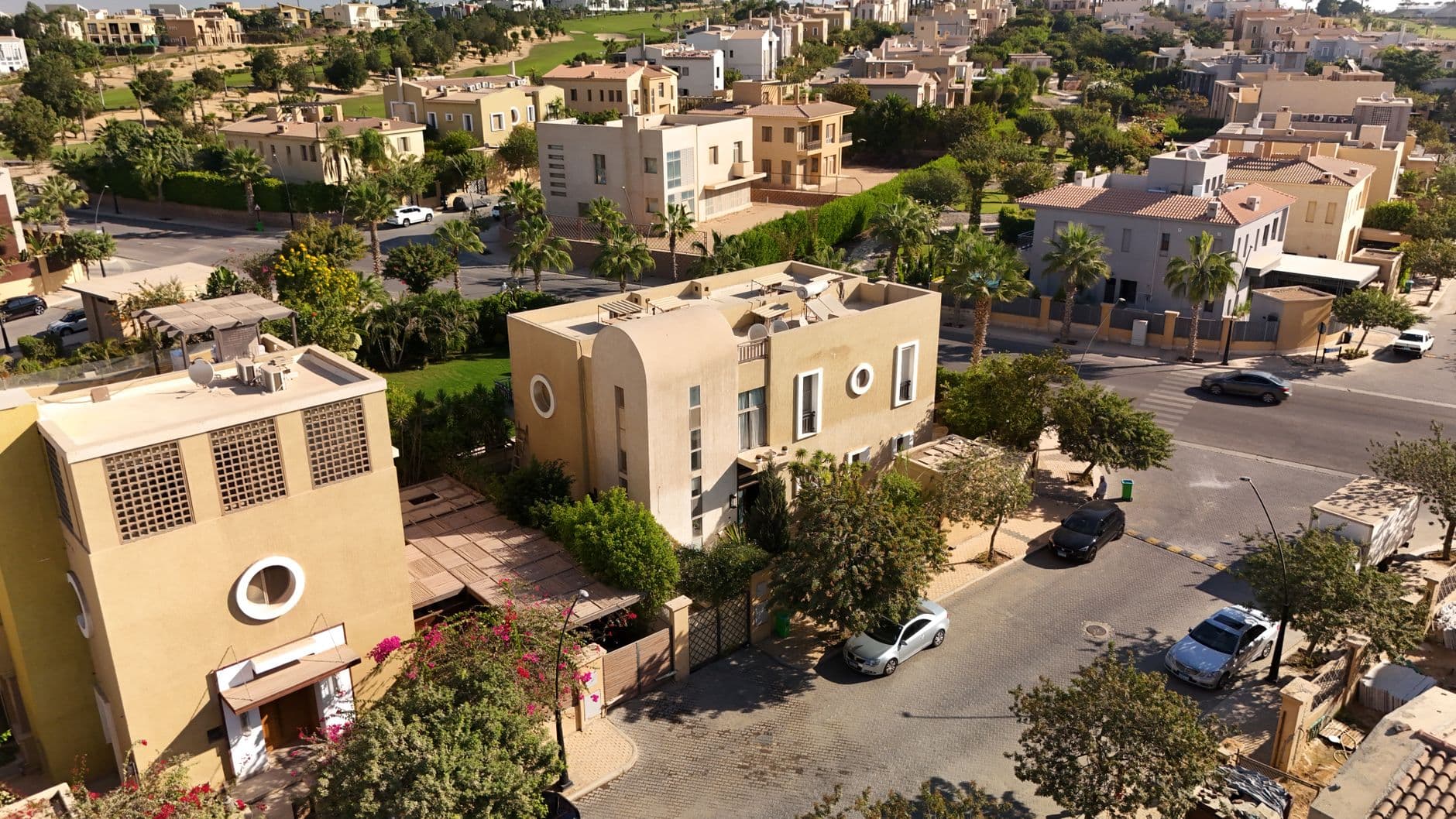
Britain occupied Egypt in 1882 and did not leave until 1956, seventy-four years during which it never formally incorporated Egypt as a colony. Egypt remained, on paper, a province of the Ottoman Empire until 1914, then a protectorate, then a nominally independent kingdom after 1922. The word colony was never used. This legal fiction mattered enormously to how the British behaved here, and it explains why the physical traces of their presence are so different from what you find in India or West Africa.
They did not build administrative capitals in their own image. They built a financial system, a cotton infrastructure, and an officer class. Then they built themselves neighborhoods and clubs and racecourses, and left the formal monuments to the Khedives whose authority they were quietly hollowing out.
The result is a colonial history that is not announced. You will not find a sign on the Qasr al-Nil barracks explaining that this is where British troops were garrisoned for decades. You will not find a plaque on the former British Residency on Garden City's Sharia Latin America explaining that Lord Cromer governed Egypt from there for twenty-four years without a single democratic mandate. What you find instead are buildings whose style is slightly off, whose proportions suggest a particular moment when European capital met Egyptian labor and Egyptian land.
This guide covers the British Egypt colonial history sites that actually reward attention, and is honest about which ones do not.
---
Downtown Cairo: The Planned City Nobody Planned to Build
Khedive Ismail wanted to make Cairo the Paris of Africa. Between 1863 and 1879 he brought in European architects, drained the swamps between the old city and the Nile, and built the grid of wide boulevards now called Downtown Cairo or Wust el-Balad. He went bankrupt doing it. His bankruptcy is precisely what gave Britain the leverage to occupy Egypt in the first place: when Ismail could not service his European debts, Britain and France installed a Dual Control over Egyptian finances in 1876, a financial occupation that preceded the military one by six years.
So the city the British used as their operational base was itself a monument to the debt trap that created their opportunity. Walk down Talaat Harb Street and you are walking a French-designed boulevard built on Khedival debt that became British leverage. The Cafe Riche at number 17, opened in 1908, was where Egyptian nationalist journalists met while British officers drank at the Savoy Hotel two blocks away. Both buildings still stand.
The most important colonial-era building in Downtown is the one most people photograph without knowing what it was. The large neoclassical building on the northwest corner of Tahrir Square, now used by various government ministries, was the original Qasr al-Nil barracks, home to the British garrison that occupied Cairo continuously from 1882. The current structure replaced the original in 1937, but it stands on the exact ground where the British military presence in Cairo was anchored for fifty years. The famous Qasr al-Nil Bridge beside it was built in 1933 by the Dorman Long company, the same British firm that built the Sydney Harbour Bridge the same year.
The Cotton Connection
The British were in Egypt for cotton. This is the fact that reframes every other fact. Lancashire textile mills had been dependent on American cotton until the US Civil War (1861 to 1865) interrupted supply, and Egyptian long-staple cotton filled the gap so profitably that British financial interest in Egypt became structural. By 1882, when General Wolseley landed troops at Alexandria, roughly £50 million in British capital was invested in Egyptian bonds and the Suez Canal. The occupation was, at its core, a debt collection operation.
You can trace this history at the former Bourse building on Sharia Sherif, where cotton futures were traded under British-supervised financial rules. The building is now occupied by the Egyptian Stock Exchange and is not generally open to tourists, but the exterior Beaux-Arts facade from 1903 is visible from the street and worth five minutes of your time.
---
Garden City and the Invisible Empire
If Downtown was where Egyptian professional and commercial life happened under British watch, Garden City was where the British lived. Planned between 1905 and 1907 by a company called the Egyptian Delta Land and Investment Company, it was designed in curving, deliberately disorienting streets that broke from the grid, meant to feel like an English garden suburb dropped onto the Nile's east bank.
The British Residency, which Lord Cromer used as his base of operations from 1883 to 1907, stood on what is now the grounds of the British Embassy on Sharia Ahmad Ragheb. Cromer was arguably the most powerful unelected governor in the world during those years: he controlled Egypt's budget, its army, its cabinet appointments, and its foreign policy, while technically holding the title of Consul-General, a rank that sounds like a mid-level diplomat. He wrote a two-volume memoir called Modern Egypt (1908) in which he describes Egyptians as constitutionally unready for self-governance. The book was a bestseller in London.
The current British Embassy building replaced the original Residency and is not open to the public, but the street outside it and the general layout of Garden City, with its curved roads and tall old trees, survives as the physical footprint of that arrangement. Walk it in the early morning before the traffic thickens and the scale of the neighborhood, larger and greener than anything built for Egyptians in the same period, tells its own story.
What Lord Cromer Actually Did
Cromer cut the Egyptian national education budget in order to repay European creditors faster. Under his financial management, literacy rates in Egypt fell between 1882 and 1907. He also abolished a progressive income tax introduced by earlier Egyptian reformers and replaced it with a system that taxed peasant agriculture while exempting financial instruments. These are not the acts of a modernizer. They are the acts of a creditor protecting his principal. The Dinshaway Incident of 1906, in which British officers were involved in a fracas with villagers during a pigeon-hunting excursion and the British military tribunal sentenced four Egyptians to hanging and others to flogging, ended Cromer's career when it was reported in the British press. He retired to England the following year and wrote his memoirs.
---
Heliopolis: The Company Town That Became a City
Twelve kilometers northeast of Downtown Cairo, the suburb of Heliopolis is one of the most complete examples of colonial urban planning surviving anywhere in the world, and almost no tourist visits it as part of a British Egypt colonial history sites itinerary. This is a mistake worth correcting.
Heliopolis was not built by the British government. It was built by Baron Édouard Empain, a Belgian industrialist, beginning in 1905. Empain built his own tramway (at his own expense) connecting Heliopolis to Cairo, sold land at premium prices to European and upper-class Egyptian families, and in the process created a city of 40,000 within fifteen years. His own palace, a Hindu-Moorish fantasy with a spiral exterior ramp for horses, still stands on Sharia Ibrahim Laqani and now operates as a cultural center with limited public access.
The colonial atmosphere of Heliopolis is different from Downtown's. It is self-consciously residential and prosperous, its wide avenues lined with arcaded buildings in a hybrid style that mixes Moorish arches with European proportions. The Basilica of Heliopolis, a Byzantine-inspired Catholic church completed in 1913, stands at the center of the original grid and is freely visitable. The former Heliopolis Palace Hotel, built in 1910, is now the Presidential Palace and visible only from outside its gates, but its scale, a building with over five hundred rooms designed to draw European tourists, tells you what Empain thought Egypt's future looked like.
The tramway Empain built is gone, replaced by a metro line. The route his trams ran is now Line 3.
---
The Connections: Layers Underneath the Layers
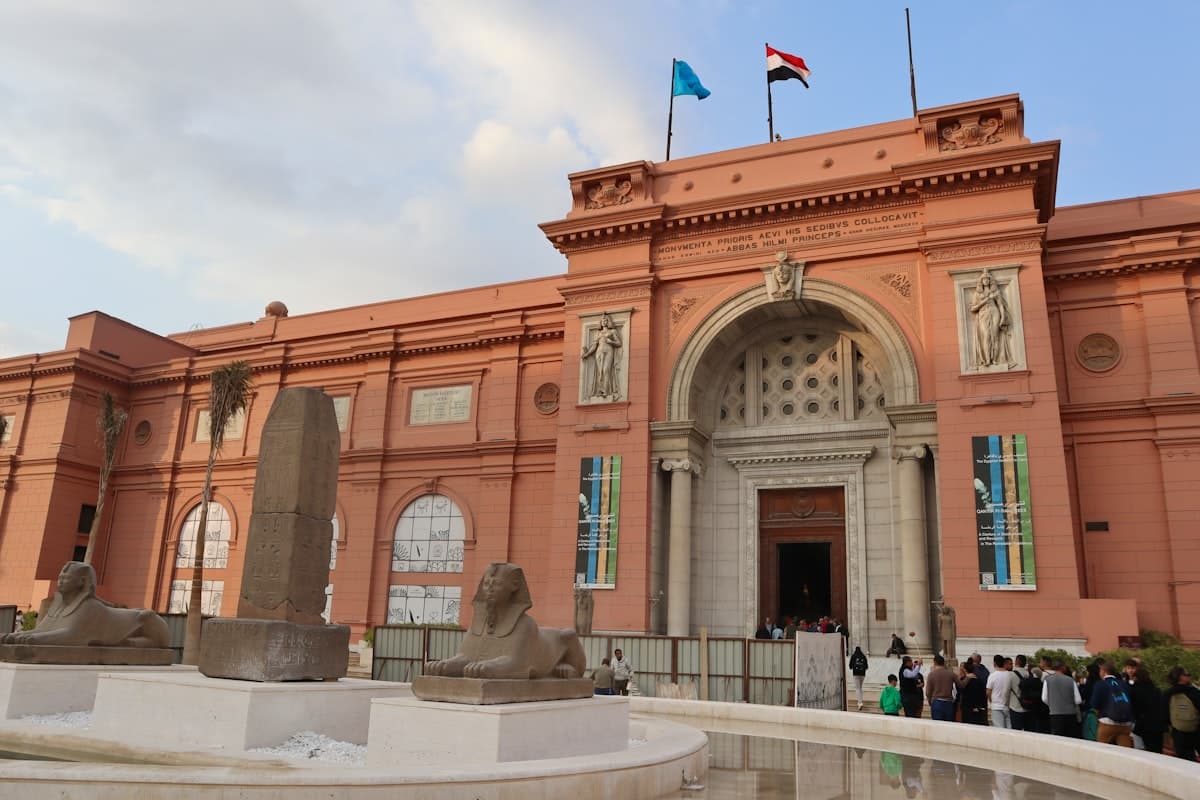
The Egyptian Museum on Tahrir Square, designed by French architect Marcel Dourgnon and opened in 1902, is a British-era institution in everything but name. The Antiquities Service that filled it was run by French Egyptologists under British financial supervision. The excavation permits that produced most of its pre-Twentieth Dynasty collection were issued under the Comité de Conservation des Monuments de l'Art Arabe, a body established in 1881, one year before the occupation, that gave European scholars institutional control over what could be excavated, what could be exported, and what would be studied. Howard Carter, who found Tutankhamun's tomb in 1922, had his career shaped entirely by this system: he started as an artist for the Egypt Exploration Fund, a British organization, before moving into the Antiquities Service under Gaston Maspero.
The tomb of Tutankhamun was found during the occupation, its contents claimed for the Egyptian state only because Egyptian nationalist pressure had been growing since 1919. Had it been found in 1890, the objects would have been split between Cairo and a European museum under the partage system then in force. The revolution of 1952 and Nasser's nationalization policies finally ended European control of the Antiquities Service in 1953.
The Coptic Museum in Old Cairo, though it covers a far earlier period, was also founded in the colonial era, by Marcus Simaika Pasha in 1908, partly as a deliberate act of Egyptian cultural self-assertion against the European assumption that only Pharaonic and Islamic heritage mattered.
---
Common Mistakes
Expecting visible monuments. British colonial history in Egypt does not announce itself with statues and plaques. It lives in street grids, building facades, and institutional names. If you come looking for a colonial monument in the way you might find one in Delhi, you will miss everything.
Visiting the Egyptian Museum without knowing its acquisition history. The museum is extraordinary, but the story of how its collection was assembled, through a permit system controlled by Europeans during the occupation, is part of what you are looking at. The context changes what the objects mean.
Taking a group tour for this subject. Standard Cairo tours do not cover colonial history as a theme. You will end up at the Pyramids. Hire a specialist guide, or use this article and walk Downtown yourself.
Spending money on the sound and light show at any Pharaonic site. The sound and light show at the Pyramids costs EGP 350 and tells you nothing a single good book could not tell you in thirty minutes. It has no connection to the colonial history theme and is not worth the detour.
Skipping Heliopolis. It requires effort (a metro ride on Line 3 to Merghany Station, then a walk or short taxi) but it is the most intact colonial-era urban environment in Egypt. Downtown Cairo has been densified and altered. Heliopolis still reads as it was designed.
Assuming the colonial period was only about Europeans. The class of Egyptian landowners, financiers, and professionals who collaborated with and sometimes profited from British presence left their own buildings and institutions across Cairo. The Egyptian millionaire Talaat Harb founded Bank Misr in 1920 explicitly as a counter to British financial dominance. His statue stands in the square named after him in Downtown. He is the more interesting figure.
Visiting Abdeen Palace without reading about its history first. The palace is fine but the guided tour covers the furniture collection, not the colonial history. Abbas Hilmi II, the Khedive deposed by the British in 1914, held court here. The British replaced him with his uncle because he was too friendly with Ottoman Turkey. Without that context, you are looking at expensive chairs.
---
Practical Tips
Wear comfortable shoes. The colonial-era Downtown district is best understood on foot, and the distances between sites are walkable but cumulative. A morning walk from Tahrir Square to the Bourse building, through Garden City, and back covers roughly five kilometers.
The best time to walk Downtown is between 7am and 10am, before the traffic and street vendors thicken. The light on the limestone facades at that hour is also worth arriving early for.
For Heliopolis, go on a weekday. The Empain Palace cultural center has irregular hours: confirm by calling ahead or checking the Egyptian Ministry of Culture website before visiting.
Carry cash. Most colonial-era sites that charge admission do not reliably accept cards. EGP 500 in small bills is enough for a full day.
If you want a specialist guide for this subject, ask your hotel to connect you with a licensed Egyptologist who covers the modern period, not only Pharaonic sites. The Egyptian Guides Syndicate registers guides by specialty. A private English-speaking guide costs EGP 800 to 1,500 for a half-day.
The British Council in Cairo on Sharia Qasr al-Aini occasionally runs events on colonial-era history and architecture. Their calendar is worth checking before your trip.
Frequently Asked Questions
The Weekly Dispatch
More on Egypt, every Friday.
Cultural depth and places most guides never mention.
No spam. Unsubscribe anytime.