British Colonial Egypt: The History Sites Guide You Actually Need
Britain occupied Egypt for 72 years but never formally colonised it. The legal fiction they invented to justify this is written in the stones of Cairo right now.

Audio Guide: British Colonial Egypt: The History Sites Guide You Actually Need
Quick Facts
- Best time to visit
- October to March for comfortable walking temperatures in Cairo and Alexandria. Downtown Cairo is best explored on Friday mornings when traffic is minimal.
- Entrance fee
- Abdeen Palace Museum: EGP 200 (approx $4 USD). Manial Palace Museum: EGP 200 (approx $4 USD). Montaza Palace Gardens Alexandria: EGP 60 (approx $1.20 USD). Many colonial-era buildings observable free from exterior.
- Opening hours
- Abdeen Palace Museum: Tuesday to Sunday 9am to 5pm. Manial Palace: Daily 9am to 5pm. Downtown Cairo walking routes: accessible at all hours, best 7am to 10am.
- How to get there
- Cairo Metro Line 2 to Opera station for Abdeen area (EGP 8 per ride). Cairo to Alexandria by first-class train from Ramses Station: EGP 160 to 200 approx, 2.5 hours. Alexandria tram network covers corniche and central sites: EGP 4 to 7 per ride.
- Time needed
- Minimum 2 full days for Cairo colonial sites done seriously. Add 1 full day for Alexandria. 3 to 4 days total for comprehensive coverage.
- Cost range
- Budget EGP 600 to 1,000 per day. Mid-range with specialist guide and transport EGP 1,800 to 3,000 per day.
Britain occupied Egypt for 72 years and never once called it a colony. Not officially. The legal framework they constructed, which classified Egypt as a "veiled protectorate" from 1882 and a formal protectorate only from 1914, was designed to extract the benefits of imperial control while avoiding the administrative inconvenience of ownership. Lord Cromer, who ran Egypt from 1883 to 1907, governed twenty-five million people without ever holding a formal government title. He was officially the British Agent and Consul-General. This distinction, and what it cost Egypt to maintain it, is written into the fabric of Cairo, Alexandria, and the Nile Valley in ways that most visitors walk directly past.
This is not a guide to monuments from the Pharaonic era. This is a guide to the other Egypt: the one built between roughly 1860 and 1952, during the Khedival and British periods that reshaped the country's cities, economy, legal system, and sense of itself. Some of these sites are now government ministries. Some are derelict villas in Alexandria. Some are still functioning in ways their original occupants would find either satisfying or horrifying, depending on your politics.
Quick Facts
Best time to visit: October through March for the main Cairo and Alexandria sites. The heat of summer makes outdoor architecture less pleasant, but most of these are urban buildings you are reading from the outside or walking through as functioning institutions.
Entrance fees: The Abdeen Palace Museum costs EGP 200 (approx $4 USD). The Manial Palace Museum costs EGP 200 (approx $4 USD). The Egyptian National Archives, for those seeking documented colonial-era records, requires a researcher's letter but has no entrance fee. Many colonial-era buildings are free to observe from the outside, as they are still in use as government offices, banks, or hotels.
Opening hours: Abdeen Palace Museum: Tuesday to Sunday, 9am to 5pm. Manial Palace: Daily 9am to 5pm. The Gezira Club, founded in 1882 by British officers, still operates as a private sports club. Day passes for non-members are occasionally available through the hotel concierge circuit.
How to get there: Cairo is the base for most of these sites. The Metro Line 2 stops at Abdeen (Opera station, then 10-minute walk). Alexandria is a 2.5-hour train journey from Ramses Station; first-class tickets cost approximately EGP 160 (approx $3.20 USD). In Alexandria, the tram network, itself a colonial-era infrastructure project, still runs through the sites you want.
Time needed: Cairo colonial sites alone require two full days if done seriously. Adding Alexandria requires an additional day, ideally overnight.
Cost range: Budget EGP 600 to 1,000 per day. Mid-range EGP 1,800 to 3,000 per day including a guide and transport.
Why These Sites Matter
The British colonial period in Egypt is usually framed as a story about the Suez Canal, which is fair, since it was largely the debt crisis caused by Khedive Ismail's canal-building ambitions that gave Britain its opening. In 1875, Britain purchased 44 percent of the Suez Canal Company's shares from a broke Egyptian government for 4 million pounds, a transaction arranged personally by Prime Minister Disraeli using a loan from the Rothschild bank because Parliament was not in session to approve public funds. Seven years later, British warships were bombarding Alexandria.
What followed was a systematic reorganisation of Egypt's finances, legal system, military, and infrastructure to serve British strategic and economic interests while maintaining the fiction of Egyptian sovereignty under the Khedive. This produced something unusual in imperial history: an entire country remade in the image of colonialism without the formal designation of a colony. The buildings that survive from this period, from the grand Italianate ministries of downtown Cairo to the decaying seafront villas of Alexandria's Stanley and Gleem districts, are the physical residue of that arrangement.
The reason this matters to a traveler is not guilt tourism. It is that these layers of history are inseparable from the Egypt you are visiting today. The system of land tenure that the British rationalised in the 1890s shaped the agricultural economy that Nasser dismantled in the 1952 revolution. The courts the British built in downtown Cairo are still functioning courts. The Gezira Island, which the British reserved as a private residential and recreational space for expatriates, is now one of Cairo's most densely populated districts. None of this is ancient. All of it is present.
Downtown Cairo: The Architecture of Administered Power
Khedive Ismail imagined Cairo as a Paris on the Nile, and he began reshaping it in the 1860s before the British arrived. But the grid of streets between Tahrir Square and Ramses, now known as Khedival Cairo or Downtown Cairo, was completed and institutionalised under British direction. Walk along Qasr el-Nil Street or Sherif Street on a weekday morning and you are inside the spatial logic of an administered capital: wide enough for troop movement, formal enough to signal civilisational order, laid out to separate the European quarter from the older Islamic city to the east.
The landmark you want here is the former Barclays Bank building on Qasr el-Nil, now a branch of the National Bank of Egypt. Built in the early twentieth century in the heavy neoclassical style the British used across their empire, from Bombay to Nairobi to here, it has the load-bearing visual grammar of permanence: we are not leaving. The Sednaoui department store building, slightly north, was opened in 1913 by Syrian Christian merchants who built their fortunes inside the British-administered free trade economy. The cosmopolitan commercial culture of this period was real. It was also conditional on an occupation.
The Abdeen Palace, completed in 1874, functions as the best single site for understanding the Khedival and British periods together. The palace museum contains the gifts given to Egyptian rulers across the nineteenth and twentieth centuries, including weapons collections, silver services, and the kind of diplomatic objects that measure the politics of the moment. More telling than the objects is the building itself: the scale at which it was built, and the speed at which it became a stage set for a sovereignty that had largely been handed to others to manage.
What Most Visitors Walk Past
On Emad El-Din Street, which runs north from Downtown Cairo toward Ramses, you will find what remains of Cairo's colonial-era theatre district. The Printania Theatre, built in 1921, is now a cinema and event space. The Cairo Opera House of the Khedival period, which stood at Opera Square (now Tahrir Square) until it burned in 1971, is gone, but the square itself still holds its original spatial relationship to the surrounding ministries. Stand at the southern edge of Tahrir and look at the Egyptian Museum building: it was completed in 1902 and designed by the French architect Marcel Dourgnon, who won the commission through an international competition. The British were running Egypt at the time. They chose a Frenchman to house the Pharaonic heritage. That particular irony was entirely intentional, a way of signaling cultural neutrality while maintaining economic and military control.
Alexandria: Where the Occupation Was Most Visible
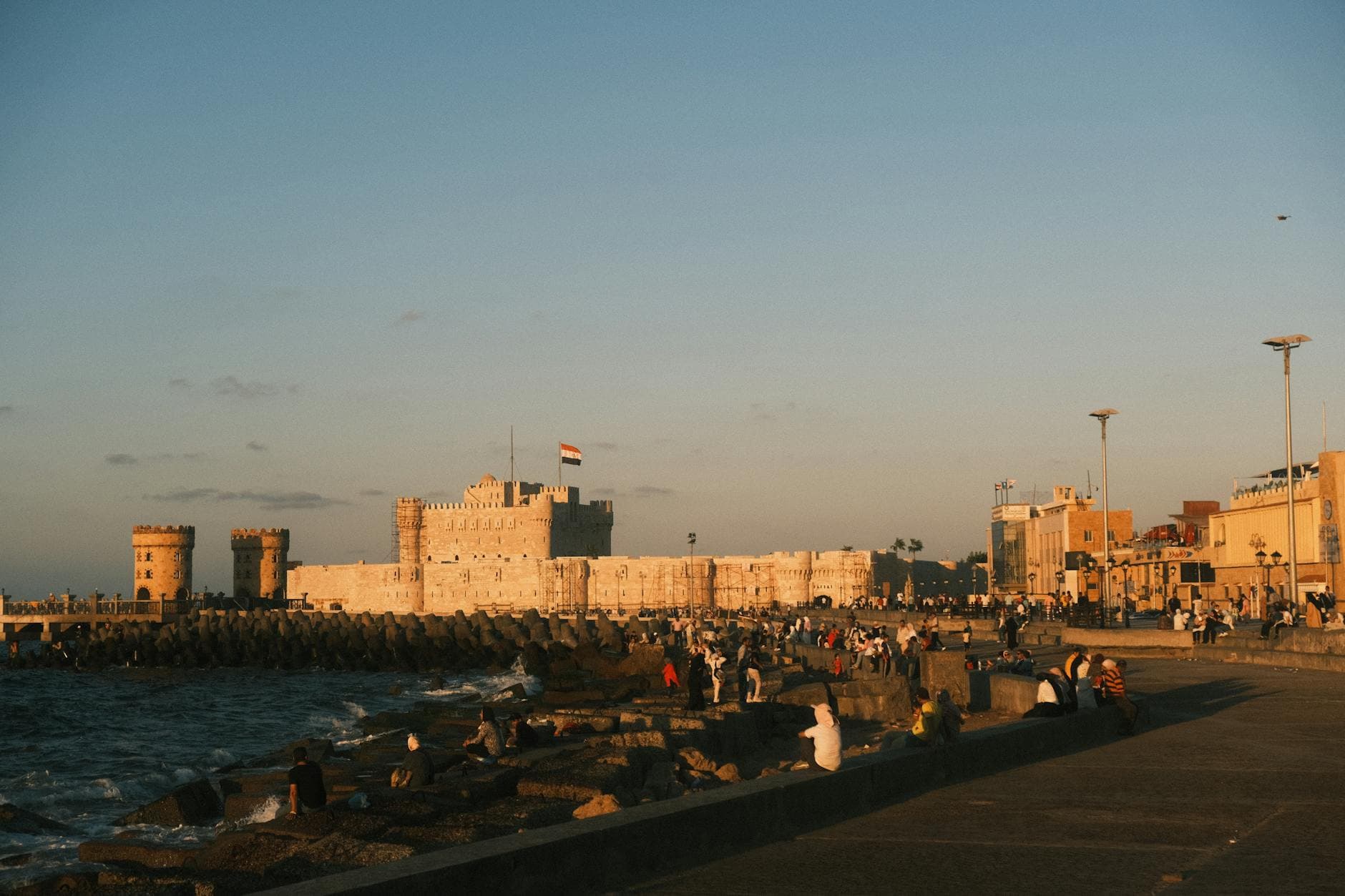
Alexandria was where British military force first landed, and it is where the colonial imprint is most physically legible. On July 11, 1882, the British Mediterranean Fleet under Admiral Beauchamp Seymour bombarded the city for ten and a half hours in response to what the British characterized as a threat to European residents. The bombardment killed several hundred people and destroyed a significant portion of the city. The rebuilding that followed produced the Alexandria you can still see: wide Haussmann-influenced boulevards, a monumental corniche, the grid of the central city.
The site of Fort Qaitbey, the fifteenth-century Mamluk fortress built on the foundations of the ancient Pharos of Alexandria, was occupied by British forces after the bombardment and used as a military installation. The fort itself had been built by Sultan Qaitbey in 1477 using stones from the collapsed lighthouse, which makes it a layered site that compresses a thousand years of Egyptian history into one structure. The British added another layer. Today it operates as a naval museum, and the fortification you are walking through contains Mamluk stonework, ancient granite columns used as fill material, and twentieth-century military modifications in the same walls.
The Cecil Hotel on the corniche, opened in 1930, operated as a British intelligence base during the Second World War. The novelist Lawrence Durrell worked in Alexandria during this period, and the hotel appears in the Alexandria Quartet under a thin fictional disguise. Winston Churchill stayed there. It has since been absorbed into a larger hotel group and refurbished. The lobby retains enough of its original proportions to convey what it felt like: a European space transplanted intact to an Egyptian city.
Be honest about what is worth your time in Alexandria. The Montaza Palace gardens and seafront, which the royal family used as a summer residence, are pleasant enough. But the EGP 60 entrance fee gets you a park with a palace you cannot enter fully and a beach that is more interesting for its geometry than its swimming. The building that most honestly tells the story of Alexandria's colonial period is the Bourse building on Midan Tahrir (Alexandria), the old cotton exchange, which was the actual economic engine of the occupation. British control of Egyptian cotton was not incidental to the imperial project. It was the project. The building is now largely disused and undercelebrated. Find it anyway.
The Connections: What the Colonial Period Built on, and What It Left
The spatial logic of colonial Cairo was laid over a city that had been continuously inhabited since the seventh century Arab conquest, which itself was built over Roman and Byzantine layers, which displaced earlier Pharaonic settlements along the same Nile bank. The building that currently houses the Egyptian Foreign Ministry on Tahrir Square stands on land that was reclaimed from the Nile itself during the nineteenth century, as Cairo expanded westward. What the British administered was not blank space. It was a palimpsest.
The most significant institutional connection between the colonial period and present Egypt is the legal system. The Mixed Courts, established in 1875 under Khedive Ismail to adjudicate disputes involving foreign nationals, were a direct product of the capitulations system that gave European powers jurisdiction over their citizens in Egypt. The British expanded and entrenched this system. The Mixed Courts were not abolished until 1949, three years before the revolution. The building that housed them in Cairo's downtown is now the Court of Appeal. Walk past it on any morning and you will see lawyers in robes carrying files, a direct institutional continuity from the Ottoman-Khedival-British period to the Egyptian Republic.
The Gezira Sporting Club, founded in 1882 on Gezira Island by British army officers, banned Egyptian members until 1947. When Egyptian officers finally joined in force after 1952, several of them were the same Free Officers who had planned the revolution. Naguib Mahfouz, who grew up in the alleys of Islamic Cairo, set several scenes of his Cairo Trilogy in the social geography created by this kind of spatial segregation. The club still operates. The horses are still there. The croquet lawn is still there. The colonial geography persists in the form of leisure.
Common Mistakes
Treating this as a single-site itinerary. The British colonial history sites guide to Egypt is not one building. It is a city walk, and then another city walk in a different city. Give it two to three days minimum across Cairo and Alexandria, or you are skimming.
Taking an organised colonial history tour without vetting the guide's perspective. Several tour operators offer "colonial Cairo" walks that aestheticize the architecture without addressing the political and economic content. Ask the guide directly: what was the cotton debt, and who paid it? If they do not know, find someone else.
Skipping the Egyptian Museum in this context. Most visitors approach the Egyptian Museum as a Pharaonic institution. It is also a colonial institution. The collection was assembled under the Direction des Antiquites, which from 1858 to 1952 was headed almost exclusively by French scholars. The first Egyptian director, Mostafa Amer, did not take the role until 1952. The museum building, the classification system, and the acquisition ethics all reflect this history.
The Nile Ritz-Carlton, formerly the Nile Hilton, is not a colonial-era building. It opened in 1959 and was the first Hilton in Africa. Some tours include it on colonial-era walks because of its location adjacent to Tahrir Square. This is sloppy history. Avoid any itinerary that makes this claim.
Spending money on the sound and light show at the Citadel. The Citadel is Ayyubid and Mamluk, not colonial in origin, and the sound and light show costs EGP 300 and covers Ottoman and nineteenth-century history in forty minutes of melodramatic narration. It tells you nothing you will not learn from thirty minutes with a good book on Muhammad Ali's Egypt. The Citadel itself, specifically the Al-Nasir Muhammad mosque inside, is worth a half day of serious attention. The show is not.
Not allocating time for Alexandria's Jewish Quarter and Greek Quarter remnants. The cosmopolitan community that existed in colonial Alexandria, including the Greek, Italian, Jewish, Armenian, and Levantine merchant families who built much of the city's commercial fabric, left behind a set of buildings that are now churches, synagogues in various states of repair, community halls, and schools. The Ben Ezra Synagogue in Old Cairo is better known. The Eliyahu Hanavi Synagogue in Alexandria, one of the largest in Africa when it was built in 1354 and renovated extensively in the nineteenth century, requires advance arrangement to visit but repays the effort.
Expecting these sites to be well-labelled. They are not. The institutional memory around the British colonial period in Egypt is politically complicated, and most sites carry minimal interpretive material. You need to come prepared.
Practical Tips
Hire a specialist guide rather than a general Cairo guide for this subject. Ahmed El-Bindari and Mohamed Gohar both lead downtown architectural walks with genuine historical depth. Rates run approximately EGP 800 to 1,200 for a half-day walk (approx $16 to $24 USD). Book directly through their social media or through the Downtown Cairo preservation group Al-Ismaelia.
For Alexandria, the Alexandria Preservation Trust sometimes organises public heritage walks. Failing that, the Cecil Hotel concierge can connect you with local architectural historians who freelance as guides.
Bring cash. Most of these sites, if they charge at all, do not accept cards.
The best time to walk downtown Cairo is early morning on a Friday, when traffic is light and the buildings are readable without the competition of a working week. The particular quality of morning light on the limestone facades of Qasr el-Nil Street between 7am and 9am on a winter Friday is something you will not find described in any official guide, because official guides are not awake at 7am on Fridays.
For research before you go: Khaled Fahmy's "All the Pasha's Men" covers the Muhammad Ali period and provides essential context. Roger Owen's biography of Lord Cromer is the best single account of the occupation's political structure. For Alexandria specifically, Michael Haag's "Alexandria: City of Memory" is uneven but contains archival photography that will orient your eye before you arrive.
Frequently Asked Questions
The Weekly Dispatch
More on Egypt, every Friday.
Cultural depth and places most guides never mention.
No spam. Unsubscribe anytime.