British Colonial Egypt: The History Sites That Explain Modern Cairo
Britain occupied Egypt for 72 years but never officially called it a colony. The buildings they left behind tell a stranger story than the textbooks do.

Quick Facts
- Best time to visit
- October to March. Walking Cairo's colonial-era districts requires several hours on foot; temperatures below 25 degrees Celsius make the circuits feasible.
- Entrance fee
- Most streets and buildings: free. Egyptian Museum: EGP 450 (approx $9 USD). Manial Palace: EGP 200 (approx $4 USD). Baron Empain Palace: EGP 100 (approx $2 USD).
- Opening hours
- Egyptian Museum daily 9am to 5pm. Manial Palace daily 9am to 5pm. Baron Empain Palace Saturday to Thursday 9am to 5pm, closed Friday.
- How to get there
- Metro to Sadat Station (Line 1 or 2) for Downtown, EGP 8. Taxi to Heliopolis EGP 80 to 120 from Downtown. Taxi to Manial Palace EGP 30 to 50 from Tahrir Square.
- Time needed
- Downtown Cairo walking circuit: 3 to 4 hours. Full itinerary including Heliopolis and Garden City: 2 days minimum.
- Cost range
- Budget EGP 600 to 900 per day. Mid-range EGP 1,800 to 2,800 per day including taxis and museum entries.
Britain occupied Egypt from 1882 until 1954, yet for most of that period Egypt remained, on paper, part of the Ottoman Empire, then a nominally independent kingdom. The British ran the country through a man called the Agent and Consul-General, a title so deliberately vague it was almost satirical. Lord Cromer, who held that title from 1883 to 1907, made every major decision about Egyptian governance, finance, and infrastructure without ever being called Governor. The bureaucratic fiction was the point. Understanding that fiction is the key to reading the buildings, boulevards, and institutions the British left behind.
Quick Facts
Best time to visit: October to March. Cairo's colonial-era buildings are best explored on foot, and temperatures between 15 and 25 degrees Celsius make long walking routes manageable. Summer heat above 38 degrees Celsius turns any urban walk into an endurance exercise.
Entrance fees: Most colonial-era sites are public buildings, streets, or gardens with free access. The Egyptian Museum, which houses artifacts collected under British-supervised excavation policy, costs EGP 450 (approx $9 USD). The Manial Palace on Rhoda Island, one of the finest surviving examples of the period's hybrid architecture, costs EGP 200 (approx $4 USD). The Baron Empain Palace in Heliopolis, recently restored, costs EGP 100 (approx $2 USD).
Opening hours: Egyptian Museum daily 9am to 5pm. Manial Palace daily 9am to 5pm. Baron Empain Palace Saturday to Thursday 9am to 5pm, closed Friday. Downtown Cairo's streets are accessible at any hour; morning light before 8am is best for photography.
How to get there: Downtown Cairo (Wust al-Balad) is served by the Cairo Metro, Sadat Station on Line 1 and Line 2, fare EGP 8. For Heliopolis, take the Metro to Heliopolis Station or a taxi for approximately EGP 80 to 120 from central Cairo. Rhoda Island is accessible by taxi for EGP 30 to 50 from Downtown.
Time needed: Downtown Cairo walking circuit, 3 to 4 hours. Full colonial-era itinerary including Heliopolis and Garden City, two days minimum.
Cost range: Budget EGP 600 to 900 per day covering entry fees, metro, and street food. Mid-range EGP 1,800 to 2,800 per day including taxis, sit-down meals, and museum entries.
Why This Place Matters
The British occupation of Egypt was triggered by a financial crisis the British helped engineer. Egypt borrowed heavily from European creditors in the 1860s and 1870s, largely to finance the Suez Canal and Khedive Ismail's modernization projects. By 1876 Egypt was bankrupt, and France and Britain imposed a Dual Control over Egyptian finances, essentially appointing themselves auditors of a sovereign state. When Egyptian army officer Ahmed Urabi led a nationalist uprising against this arrangement in 1882, Britain responded with a naval bombardment of Alexandria and a land invasion. They intended to stay for a few years. They stayed for seventy-two.
What makes tracing British colonial Egypt history sites so interesting is the layering. The British did not build on empty ground. They built on a city that already contained Fatimid mosques, Mamluk mausoleums, Coptic churches, and ancient Roman walls. Their Greco-Roman Museum in Alexandria was constructed over a neighborhood that had been continuously inhabited since the Ptolemaic period. Their irrigation reforms in the Nile Delta followed canal routes that Ramesses II had used. The colonial period is not a separate chapter. It is another coat of paint on a very old wall.
Downtown Cairo: The City Cromer Built
Cairo's Downtown district, known in Arabic as Wust al-Balad, was planned in the 1860s by Khedive Ismail as an Egyptian Paris, predating the British occupation by two decades. But it was under British administration that the district filled with the institutions of colonial governance: banks, ministry buildings, department stores, and the Shepheard's Hotel, which became the social headquarters of British Egypt.
The original Shepheard's burned down in the Black Saturday riots of January 1952, when Cairene crowds torched over 700 foreign-owned businesses in a single afternoon. The fire was a direct response to a British military massacre of Egyptian auxiliary police in Ismailia the previous day, in which 41 Egyptians were killed. The current Shepheard's Hotel, rebuilt on the Corniche, is a different building with the same name. The original site on Ibrahim Pasha Street, now called Gumhurriyya Street, is occupied by a building that most visitors walk past without knowing they are standing on the ash of one of the twentieth century's most significant anti-colonial acts.
What survives better than the hotel is the streetscape. Walk from Tahrir Square east toward Ataba and you move through blocks of early twentieth century apartment buildings with wrought-iron balconies, limestone facades, and ground-floor arcades. These are not British buildings specifically; they are the work of Italian, Greek, and Syrian architects working within the hybrid aesthetic the occupation produced. The Cicurel department store building on Fuad Street, now housing a state-owned retailer, was designed by the Egyptian-Jewish architect Antoine Lasciac, who also designed much of the Abdin Palace district. The cosmopolitan Cairo that British cultural memory tends to romanticize was built by Egyptians and Levantines, not by the British themselves.
The Mogamma building at Tahrir Square, the enormous Soviet-designed bureaucratic complex completed in 1952, replaced what had been the British military barracks. The square itself was called Ismailiyya Square under both Khedivial and British rule. The name Tahrir, meaning Liberation, was given after the 1952 revolution. The physical center of modern Egyptian national identity is built on the footprint of an occupying army's garrison.
Garden City and the Architecture of Control
South of Downtown, between the Nile and the old city, lies Garden City, a neighborhood designed in 1906 by a Belgian developer named Edouard Empain on a street plan based on English garden suburbs. It was intended for senior British officials and wealthy Egyptian collaborators. The curving, deliberately disorienting streets, so unusual in a city built on grids and organics, were a design choice: they made the neighborhood feel separate from Cairo, a buffer zone for the men running the occupation.
The British Embassy has occupied a large plot in Garden City since 1894, and the diplomatic compound remains one of the largest foreign-government landholdings in Cairo. Several of the original villas survive, though many have been subdivided or modified. What Garden City communicates architecturally is separation: from Islamic Cairo to the east, from the commercial center to the north, from the river to the west. It was a city inside a city, which was itself inside a country the British refused to officially own.
Empain himself went on to build something far stranger five kilometers to the northeast.
Heliopolis: The Desert City That Was Never Supposed to Be Egyptian
In 1905, Edouard Empain purchased 25 square kilometers of desert northeast of Cairo for roughly the equivalent of nothing, since no one believed desert land outside the Nile floodplain had any value. He built an entirely new city called Heliopolis, served by an electric tramway he also owned. The city's architecture was designed to appeal to European residents while gesturing toward an orientalist fantasy of the Middle East: Moorish arches on Belgian-engineered buildings, Hindu temple references on Catholic churches, Pharaonic columns on apartment blocks.
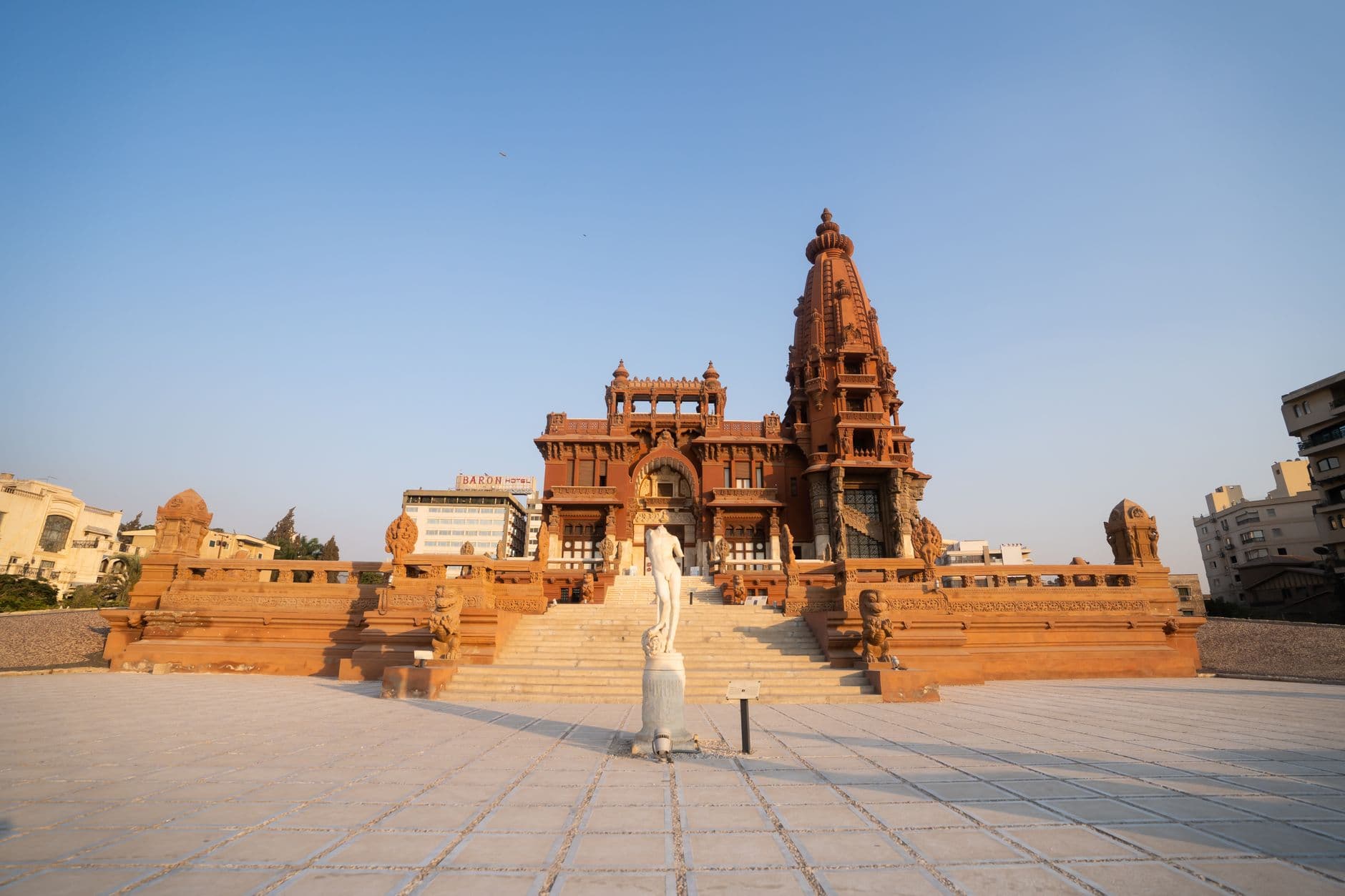
Empain's own palace, completed around 1911, was built in a style best described as Hindu Baroque. It has no parallel in Cairo and almost no parallel anywhere. The building sat derelict for decades and was reopened after restoration in 2020. The restoration is competent but the building remains disorienting in the best possible way, a Hindu-inspired fantasy palace in the middle of a Cairo suburb, built by a Belgian industrialist who made his fortune in trams.
Heliopolis was explicitly designed to be a European enclave. Egyptian workers were permitted to work there but initially not to live there. By the 1930s and 1940s, as Egyptian professionals and middle-class families moved in, the neighborhood changed character, and it is now one of Cairo's densest and most mixed urban areas. The transformation of Heliopolis from planned European suburb to chaotic Egyptian city is one of the more satisfying reversals the twentieth century produced.
The Connections: Layers Beneath the Colonial Surface
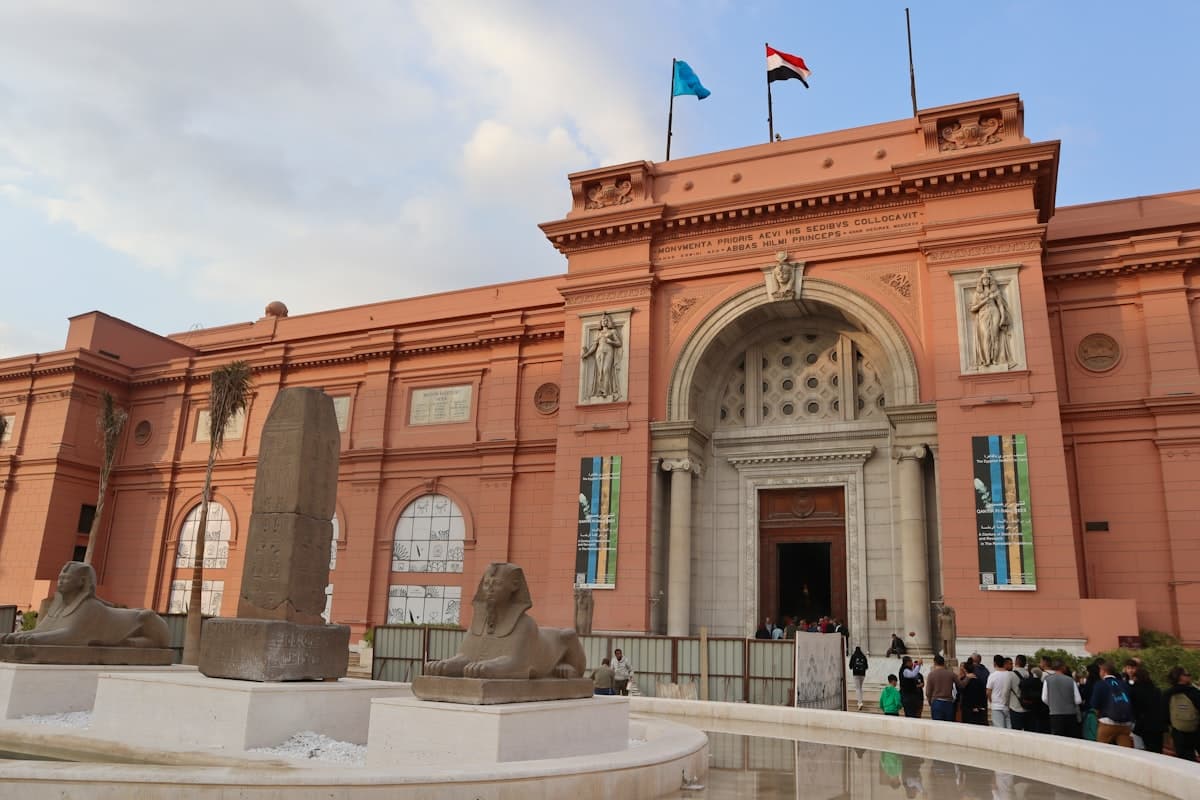
The Egyptian Museum on Tahrir Square, opened in 1902 and designed by French architect Marcel Dourgnon, houses the artifacts that European archaeologists excavated under the oversight of the Egyptian Antiquities Service, which was itself controlled by French Egyptologists from 1858 until 1952. The objects inside the museum were removed from sites across Egypt under a legal framework the British and French jointly administered. This is not ancient history. The debate over which objects should be repatriated, and to whom, is active.
The Antiquities Law of 1835, Egypt's first attempt to regulate the export of ancient objects, was systematically bypassed during the colonial period. The Rosetta Stone, discovered by a French soldier in 1799 and taken by Britain under the Treaty of Alexandria in 1801, sits in the British Museum. It has never returned. Every object in every European museum with an Egyptian provenance exists within this legal and ethical history.
The Coptic Museum in Old Cairo, which holds the world's largest collection of Coptic art, was founded in 1908 by Marcus Simaika Pasha with British administrative support. It was one of the first institutions in Egypt devoted to preserving a specifically Egyptian Christian heritage, distinct from both the Islamic and Pharaonic identities the colonial administration tended to emphasize. The British found the Pharaonic past useful as a legitimizing narrative: ancient Egypt was glorious, medieval Egypt was chaotic, modern Egypt needed European management to recover its potential. The Coptic Museum complicated this story by insisting that Egyptian civilization had never actually stopped.
Common Mistakes
Treating Downtown Cairo as a detour rather than a destination. Most tour itineraries treat the pyramids, the Egyptian Museum, and Islamic Cairo as the core of Cairo, with Downtown as the area where your hotel happens to be. The colonial-era urban fabric of Downtown is the site. Build your walking route before you arrive.
Skipping the Manial Palace because it sounds minor. The Manial Palace on Rhoda Island was built by Prince Mohammed Ali Tewfik between 1899 and 1929 and is one of the most genuinely strange buildings in Cairo: five separate structures in five different Islamic architectural styles, built by an Egyptian prince who was both a product of and a reaction against the colonial period. Most visitors do not know it exists. It should take two hours of your time.
Paying for the Heliopolis sound and light show, which runs infrequently and adds nothing. If you want to understand Heliopolis, walk the streets between the Baron Empain Palace and the Basilica of Notre Dame de Heliopolis and look at the architectural details at street level. The buildings tell the story. The show does not.
Assuming the Egyptian Museum has no agenda. The museum's original display logic, some of which persists despite recent reorganizations, organized Egyptian history in ways that served the colonial-era narrative of Pharaonic greatness followed by decline. Read the labels critically and visit the newer Grand Egyptian Museum at Giza for a display framework that reflects contemporary Egyptian scholarship.
Ignoring Alexandria entirely. The most concentrated collection of colonial-era architecture in Egypt is not in Cairo but in Alexandria, specifically along the Corniche, around Mohamed Ali Square (now Tahrir Square, Alexandria), and in the neighborhoods of Smouha and Gleem. The Greco-Roman Museum, currently under restoration, is the best surviving example of colonial-era institutional architecture in the country. Alexandria is a three-hour train ride from Cairo for approximately EGP 120 to 200 second class.
Expecting the British colonial sites to be marked or interpreted. There are almost no plaques, almost no museums dedicated specifically to the occupation period, and almost no official narrative that addresses the 1882 to 1954 period as a distinct historical era. You are largely on your own, which means preparation matters enormously.
Practical Tips
Bring a printed or downloaded street map of Downtown Cairo. The area's grid is logical but the numbering is not, and mobile data can be unreliable inside older buildings.
The best guide to colonial-era Cairo is Samir Raafat's book Cairo: The Glory Years, which covers the 1880s to 1950s in specific architectural and biographical detail. It is out of print but available as a PDF and in secondhand bookshops near the American University in Cairo campus on Tahrir Square.
For Heliopolis, the ride-hailing app Careem or inDrive will get you there from Downtown for EGP 80 to 120 depending on time of day. The Metro to Heliopolis requires a change and is slower but cheaper at EGP 8 to 10.
If you are researching specific buildings, the Rare Books and Special Collections Library at the American University in Cairo holds the archives of several colonial-era newspapers including the Egyptian Gazette and the Egyptian Mail. Access requires a written request but is generally granted to serious researchers.
Morning visits to Downtown work better than afternoon. By noon, traffic on the main streets is dense enough to make walking unpleasant. Start at the Egyptian Museum at 9am, walk east through Talaat Harb Square by 11am, and finish near Al-Azhar by early afternoon.
Frequently Asked Questions
The Weekly Dispatch
More on Egypt, every Friday.
Cultural depth and places most guides never mention.
No spam. Unsubscribe anytime.