British Colonial Egypt: The Sites, Stories, and Scars Still Visible Today
Britain occupied Egypt in 1882 and never formally annexed it. The legal fiction lasted 40 years. The physical evidence is still everywhere if you know where to look.

Quick Facts
- Best time to visit
- October through March. Most colonial sites are urban and unshaded. Alexandria is tolerable through April; Cairo becomes difficult above 35C from May onward.
- Entrance fee
- Egyptian Museum EGP 450 (approx $9 USD), camera permit EGP 300. Baron Empain Palace EGP 100 (approx $2 USD). Beit al-Umma EGP 30 (under $1 USD). El Alamein War Cemetery free. Most colonial buildings exterior only, free.
- Opening hours
- Egyptian Museum daily 9am-7pm. Baron Empain Palace variable, confirm locally. Beit al-Umma Tuesday-Sunday 9am-5pm. El Alamein War Cemetery daily sunrise to sunset.
- How to get there
- Cairo Metro to Tahrir Square (Line 1 or 2, EGP 8). Taxi or ride-share to Heliopolis EGP 80-120 from central Cairo. Alexandria by Talgo train from Ramses Station EGP 90-180, journey 2.5 hours. El Alamein by road from Alexandria approximately EGP 400-600 round trip by private taxi.
- Time needed
- Colonial Cairo (Tahrir, Garden City, Zamalek): full day. Heliopolis: half day separate. Alexandria colonial circuit: 2 days minimum. El Alamein cemeteries: 3-4 hours on site.
- Cost range
- Budget EGP 600-900 per day covering entry fees, metro, and street food. Mid-range EGP 2,000-3,500 per day with licensed guide and restaurant meals. Specialist guide for colonial history topic: EGP 1,500-2,500 per day.
The British never called Egypt a colony. They called it a "veiled protectorate", then a protectorate, then a nominally independent kingdom under effective military control. The legal categories shifted every decade or so, but the Qasr al-Nil barracks stood on the Nile corniche, the Gezira Sporting Club kept its membership lists, and Lord Cromer ran Egyptian finances from a desk in what is now the Foreign Ministry on Ramses Street. Britain occupied Egypt in 1882 following the bombardment of Alexandria, and by the time the last British troops left the Suez Canal Zone in 1956, they had been there for 74 years. The physical residue of that occupation is still in Cairo, Alexandria, Luxor, and Ismailia, scattered across buildings and cemeteries and train stations and clubs. Most of it is unlabeled. Some of it is magnificent. This is a guide to finding it honestly.
Quick Facts
Best time to visit: October through March. The colonial-era sites are largely urban and unshaded. Cairo and Alexandria are brutal between June and September. Alexandria's Mediterranean climate makes it tolerable a month longer in each direction than Cairo.
Entrance fees: Most colonial-era buildings are not tourist sites with ticket booths. The Egyptian Museum (which holds artifacts from the colonial excavation period): EGP 450 (approx $9 USD), camera permit EGP 300. The Baron Empain Palace in Heliopolis: EGP 100 (approx $2 USD). The Gezira Sporting Club day membership for non-members: occasionally available through hotel concierge, approx EGP 500-800. The Anglican All Saints Cathedral in Zamalek: free, donations welcomed.
Opening hours: Most sites are accessible during standard daylight hours, 9am to 5pm. The Egyptian Museum is open daily 9am to 7pm. The Baron Empain Palace keeps variable hours; confirm before visiting.
How to get there: Cairo Metro Line 1 or 2 covers Tahrir Square (Egyptian Museum), Heliopolis requires a taxi or ride-share from central Cairo, roughly EGP 80-120 each way. Alexandria is 2.5 hours from Cairo's Ramses Station by Spanish Talgo train; tickets EGP 90-180 depending on class. The Alexandria train station itself is a colonial site worth examining on arrival.
Time needed: A focused colonial Cairo walk covers Tahrir, Garden City, and Zamalek in a full day. Adding Heliopolis requires a separate half day. Alexandria's colonial waterfront and cemeteries need at least two days to do justice.
Cost range: Budget EGP 600-900 per day covering transport, entry fees, and street food. Mid-range EGP 2,000-3,500 per day with a licensed guide and sit-down meals.
Why This Place Matters
The standard account of British Egypt begins with the 1882 bombardment of Alexandria and ends with Nasser nationalizing the Suez Canal in 1956. That account is not wrong, but it omits the texture. Evelyn Baring, the first Earl of Cromer, ran Egypt as Consul-General from 1883 to 1907, during which time he kept Egyptian cotton cheap for Lancashire mills, held Egyptian education deliberately underfunded to prevent the emergence of a professional class that might challenge British control, and wrote a book called "Modern Egypt" in which he described Egyptians as fundamentally incapable of self-governance. The book was widely read and admired in London.
What Cromer built, or rather what he allowed to be built around him, was a dual city layered over an Islamic city layered over a Coptic city layered over a Pharaonic one. Garden City, the residential district carved out of the Nile bank south of Tahrir, was designed in the early 1900s with curving streets specifically to disorient anyone trying to navigate it quickly. It was, in effect, a security feature, a European quarter with deliberately confusing geometry. The British Embassy still sits there. The streets are still confusing.
What the British colonial presence also produced, paradoxically, was the systematic excavation and documentation of Pharaonic Egypt. The Egyptian Antiquities Service, which controlled all excavation permits until 1952, was founded by Auguste Mariette but run by a series of French and then British directors. The artifacts those digs produced were divided: half to the Cairo Museum, half to the excavating country's national museum. The Petrie Museum in London holds 80,000 objects excavated from Egypt by Flinders Petrie. The Ashmolean in Oxford holds the wall paintings from Amarna. This is the context you are walking through when you visit colonial Egypt.
Cairo: The Architecture of Occupation
Tahrir Square and the Egyptian Museum
The Egyptian Museum on Tahrir Square is not, as it appears, a timeless institution. It was built in 1902, during the Cromer years, and the building itself is a Neoclassical statement: a European structure designed to house objects taken, catalogued, and interpreted largely by Europeans. The museum's first director was Gaston Maspero, a Frenchman who authorized the unwrapping of the royal mummies in 1886 in front of an audience that included the Khedive Tewfik. Photographs of the event were sold as souvenirs.
Walk around the exterior before you go in. The pink facade was originally white. The ironwork gates were French. The garden statues are Pharaonic originals that could not fit inside. Inside, the mummy room on the upper floor holds Ramesses II, Seti I, Thutmose III, and seventeen others, all exhumed from the Deir el-Bahari cache discovered in 1881, the year before the British arrived. The timing is not incidental.
Tahrir Square itself was called Ismailia Square until 1952. The name change happened within weeks of the Free Officers' revolution. The original layout, with the Qasr al-Nil barracks blocking the Nile view, is gone. The barracks were demolished after independence. The Nile Hilton, opened in 1959, was built on their foundations. The Nile Ritz-Carlton, as it is now called, is therefore sitting on the ghost of British military occupation.
Garden City and the Embassy Quarter
Walk south from Tahrir along the Corniche and turn inland at the first roundabout. You are in Garden City, and within two blocks you will be lost, which was the point. The curved street plan was drafted by a Belgian firm hired by a British-controlled land development company in 1905. The villas, most of them now divided into flats or occupied by embassies, were built for British civil servants, Syrian merchants, and Levantine bankers who serviced the occupation economy.
The British Embassy compound on Ahmed Ragheb Street occupies a Nile-facing plot that has belonged to Britain since 1894. The external wall, topped with the kind of razor wire that makes its intentions clear, runs for nearly 200 meters along a street that was once the garden boundary. The building is not open to the public. Stand outside it and consider that this is one of the few pieces of Egyptian real estate that has not changed hands since Cromer's era.
Heliopolis: The Company Town That Became a City
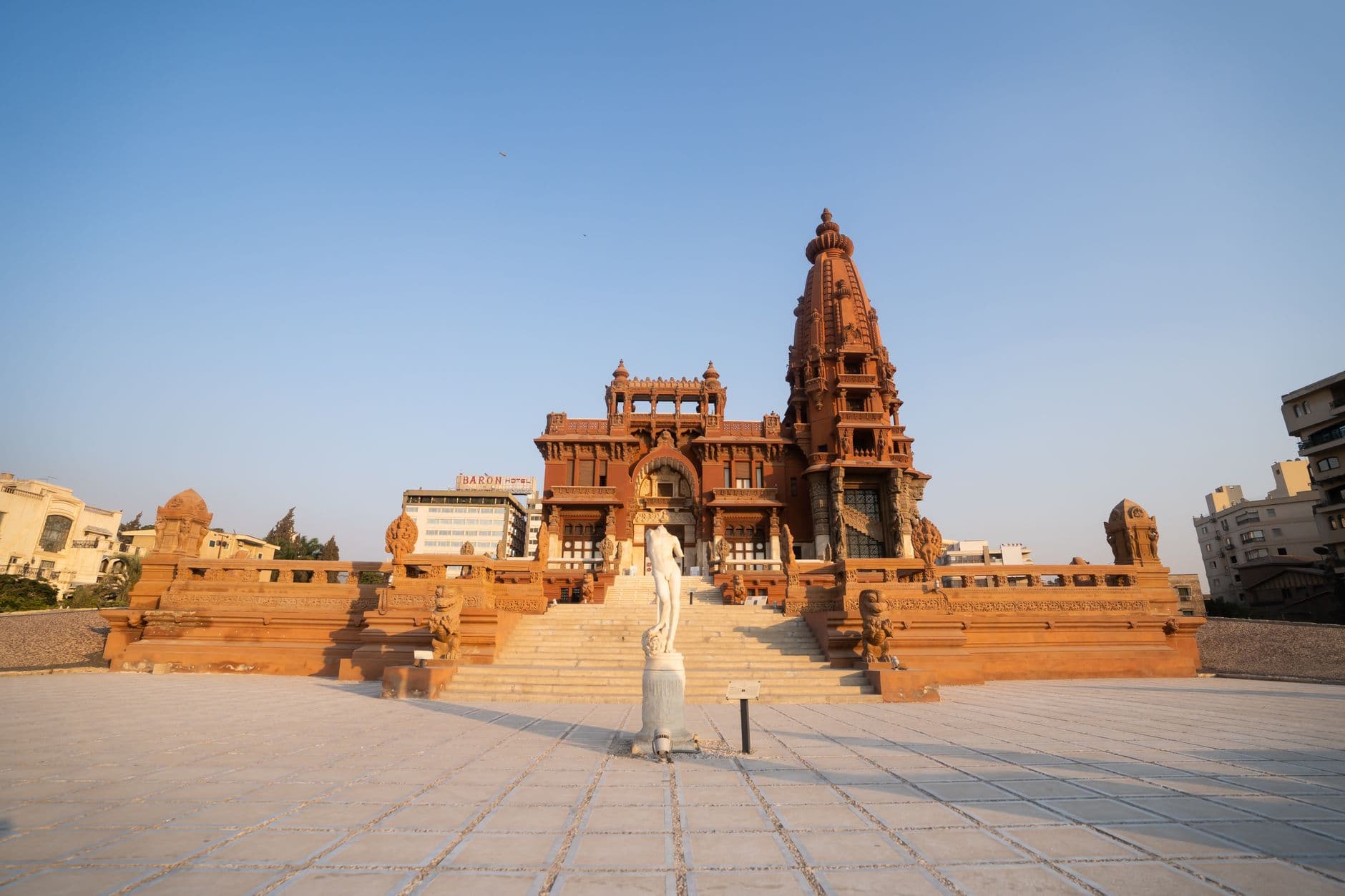
Heliopolis, now a sprawling northeast Cairo suburb, was built almost entirely from scratch beginning in 1907 by Edouard Empain, a Belgian industrialist who secured a concession from the Egyptian government to develop desert land northeast of Cairo. Empain built tram lines, hotels, a hippodrome, a basilica, and, for himself, a Hindu-Moorish palace of absolute architectural derangement.
The Baron Empain Palace, known locally as Qasr al-Baron, is worth the taxi ride. It was modeled on the Angkor Wat temple complex, built with cast concrete, and sat abandoned from the 1950s until a recent restoration. The interior is now accessible. The building is singular in a city full of singular buildings. What most visitors miss is the broader Heliopolis urban plan around it: the arcaded streets were designed so that residents could walk in shade at all times, a solution to Cairo's heat that Islamic urban planners had understood for a thousand years and that Empain rediscovered independently, or borrowed without attribution.
The suburb also contains the presidential palace used by Nasser, Sadat, and Mubarak. Sadat was assassinated 3 km away at a military parade ground in October 1981. The proximity of the colonial pleasure suburb to the site of his killing is not noted on any signage.
Alexandria: The City Britain Bombarded and Then Loved
Britain shelled Alexandria on July 11, 1882, for ten and a half hours. The bombardment destroyed roughly a third of the city and killed an estimated 2,000 people. Within months, British engineers were rebuilding the waterfront. The city that rose from that destruction is the Alexandria of Cavafy's poems, of Lawrence Durrell's Quartet, of E.M. Forster's wartime letters: a layered, polyglot Mediterranean port that the British simultaneously damaged, inhabited, romanticized, and failed to understand.
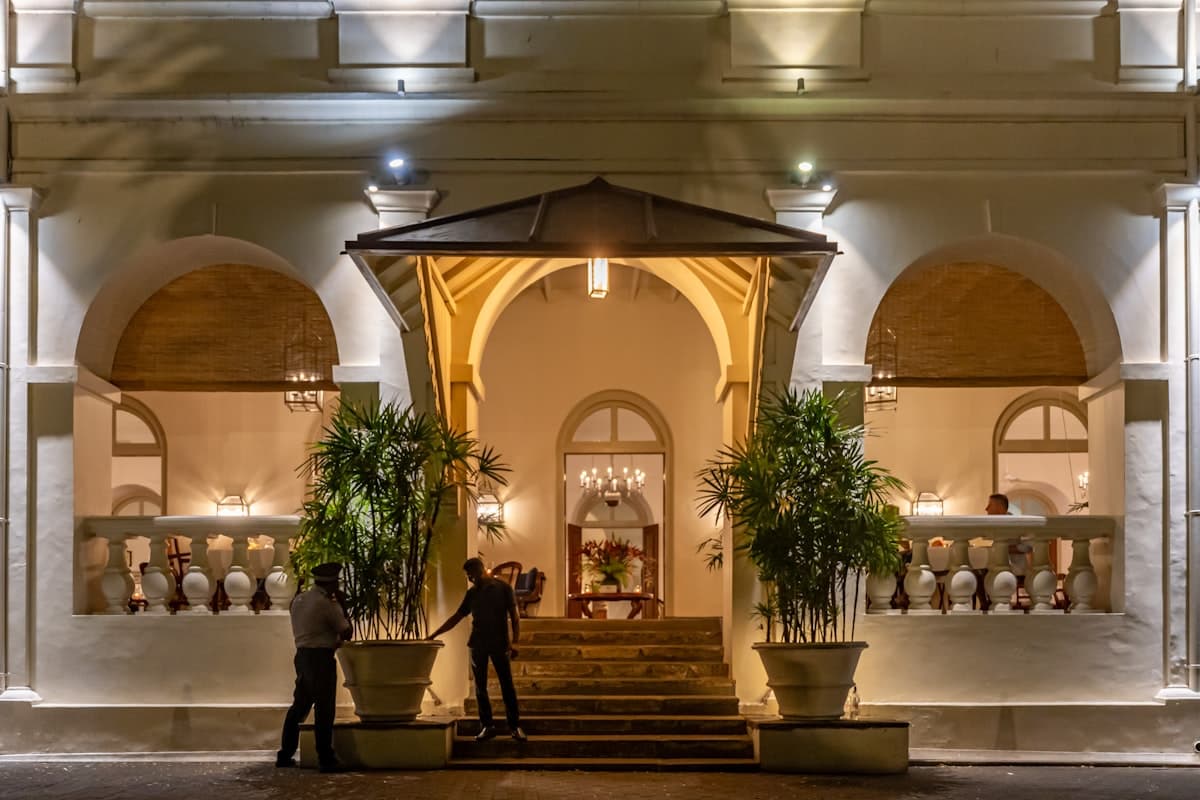
The Cecil Hotel on Saad Zaghloul Square opened in 1929 and became the preferred address of British intelligence officers during World War II. Montgomery stayed there during the Western Desert campaign. So did Somerset Maugham, who used it as material. The hotel is now a Sofitel, which has preserved the lobby's dark wood and brass in approximately the condition it was in during the 1940s. You can have tea there for EGP 200-300. The tea is mediocre. The ceiling is worth it.
The colonial-era cemeteries are the most honest historical record Alexandria has. The Commonwealth War Graves Commission maintains El Alamein War Cemetery, 105 km west of Alexandria, where 7,240 Commonwealth soldiers are buried in a grid that is the definition of administered grief. Admission is free. The register in the entrance building lists every name, regiment, and date. More affecting, for a different reason, is the smaller Chatby Cemetery in central Alexandria, where the British civilian dead of the 19th century are buried among Greek Orthodox, Jewish, and Catholic sections. The British plots record the full demographics of occupation: administrators, wives, children, servants who converted to Christianity and were buried with their employers.
The Connections
The colonial period did not arrive in an empty Egypt. The Khedive Ismail, who ruled Egypt from 1863 to 1879, borrowed so heavily from European banks to fund the Suez Canal and his modernization projects that Egypt's national debt reached 100 million Egyptian pounds by 1876. European creditors demanded control of Egyptian finances. The Dual Control, a joint Anglo-French financial commission, preceded the British occupation by six years. Britain took sole control only because France was distracted by internal politics in 1882 and did not send ships to join the bombardment.
The Suez Canal itself, often described as the reason for British occupation, was built by forced Egyptian labor. Between 1859 and 1869, an estimated 1.5 million Egyptian laborers worked on the canal, of whom approximately 125,000 died. The canal is in Ismailia, a purpose-built colonial city that still contains French and British villas from the construction era, some of them occupied, some of them derelict, and exactly none of them marked with this information.
The 1919 Egyptian Revolution, which most visitors have never heard of, was triggered when British authorities exiled the nationalist leader Saad Zaghloul to Malta. The subsequent uprising, in which Egyptians from every class, religion, and region participated, including Coptic Christians marching alongside Muslims under a crescent-and-cross banner, forced Britain to issue the 1922 Declaration of Egyptian Independence. The declaration was largely fictional: Britain retained control of foreign policy, defense, and the Suez Canal Zone. Zaghloul's house in Cairo, Beit al-Umma, is now a museum. It costs EGP 30 to enter and it is almost always empty.
Common Mistakes
Skipping Beit al-Umma entirely. Most colonial history guides focus on British buildings. Beit al-Umma, Saad Zaghloul's house in the Munira district, is where the opposition was organized, and the house itself has been preserved with his furniture, his library, and the room where he died. It costs EGP 30 and receives almost no foreign visitors. This is a mistake.
Taking a general Cairo city tour that mentions the colonial period. General tours cover Pharaonic and Islamic Cairo. The British period gets three sentences in a minibus. Hire a guide specifically for this topic, or use this article and walk it yourself.
The Nile dinner cruise marketed as a "colonial-era experience". These boats are not colonial-era. They are fiberglass vessels built in the 1990s with loud music and overpriced food. No colonial history is discussed or visible from the water. The cruise costs EGP 800-1,500 per person and teaches you nothing. Skip it.
Assuming the Egyptian Museum tells the colonial acquisition story. The museum's labeling is largely about Pharaonic chronology, not about how the objects were excavated, who funded the digs, or what happened to the other half of each find. You will need outside reading to understand what you are looking at in that context. The museum's gift shop sells a catalog. Buy it before entering, not after.
Visiting El Alamein without going to the Italian and German cemeteries. The Commonwealth cemetery is the best maintained and most visited. The Italian Ossario and the German military cemetery are within 2 km of it and are architecturally and historically distinct. The Italian memorial contains the remains of 4,800 soldiers in a structure that looks like a modernist church. The German cemetery is built from local stone and has a different register of solemnity. Seeing all three takes less than two hours and gives you the full picture of what that desert absorbed.
Treating Heliopolis as just a transit suburb. Most travelers pass through Heliopolis on the way to Cairo International Airport and see nothing. The Empain Palace, the arcaded streets around Ibrahim al-Laqqany Square, and the original Heliopolis Basilica are all within walking distance of each other. Budget three hours if your flight allows it.
Expecting any of this to be well-labeled or interpreted. Egypt's approach to its colonial history is ambivalent, not because Egyptians are unaware of it but because the public interpretation of this period is politically complex in a country where the post-1952 state defined itself against it. You will find plaques about Nasser, rarely about Cromer. Bring your own context.
Practical Tips
Hire a licensed Egyptologist guide who specializes in modern history, not ancient history. Most licensed guides in Egypt are trained primarily in Pharaonic and Islamic periods. Ask specifically about their knowledge of the 19th and 20th century urban history before booking. A good guide for this topic costs EGP 1,500-2,500 for a full day.
For Alexandria, the Alexandria Bibliotheca's historical archive is accessible to researchers and serious visitors by appointment. The original Greek and colonial-era maps of the city are held there and provide extraordinary context for walking the Corniche.
Carry cash. None of the colonial-era sites that have entry fees accept cards reliably. ATMs near Tahrir Square and on Alexandria's Corniche are functional but sometimes out of service.
Wear shoes appropriate for uneven pavement and occasional rubble. Several of these sites are in varying states of maintenance. The Heliopolis streets in particular combine old tram tracks with modern paving in ways that are uneven underfoot.
Photograph exteriors freely. Interior photography at the Baron Empain Palace and the Egyptian Museum requires a paid permit. At embassies and military-adjacent sites, do not photograph security infrastructure. The rules are not always posted; use judgment.
The best single preparatory text is Khaled Fahmy's "In Quest of Justice", which deals with 19th-century Egyptian legal and social history and provides the ground-level Egyptian perspective that British colonial memoirs systematically omit.
Frequently Asked Questions
The Weekly Dispatch
More on Egypt, every Friday.
Cultural depth and places most guides never mention.
No spam. Unsubscribe anytime.