British Colonial Egypt: The Sites, Stories, and Scars That Remain
Britain occupied Egypt for 72 years but never formally colonized it. The distinction is legal, not architectural. Cairo still carries the blueprints.

Quick Facts
- Best time to visit
- October through March. Cairo colonial neighborhoods involve significant walking on exposed streets; summer heat above 35C makes this genuinely unpleasant. Alexandria is slightly cooler year-round but the sea humidity in August is punishing.
- Entrance fee
- Egyptian Museum: EGP 450 (approx $9 USD), students EGP 200. Manial Palace Museum: EGP 200 (approx $4 USD). British War Cemetery Heliopolis: free. Cecil Hotel bar: no entry fee, drinks from EGP 250.
- Opening hours
- Egyptian Museum: daily 9am to 5pm. Manial Palace: daily 9am to 5pm. British War Cemetery: daily 7am to 3:30pm. Garden City and Heliopolis streets: accessible at all hours.
- How to get there
- Cairo Metro Line 2 to Tahrir for the Egyptian Museum and Garden City (EGP 10). Taxi to Heliopolis from Downtown: EGP 80 to 120. Train Cairo to Alexandria from Ramses Station: EGP 180 to 230 first class, journey 2.5 hours.
- Time needed
- Minimum two full days in Cairo to cover Garden City, Heliopolis, and the Egyptian Museum with any seriousness. Add a full day for Alexandria. Trying to compress this into a half-day colonial history tour produces a list of facades, not understanding.
- Cost range
- Budget EGP 600 to 900 per day covering metro, taxis, and entry fees. Mid-range EGP 2,000 to 3,500 per day including a meal or drink at a colonial-era hotel property. Alexandria day trip adds EGP 400 to 500 in train fares and local transport.
Britain occupied Egypt for 72 years and never once called it a colony. The legal fiction was elaborate: Egypt remained nominally Ottoman, then nominally independent, while British officials controlled its army, its finances, its cotton, and its canal. Lord Cromer, the Consul-General who effectively ruled Egypt from 1883 to 1907, held no official government position in the Egyptian state whatsoever. He simply ran everything. The sites this occupation left behind are not gathered in a single district or labeled on most tourist maps. You find them the way you find most things in Cairo: by knowing where to look, and by understanding that every layer of this city sits on top of something older.
Quick Facts
Best time to visit: October through March, when Cairo is cool enough to walk between sites without losing your mind. The Garden City neighborhood, where several key colonial buildings cluster, is relentlessly exposed to afternoon sun in summer.
Entrance fees: Most colonial-era sites are exterior-only or embedded in functioning institutions. The Egyptian Museum (which opened under British oversight in 1902) costs EGP 450 (approx $9 USD) for general admission, EGP 200 for students. The Manial Palace Museum on Rhoda Island costs EGP 200 (approx $4 USD). The British War Cemetery in Heliopolis is free and open daily.
Opening hours: Egyptian Museum: daily 9am to 5pm. Manial Palace: daily 9am to 5pm. The Cecil Hotel in Alexandria (now a Sofitel) is accessible as a guest or for a drink at the bar: open daily. British War Cemetery, Heliopolis: daily 7am to 3:30pm.
How to get there: Cairo Metro Line 2 stops at Tahrir Square (Egyptian Museum, Garden City). A taxi from Downtown Cairo to Heliopolis runs EGP 80 to 120. Alexandria is 2.5 hours by train from Ramses Station; first class tickets cost EGP 150 to 230. Microbuses from Heliopolis to the Almaza area run EGP 5.
Time needed: Two full days minimum to cover Cairo colonial sites seriously. Add a day for Alexandria.
Cost range: Budget EGP 600 to 900 per day covering transport and entry fees. Mid-range EGP 2,000 to 3,500 per day including a meal at a colonial-era hotel.
Why This Place Matters
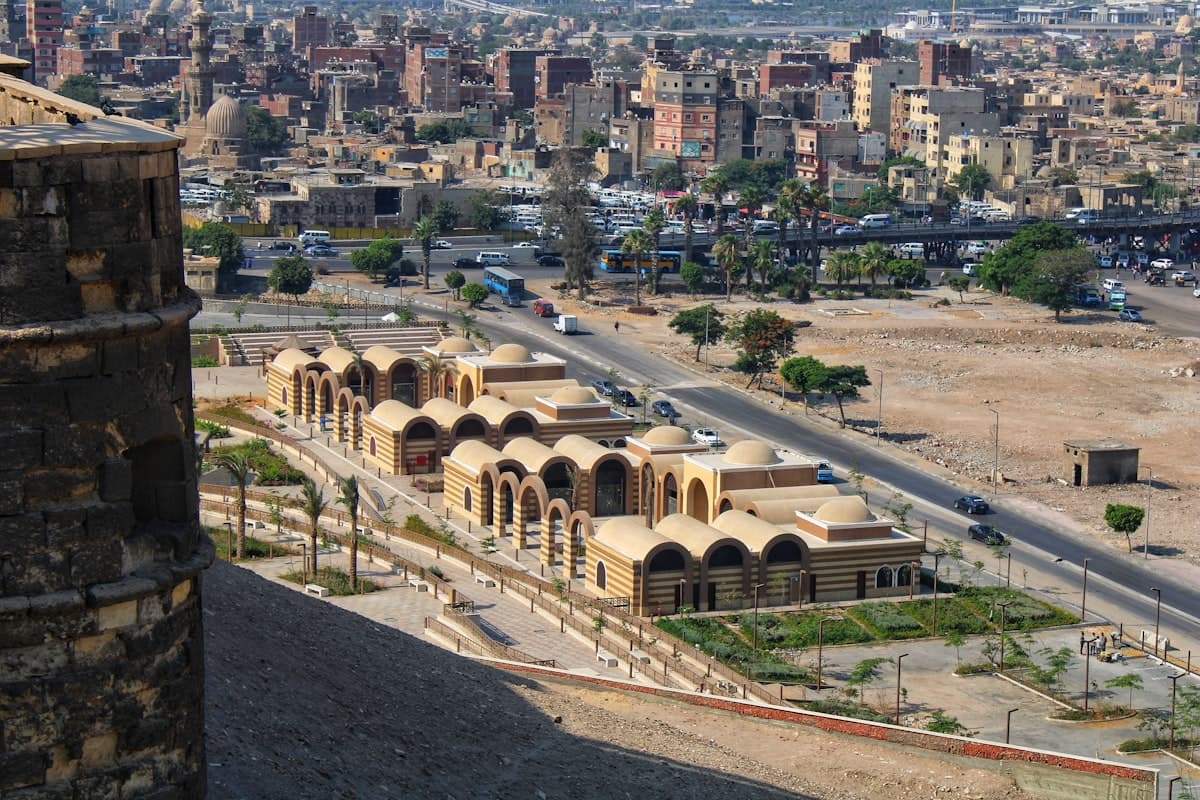
The British arrived in Egypt in 1882 under the pretext of restoring order after the Urabi Revolt, a nationalist uprising against the ruling Khedive. They planned to stay a few years. They stayed until 1956, when Nasser nationalized the Suez Canal and the pretense finally collapsed. In that span, they built a bureaucratic and architectural infrastructure across Cairo and Alexandria that you can still read like a ledger: who held power, who was meant to feel it, and who was meant to disappear into it.
What makes tracing British Egypt colonial history sites a more complex exercise than visiting, say, French Indochina or British India is precisely that ambiguity of status. Egypt was not a Crown Colony. It was not a protectorate until 1914, and even then the arrangement was contested. This meant British influence expressed itself not through grand colonial government buildings in the New Delhi mold, but through financial institutions, military barracks, private clubs, luxury hotels, and the redesign of Cairo's street grid to funnel cotton and capital toward the canal.
The Suez Canal itself, completed in 1869 under French engineering and Egyptian forced labor that killed tens of thousands of workers, became Britain's primary obsession. In 1875, a cash-strapped Khedive Ismail sold his 44 percent stake in the canal to the British government for £4 million. Prime Minister Disraeli borrowed the money from the Rothschild banking house and did not consult Parliament until after the deal closed.
Garden City and the Architecture of Control
Garden City is the neighborhood that most clearly illustrates how the British occupation organized space in Cairo. Built on land that had been a Khedival garden south of Tahrir, it was developed from around 1905 onward as a residential enclave for foreign diplomats, wealthy Levantine merchants, and senior British officials. The curving streets, unusual in a city that defaults to grids and warrens, were deliberately designed to disorient: wide enough for carriages, curved enough to be unwalkable in a hurry, oriented away from the working-class quarters of Old Cairo.
The British Embassy still occupies a large compound on Corniche el-Nil, on land that has been in British diplomatic hands since the 1890s. You cannot enter, but the perimeter wall alone tells you something about scale. Nearby, the former Savoy Hotel (now a government building at the corner of Kasr el-Aini and Talaat Harb) was where Lord Kitchener held court after replacing Cromer. Kitchener, who had crushed the Mahdist uprising at the Battle of Omdurman in 1898 using early machine gun technology against infantry, then served as British Agent in Egypt from 1911 to 1914 before the war called him away. He loved Egyptian gardens and is largely responsible for introducing the jacaranda tree to Cairo's streets. This is the mundane intimacy of occupation: the man who ordered the posthumous desecration of the Mahdi's tomb in Khartoum also planted the trees you are sitting under on Gezira.
Walk south along the Corniche toward Maadi, and the colonial residential architecture thickens. Maadi itself was built by a British land company from 1904 onward as a garden suburb, its streets named after English counties, its railway station designed to connect the expatriate community directly to central Cairo. Today it is one of the most expensive residential areas in the city, favored by diplomats and NGO workers. The colonial logic persists under a different flag.
Alexandria: Where the Colonial Project Was Most Legible
If Cairo hid the occupation in curved streets and club memberships, Alexandria wore it on its face. The city had been cosmopolitan long before the British arrived, but the occupation hardened its hierarchies. By 1900, Alexandria's European quarter around Raml Station contained department stores, stock exchanges, consulates, and private clubs with explicit exclusion policies.
The Cecil Hotel, opened in 1929 on the Corniche, is the most photogenic survivor. Somerset Maugham stayed here. Winston Churchill used it as a base. During the Western Desert Campaign of World War II, British military intelligence operated out of its upper floors while Rommel's Afrika Korps was less than 100 kilometers away at El Alamein. The hotel was close enough to the front that guests could occasionally hear artillery. Today, as a Sofitel property, it has been renovated into something glossy and largely drained of atmosphere, but the bones of the lobby are original, and a drink at the bar costs less than you expect and delivers more historical density than any tour.
The Bibliotheca Alexandrina, opened in 2002 on the presumed site of the ancient Library, contains an excellent Antiquities Museum and a dedicated exhibition on the history of Alexandria that treats the colonial period with more honesty than most official Egyptian institutions. The exhibition on the 1956 nationalization of the canal and the subsequent expulsion of 25,000 Greeks, 24,000 Italians, and thousands of Jewish Egyptians is particularly clear-eyed. These communities had been in Egypt for generations. The British occupation had made their presence economically essential and politically complicated in ways that outlasted the British themselves.
The Connections
Nothing in Egypt sits in isolation, and the British colonial layer is no exception. The Egyptian Museum in Tahrir Square, which visitors treat as a Pharaonic institution, was built in 1902 under the directorship of Gaston Maspero, a Frenchman appointed by a Khedive and funded through a budget controlled by British financial advisors. The building itself, designed by the French architect Marcel Dourgnon, won an international competition. The British pushed for the museum partly because Egyptian antiquities were being looted at industrial scale, including by British collectors, and a central repository made the practice slightly harder to deny.
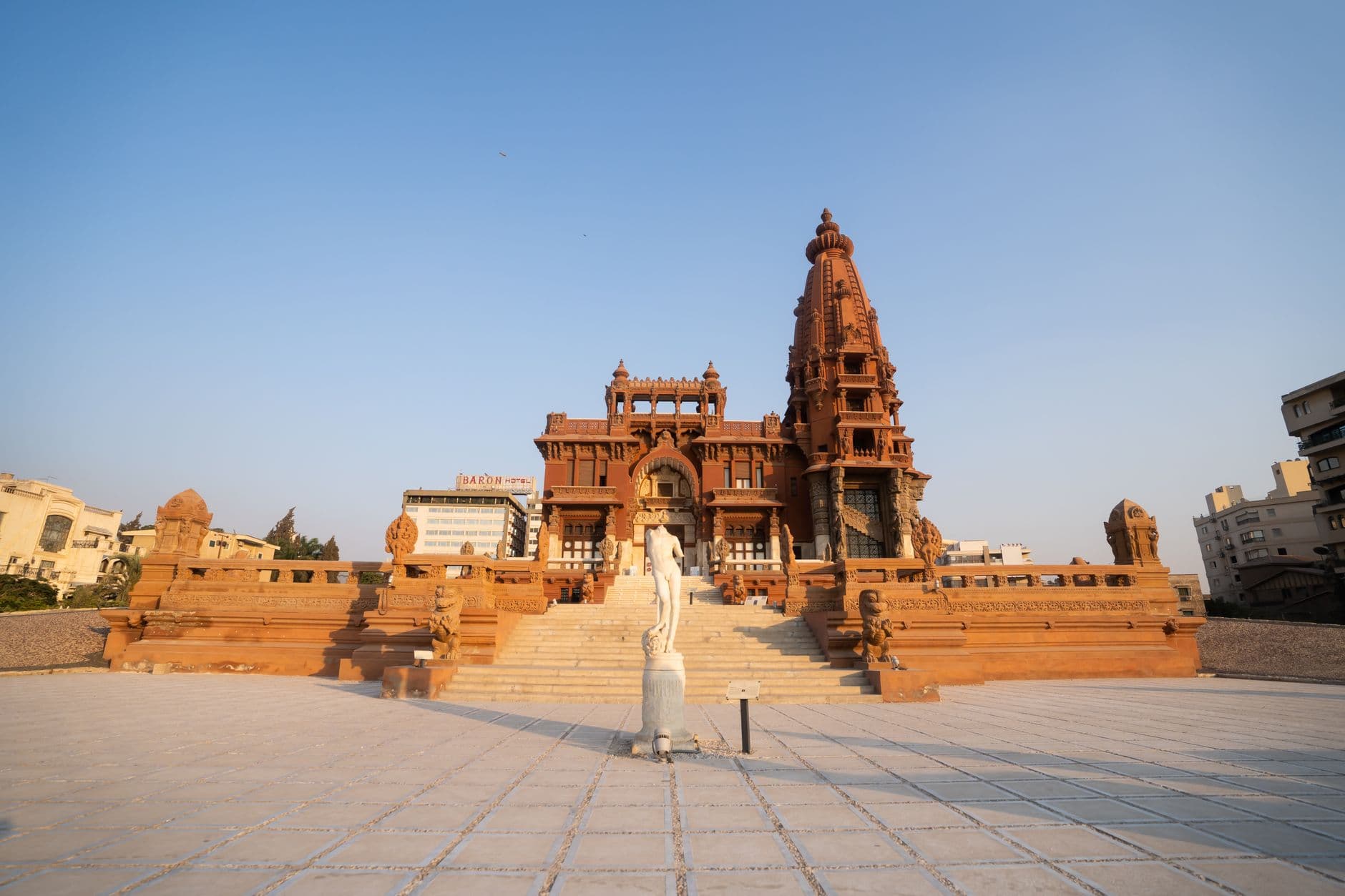
The Heliopolis neighborhood, northeast of central Cairo, was designed from scratch by Edouard Empain, a Belgian industrialist, starting in 1905. It is not a British project but it is a colonial one, and its relationship to the British occupation is direct: Empain needed British financial guarantees and British-controlled rail infrastructure to make the project viable. The Heliopolis Palace Hotel, now the Egyptian Presidential Palace, was built in a style that blends Moorish, Hindu, and European elements in a way that could only have been conceived by someone who regarded Egyptian aesthetics as a decorative resource rather than a living tradition. The Baron Empain Palace nearby, currently under restoration after years of dereliction, is the more honest building: a Hindu temple dropped into a Cairo suburb by a man who had never been to India.
The British War Cemetery in Heliopolis contains 1,742 graves from both World Wars, maintained by the Commonwealth War Graves Commission with the precision that organization brings to every site it touches. The graves include Egyptians who served in the Egyptian Labour Corps, a fact that most visitors do not know and that most guides do not mention. Approximately 150,000 Egyptians were conscripted into that Corps during World War I, many involuntarily, to support a war they had no stake in. Some are buried here alongside the officers who commanded them.
Common Mistakes
Treating the Egyptian Museum as purely Pharaonic. The building and its early curatorial decisions are a colonial document. The way artifacts were classified, what was sent to European museums before the museum opened, and what was kept reflects British and French priorities, not Egyptian ones. Knowing this changes how you read every label.
Skipping Garden City because it looks like a residential neighborhood. It is a residential neighborhood. That is the point. Walking its streets slowly for an hour tells you more about how occupation organizes daily life than any monument.
Doing the Nile cruise from Luxor to Aswan and calling it Egyptian history. The cruise infrastructure, the hotels in Luxor, the tourist police system, the division of the country into pharaonic spectacle in the south and modern city in the north: this geography was largely set by British tourism policy in the 1890s and 1900s, which wanted antiquities accessible and the contemporary Egyptian population invisible. Thomas Cook and Son held the monopoly on Nile tourist transport from 1880 to 1952.
Paying for the Alexandria Corniche horse-carriage tours. They cost EGP 300 to 500, last twenty minutes, and show you a seafront you can walk in forty. The drivers are aggressive and the experience is unpleasant. Walk the Corniche from the Cecil to the Citadel of Qaitbay on foot and spend the money on coffee at a seafront cafe instead.
Visiting Heliopolis only for the Baron Palace. The surrounding streets, specifically the arcaded commercial buildings along Ibrahim al-Lakany Street, are in better condition and more atmospheric. The palace itself is under reconstruction and the exterior view, while photogenic, takes fifteen minutes.
Expecting the British Council or colonial-era clubs to be accessible. The Gezira Sporting Club, founded in 1882 as an exclusively British institution on land gifted by Khedive Tewfik, is now Egyptian-owned and membership-only. You will not get in without a member escort. Do not waste an afternoon trying.
Taking any tour that packages the pyramids with colonial history in a single day. These are different cities, different mindsets, different Egypts. You will do neither justice.
Practical Tips
Bring a printed or downloaded map of Garden City before you go. Google Maps works but the curved streets confuse its routing. The neighborhood is quiet and safe at all hours, but most interesting in the morning before the embassies activate their security perimeters.
For Alexandria, take the Spanish Train (air-conditioned first class) from Ramses Station rather than the bus. The journey is the same length but you arrive without the particular exhaustion of Delta highway traffic. Book tickets at the station one day ahead or through the Egyptian National Railways website. Expect to pay EGP 180 to 230 for first class.
The Heliopolis War Cemetery requires you to sign a register at the gate. The staff are courteous and the grounds are immaculate. Bring water. The neighborhood around it is interesting but lacks shade.
If you want to understand the financial architecture of the occupation rather than just the physical one, the book you need before arriving is Roger Owen's "Lord Cromer: Victorian Imperialist, Edwardian Proconsul." It is dense and worth it. Alternatively, Khaled Fahmy's "In Quest of Justice" situates the occupation within Egyptian legal and social history in ways that most English-language accounts do not.
Do not hire a guide for Garden City or Heliopolis. These neighborhoods reward slow, unscheduled walking. A guide will give you dates and names when what you need is time to notice the thickness of a gate, the angle of a balcony, the way a building turns its back on the street behind it.
Frequently Asked Questions
The Weekly Dispatch
More on Egypt, every Friday.
Cultural depth and places most guides never mention.
No spam. Unsubscribe anytime.