British Colonial Egypt: The Sites, Stories, and What Remains
Britain occupied Egypt in 1882 and never formally colonized it. That legal fiction shaped everything. Here is where to read it in stone, marble, and wrought iron.

Quick Facts
- Best time to visit
- October to February. Walking between colonial-era sites is central to understanding them, and summer temperatures above 35°C make sustained walking impractical. January and February offer the clearest light for photography.
- Entrance fee
- Egyptian Museum EGP 450 (approx $9 USD). Abdeen Palace Museum EGP 100 (approx $2 USD). Baron Empain Palace EGP 100 (approx $2 USD). Heliopolis War Cemetery free. Most colonial-era streetscapes and exterior architecture free.
- Opening hours
- Egyptian Museum daily 9am to 5pm. Abdeen Palace Museum daily 9am to 3pm, closed Fridays. Baron Empain Palace Tuesday to Sunday 10am to 5pm. Heliopolis War Cemetery Sunday to Thursday 7am to 3pm.
- How to get there
- Cairo Metro Line 1 to Sadat Station for Downtown and the Egyptian Museum. Heliopolis tram from Abdel Moneim Riad Square for EGP 5, or ride-share for EGP 80 to 120. Train from Cairo Ramses Station to Port Said EGP 65 to 95 second class, to Ismailia EGP 40 to 60.
- Time needed
- Minimum three days for a serious engagement: one day Downtown and Garden City, one day Heliopolis, one day Egyptian Museum with colonial context plus Abdeen Palace. Add one additional day for Port Said or Ismailia if extending beyond Cairo.
- Cost range
- Budget EGP 600 to 1,000 per day covering transport, entry fees, and street food. Mid-range EGP 2,000 to 3,500 per day including a colonial-specialist guide, sit-down meals in historic Downtown cafes, and accommodation in the Garden City area.
Quick Facts
Best time to visit: October to February, when Cairo temperatures drop below 25°C and walking between sites does not drain you. The British-era buildings in Garden City and Heliopolis are best seen on foot.
Entrance fees: The Egyptian Museum (home to the colonial-era excavation spoils debate) costs EGP 450 (approx $9 USD). The Abdeen Palace Museum, which holds the occupation-era throne room, costs EGP 100 (approx $2 USD). The Baron Empain Palace in Heliopolis costs EGP 100 (approx $2 USD). Most colonial-era streetscapes and exterior architecture are free to walk.
Opening hours: Egyptian Museum daily 9am to 5pm. Abdeen Palace Museum daily 9am to 3pm, closed Fridays. Baron Empain Palace Tuesday to Sunday 10am to 5pm.
How to get there: Cairo Metro Line 1 to Sadat Station deposits you between the Egyptian Museum and Tahrir Square, the colonial administrative heart. A ride-share from Downtown to Heliopolis costs EGP 80 to 120 (approx $1.50 to $2.50 USD). A taxi from Garden City to the Citadel costs EGP 60 to 100.
Time needed: A serious engagement with colonial-era Cairo takes at least three days. One day for Downtown and Garden City, one day for Heliopolis, one day for the Egyptian Museum's colonial context and the nearby Qasr al-Nil barracks site.
Cost range: Budget EGP 600 to 1,000 per day, mid-range EGP 2,000 to 3,500 per day including entry fees, transport, and meals in the old European-style cafes.
---
Britain never called Egypt a colony. From 1882, when General Garnet Wolseley's forces defeated Ahmed Urabi's nationalist army at the Battle of Tel el-Kebir in 57 minutes, until 1956, when Nasser nationalized the Suez Canal, the legal status of Egypt shifted through a series of fictions: occupied territory, protectorate, nominally independent kingdom under effective British control. The Khedive remained on his throne. The British Consul-General ran the country. Lord Cromer, who served in that role from 1883 to 1907, is probably the most consequential figure in modern Egyptian history that most visitors have never heard of. He restructured Egypt's entire agricultural economy to produce cotton for Lancashire mills and called this development. You can read his fingerprints on Cairo today, if you know what to look for.
Why This Place Matters
The British presence in Egypt produced a layered city that most visitors walk through without recognizing the layer they are standing on. The wide boulevards of Downtown Cairo, the department stores on Talaat Harb Street, the Greco-Roman apartment facades in Garden City: these were built during the occupation era for a cosmopolitan population of British administrators, French financiers, Greek merchants, and Levantine bankers that reached perhaps 100,000 people in a city of roughly one million.
What most visitors do not know is that this European Cairo was built directly over an Islamic city that was itself built over a Roman and Pharaonic landscape. When the French engineers of Napoleon's expedition mapped Cairo in 1798, they documented an Ayyubid street grid that followed the line of a Pharaonic canal. The British administrators who arrived eighty years later did not erase that grid. They imposed their own logic on top of it, which is why Cairo's Downtown streets run at odd angles to everything around them and why a Mamluk mosque can appear at the end of a street that otherwise resembles a minor French provincial town.
The colonial-era sites that matter most for understanding this period are not single monuments. They are a network: administrative buildings, barracks, bridges, banks, cemeteries, and private villas scattered across several Cairo neighborhoods and down into the Nile Delta, where British cotton inspection stations still stand in various states of disintegration.
The Downtown Layer: Where Empire Did Its Paperwork
Tahrir Square in its current form is a product of the Nasser era, but the streets radiating from it are colonial Cairo's administrative skeleton. Walk south from the square and you enter Garden City, a neighborhood designed by an Egyptian developer, Boghos Nubar, in 1905 on land owned by the Khedival family. Its curved streets were explicitly modeled on English garden suburbs, and it housed the British Agency, which was not an embassy because Egypt was not a foreign country to Britain, but functioned as one. The current British Embassy building on Ahmed Ragheb Street stands on the footprint of that Agency.
East of Tahrir, the Qasr al-Nil barracks sat on the Nile bank until 1983, when they were demolished to build the Ramses Hilton. The British garrison stationed there from 1882 onward was the physical guarantee of the occupation's legal fiction. The site is worth noting on a map not because anything remains, but because the hotel's location still marks the line between the Khedival city and the European one.
On Talaat Harb Street, the old Cicurel department store building, opened in 1909 by a Sephardic Jewish merchant family, sold European goods to the cosmopolitan population until the 1950s nationalizations. The building still stands. It is now a government clothing outlet. The mosaic floors are partially intact. Ask to look down at them.
The Egyptian Museum's Colonial Subtext
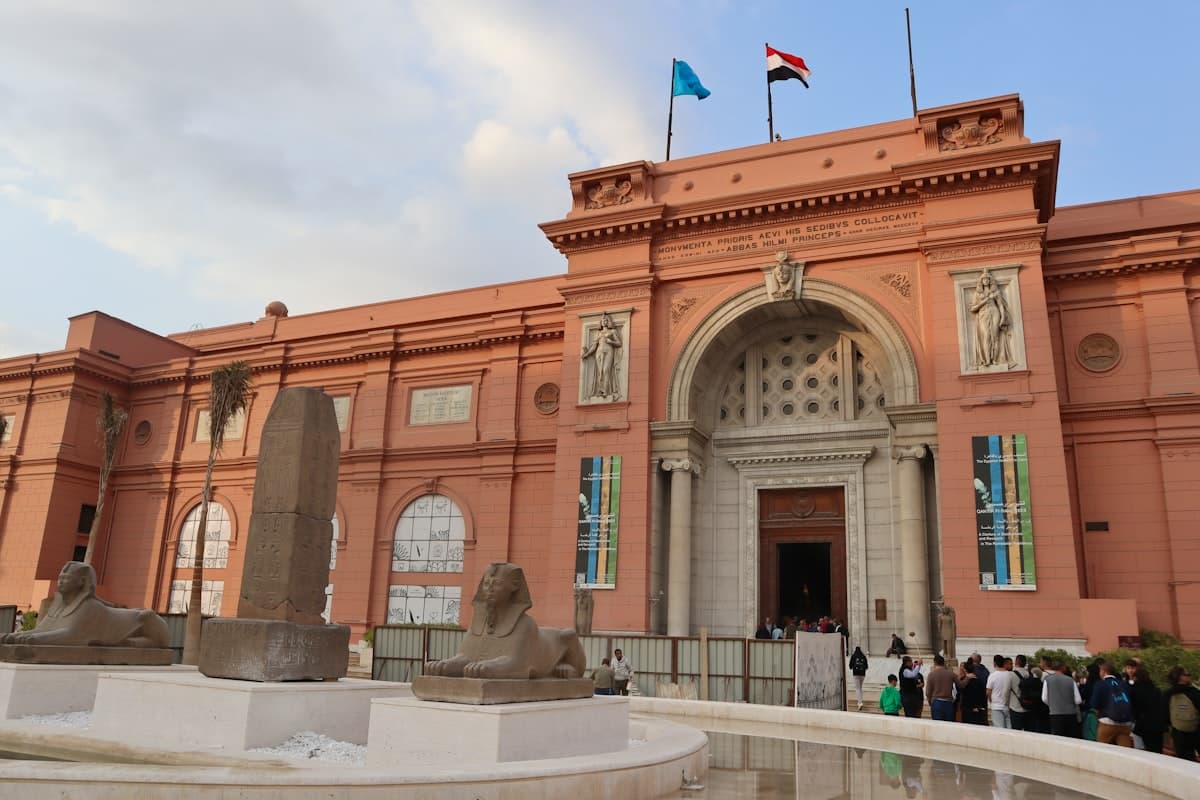
The Egyptian Museum on Tahrir Square, opened in 1902, is usually presented as a repository of Pharaonic treasures. It is also a monument to colonial-era archaeology, which operated on a concession system: foreign expeditions excavated, the Egyptian government received half of whatever was found, and the other half left the country. This system, called partage, transferred hundreds of thousands of objects to European and American museums between 1882 and 1952. The pieces in the Cairo museum are what stayed. The pieces in London, Paris, Berlin, and New York are what did not.
The museum's building was designed by the French architect Marcel Dourgnon, who won an international competition in 1895. His drawings were selected over 73 other submissions. The building cost 60,000 Egyptian pounds, roughly equivalent to $7 million USD in current purchasing power, which was paid from Egypt's national budget while the country was under British financial supervision. The irony is architectural as well as political: the French designed the building that houses the objects that British-licensed expeditions excavated from a country that neither France nor Britain owned.
Heliopolis: A Colonial City Within the City
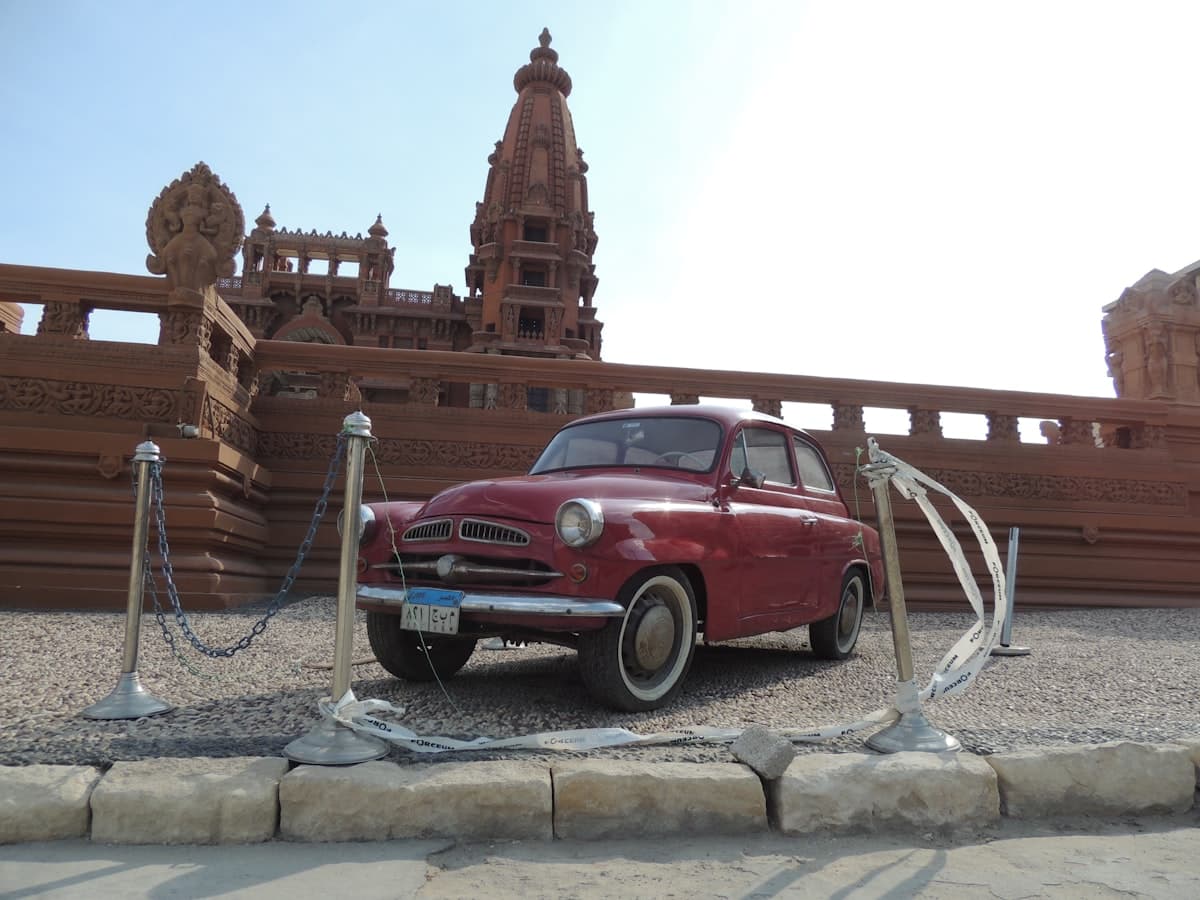
If Downtown Cairo represents the administrative body of the British occupation, Heliopolis represents its fantasies. The suburb was built almost entirely by one man, Edouard Empain, a Belgian industrialist who in 1905 obtained a concession from the Khedive to build a new city on desert land northeast of Cairo. He constructed it in a style he called Moorish-Byzantine, hired European architects to design buildings that looked vaguely Islamic without being accurately so, built a tramway connecting it to central Cairo, and sold plots to European families who wanted Cairo's commercial opportunities without its density.
Empain's own palace, now open to visitors after a long restoration, is an extraordinary object. It is built in a Hindu style, modeled loosely on Cambodian temple architecture, set in a Cairo suburb designed to look Islamic, built by a Belgian baron using Egyptian labor. The building rotated, according to persistent local legend, so that Empain's bedroom always faced the sun. Structural engineers who examined it during the restoration found no evidence that it actually rotated. The legend is more interesting than the truth, which is usually the case in Cairo.
The Heliopolis suburb also contains the Heliopolis War Cemetery, maintained by the Commonwealth War Graves Commission, where 1,742 Commonwealth soldiers from the First World War are buried. Visiting it is free and takes about 45 minutes. Most Cairo visitors never go. The graves include soldiers from Australia, Canada, New Zealand, India, and South Africa, which tells you something about the geographic reach of the enterprise that used Egypt as a military base.
The Suez Zone: Where the Occupation Made Its Last Stand
The British colonial history sites guide that stops in Cairo tells only half the story. The Suez Canal Zone, specifically Ismailia and Port Said, contains the clearest physical evidence of British administrative infrastructure outside the capital.
Ismailia was built by Ferdinand de Lesseps as the headquarters for the Suez Canal Company, which means it was French before it was British. The de Lesseps family villa still stands on the banks of Lake Timsah. The British military headquarters for the Canal Zone was established in Ismailia after the First World War, and the garden suburbs built for British officers remain, now occupied by Egyptian civil servants and their families. The architecture is unmistakably English: brick bungalows with small gardens, street layouts that assume car ownership rather than street life. They look almost comic in the Egyptian context, which is exactly what they are.
Port Said's colonial streetscape is better preserved than Cairo's because Port Said never went through the same cycles of demolition and redevelopment. The old Casino building, the Customs House, the Credit Lyonnais branch, and the row of covered arcades along the harbor front all survive. The Suez Crisis of 1956 began here. When Egyptian forces fired on the British and French landing parties in November of that year, the empire that had been administered from Garden City for 74 years effectively ended on Port Said's waterfront.
The Connections
Nothing in this colonial layer exists without its Pharaonic, Roman, Coptic, and Islamic understorey. Lord Cromer's agricultural reforms, which made Egypt the world's largest exporter of long-staple cotton by 1900, relied entirely on the irrigation infrastructure that Pharaonic and later Ottoman engineers had built over three millennia. The British did not build new canals. They regulated and taxed existing ones.
The Egyptian Museum sits 200 meters from the Nile on land that was, in the medieval period, the western bank of a different Nile channel. The island of Gezira was barely an island in the Mamluk era. The geography of colonial Cairo was determined by a river that has been moving westward for centuries.
The Heliopolis tramway that Empain built in 1906 still runs, now as part of Cairo's urban tram network. It is one of the few physical systems from the occupation era still performing its original function. A tram ride from central Cairo to Heliopolis costs EGP 5 (approximately $0.10 USD) and passes through five distinct urban layers without stopping for any of them.
Common Mistakes
Treating the Egyptian Museum as purely Pharaonic. The museum's colonial-era context is as important as any object inside it. Spend 20 minutes reading the concession history before you enter. It changes what you see.
Skipping Heliopolis entirely. Every Cairo itinerary sends visitors to Islamic Cairo and Giza. Almost none includes Heliopolis. The Baron Empain Palace alone is worth the 30-minute tram ride, and the war cemetery is one of the most affecting places in the city.
Taking the colonial-history walking tour offered by most Cairo hotels. These tours concentrate almost entirely on Downtown architecture and skip the political and economic context entirely. You will see buildings but not understand them. Read Robert Tignor's "Modernization and British Colonial Rule in Egypt" or Timothy Mitchell's "Colonising Egypt" before arriving. Both are available as PDFs.
Paying for the Nile dinner cruise that departs from near the old Qasr al-Nil barracks site. It costs EGP 800 to 1,500, the food is managed specifically for foreign palates, and the view is of the backs of hotels. Take the public felucca for EGP 50 per hour instead and spend the difference on a meal at one of the Heliopolis patisseries that date to the 1930s.
Assuming that Port Said is too far. It is 220 kilometers from Cairo, two hours by road or a direct train for EGP 65 to 95 (approx $1.30 to $2 USD) in second class. The colonial streetscape there is better preserved than anything in Cairo and almost entirely unvisited by foreign tourists.
Visiting Abdeen Palace Museum without researching the 1942 incident first. In February 1942, British tanks surrounded the palace and the British ambassador delivered an ultimatum to King Farouk: appoint a Wafdist government Britain could work with, or abdicate. Farouk complied. It is one of the most naked displays of colonial power in modern Middle Eastern history and it happened in the building you are about to tour. The museum guides do not mention it.
Practical Tips
Wear shoes you can walk in for four to five hours. The colonial sites are spread across several neighborhoods and the interesting things are almost always between destinations, not at them.
The light in Heliopolis between 7am and 9am is genuinely good for photography. The suburb is quiet in the early morning, the facades are detailed, and the streets are empty enough to see the architecture without the traffic.
Hire a local guide specifically for the colonial period, not a general Cairo guide. Ask for someone who has studied the 1919 Revolution or the Wafd Party period. The Egyptian Guides Syndicate can provide referrals. Rates run EGP 800 to 1,500 for a half-day (approx $16 to $30 USD).
If you read Arabic, the graffiti on some of the colonial-era downtown buildings is its own historical layer. Nationalist slogans from the 1919 Revolution were painted over nationalist slogans from the 1952 Revolution, which were painted over colonial-era commercial signage. It is an accidental palimpsest.
The Heliopolis war cemetery is open Sunday to Thursday 7am to 3pm. Entry is free. Bring water. There is no shade.
Frequently Asked Questions
The Weekly Dispatch
More on Egypt, every Friday.
Cultural depth and places most guides never mention.
No spam. Unsubscribe anytime.