British Colonial Egypt: The Sites That Still Show the Seams
Britain occupied Egypt for 72 years and left almost no monuments. What it left instead was infrastructure, institutions, and a city within Cairo you probably walked through without knowing.

Quick Facts
- Best time to visit
- October through March; Cairo heat makes walking tours genuinely difficult from June through September, and most colonial sites require significant on-foot exploration
- Entrance fee
- Most sites are free public streets and neighborhoods; Egyptian Museum EGP 450 (approx $9 USD), students EGP 225; Montaza Palace gardens EGP 30 (approx $0.60 USD); Commonwealth cemeteries free
- Opening hours
- Garden City and Zamalek: always accessible. Egyptian Museum daily 9am to 5pm. Montaza gardens daily 7am to 10pm. Commonwealth cemeteries open daily during daylight hours
- How to get there
- Garden City via Sadat Metro Station, Line 1 or 2, EGP 10 flat fare. Zamalek by Uber or taxi EGP 40 to 60 from Downtown. Alexandria by train from Ramses Station, EGP 60 to 180, approximately 2.5 hours
- Time needed
- Cairo colonial circuit: one full day minimum. Alexandria colonial circuit: one full day. Combined itinerary: two days, three if including cemetery visits and Baron Empain Palace
- Cost range
- Budget EGP 400 to 700 per day including metro, one paid museum, and local meals; mid-range EGP 1,500 to 2,500 per day with guided elements, taxis, and restaurant dining
The British never built a temple. They never carved their names into granite or raised an obelisk. In 72 years of occupation, from 1882 to 1954, they erected cotton offices, irrigation barrages, a Heliopolis racecourse, and a district of Cairo so aggressively European that Egyptian nationalists called it 'the other country.' Most of it is still standing. Almost none of it is on a tour.
This is a guide to the British colonial layer of Egypt: the buildings, the battlefields, the cemeteries, the institutions, and the moments where that layer sits directly on top of something older and more complicated. It is also, inevitably, a guide to Egyptian resistance, because the two are inseparable.
Quick Facts
Best time to visit: October through March. Cairo in summer is genuinely difficult, and most of the sites require walking. Garden City and Zamalek are best explored on foot in cooler months.
Entrance fees: Most colonial-era sites are public streets, parks, or buildings with no admission charge. The Egyptian Museum (which holds significant colonial-era acquisition history) costs EGP 450 (approx $9 USD), students EGP 225. Montaza Palace gardens in Alexandria cost EGP 30 (approx $0.60 USD). The Commonwealth War Graves cemeteries are free and open daily.
Opening hours: Garden City and Zamalek neighborhoods: always accessible. Montaza gardens daily 7am to 10pm. Egyptian Museum daily 9am to 5pm. Most colonial-era churches open during morning services, typically 8am to 11am.
How to get there: Garden City is a 10-minute walk from Sadat Metro Station on Line 1/2 (EGP 10 flat fare anywhere on the network). Zamalek is best reached by taxi or Uber (EGP 40 to 60 from Downtown). Alexandria sites require the Cairo to Alexandria train, EGP 60 to 180 depending on class, two and a half hours.
Time needed: Cairo colonial circuit: one full day minimum. Alexandria colonial circuit: one full day. Combined: plan two days, three if you want to spend time at the cemeteries.
Cost range: Budget EGP 400 to 700 per day in Cairo, mid-range EGP 1,500 to 2,500 per day with meals and transport.
Why This Place Matters
The standard colonial history narrative positions Egypt as a passive subject: ancient civilization, Arab conquest, Ottoman rule, European intrusion, independence. The actual history is messier and more interesting. Britain did not colonize a backward country. It colonized one of the most strategically significant pieces of real estate on earth, held by a modernizing state that had already built the Suez Canal, already reformed its army, and was already drowning in European debt that European banks had deliberately engineered.
The 1882 British bombardment of Alexandria, which killed somewhere between 2,000 and 3,000 Egyptians and preceded the military occupation, was not the beginning of the story. The beginning was the 1875 sale of Egypt's Suez Canal shares to Britain by Khedive Ismail, who was so deeply in debt to French and British creditors that he had no other choice. The canal had opened in 1869 and immediately changed the geometry of global trade: the route from London to Bombay shrank by 4,500 miles. Whoever controlled the canal controlled the artery of the British Empire. This is why Britain was in Egypt. Everything else, the architecture, the institutions, the agriculture, served that single strategic fact.
Understanding this makes the colonial sites legible in a way that sightseeing alone cannot achieve.
Cairo: The Neighborhoods Built for Control
Garden City
Garden City was designed between 1905 and 1910 by the Egyptian government under British supervision as a residential quarter for British officials, diplomats, and wealthy Egyptians deemed acceptable company. Its curving streets, which confuse every first-time visitor trying to navigate it, were not an accident or a whim. They were deliberately non-grid, modeled on English garden suburb planning, and they made the neighborhood defensible. Straight streets allow cavalry charges and crowd movement. Curves do not.
The British Embassy still occupies its original position on Corniche el-Nil, a building of such assertive permanence that it reads less as a diplomatic facility than as a territorial claim. The current structure replaced an earlier one, but the site has been British-held since the 1890s. Walk the streets immediately behind it and you find villas in various states of occupation: some are embassies, some are NGO offices, some are subdivided into apartments, and a handful are still family homes with gardens that smell of jasmine in February.
What most visitors walking through Garden City do not know: several of its buildings sit on the filled-in remains of a Fatimid-era canal that once connected the Nile to the city's water system. The British didn't invent layered urbanism in Cairo. They simply added another layer.
Zamalek and the Gezira Sporting Club
The Gezira Sporting Club was founded in 1882, the same year as the military occupation, on the southern tip of Gezira Island. It was, for decades, explicitly a British institution: Egyptians could not join as members. The club's cricket pitch, tennis courts, and golf course occupied some of the most valuable urban land in Cairo. Egyptian membership became possible only incrementally, and full Egyptian control came after the 1952 revolution.
The club still exists, still functions, and still costs more to join than most Cairenes earn in a month. Its current membership is Egyptian by definition. Its architecture, its pace, and its self-conscious distance from the city outside its gates are inherited directly from the colonial model. This is not a criticism. It is an observation about how institutional culture outlasts the institutions that created it.
Zamalek itself, the neighborhood occupying the northern portion of Gezira Island, was developed as an extension of the European quarter. Its apartment buildings from the 1920s and 1930s carry the specific look of interwar Cairo: a hybrid of Art Deco, neoclassical, and something the Egyptians developed that has no clean Western label, ornate facades with Islamic geometric details worked into Beaux-Arts frameworks.
Alexandria: The City the British Nearly Erased
The 1882 bombardment of Alexandria by the British Mediterranean Fleet is one of the less-discussed episodes in British imperial history. The justification was an Egyptian nationalist uprising led by Colonel Ahmed Urabi, who had the temerity to demand that Egyptians govern Egypt. The bombardment lasted two days, destroyed large portions of the city, and was followed by looting in which British sailors participated alongside local opportunists.
What the British then built on the ruins is what you see in much of central Alexandria today: wide European boulevards, neoclassical civic buildings, a functioning tram system (installed 1863, still running), and a cotton exchange economy that made a small number of people extraordinarily wealthy. The population of Alexandria in 1900 was roughly 320,000 people, of whom perhaps 100,000 were European or of European descent: Greek, Italian, French, British, Maltese. This was not an Egyptian city with a European quarter. It was, briefly, a city that couldn't decide what it was.
Montaza Palace
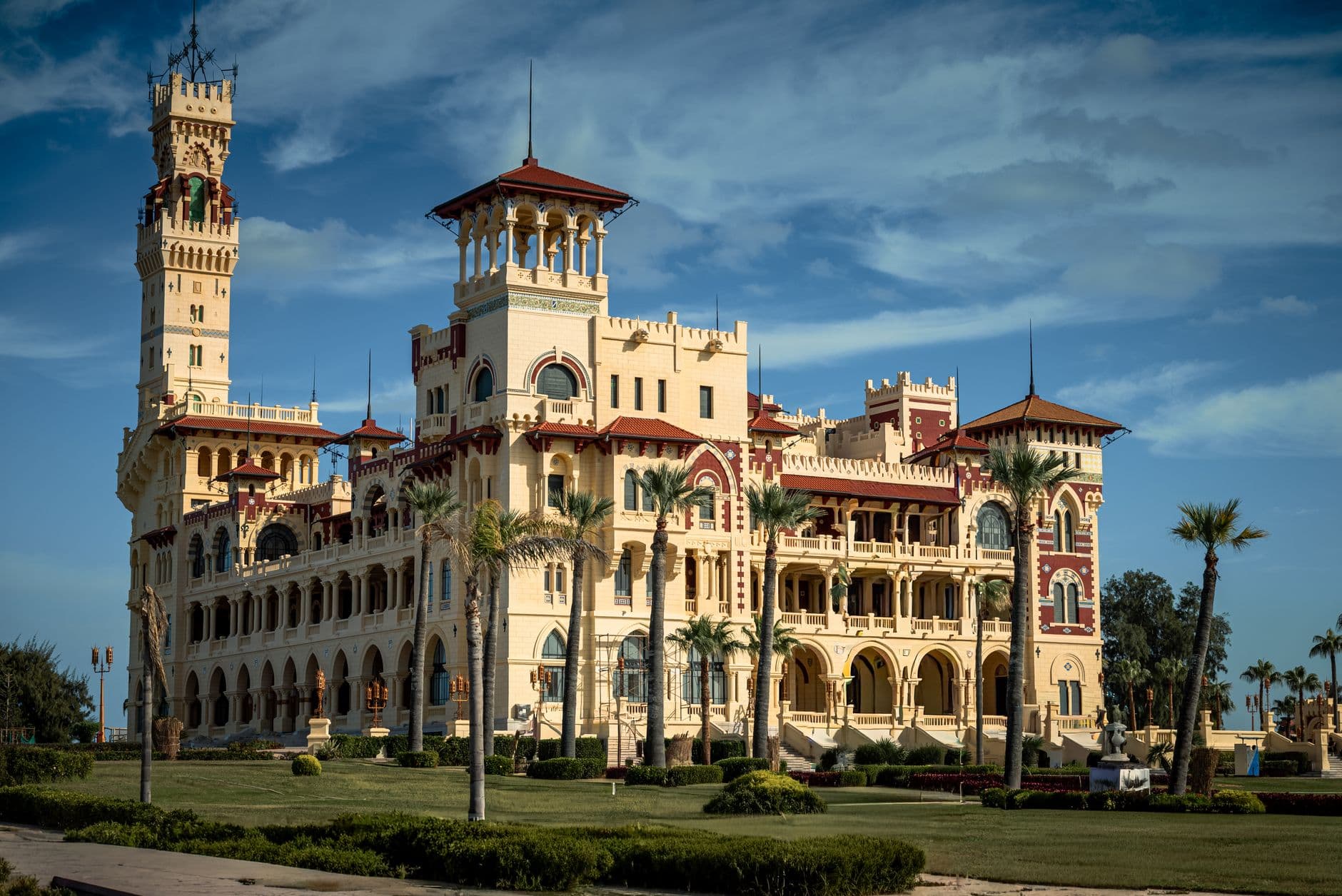
Montaza was built by Khedive Abbas II between 1892 and 1932 across two construction phases, and its architecture tells you everything about the identity crisis of Egyptian rulers under British supervision. The main palace mixes Florentine and Ottoman elements in a combination that architectural historians have variously described as eclectic, ambitious, and confused. What it actually represents is an Egyptian ruler trying to build something that would impress both his European creditors and his Egyptian subjects without fully committing to either.
The British used Montaza as a military hospital during the First World War. After the revolution, Nasser's government converted it into a public park. The gardens are the point now: 150 acres of Mediterranean vegetation on the sea, and in spring the bougainvillea is the color of something you don't have a word for in English.
The Commonwealth War Graves Cemeteries
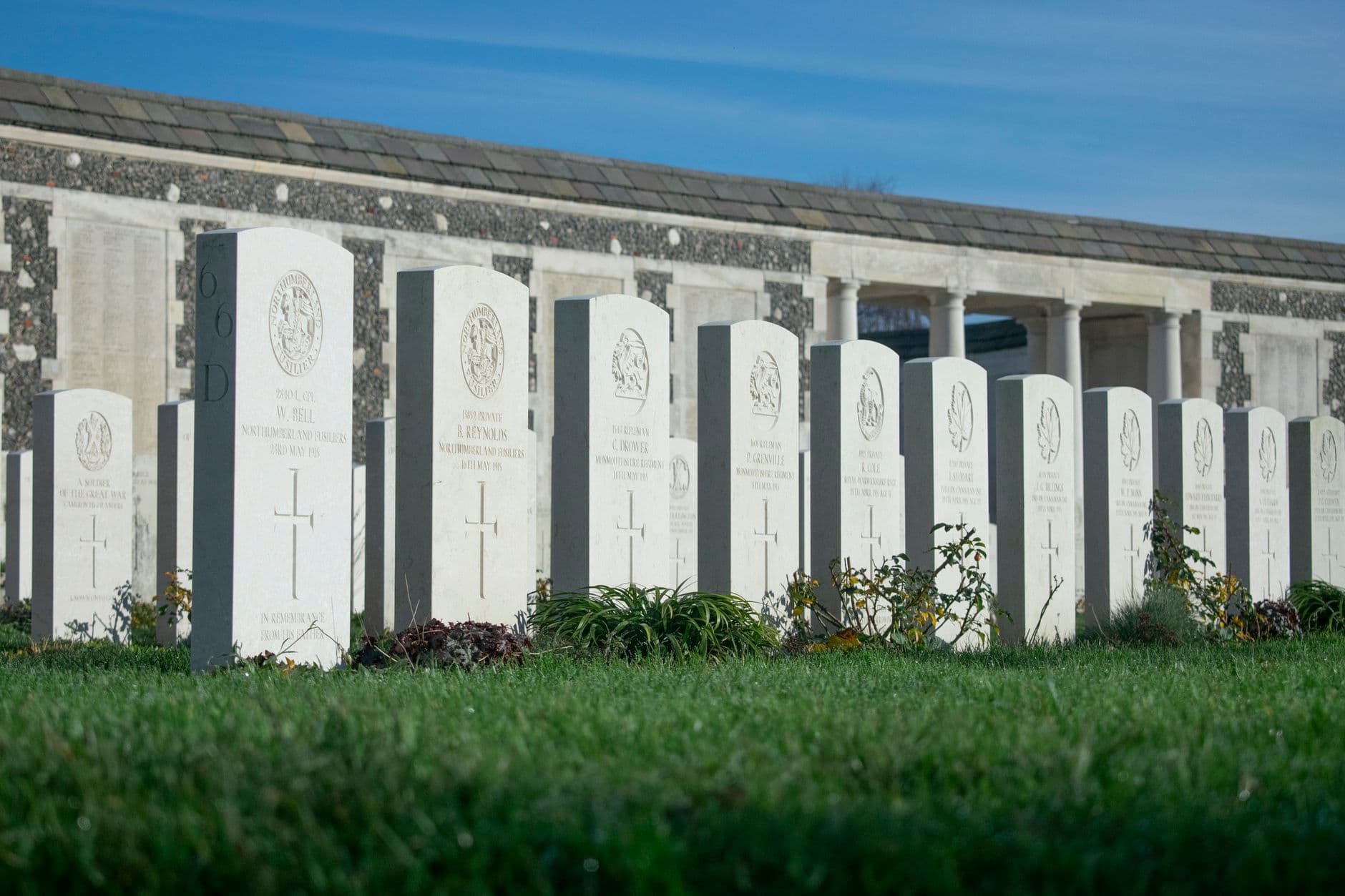
Egypt contains 28 Commonwealth War Graves Commission cemeteries. The two most significant are the Alexandria (Hadra) Military Cemetery and the Cairo War Memorial Cemetery in Heliopolis. Between them they hold over 3,000 graves from the First and Second World Wars.
The Heliopolis cemetery is the one most visitors overlook. It sits inside what is now a dense residential suburb, and finding it requires intention. The graves include soldiers from Australia, New Zealand, India, South Africa, and Britain, the full imperial apparatus of two wars fought partly in Egyptian territory. Reading the headstones, particularly the Indian and West African graves, gives the empire a human scale that no museum exhibit quite achieves.
These cemeteries are free, quiet, and almost never crowded. They are worth two hours of anyone's time.
The Connections: What the British Built On
The irrigation barrages at Assiut and Asyut, completed by British engineers in 1902, were built to regulate Nile flooding and increase cotton production for British textile mills. They were engineering achievements by any measure. They were also built over and around existing Islamic-era water management infrastructure that had served Egyptian agriculture since the Fatimid period. The British did not invent Nile management. They industrialized it.
The Egyptian Museum on Tahrir Square, opened in 1902, was built partly to stop the systematic removal of Egyptian antiquities to European collections. The irony is substantial: British and French archaeologists had been among the most prolific exporters of Egyptian objects throughout the 19th century. The museum's founding was, in part, a closing of the barn door. The Rosetta Stone, found by French soldiers in 1799 and seized by the British after Napoleon's defeat, is in the British Museum in London. Egypt has formally requested its return. The request has not been granted.
The Corniche road running along the Nile in Cairo, which every tourist walks and every local jogs, was widened and formalized under British administration. Its current form owes something to that period, though Cairenes have claimed it so completely that the colonial origin feels abstract.
Common Mistakes
Skipping Alexandria entirely. Most colonial-era Egypt tours focus on Cairo. Alexandria carries more of the physical imprint of the occupation than Cairo does, and it is two and a half hours away by train. One overnight is enough to change your understanding of the period.
Treating Garden City as scenery rather than text. The neighborhood rewards reading. The curve of a street, the setback of a gate, the weight of a building against a street: these are decisions made for reasons. Bring a basic knowledge of the period and the neighborhood becomes a document.
Paying for a colonial history walking tour before doing your own reconnaissance. Several tour operators offer excellent colonial Cairo walks. None of them are cheap. The neighborhoods are public, the streets are free, and a good book (Jason Thompson's 'A History of Egypt' is the best single-volume starting point) will tell you more than most guides.
The sound and light show at the Citadel. It costs EGP 350, runs for 45 minutes, and covers Islamic Cairo history in a format designed for people who do not want to read. It says nothing about the colonial period specifically and nothing you cannot get from standing in the Citadel during the day and reading a paragraph on your phone. Skip it.
Assuming the colonial layer is only European in character. The Heliopolis suburb, built by Belgian entrepreneur Edouard Empain beginning in 1905, is often grouped with British colonial sites but was Belgian-financed, designed by a mix of European and Egyptian architects, and intended as a cosmopolitan new city rather than a British administrative district. The Baron's Palace there, a Hindu-Moorish-Gothic confection that Empain built for himself, is one of the strangest buildings in Africa. It is currently under restoration and partially open.
Neglecting the Egyptian nationalist sites that exist alongside the colonial ones. The tomb of Ahmed Urabi, the colonel whose nationalist movement prompted the 1882 bombardment, is in the Cairo suburb of Heliopolis. The house where Saad Zaghloul, leader of the 1919 revolution, lived and worked is now the Saad Zaghloul Museum in Garden City, a 10-minute walk from the British Embassy. Visiting both in the same morning is not ironic. It is accurate.
Assuming nothing has been lost. The cosmopolitan Alexandria of the early 20th century, Greek coffeehouses, Italian opera seasons, Levantine commercial culture, was largely dismantled after the 1952 revolution and accelerated by the Suez Crisis of 1956, when Nasser nationalized the canal and expelled most of the European community. The buildings remain. The communities are almost entirely gone. What you are walking through is an archive, not a living culture.
Practical Tips
Wear comfortable shoes and plan for more walking than you expect. Garden City and Zamalek are manageable on foot; central Alexandria requires a mix of walking and trams (EGP 5 flat fare, cash only).
The best photography light in Cairo is early morning, before 9am, when the city is quieter and the Nile-facing streets catch the eastern light cleanly. In Alexandria the afternoon light on the Corniche is what painters have always come for.
For the cemeteries, register in advance with the Commonwealth War Graves Commission if you are searching for a specific grave. Their online records are complete and specific to the grave location within the cemetery.
If you read Arabic even partially, the street-level signage in older parts of Cairo occasionally carries dual-language text from the colonial period where the Arabic and English versions don't quite match, a small artifact of translation under pressure that no guidebook will point out to you.
The British colonial history sites guide you can construct from this article costs less than EGP 200 for a full day in Cairo, including metro, one museum, and lunch at a foul and ta'ameya shop in Garden City. The history is embedded in streets that have been Egyptian for decades. You just have to know where the seams are.
Frequently Asked Questions
The Weekly Dispatch
More on Egypt, every Friday.
Cultural depth and places most guides never mention.
No spam. Unsubscribe anytime.