British Colonial Egypt: The Sites That Tell the Occupation's Story
Britain occupied Egypt for 72 years but never officially colonized it. The architecture they left behind is still in use, and most visitors walk past it daily without knowing what it was.

Quick Facts
- Best time to visit
- October through March. Colonial sites involve sustained street-level walking in full sun. Summer heat makes afternoon tours physically punishing.
- Entrance fee
- Most colonial street architecture is free. Egyptian Museum: EGP 450 (approx. $9 USD), Royal Mummies room EGP 300 extra ($6 USD). Abdeen Palace Museum: EGP 200 (approx. $4 USD). De Lesseps House in Ismailia: EGP 40 (approx. $1 USD).
- Opening hours
- Egyptian Museum: daily 9am to 5pm. Abdeen Palace Museum: Saturday to Thursday 9am to 3pm, closed Friday. Street architecture accessible at all times.
- How to get there
- Cairo Metro Line 1 or 2 to Sadat Station (EGP 10). Taxis from Zamalek to downtown EGP 50 to 80. Bus from Cairo to Ismailia: EGP 50 to 70 from Turgoman terminal. Bus to Port Said: EGP 80 to 120.
- Time needed
- Downtown Cairo colonial walking tour: 4 to 5 hours. Full day combining Egyptian Museum and Abdeen Palace. Canal Zone day trip to Ismailia: 8 to 10 hours including travel.
- Cost range
- Budget EGP 600 to 900 per day (metro, street food, one museum). Mid-range EGP 1,800 to 2,500 (guided tour, two museums, sit-down lunch).
Britain occupied Egypt for 72 years and never once called it a colony. Officially, Egypt remained an Ottoman province, then a protectorate, then a nominally sovereign kingdom. This semantic game was not accidental. It allowed London to extract the Suez Canal revenues, station troops along the Nile Valley, and install compliant governments while insisting, to anyone who asked, that they were simply there to maintain order. The buildings they left behind are still standing, still in use, and largely unmarked. This is a guide to finding them, understanding them, and reading the city they shaped.
Quick Facts
Best time to visit: October through March. Cairo's colonial-era buildings are street-level experiences, which means you are walking in full sun. The difference between a February morning and a July afternoon is the difference between pleasure and survival.
Entrance fees: Most colonial-era sites are free to observe from the street. The Egyptian Museum (which was built under British-era administration in 1902) charges EGP 450 (approx. $9 USD) general admission, with an additional EGP 300 ($6 USD) for the Royal Mummies room. The Abdeen Palace Museum charges EGP 200 (approx. $4 USD).
Opening hours: Egyptian Museum daily 9am to 5pm. Abdeen Palace Museum Saturday to Thursday 9am to 3pm, closed Friday. Street architecture is always accessible.
How to get there: The Cairo Metro is the most efficient tool for navigating downtown's colonial layer. Sadat Station (Line 1 and 2 interchange) deposits you at Tahrir Square, the geographic heart of the Khedival and British-era city. Fare: EGP 10 per trip. Taxis from Zamalek run EGP 50 to 80.
Time needed: A serious walking tour of downtown colonial Cairo takes 4 to 5 hours. Combining it with the Egyptian Museum requires a full day.
Cost range: Budget EGP 600 to 900 per day (metro, street food, single museum). Mid-range EGP 1,800 to 2,500 (guided tour, two museums, lunch at a downtown cafe).
Why This Place Matters
The British arrived in Egypt in September 1882, following the bombardment of Alexandria and the defeat of Colonel Ahmad Urabi's nationalist army at the Battle of Tel el-Kebir. What followed was not a formal annexation but a prolonged administrative occupation that lasted until the 1952 revolution effectively ended it, with the last British troops withdrawing from the Canal Zone in 1956. During those 74 years, two Egypts were built simultaneously: the one governed from London through compliant khedives and pashas, and the one that resisted it.
The physical evidence of both is concentrated in three zones: downtown Cairo (Khedival Cairo, designed before the British arrived but administered through them), the Nile-side institutions built to project British scientific and administrative authority, and the Canal Zone cities of Port Said, Ismailia, and Suez, which were effectively company towns run by the Suez Canal Company under French and British joint ownership.
What most visitors engaging with British Egypt colonial history sites do not know is that the urban planning they see in downtown Cairo predates the British occupation by a decade. Khedive Ismail commissioned Baron Haussmann's collaborator, urban planner Ali Mubarak, to redesign Cairo on Parisian lines in the 1860s, partly to impress European dignitaries arriving for the opening of the Suez Canal in 1869. The British inherited this infrastructure and used it. The elegant boulevards of Wust el-Balad were Egyptian ambition first, British exploitation second.
Downtown Cairo: The Colonial City on Foot
Start at Midan Talaat Harb, the circular plaza anchored by the statue of Talaat Harb himself, the Egyptian economist who founded Bank Misr in 1920 specifically to create Egyptian-controlled capital independent of British financial institutions. The plaza is ringed by buildings from the early twentieth century: the Cicurel department store building, now a clothing retailer; the Groppi café, which opened in 1909 and served as the social center of the European and Levantine business community under British administration; and several insurance and banking buildings whose facades still carry the ornamental stonework of firms long since absorbed or dissolved.
Walk north on Talaat Harb Street toward Ramses and you pass the former Shepheard's Hotel site. The original Shepheard's, which stood from 1841 and became the unofficial headquarters of British officers and colonial administrators, was burned to the ground on January 26, 1952, during the Cairo Fire, in which nationalist mobs destroyed approximately 700 properties associated with British and foreign influence. The current building on the site is a replacement. The fire, which British authorities initially blamed on communist agitators, was more plausibly the work of a city that had decided it had tolerated enough.
The Abdeen Palace, fifteen minutes east on foot, tells a more complicated story. Built by Khedive Ismail between 1863 and 1874 to serve as the official seat of Egyptian government, it was here that the pivotal confrontation of the occupation took place: in January 1952, just days before the Cairo Fire, British forces surrounded Egyptian police barracks in Ismailia and demanded disarmament. When the police refused, the British shelled the building, killing 50 Egyptian officers. The outrage triggered the Fire. Abdeen's museum wing, which is rarely visited and genuinely worth your time, contains documents, medals, and royal correspondence from both the Khedival and British periods. The arms collection alone repays the entrance fee.
The Institutions Built to Last
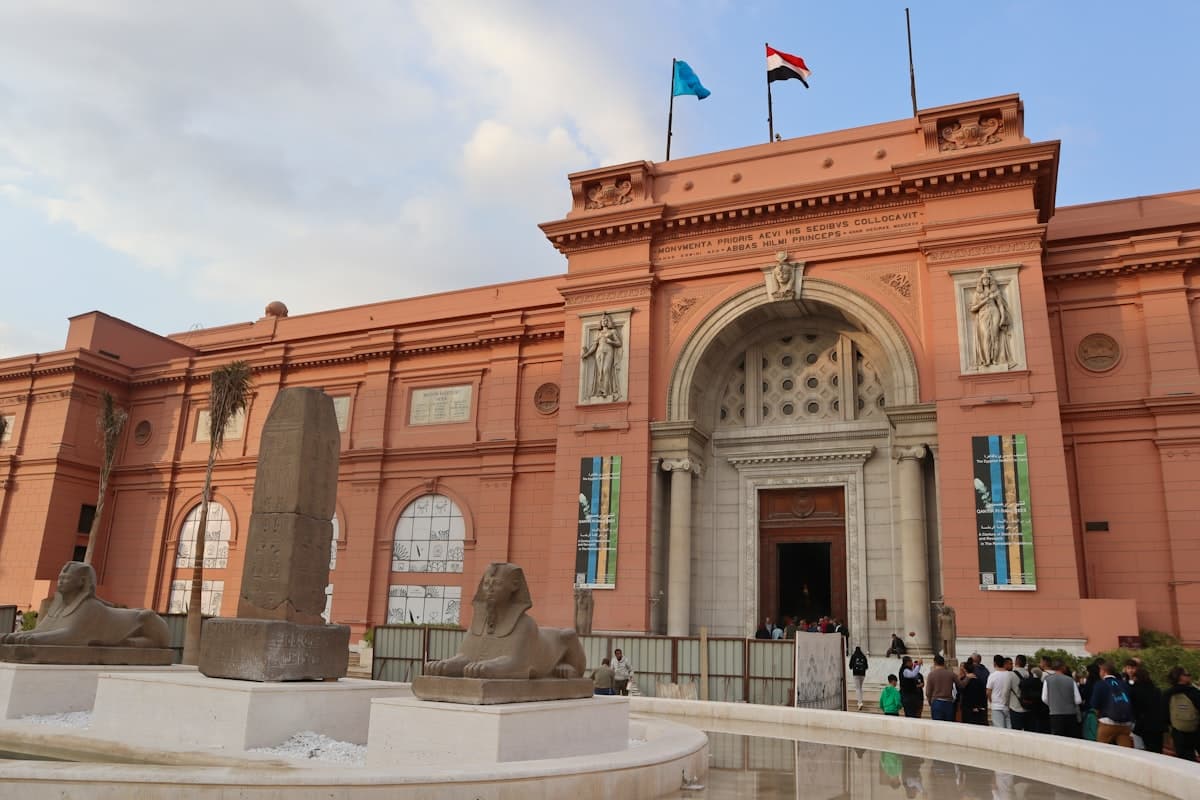
The Egyptian Museum on Tahrir Square, the coral-pink building that most visitors treat as a simple repository for ancient artifacts, was designed by French architect Marcel Dourgnon and inaugurated in 1902 under British Consul-General Lord Cromer. Cromer, who effectively governed Egypt from 1883 to 1907 without holding any formal Egyptian title, understood that institutions projected legitimacy. The museum was one of several built during his tenure, including the Cairo Sanitary Department and the reorganized Irrigation Department, which Cromer used to extend British administrative reach into the Nile Valley under the language of hydraulic modernization.
The Qasr el-Nil Barracks, which stood on the Nile corniche where the Nile Hilton now stands, housed British troops from 1882 until 1946. When the barracks were finally demolished, Egyptian newspapers described it as the removal of a splinter from the city's body. The site's current occupant, built in 1959, was deliberately designed to announce that something Egyptian had replaced something British. The symbolism was intentional.
For those seriously tracing the British Egypt colonial history sites circuit, Ismailia is worth the three-hour train journey from Cairo. The Ismailia Museum houses artifacts from the Eastern Delta and Canal Zone, but the city itself, with its colonial-era villas and the Ferdinand de Lesseps House (now a museum, EGP 40 entrance), is a preserved specimen of the Canal Zone as the British and French administered it. De Lesseps, the Frenchman who built the canal, is a contested figure: his statue was torn down by Egyptian workers in 1956, the week Nasser nationalized the canal.
The Connections
Nothing in Egypt exists in isolation, and the British colonial layer is no exception. The Citadel of Cairo, built by Saladin in the twelfth century on Muqattam Hill, was occupied by British forces from 1882 as a military garrison. The Mosque of Muhammad Ali inside the Citadel, completed in 1848, was already forty years old when British troops moved in. They were sleeping in the shadow of an Ottoman-commissioned mosque built on the ruins of a Fatimid palace over the foundations of a Pharaonic limestone quarry. Egypt compresses its contradictions vertically.
The Suez Canal itself connects directly to Pharaonic precedent most visitors miss entirely. The ancient Egyptians built a precursor canal linking the Nile to the Red Sea under Pharaoh Senusret III around 1850 BC, and later Darius I of Persia reopened it in the sixth century BC. When de Lesseps presented his canal project to European investors, he was not inventing a route. He was monetizing one that Egyptians had used for three thousand years. This context was entirely absent from the British justification for occupying the Canal Zone in 1882, which framed the occupation as the protection of a modern European enterprise.
The Corniche el-Nil, Cairo's riverside boulevard, was expanded and formalized during the British period, continuing a pattern set by Khedive Ismail. The felucca captains who work the same stretch of river today are operating a trade that predates every layer of foreign administration by several millennia. The British built the embankment. Egyptians were already on the water.
Common Mistakes
Skipping downtown entirely for the Giza plateau. The Pyramids are not the British colonial story. Downtown Cairo is. Most visitors to Egypt spend a combined forty minutes in the area that most directly explains what the British occupation looked like, felt like, and cost.
Taking the standard Egyptian Museum tour without context. The museum's colonial framing matters. Lord Cromer's administration also systematically allowed European and American collectors to export artifacts under licensing arrangements that were, by any contemporary standard, institutionalized looting. The museum was partly built to regulate what remained after those exports.
The Nile dinner cruise. This is not a colonial history experience. It is a tourist product that appropriates Nile aesthetics while telling you nothing about the river's administrative or political history. It costs EGP 800 to 1,500 per person and offers neither good food nor meaningful content. Take a felucca for EGP 100 an hour instead and bring your own reading.
Relying on Zamalek as a base for the colonial circuit. Zamalek, the island district developed as an upscale European residential area during the British period, is comfortable and well-serviced, but its distance from downtown adds forty minutes to every morning. Stay in downtown Cairo itself, where the colonial fabric is walkable from your door.
Missing Port Said entirely. The city at the northern mouth of the Suez Canal was the front line of British commercial power in Egypt and the site of the 1956 Suez Crisis military landings, when British and French forces briefly reoccupied the canal zone following Nasser's nationalization. The city's lighthouse, built in 1869, still stands. The memory of 1956 is not distant here. Ask anyone over sixty.
Assuming the colonial story is purely a Cairo story. Alexandria was where the British bombardment of 1882 began, and the city's Corniche, its Cecil Hotel (opened 1929, used as British military intelligence headquarters in World War Two), and its Greek and Italian neighborhoods are all part of the same layered occupation history. A day trip from Cairo by train (EGP 100 to 180 in air-conditioned second class) covers it adequately.
Paying for a colonial history guided tour without vetting the guide's Egyptian nationalist perspective. Most English-language tours of this material are still written from a framework that treats the British period as modernizing and benevolent. It was neither. Find a guide who can name Ahmad Urabi alongside Lord Cromer.
Practical Tips
The best single-day structure for tracing the colonial layer in Cairo: Metro to Sadat Station by 9am, Egyptian Museum until noon, lunch at one of the downtown fuul and ta'meya shops on Hoda Shaarawy Street (EGP 30 to 50 for a full meal), walking tour of Midan Talaat Harb, Groppi, and the surrounding blocks through the afternoon, Abdeen Palace if time allows before 3pm closing.
Bring a physical map or download offline maps before arrival. The downtown street grid follows the Haussmann-inspired plan reasonably consistently, but street names change at district boundaries and Google Maps has not always caught up with recent renamings, many of which have replaced colonial-era designations with Egyptian nationalist figures.
The heat between May and September is not a minor inconvenience. It is a serious planning consideration. A 4-hour walking tour at 11am in July is a medical event waiting to happen. Do the walking before 10am or after 4pm.
For the Canal Zone sites, the overnight train from Cairo to Port Said is no longer operating reliably. The bus from Cairo's Turgoman terminal runs every two hours, costs EGP 80 to 120, and takes approximately 3.5 hours. Ismailia is served by buses from the same terminal for EGP 50 to 70, taking 2 hours.
The most honest summary of what the British left in Egypt is this: buildings that still function, institutions that were deliberately underfunded to prevent Egyptian self-sufficiency, and a canal they did not build but occupied for 74 years. The architecture is worth seeing. The history behind it is worth knowing before you go.
Frequently Asked Questions
The Weekly Dispatch
More on Egypt, every Friday.
Cultural depth and places most guides never mention.
No spam. Unsubscribe anytime.