British Colonial Egypt: The Sites That Tell the Real Story
Britain occupied Egypt for 72 years but never officially called it a colony. The sites where that contradiction played out are hiding in plain sight across Cairo.

Quick Facts
- Best time to visit
- October to March. Cairo winters allow comfortable walking between sites. Summer heat above 35C makes the outdoor colonial streetscapes nearly impossible.
- Entrance fee
- Egyptian Museum EGP 450 (approx $9 USD), students EGP 225. Abdeen Palace Museum EGP 100 (approx $2 USD). Empain Palace grounds Heliopolis approx EGP 50 (approx $1 USD). Most street-level colonial architecture is free to view.
- Opening hours
- Egyptian Museum daily 9am to 5pm. Abdeen Palace Museum Saturday to Thursday 9am to 3pm, closed Friday. Garden City and Heliopolis streets accessible at all hours.
- How to get there
- Metro Line 1 to Sadat station for Egyptian Museum, Tahrir Square, and Garden City. Metro Line 3 to Heliopolis or taxi from downtown EGP 80 to 120. Taxi from Cairo Airport to downtown colonial district EGP 150 to 250.
- Time needed
- Minimum one full day for downtown Cairo and Garden City. Two days to include Heliopolis and the Citadel northern enclosure properly.
- Cost range
- Budget EGP 600 to 900 per day covering metro, museum entries, and street food. Mid-range EGP 1,800 to 2,800 per day including a specialist historian guide (EGP 600 to 800).
Quick Facts
Best time to visit: October to March, when Cairo is cool enough to walk between sites without losing your mind. The outdoor colonial-era spaces, particularly the Gezira and Garden City streets, are miserable in July.
Entrance fees: Most colonial-era sites are free to enter or view externally. The Egyptian Museum (where British archaeologists deposited their finds) costs EGP 450 (approx $9 USD), students EGP 225. The Abdeen Palace Museum costs EGP 100 (approx $2 USD). Some Garden City mansions are now embassies and cannot be entered.
Opening hours: Egyptian Museum daily 9am to 5pm. Abdeen Palace Museum Saturday to Thursday 9am to 3pm, closed Friday. Street-level colonial architecture is accessible at any hour.
How to get there: Cairo Metro Line 1 to Sadat station puts you within walking distance of the Egyptian Museum, Tahrir Square, and Garden City. A taxi from Cairo Airport to the downtown colonial district costs EGP 150 to 250 (approx $3 to $5 USD). The colonial buildings in Heliopolis are best reached by Metro Line 3 to Heliopolis or by taxi from downtown for EGP 80 to 120.
Time needed: A focused colonial Cairo walking tour requires a full day. To do it properly across multiple neighborhoods, including Heliopolis, Garden City, and downtown, allow two days.
Cost range: Budget EGP 600 to 900 per day covering transport, museum entry, and street food. Mid-range EGP 1,800 to 2,800 per day if you add a guided walking tour (EGP 600 to 800 for a good local historian guide).
---
Why This Place Matters
Britain occupied Egypt in 1882 and stayed until 1956, yet it never formally made Egypt a colony. For most of that period, Egypt remained nominally under Ottoman suzerainty, then nominally independent under a king. The British Agent and Consul-General ran the country from a villa in Garden City, not from a governor's palace. This legal fiction produced an extraordinary built environment: a country administered by a foreign power that could not officially leave its name on anything, which means the evidence is scattered, layered, and far more interesting than a straightforward colonial capital.
Lord Cromer, the man who actually governed Egypt from 1883 to 1907, held the title of Consul-General. He controlled the budget, the army, the irrigation system, and effectively every minister. He wrote two books about Egypt after leaving, both of which reveal more about Victorian assumptions than about Egyptians. His residence, the British Agency, stood in what is now Garden City, a neighborhood that Cromer's administration literally designed and built on land drained from the Nile floodplain. That neighborhood, with its curved streets deliberately planned to prevent the kind of barricade-building that had troubled the French in Paris, is still there.
The British occupation also intersected with three thousand years of previous occupation. The barracks they built at Qasr el-Nil sat over Mamluk-era waterfront structures. The Citadel they used as a military headquarters had been built by Saladin in the twelfth century on a spur of the Muqattam Hills where Pharaonic quarries once operated. Nothing in Egypt exists in a single era.
---
Garden City and the Architecture of Indirect Rule
Garden City does not look like a colonial neighborhood. It looks like a slightly faded European quarter that took a wrong turn somewhere between Paris and Beirut. That is precisely what it is. The curved, tree-lined streets were laid out between 1905 and 1910 on land that had been royal gardens, using a design explicitly borrowed from the English garden city movement of Ebenezer Howard. The British brought the concept, an Egyptian prince provided the land, and the resulting neighborhood housed the British Agency, senior Egyptian officials, and eventually the embassies that remain there today.
Walk down Kamal el-Din Salah Street in the early morning, before the traffic arrives, and you can still read the architectural argument the occupation made about itself: these are not administrative blocks, they are homes, domestic, reasonable, permanent. The buildings are a mix of neoclassical, Islamic revival, and what historians of Egyptian architecture call the "Arabesque compromise," facades with pointed arches and mashrabiya screens applied to otherwise European floor plans. It was an architecture of legitimacy-seeking.
The British Embassy compound remains on its original site on Corniche el-Nil. You cannot enter, but the exterior tells you something: it faces the river, not the city. This was true of almost all significant British buildings in Cairo. They oriented themselves toward the Nile and toward each other, not toward the existing urban fabric of Islamic Cairo to the north and east.
One specific detail worth knowing: the road layout of Garden City was deliberately irregular to prevent crowds from gathering and moving en masse. This was documented in the urban planning records of the period. The British administrators were still thinking about the 1882 uprising of Ahmed Urabi, the Egyptian army officer whose nationalist revolt had provided Britain's justification for intervention in the first place.
---
The Egyptian Museum's Colonial Backstory
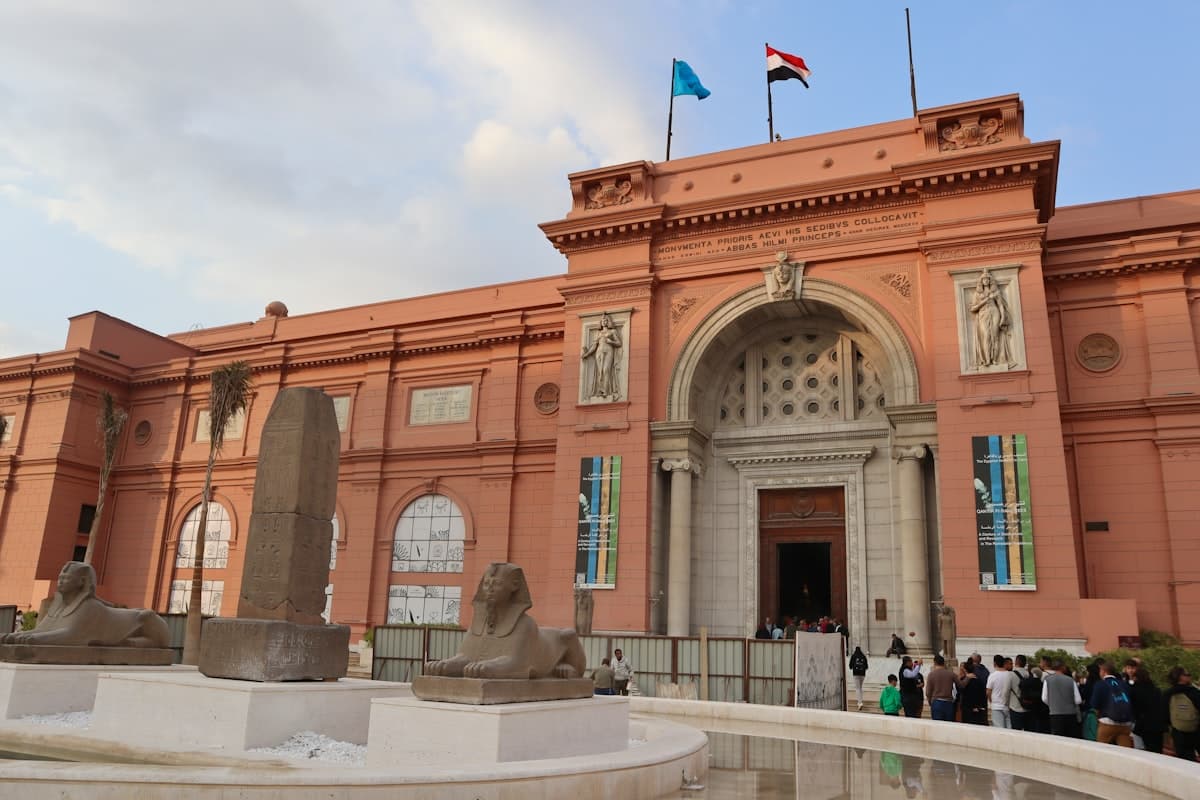
The building on Tahrir Square that houses Egypt's national collection was designed by the French architect Marcel Dourgnon, completed in 1902, and funded partly through the proceeds of a khedival government that was, by that point, effectively managed by British financial advisors. This is the museum where Howard Carter's finds from Tutankhamun's tomb eventually landed, where Flinders Petrie deposited documentation of his excavations, and where the systematic transfer of Egyptian antiquities to European collections was also organized.
Before this building existed, Egyptian antiquities were stored in a series of increasingly inadequate facilities. The first dedicated antiquities museum was established in 1835 by Muhammad Ali's government, but its entire collection was given to Archduke Maximilian of Austria in 1855 as a diplomatic gift. The collection was effectively rebuilt from scratch.
The colonial history of British Egypt is embedded in this building's catalog. The Egyptian Antiquities Service was run by French archaeologists for most of the British occupation period, a compromise between competing European imperial interests, which produced a genuinely strange administrative situation: Britain controlled the country, France controlled the digs. This arrangement lasted until 1952. When you walk through the museum's upper floor and see the Amarna artifacts, you are looking at objects whose excavation, cataloging, and interpretation were shaped by this Franco-British competition as much as by any scholarly impulse.
The room containing the royal mummies is also, if you know where to look, a record of which pharaohs were looted by nineteenth-century collectors and which were found intact by the formal archaeological establishment. The difference in what survives tells you something about the difference between the two eras.
---
Heliopolis: The Colonial City That Forgot It Was Colonial
Northeast of central Cairo, about thirty minutes by Metro or forty by taxi depending on traffic, is a neighborhood that represents the most complete surviving example of British-era urban planning in Egypt, and almost nobody visits it as a colonial history site because it does not feel like one.
Heliopolis was built entirely from scratch beginning in 1905 by Baron Édouard Empain, a Belgian industrialist who obtained a concession from the Egyptian government to build a new city in the desert. Empain was not British, but his project was made possible by the investment climate and legal framework the British occupation had created, and the neighborhood was populated primarily by British and other European residents of Cairo who worked in the colonial administration.
Empain's own palace, the Palais Hindou, still stands on a rotary on Abu Bakr el-Siddiq Street. It is one of the strangest buildings in Africa: a Hindu-Moorish fantasy of rotating statues and covered terraces, built by a Belgian for himself in the Egyptian desert using Indian architectural references, because Empain had recently returned from a business trip to Southeast Asia and liked what he saw. The building is currently under restoration and partially accessible. It costs EGP 50 to enter the grounds.
The broader Heliopolis street grid, its arcaded sidewalks, its Belle Epoque apartment buildings with Islamic ornamental details, and its surviving tram line (one of the oldest in Africa, dating to 1906) represent a kind of colonial urbanism that was always more honest about its intentions than Garden City. Empain was not pretending to govern. He was building a real estate investment. The result, a century later, is a neighborhood that Cairenes simply call home, which may be the most complete colonial legacy of all.
---
The Connections
The Qasr el-Nil barracks, which stood where the Nile Hilton and the Arab League headquarters now stand, were the physical center of British military occupation. The Egyptian army evicted from those barracks in 1882 included officers trained in the Ottoman military tradition and armed partly through French military assistance programs. The site before the barracks was a Mamluk-era waterfront palace. The site after the barracks is now the plaza where the 2011 revolution gathered. The same ground has absorbed every major shift in Egyptian political life for six hundred years.
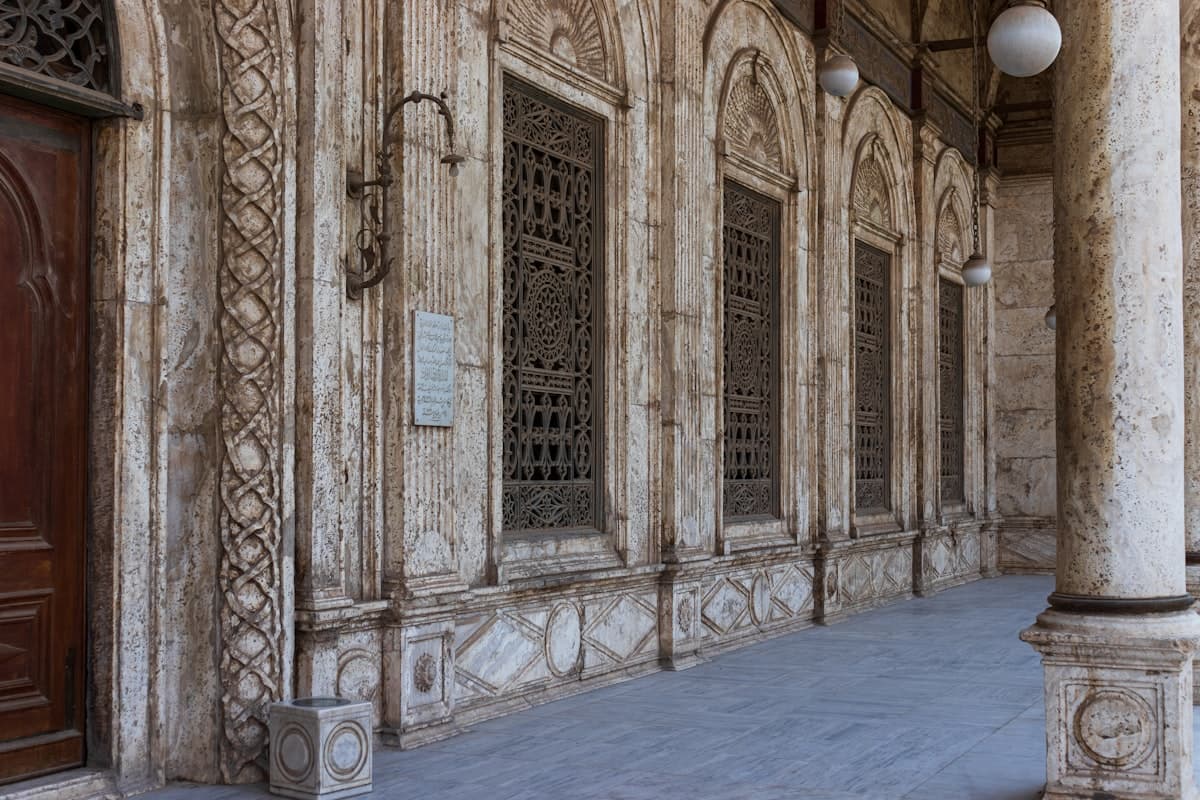
The Citadel, which British forces used as a military garrison until the 1946 evacuation, was built by Saladin between 1176 and 1183 using stone quarried from the Giza plateau. The British modifications to the Citadel, particularly the Joseph's Well pumping systems they mechanized and the barracks they expanded, are still visible in the northern enclosure. Most visitors to the Citadel see only the Muhammad Ali Mosque. The northern enclosure, which contains the British-era military museum and the Carriage Museum, receives a fraction of the traffic and is considerably more honest about the full history of the site.
Coptic Cairo connects to this history too. The British administration was consistently more protective of Egypt's Coptic Christian minority than the preceding khedival governments had been, partly for strategic reasons related to managing a population they considered more reliably pro-British. The Coptic Museum in Old Cairo, which holds some of the most important early Christian artifacts in the world, was founded in 1910 under British patronage, with Coptic community funding and the active support of the Antiquities Service. It is an institution with a colonial origin that became genuinely Egyptian.
---
Common Mistakes
Visiting only the Egyptian Museum without understanding its political history. The museum is extraordinary, but most visitors treat it as a neutral repository. Reading about the history of the Antiquities Service before you go transforms the experience. The galleries are not arranged by scholarship alone. They reflect a century of Franco-British competition, khedival politics, and post-revolutionary Egyptian nationalism.
Taking a colonial Cairo tour without including Heliopolis. Every guided walking tour offered in downtown Cairo covers Garden City and the museum district. Almost none include Heliopolis, which requires thirty extra minutes of travel but contains the most intact and livable colonial urban environment in the country.
Paying EGP 400 for the Nile Hilton rooftop bar to see the view of where the Qasr el-Nil barracks stood. The information plaques outside the Arab League building explain the site's history for free. The view from the Qasr el-Nil Bridge is better and costs nothing.
Skipping the Abdeen Palace Museum. This is genuinely underrated. Abdeen contains rooms that document the British occupation directly, including royal correspondence and photographs from the period when British Agents dictated terms to Egyptian khedives in the formal reception rooms now on display.
Relying on English-language colonial history plaques. They are sparse, often outdated, and occasionally wrong. Bring a good book. Roger Owen's "Lord Cromer: Victorian Imperialist, Edwardian Proconsul" and Khaled Fahmy's "In Quest of Justice" give you the framework to read what you are actually looking at.
Dismissing the colonial period as simply British. The occupation drew in French administrators, Italian architects, Greek merchants, Armenian photographers, and Jewish financiers. The colonial sites reflect all of these communities. The Greek Orthodox Patriarchate in downtown Cairo, the Armenian Church in Bab el-Louq, and the Italian-owned buildings on Talaat Harb Street are part of the same history.
Expecting explanatory signage at street-level colonial sites. There is almost none. Garden City has no walking tour markers. The Empain Palace in Heliopolis has limited interpretation. You will need to do the reading before you arrive, or hire a local historian guide who specializes in modern Egyptian history, not pharaonic history.
---
Practical Tips
The best guide to British Egypt colonial history sites is not a tour company but an individual: look for Egyptian historians who advertise walking tours of modern Cairo specifically. The pharaonic guide industry is vast and competitive. The modern history specialists are fewer, charge similar rates, and offer something most visitors cannot find elsewhere.
Wear comfortable shoes that can handle both cobblestone and marble. A colonial Cairo day will take you from Garden City's tree-lined streets to the Egyptian Museum's stone floors to the Citadel's uneven northern enclosure.
Photography of embassies and military buildings is technically restricted and occasionally enforced. Do not photograph the British Embassy or any building currently housing a government security function. The colonial-era private buildings and residential streets are photographable without restriction.
The best time to walk Garden City is 7am to 9am on a weekday, when the streets are quiet and the morning light is coming through the eucalyptus trees at an angle that makes the architecture legible. After 10am, the area is clogged with traffic serving the embassy district.
For Heliopolis, go on a Friday morning. The weekend quiet means you can walk the arcaded streets and actually hear yourself think. The Empain Palace grounds are best visited when they are not crowded, which is almost always.
If you are combining this guide with other Egyptian history, the logical sequence is: one day in downtown Cairo and Garden City, one day at the Egyptian Museum with the specific colonial framing in mind, a morning at Heliopolis, and an afternoon at the Citadel's northern enclosure. That covers the core of what the British colonial period left behind in visible, accessible form.
Frequently Asked Questions
The Weekly Dispatch
More on Egypt, every Friday.
Cultural depth and places most guides never mention.
No spam. Unsubscribe anytime.