British Egypt Colonial History Sites: The Full Guide
Britain occupied Egypt for 72 years but never officially colonized it. The legal fiction cost thousands of lives. Here is where the evidence still stands.

Quick Facts
- Best time to visit
- October to March. Cairo temperatures are manageable for walking outdoor sites, and Alexandria is dry and clear. Avoid July and August when daytime heat above 38°C makes walking colonial-era neighborhoods genuinely unpleasant.
- Entrance fee
- Abdeen Palace EGP 200 (approx $4 USD), Baron Empain Palace EGP 100 (approx $2 USD), Port Said National Museum EGP 100 (approx $2 USD), Egyptian Museum EGP 450 (approx $9 USD). Most sites offer 50% student discounts with valid ID.
- Opening hours
- Abdeen Palace Tuesday to Sunday 9am to 3pm. Baron Empain Palace daily 9am to 5pm. Egyptian Museum daily 9am to 5pm (Fridays closed 11:15am to 1:30pm for prayer). Port Said National Museum Tuesday to Sunday 9am to 4pm.
- How to get there
- Cairo metro Line 1 to Heliopolis stations (EGP 8 flat fare). Ride-share apps (Uber, Careem) to Abdeen Palace from central Cairo approximately EGP 50 to 80. Cairo to Alexandria by train from Ramses Station, EGP 120 to 200 second class, 2.5 hours. Cairo to Port Said by bus from Turgoman Station, EGP 100 to 150, 2.5 to 3 hours.
- Time needed
- Two full days in Cairo to cover primary colonial sites without rushing. One full day in Alexandria. Half day in Port Said. Total three to four days for a comprehensive British Egypt colonial history visit.
- Cost range
- Budget EGP 600 to 900 per day covering metro, entry fees, and street food. Mid-range EGP 2,000 to 3,500 per day including a licensed guide and restaurant meals. Private guide rates EGP 800 to 1,500 for a half-day.
Quick Facts
Best time to visit: October to March, when Cairo temperatures stay below 25°C and outdoor sites are walkable without heat exhaustion.
Key sites and entrance fees: Abdeen Palace Museum: EGP 200 (approx $4 USD), students EGP 100. Open Tuesday to Sunday, 9am to 3pm. Baron Empain Palace (Heliopolis): EGP 100 (approx $2 USD). Open daily 9am to 5pm. Port Said National Museum (colonial artifacts section): EGP 100 (approx $2 USD). Open Tuesday to Sunday, 9am to 4pm. Egyptian Museum (colonial and Napoleonic-era rooms): included in EGP 450 (approx $9 USD) main ticket. Ras el-Tin Palace (Alexandria, exterior and grounds only): access varies seasonally, check locally.
Getting around: Cairo sites are best combined using the metro (EGP 8 per journey, flat fare) and ride-share apps. Heliopolis is Line 1 from Attaba to Heliopolis stations (El-Nozha or Haroun). Alexandria sites require a taxi or ride-share from Ramses station after a 2.5-hour train from Cairo (EGP 120 to 200 second class).
Time needed: Allow two full days in Cairo to cover the primary colonial-era sites without rushing. Add one full day in Alexandria and a half-day in Port Said if you want a complete picture of British Egypt colonial history.
Cost range: Budget EGP 600 to 900 per day covering transport, entry fees, and street food. Mid-range EGP 2,000 to 3,500 per day with a guide and sit-down meals.
---
Britain occupied Egypt in September 1882 following the Battle of Tel el-Kebir, a 35-minute engagement in which 57 British soldiers died compared to roughly 2,000 Egyptian casualties. For the next 40 years, Britain ran the country through a system it called a "protectorate," then a "veiled protectorate," then a "sphere of influence." It never used the word colony. The legal gymnastics were deliberate: calling Egypt a colony would have required Parliament to legislate for it, which would have invited scrutiny Britain preferred to avoid. So Egypt was occupied but not colonized, controlled but not administered, British in all but name. The sites that survive from this period are the physical evidence of that contradiction, and they are stranger, more layered, and more honest about power than any official history.
Why This Place Matters
The standard narrative of British colonialism in Egypt tends to open with Lord Cromer, the British Consul-General who ran the country from 1883 to 1907 with near-absolute authority while technically serving under the Khedive. What that narrative often omits is that Cromer was simultaneously a director of the Suez Canal Company, which was partly French-owned, and that his financial policies deliberately suppressed Egyptian cotton manufacturing to keep Egypt as a raw-material exporter for British mills in Lancashire. This was not incidental. It was policy.
What also tends to get omitted from the British Egypt colonial history guide: the occupation was triggered partly by a nationalist uprising. Ahmed Urabi, an Egyptian army colonel who organized the first mass political movement in modern Egyptian history, was demanding constitutional limits on Khedival power and protections against European financial domination when Britain intervened militarily. Urabi was exiled to Ceylon. He returned to Cairo in 1901 and died there in 1911. There is a statue of him now in Ramses Square.
The sites that bear witness to this 72-year period are scattered across Cairo, Alexandria, and the Canal Zone. They include palaces built by Egyptian rulers trying to impress European creditors, public buildings designed by British architects to project imperial permanence, entire new cities commissioned by financiers who assumed the occupation would never end, and cemeteries where the British buried soldiers who died enforcing a legal fiction. Each one rewards careful attention.
Cairo: The Architecture of Occupation
Abdeen Palace and the Weight of Debt
Khedive Ismail built Abdeen Palace between 1863 and 1874 at a cost that contributed directly to the Egyptian state bankruptcy of 1876, which is the event that gave European creditors the justification to install a Dual Control Commission over Egyptian finances, which is what created the conditions for the Urabi uprising, which is what gave Britain its pretext to invade. The palace is a consequence and a cause simultaneously.
Today the palace is a museum complex, and most visitors move through the state rooms looking at the chandeliers. Go instead to the weapons museum on the lower level and to the silver museum. The weapons collection includes British-era military artifacts alongside Ottoman and Mamluk pieces that make the transitions of power visible in a single room. The silver collection contains diplomatic gifts from European heads of state to the Khedives, which is another way of saying: evidence of the negotiation between Egyptian rulers and European powers over the terms of their own subordination. The pieces are remarkable. The context makes them more so.
One connection almost no guide mentions: the square in front of Abdeen Palace was the site of the confrontation on February 4, 1942, when British Ambassador Sir Miles Lampson surrounded the palace with tanks and troops and forced King Farouk to appoint a pro-British prime minister under threat of deposition. This event, known in Egyptian history as the Abdeen Palace Incident, destroyed Farouk's credibility with Egyptian nationalists and contributed directly to the conditions that produced the 1952 revolution. The tanks are gone but the square is the same square.
Heliopolis: A City Built on a Bet
The suburb of Heliopolis, northeast of central Cairo, was built almost entirely between 1905 and 1915 by Edouard Empain, a Belgian industrialist who obtained a 99-year concession from the Egyptian government to develop desert land on the condition that he build a tramway connecting it to Cairo. He built the tramway, the city, the hotels, the churches, and the Baron Palace for himself, a Hindu-Flemish architectural hallucination that has no equivalent anywhere else in the world.
Empain's palace was designed by French architect Alexandre Marcel after a Cambodian temple. It was completed in 1911. Empain lived in it until he left Egypt. After his departure it passed through several owners, fell into severe disrepair, and was partially restored by the Egyptian government and opened to the public in 2020 after 17 years of renovation. The interior is still not fully finished, but the exterior and the newly accessible rooms are worth the visit for the sheer improbability of the thing: a Belgian baron's fantasy of Asian architecture sitting in a Cairo suburb, surrounded by apartment blocks, adjacent to a Coptic church and a mosque.
The Heliopolis neighborhood itself is the larger lesson. Walk Baron Street and the surrounding grid. The buildings are a catalog of early 20th-century European styles adapted for Egyptian conditions: colonnaded arcades to block the sun, rooftop terraces, Arabic and Islamic decorative motifs applied to European facades. This is what the occupation looked like at street level for the Europeans who lived comfortably inside it, and the streets are substantially intact.
Alexandria: The City Britain Actually Shelled
In July 1882, two months before Tel el-Kebir, the British Mediterranean Fleet bombarded Alexandria for ten and a half hours. The shelling destroyed roughly 40 percent of the city, killed an unknown number of Egyptian civilians (estimates range from several hundred to over a thousand), and burned the city center. The official British justification was that Egyptian forces were fortifying the harbor. The less official reason was to demonstrate consequences for resistance.
The Alexandria that tourists visit today is substantially a reconstruction built in the aftermath of that bombardment and during the subsequent decades of occupation. The Corniche, the Cecil Hotel (opened 1929), the Mohammed Ali Square, the monumental European-style buildings along the waterfront: these are occupation-era constructions built on the ash of what the occupation destroyed to justify itself. This is not a comfortable story, and it is rarely told on site.
The Ras el-Tin Palace, west of the city center, was where King Farouk signed his abdication on July 26, 1952, before boarding a yacht into exile. The palace grounds are partly open and the exterior is worth seeing for its scale and its Ottoman-Egyptian hybrid architecture. The abdication room is not publicly accessible, but the act it witnessed ended the last chapter of the British Egypt colonial era definitively.
The Cavafy Museum, in the apartment where Greek-Alexandrian poet Constantine Cavafy lived from 1907 until his death in 1933, is the most honest cultural document of colonial Alexandria available to visitors. Cavafy wrote about power, desire, decline, and the polyglot city he inhabited. His apartment has been preserved as a museum (entry approximately EGP 50). Read him before you visit.
The Suez Canal Zone: Where the Occupation Ended
The 1922 declaration of Egyptian independence was not, in practical terms, independence. British troops remained in the Suez Canal Zone under treaty arrangements until 1956, when Nasser nationalized the Canal and Britain, France, and Israel launched the military operation known as the Suez Crisis. British forces withdrew from Egyptian soil permanently on December 22, 1956.
Port Said, at the northern entrance of the Canal, bears the most visible evidence of this late colonial period. The Port Said National Museum contains photographs, documents, and artifacts from the 1956 conflict, including material from the tripartite invasion. The city itself suffered significant damage during the 1956 fighting and the subsequent 1967 and 1973 conflicts. What you see walking Port Said is a city that has been fought over several times for control of a waterway that generates approximately $9 billion USD in annual revenue at current rates.
The statue of Ferdinand de Lesseps, the French engineer who supervised the Canal's construction and is credited with its creation, stood at the Canal entrance at Port Said until 1956, when Egyptians pulled it down during the nationalization. The plinth remained empty for years. It is now a decorative element. The Canal was built between 1859 and 1869 using forced labor, corvée labor technically, by Egyptian workers under conditions that killed an estimated 120,000 people over the course of construction. De Lesseps was celebrated in Europe. The Egyptian workers have no monument.
The Connections
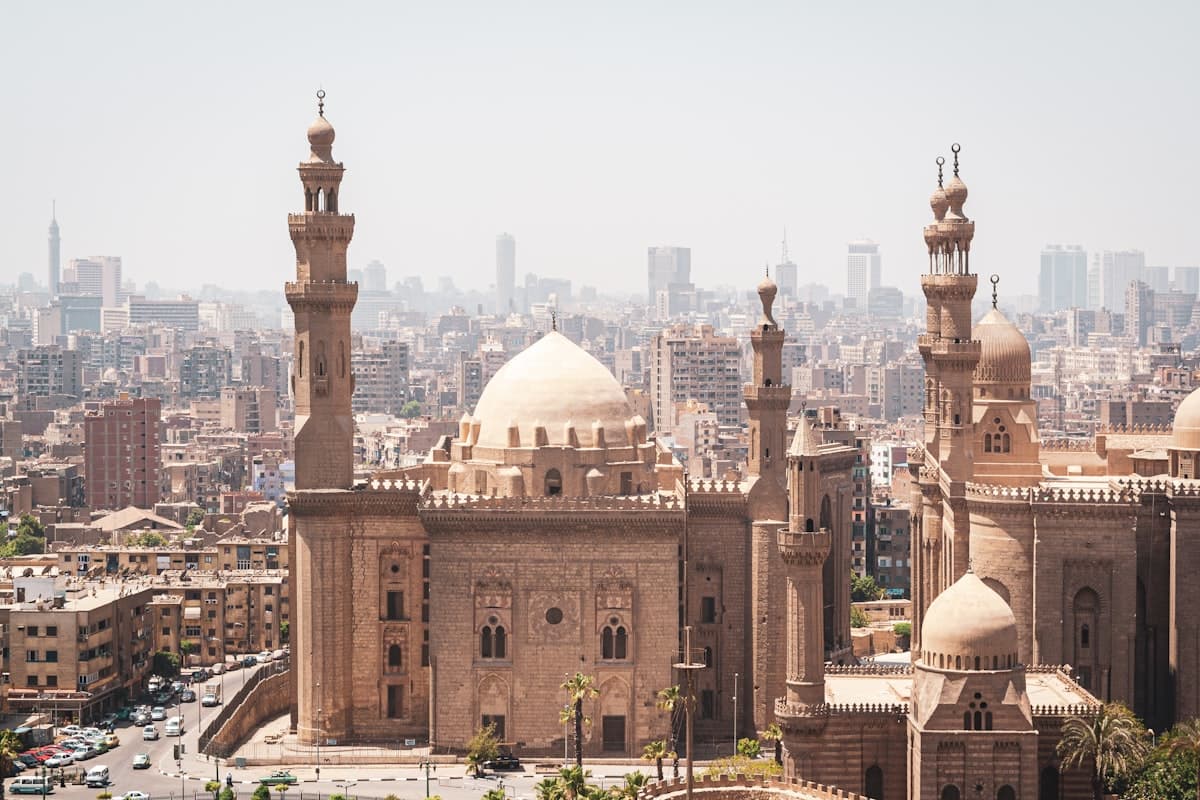
Nothing in Egypt exists in a single era, and the British colonial period is no exception. The Egyptian Museum in Tahrir Square, which British administrators helped fund and organize at its founding in 1902, sits on a square that was named Liberation Square (Tahrir) after the 1952 revolution, which then became the site of the 2011 uprising that ended the Mubarak government. The museum that Britain helped build faces the square where Egyptians have repeatedly demonstrated that they make their own history.
Kasr el-Aini Hospital in Cairo, Egypt's oldest and largest public hospital, was reorganized by British military physicians during the occupation and was where Egyptian medical training was substantially restructured along British lines. The medical school attached to it produced the first generation of Egyptian doctors trained under European curricula. Medicine, like everything else under occupation, was a site of simultaneous imposition and appropriation.
The Coptic Museum in Old Cairo, founded in 1910 with significant British scholarly involvement, preserves Coptic textiles, manuscripts, and icons that would otherwise have been scattered by the antiquities trade that British and European collectors had been feeding for decades. The institution that protected the objects was partly built by the same network that had been depleting them. Egypt's relationship with the people who studied it during the colonial period is exactly this complicated.
Common Mistakes
Visiting the Egyptian Museum expecting British colonial context. The museum is extraordinary for Pharaonic material. Its documentation of the colonial period is thin. Do not rely on it for this particular history. Use it for the Amarna and Tutankhamun rooms and go elsewhere for the 19th and 20th century.
Taking an organized colonial history tour without checking the guide's credentials. Several Cairo operators offer "colonial history" tours led by guides whose knowledge of the period is superficial. Ask specifically whether the guide can speak to the 1882 bombardment of Alexandria, the Dual Control financial commission, and the 1942 Abdeen Palace Incident. If they cannot, find another guide.
Skipping Heliopolis because it looks like a suburb. This is the most consistent mistake made by visitors interested in British Egypt colonial history. Heliopolis is not a side trip. It is a primary document of how the occupation reorganized Cairo's geography for European benefit.
Spending money on the Cairo Nile cruise dinner shows. They cost between EGP 800 and EGP 1,500 per person and have no connection to any history, colonial or otherwise. The money is better directed toward a private guide for a half-day walk through Downtown Cairo's early 20th-century architecture.
Assuming the Suez Canal area is accessible as a day trip from Cairo. Port Said is doable in a day but requires a 2.5 to 3 hour bus from Cairo's Turgoman station (EGP 100 to 150 each way). Start early or stay overnight.
Visiting Alexandria without reading anything about it first. Alexandria's colonial-era history is dense and requires some preparation to see clearly on site. Twenty pages of Robert Ilbert's work on colonial Alexandria or a chapter of Michael Haag's Alexandria: City of Memory will transform what you see into something coherent.
Expecting clear, honest interpretation at the sites themselves. Egyptian national museums present colonial history from an Egyptian national perspective, which means British actions are often characterized in ways that are accurate but partial. This is not a criticism; every national museum does this. Bring your own reading and your own questions.
Practical Tips
The best single day for this history in Cairo: start at the Egyptian Museum (arrive at 9am when it opens to beat the tour groups), spend two hours there, take the metro to Heliopolis for the Baron Palace and a walk through the neighborhood, then end the afternoon in Downtown Cairo walking Talaat Harb Street and the surrounding blocks, which were largely built between 1900 and 1940 and contain some of the finest colonial-era commercial architecture in North Africa.
For Alexandria, the coastal walk from the Corniche toward Ras el-Tin takes you past the sites of the 1882 bombardment without a single marker acknowledging what happened. That absence is its own kind of monument. Allow a full day and book the overnight train from Cairo (EGP 200 to 300 in a sleeper compartment) to arrive fresh in the morning.
In Port Said, the National Museum is small enough to see in 90 minutes. Spend the remaining time walking the harbor and the old French company buildings near the Canal entrance. The light on the water in the late afternoon is unlike anything in Cairo.
Hire a local guide in each city rather than a Cairo-based guide traveling with you. Local guides in Alexandria and Port Said know the streets and the specific histories in ways that generalist Cairo guides do not. Expect to pay EGP 600 to 1,200 for a half-day in Cairo, slightly less in other cities.
Frequently Asked Questions
The Weekly Dispatch
More on Egypt, every Friday.
Cultural depth and places most guides never mention.
No spam. Unsubscribe anytime.