Cleopatra's Alexandria: A Historical Guide to the Lost City
Cleopatra ruled the most powerful city on earth from a palace that is now underwater. You can dive to it. Most tourists never find out.

Quick Facts
- Best time to visit
- October to April for mild weather and thinner crowds. Avoid July and August when the city fills with Cairo vacationers and Mediterranean humidity peaks.
- Entrance fee
- Catacombs of Kom el-Shoqafa EGP 180 (approx $3.50 USD). Pompey's Pillar site EGP 100 (approx $2 USD). Graeco-Roman Museum EGP 200 (approx $4 USD). Qaitbay Citadel EGP 100 (approx $2 USD). Underwater dive tours USD 80-120 per person.
- Opening hours
- Most sites daily 8am-5pm. Catacombs close at 4:30pm. Graeco-Roman Museum closed Mondays.
- How to get there
- Train from Cairo Ramses Station to Alexandria Misr Station: 2-3 hours, EGP 60-900 depending on class. Bus from Turgoman terminal: EGP 80-130. Within Alexandria: city tram EGP 3-5, white taxis EGP 30-60 per trip.
- Time needed
- Minimum 2 full days for serious historical coverage. 3 days if including an underwater harbor tour and the Graeco-Roman Museum in depth.
- Cost range
- Budget EGP 800-1,200 per day. Mid-range EGP 2,500-4,000 per day including a licensed Egyptologist guide for half a day.
The City That Drowned
Cleopatra VII never once called herself Egyptian. She was the first ruler of the Ptolemaic dynasty in three centuries to bother learning the language. Before her, the Greeks who controlled Egypt since Alexander's conquest treated hieroglyphics as decoration and the local priests as political inconveniences. Cleopatra learned nine languages, including Egyptian, and presented herself at the temple of Dendera as a pharaoh in full regalia. That detail, more than any romantic legend, explains why she was the last one. She actually tried to hold it together.
The Alexandria she ruled is mostly gone. The Royal Quarter, which covered one-third of the ancient city, slid into the harbor after a series of earthquakes and tsunamis between the 4th and 8th centuries AD. The palace where she met Julius Caesar, the mausoleum she built for herself, the ceremonial avenue that ran from the sea to the Canopic Way: all of it is somewhere between two and eight meters underwater in what is now the Eastern Harbor. French archaeologist Franck Goddio has been excavating it since 1992. You can take a boat out and look down at the columns. If you have a diving certificate, you can descend into what remains of the last great royal court of the ancient world.
This guide is about what survives, what doesn't, and what most travelers to Alexandria completely miss because the city does not sell itself the way Luxor does.
---
Quick Facts
Best time to visit: October through April. Alexandria sits on the Mediterranean and gets genuine rain and sea wind in winter, which is part of its character. The summer humidity is unpleasant and the city fills with Egyptian vacationers from Cairo. Spring and autumn give you mild temperatures and thinner crowds.
Key sites and entrance fees: Graeco-Roman Museum (reopened after 17-year renovation): EGP 200 (approx $4 USD) Catacombs of Kom el-Shoqafa: EGP 180 (approx $3.50 USD) Pompey's Pillar and Serapeum site: EGP 100 (approx $2 USD) Bibliotheca Alexandrina: free entry to the library itself, museum complex EGP 100-150 Qaitbay Citadel: EGP 100 (approx $2 USD) Underwater archaeology dive tours: USD 80-120 per person through licensed operators
Opening hours: Most sites open daily 8am-5pm. Catacombs close at 4:30pm. Friday closures for prayers do not affect ticket offices.
Getting there: The overnight sleeper train from Cairo (Ramses Station) costs EGP 500-900 for an air-conditioned cabin and takes around 2.5 hours to 3 hours. Day trains run frequently for EGP 60-120. Buses from Cairo's Turgoman terminal cost EGP 80-130. Driving is an option but Alexandria traffic is its own kind of commitment.
Time needed: Minimum two full days to cover the serious historical sites. Three days if you want the underwater tour, time in the Graeco-Roman Museum, and a walk through the Jewish, Coptic, and Islamic layers of the city.
Cost range: Budget EGP 800-1,200 per day (hostel, street food, sites). Mid-range EGP 2,500-4,000 per day (hotel, restaurants on the Corniche, guide fees).
---
Why This Place Matters
Alexander the Great founded the city in 331 BC, but he never saw it finished. He left for Persia almost immediately and died in Babylon eight years later. His body was brought back to Alexandria and placed in a golden sarcophagus in a mausoleum called the Soma, which successive Roman emperors, including Augustus, Caligula, and Hadrian, made a point of visiting. No one has found the Soma. It is almost certainly under the modern city, possibly beneath the district of Shallalat or the area of the old royal quarter near the current corniche.
At its peak under the Ptolemies, Alexandria had a population of perhaps 500,000, making it one of the two or three largest cities in the world. The Great Library was not one building but a complex: the Mouseion (from which we get the word museum), a research institution that paid scholars a salary, provided free housing, and exempted them from taxation. Euclid worked there. Eratosthenes calculated the circumference of the earth there, with an error of roughly 2%, using two sticks and the angle of shadows at noon. Archimedes visited. The library's holdings at their height are estimated at between 400,000 and 700,000 scrolls.
For the Cleopatra Alexandria Egypt historical picture to make sense, you need to understand that this was not simply a city with a famous queen. It was the intellectual capital of the Mediterranean world for three centuries. Cleopatra inherited an institution.
---
What Actually Survives and Where to Find It
The Catacombs of Kom el-Shoqafa
This is the single most important site in Alexandria that most tourists underestimate. Discovered in 1900 when a donkey fell through the ground into an underground shaft, the catacombs are a working document of what Alexandria actually was: not Greek, not Egyptian, not Roman, but all three simultaneously, pressed together in a single carved room.
Descend three levels into the rock and you find the Triclinium, a banquet hall where the living ate meals in the presence of the dead, a Roman custom. Look at the carved decoration and you see Egyptian gods rendered in Roman sculptural style: Anubis wearing a Roman military breastplate, Sobek the crocodile god carved in a Greek architectural niche. This visual mashup was not an accident or a compromise. It was the product of a city that had spent three centuries absorbing and combining. Dating to the 2nd century AD, roughly two hundred years after Cleopatra's death, the catacombs show what the culture she governed eventually became.
Spend at least ninety minutes here. The lowest level, often flooded, can sometimes be seen through a viewing window installed near the bottom of the main shaft.
Pompey's Pillar and What Is Actually Under It
The column everyone calls Pompey's Pillar has nothing to do with Pompey. It was erected in 297 AD to honor Emperor Diocletian. The name came from medieval European crusaders who assumed any impressive Roman monument in Alexandria must be connected to Pompey, who was in fact murdered just outside the city in 48 BC. His head was presented to Julius Caesar, who was reportedly disgusted by the gift.
The pillar itself, at 26.85 meters, is the largest monolithic column outside Rome and Constantinople. What matters more is what is underneath it: the ruins of the Serapeum, the temple of Serapis, which was one of the greatest religious complexes in the ancient world. Serapis was a god invented by Ptolemy I specifically to give Greeks and Egyptians a deity they could share, combining elements of Osiris, Apis, Zeus, and Hades. The temple was destroyed by a Christian mob in 391 AD on the orders of the Patriarch Theophilus, one of the more consequential acts of religious violence in late antiquity. Sphinx statues salvaged from the site sit in the open air next to the pillar. The subterranean galleries where sacred bulls were kept can be partially explored.
The Graeco-Roman Museum
After seventeen years of renovation, this museum has reopened and is still finding its feet in terms of how it presents the collection. The holdings are extraordinary: faience figures, Tanagra terracotta statuettes, a mummified crocodile, coins bearing Cleopatra's actual face (which looks nothing like Elizabeth Taylor), and artifacts that trace the city's three-century experiment in cultural fusion. The coin portraits are important because they are among the few contemporary images of Cleopatra that survive. She is shown with a strong nose, a prominent chin, and the double crown of Egypt. She was clearly not being flattered.
---
The Connections: Alexandria as Accumulated City
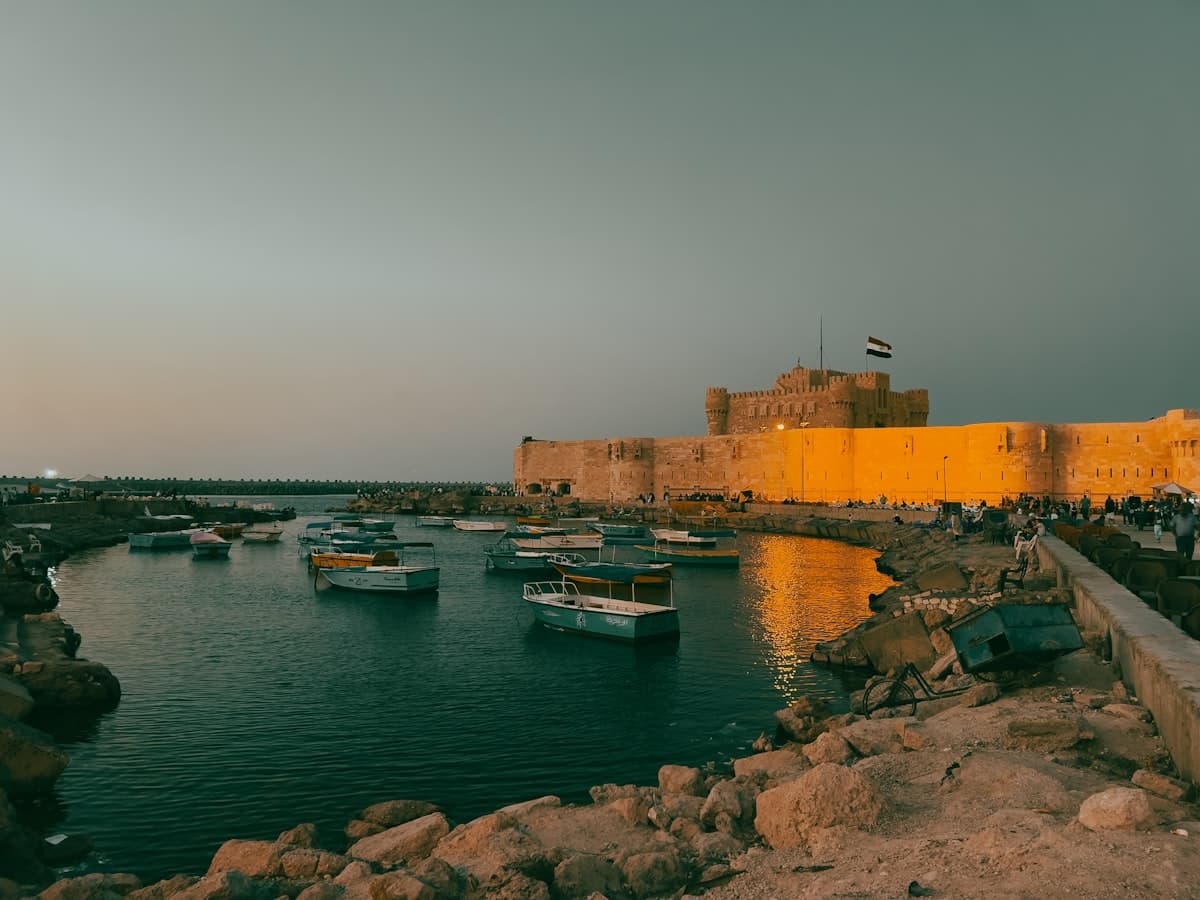
The Qaitbay Citadel sits at the end of a narrow peninsula in the Eastern Harbor and looks entirely medieval Islamic in character. It was built in 1477 by Sultan Qaitbay, a Mamluk ruler who had been purchased as a slave in the Caucasus as a child and eventually rose to command one of the most sophisticated military states in the medieval world. What he built his fortress on top of was the base of the Pharos Lighthouse, one of the Seven Wonders of the Ancient World, which was progressively destroyed by earthquakes between 956 and 1323 AD. Archaeologists have found lighthouse blocks incorporated directly into the citadel walls: enormous granite pieces, some weighing several tons, reused as convenient building material.
This is how Alexandria works. The Bibliotheca Alexandrina, the modern library opened in 2002, was built on or near the site of the ancient library complex. The mosque of the Prophet Daniel, a small Ottoman-era building in the city center, sits above a network of underground passages and may, according to some archaeologists, mark the general area of Alexander's tomb. The Coptic Orthodox church of Saint Mark, the apostle who founded Egyptian Christianity, is built in a city that was a center of Jewish scholarship before it was Christianized, and of Greek philosophy before that.
Every stone in this city is borrowed from something older.
---
Common Mistakes
Spending your Alexandria time at the Bibliotheca Alexandrina. The modern library is architecturally interesting and culturally important to contemporary Egyptians. As a historical experience of ancient Alexandria, it gives you almost nothing. The ancient library is not here in any physical sense. If your time is limited, spend it underground at Kom el-Shoqafa and at the Graeco-Roman Museum.
Expecting to see Cleopatra's palace above ground. It does not exist above the waterline. If you come to Alexandria specifically for Cleopatra Alexandria Egypt historical content and expect a preserved palace, you will be disappointed unless you arrange a boat trip or diving excursion into the Eastern Harbor through an operator licensed by the Egyptian Supreme Council of Antiquities. Contact the Alexandria Dive Center or Franck Goddio's foundation website for current tour availability.
Doing Alexandria as a day trip from Cairo. Technically possible. Practically a waste. You arrive exhausted, rush through two sites, eat at the first place you see, and leave having understood nothing. Two nights minimum.
Taking the organized Cleopatra tour from most major hotels. These typically take you to Pompey's Pillar for twenty minutes, the Catacombs for thirty minutes, a quick stop at the Citadel for photos, and then a seafood lunch that costs more than all your entrance fees combined. You will leave having been efficiently moved through the city without having actually been in it.
Skipping the Jewish history. Alexandria had one of the largest Jewish communities in the ancient world. Philo of Alexandria, a contemporary of both Cleopatra and Jesus, wrote extensively here. The Ben Ezra Synagogue is in Cairo (in Old Cairo's Fustat district) rather than Alexandria, but the Eliyahu Hanavi Synagogue in Alexandria's Manshiyya district, built in 1354, is one of the oldest in Egypt and is now open for visits by arrangement. Most historical tours do not mention it.
Ignoring the Eastern Harbor waterfront for the Corniche's western end. Walk the stretch from the Citadel toward the old royal quarter area in the evening. The light drops into the harbor at an angle that makes the water above the submerged ruins look darker than the surrounding sea. Whether that is imagination or sediment is a question the archaeologists have not fully resolved.
Assuming the sites are well-signed in English. Some are, some are not. Download an offline map, carry the addresses in Arabic, and if your budget allows, hire a licensed Egyptologist guide for half a day. The independent guides who approach you outside Pompey's Pillar are not licensed and their historical information is often inventive.
---
Practical Tips
Arrive in Alexandria by train, not bus. The Misr Station is central. The bus terminal is not.
The Corniche is a forty-kilometer arc of seafront road and is not walkable end-to-end in a day. Use white taxis (negotiate before getting in, EGP 30-60 for most cross-city trips) or the city tram, which is one of the oldest in Africa, still running on tracks laid in 1863, and costs EGP 3-5 per ride.
For the underwater site, booking in advance is not optional. There are currently very few operators authorized to run dives at the submerged royal quarter. Availability is limited and weather in the Eastern Harbor cancels trips regularly between November and February.
The Graeco-Roman Museum's permanent collection contains over 40,000 objects. Not all are displayed. Ask specifically to see the coin collection and the section on Ptolemaic religious syncretism. These are the rooms that answer the question of what Cleopatra's city actually looked like in practice.
Eat at restaurants facing the sea on the Corniche's eastern stretch, not the tourist cluster near the Citadel. Order the catch of the day and ask the price before agreeing. Fish is sold by weight and prices shift constantly.
Frequently Asked Questions
The Weekly Dispatch
More on Egypt, every Friday.
Cultural depth and places most guides never mention.
No spam. Unsubscribe anytime.