Cleopatra's Alexandria: The Egypt Historical Guide You Need
Cleopatra's tomb has never been found. Her palace lies under 6 meters of Mediterranean seawater. Alexandria rewards the curious who know where to look.

Audio Guide: Cleopatra's Alexandria: The Egypt Historical Guide You Need
Quick Facts
- Best time to visit
- October to April. The Mediterranean humidity drops, temperatures stay between 14 and 22 degrees Celsius, and the lateral winter light is exceptional for photography and walking.
- Entrance fee
- Graeco-Roman Museum EGP 200 (approx $4 USD); Catacombs of Kom el-Shoqafa EGP 180 (approx $3.50 USD); Kom el-Dikka EGP 100 (approx $2 USD); Qaitbay Citadel EGP 100 (approx $2 USD); Bibliotheca Alexandrina exhibitions EGP 70 (approx $1.50 USD)
- Opening hours
- Most sites daily 9am to 5pm (winter), 9am to 6pm (summer). Catacombs close at 4:30pm year-round. Graeco-Roman Museum closed on Mondays.
- How to get there
- Spanish train from Cairo Ramses Station: EGP 85 to 130 (approx $1.70 to $2.60 USD), 2 hours 15 minutes. Within Alexandria: trams EGP 2 per ride, taxis between sites EGP 30 to 60.
- Time needed
- 2 full days for major sites. 3 days if adding Taposiris Magna or Abu Mena. Half a day is not enough for anything beyond a surface impression.
- Cost range
- Budget EGP 600 to 900 per day including entrance fees, local transport, and meals at neighborhood restaurants. Mid-range EGP 1,800 to 3,000 per day including a quality seafood dinner.
Quick Facts
Best time to visit: October to April, when the Mediterranean humidity drops and the light turns clean and lateral across the city's limestone facades.
Entrance fees: Bibliotheca Alexandrina: EGP 70 (approx $1.50 USD) for exhibitions; free to walk the exterior and reading rooms with ID Graeco-Roman Museum (reopened after 17-year renovation): EGP 200 (approx $4 USD) Kom el-Dikka Roman Theatre: EGP 100 (approx $2 USD) Catacombs of Kom el-Shoqafa: EGP 180 (approx $3.50 USD) Qaitbay Citadel: EGP 100 (approx $2 USD)
Opening hours: Most sites open daily 9am to 5pm in winter, 9am to 6pm in summer. The Catacombs close at 4:30pm regardless of season. Arrive early.
How to get there: Alexandria is 220km from Cairo. The Spanish train (Espania service) from Ramses Station costs EGP 85 to 130 (approx $1.70 to $2.60 USD) and takes 2 hours 15 minutes. It is the most reliable option. Within Alexandria, white-and-blue trams cost EGP 2 and cover the central corniche route. Taxis between sites rarely exceed EGP 50. The airport serves a handful of domestic routes if you are continuing to Upper Egypt.
Time needed: Two full days minimum for the major Cleopatra Alexandria Egypt historical sites. Three days if you intend to understand how the city actually layered itself over three millennia.
Cost range: Budget EGP 600 to 900 per day including food, transport, and entrance fees. Mid-range EGP 1,800 to 3,000 per day including a decent seafood dinner on the corniche.
---
Cleopatra VII never called herself Egyptian. She was Macedonian Greek by descent, the last ruler of a dynasty founded by one of Alexander the Great's generals, a family that had ruled Egypt for 275 years without any of them bothering to learn the local language. She was the first Ptolemy who did. She spoke nine languages including Egyptian, Ethiopian, Hebrew, Arabic, and Parthian, according to Plutarch, and used this deliberately, conducting temple rituals in the old tongue to present herself to Egyptian priests as a daughter of Isis rather than a foreign administrator. The strategy worked. It also tells you everything about the city she ruled from: Alexandria was never purely Egyptian. It was always a negotiation between civilizations, and that negotiation is still visible if you know what you are looking at.
Why This Place Matters
Alexander the Great founded the city in 331 BC, reportedly pacing out its dimensions himself on the shore of the Mediterranean. He did not live to see it built. He died in Babylon eight years later, and his body was brought back to Alexandria and interred in a mausoleum the ancient world described as one of its great wonders. The tomb has never been found. Archaeologists have been looking for it for over a century.
At its peak, Ptolemaic Alexandria held 500,000 people, making it the second-largest city on earth after Rome. It contained the Great Library, which at its height housed an estimated 400,000 to 700,000 scrolls, including works by Euclid, Archimedes, and Eratosthenes, the mathematician who calculated the circumference of the earth to within 2 percent accuracy in the third century BC using the angle of shadows in Aswan on the summer solstice. The Library was not destroyed in a single fire, despite the persistent myth. It declined across several centuries, damaged incrementally by war, neglect, and political abandonment, and was effectively defunct long before Julius Caesar's forces accidentally burned ships in the harbor in 48 BC, the moment usually blamed for its destruction.
The city's real significance is architectural layering. The Ptolemies built on top of older settlements. The Romans rebuilt what the Ptolemies left. The Byzantines added churches to Roman temples. Arab armies arrived in 641 AD and found a city the Byzantine historian John of Nikiu described as containing buildings "past counting". Then came the Fatimids, the Ayyubids, the Mamluks, the Ottomans, and finally Napoleon's expedition in 1798, whose scientists documented a city that was already mostly rubble, a fraction of what Cleopatra would have recognized. Understanding Alexandria means understanding that what you see now is about the fourth or fifth version of the city, and that the most interesting version is largely underwater.
What Survives Aboveground (and What It Actually Tells You)
Kom el-Dikka: The Roman City Beneath the Modern One
In 1960, Polish archaeologists excavating for an apartment building in central Alexandria found something the builders had not expected: a Roman theatre from the second century AD, complete with marble seats arranged in a semicircle of thirteen tiers, capable of holding 800 people. What makes Kom el-Dikka remarkable is not just the theatre but the neighborhood surrounding it: Roman baths, lecture halls (the only complex of Roman auditoria found anywhere in the ancient world), workshops, and a residential quarter that remained in use from the first century AD through the seventh. You can walk between the structures and understand, at least partially, how a person in Cleopatra's era and afterward actually moved through this city.
The site is consistently undervisited. Most tourists do the corniche, the Catacombs, and the Citadel, skip Kom el-Dikka entirely, and miss the only place in Alexandria where the Ptolemaic and Roman street grid is still legible.
The Catacombs of Kom el-Shoqafa
These were discovered in 1900 when a donkey fell through the ground. The animal had stepped onto a shaft that dropped into a three-level necropolis built in the second century AD, combining Egyptian, Greek, and Roman funerary iconography in a way that has no equivalent anywhere in the ancient world. The god Anubis appears wearing Roman armor. Medusa shields flank the entrance to chambers decorated with pharaonic motifs. The Egyptians who built this were themselves confused, or rather, they were sophisticated: they pulled from every tradition available to them because Alexandria in the second century AD was a city where those traditions had lived side by side for four hundred years.
The lowest level is flooded, and has been since the water table rose in the twentieth century. What you can see is still substantial. Bring a jacket. The underground temperature drops sharply.
Pompey's Pillar and What It Actually Commemorates
The 27-meter granite column that dominates the Serapeum plateau has been called Pompey's Pillar since medieval Arab geographers named it, almost certainly incorrectly. The column was erected in 297 AD to honor the Roman Emperor Diocletian after he suppressed a revolt in Alexandria. Pompey, who was killed in Egypt in 48 BC, has no connection to it. The base inscription in Greek makes this clear. The column is actually one of the largest monolithic columns ever erected in the ancient world, carved from Aswan granite and shipped north, standing on the ruins of the Serapeum, the great temple of Serapis that the Ptolemies built as a deliberate synthesis of Greek and Egyptian religion. Serapis was a deity invented by committee: Ptolemy I wanted a god who could be worshipped by both Greeks and Egyptians, so he commissioned a synthesis of Osiris and the sacred Apis bull, dressed in Greek iconography, and installed him in a temple designed to rival the greatest sanctuaries of the Mediterranean world. It worked for about six hundred years, until Christian mobs tore the Serapeum down in 391 AD.
The Bibliotheca Alexandrina
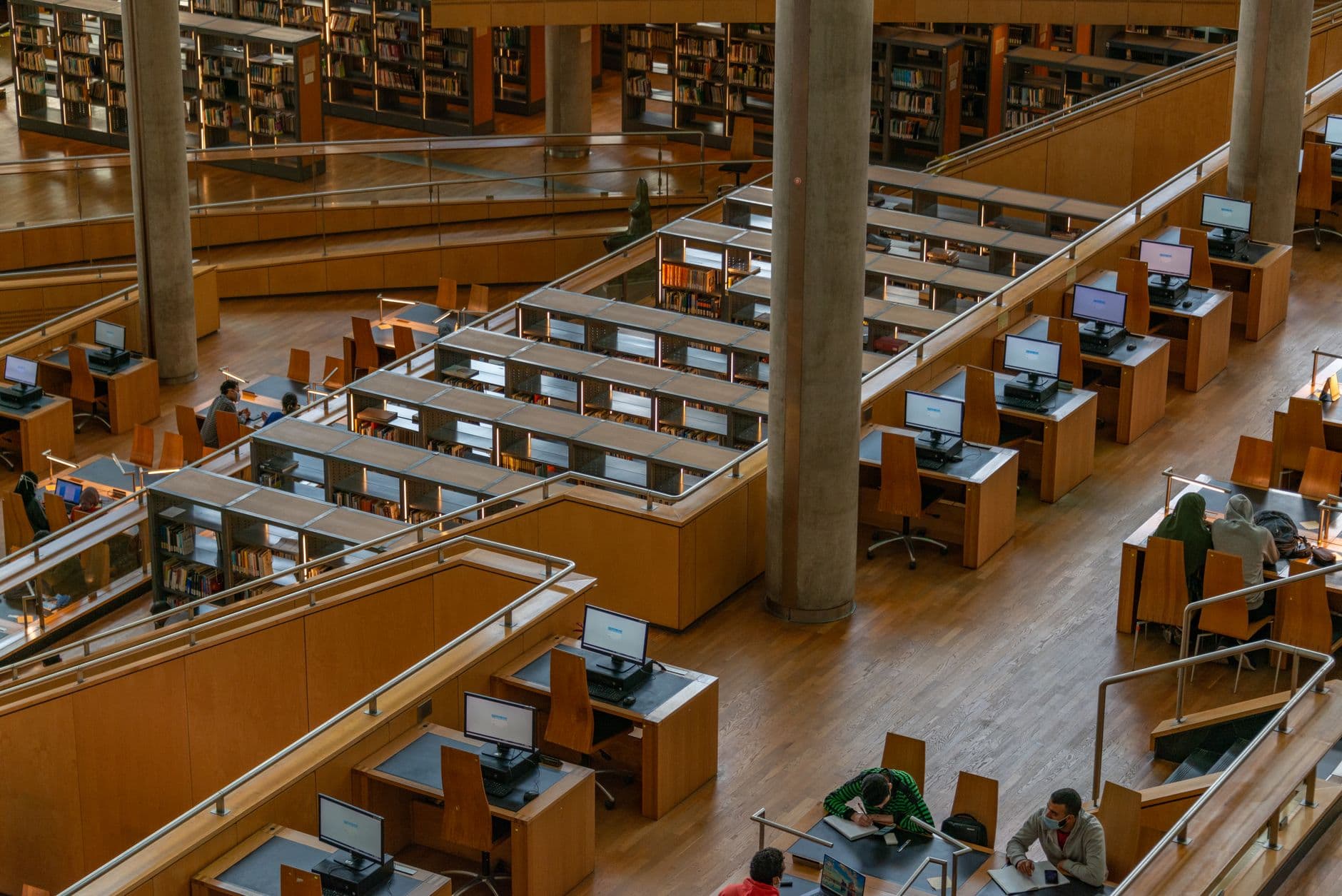
The modern library, opened in 2002, was designed by the Norwegian firm Snohetta as a tilted disc emerging from the ground near the presumed site of the ancient Library. Architecturally it is serious: the exterior wall is carved with letters from 120 different scripts, ancient and modern. Inside, a single reading room cascades down seven levels under a glass ceiling, holding eight million volumes. The Antiquities Museum on the fourth floor holds genuine Ptolemaic and Roman artifacts including a black granite head of Alexander that was found in the harbor, and a bas-relief of Cleopatra identified by the cartouche beside it.
The library is worth two hours of your time. The planetarium shows inside are not.
The Connections: Alexandria as a Relay Station Between Civilizations
The Qaitbay Citadel, which you will see on every Alexandria postcard, was built in 1477 AD by the Mamluk Sultan Qaitbay, who spent his life as an enslaved soldier before rising to rule Egypt for twenty-eight years. He built the citadel on the exact foundations and using the fallen stones of the Pharos Lighthouse, one of the Seven Wonders of the Ancient World. The lighthouse had been destroyed by earthquakes in the fourteenth century. Qaitbay used its granite blocks as raw material, which means the walls of a fifteenth-century Islamic fortress contain Ptolemaic-era stone that was quarried in Aswan and shipped north two thousand years earlier. When French marine archaeologist Jean-Yves Empereur began cataloguing the underwater ruins around the citadel in 1994, he found over 2,500 stone blocks on the seabed, many of them inscribed with pharaonic cartouches. The lighthouse and Cleopatra's palace quarter occupy the same stretch of submerged seafloor, roughly 6 to 8 meters down. Recreational diving to the site is occasionally permitted through the Egyptian Ministry of Antiquities. It requires advance permission and is genuinely worth pursuing.
The Coptic community in Alexandria, one of the oldest Christian communities on earth, traces its founding to Saint Mark, who arrived around 42 AD, roughly a decade after the death of Christ and just a decade after Cleopatra's own death in 30 BC. The Cathedral of Saint Mark on Pope Dimitri Street holds what are claimed to be the saint's relics, returned to Alexandria from Venice in 1968, having been removed by Venetian merchants in 828 AD. The original theft was accomplished by hiding the relics under layers of pork and cabbage to deter Muslim customs inspectors. It worked.
Common Mistakes
Going in July or August. The humidity off the Mediterranean in peak summer makes outdoor site visits genuinely unpleasant. The heat is not Luxor-dry heat. It is heavy and relentless. October through March is a different city.
Spending most of your time at the corniche and Qaitbay. The citadel is pleasant but its interior is sparse. An hour is sufficient. The Catacombs and Kom el-Dikka together will tell you more about what Alexandria actually was than anything on the waterfront.
Taking a private tour that covers four sites in one morning. This is how you end up with fifteen minutes at the Catacombs and a photograph at Pompey's Pillar. The sites require slow attention, not logistics efficiency.
The underwater museum boat tours. Multiple operators offer glass-bottom boat tours of the submerged royal quarter, claiming you will see Cleopatra's palace. What you will see, in practice, is murky Mediterranean water with indistinct shapes. The visibility is rarely sufficient. Save the money. Legitimate diving permits are the only way to actually engage with the submerged site.
Skipping the Graeco-Roman Museum. It was closed for seventeen years and many travelers have not recalibrated. It is open. The collection includes artifacts that provide direct context for everything else in the city, including a rare painted mummy portrait from the Fayum tradition and a coin series showing Cleopatra's actual face, not the idealized profile on modern reconstructions, a face that Roman sources described as less conventionally beautiful than capable of extraordinary expression.
Eating on the corniche tourist strip. The fish restaurants two streets back toward El-Anfoushy charge a third of the price for the same catch.
Expecting to find Cleopatra's tomb. Three major expeditions, including Kathleen Martinez's ongoing excavation at Taposiris Magna 45km west of Alexandria, have failed to locate it. Do not book a tour that promises proximity to the discovery. No such discovery has been confirmed.
Practical Tips
Come on a weekday. Alexandrians visit their own sites heavily on Fridays and holidays, and the Catacombs in particular become uncomfortably crowded.
The Graeco-Roman Museum is best done on the first morning before your feet hurt. The labeling is inconsistent and an audio guide, available at the entrance for EGP 50, is worth it.
If you are serious about the underwater archaeology, contact the Egyptian Ministry of State for Antiquities in Cairo before your trip. Dive permits for the Portus Magnus site exist but require advance paperwork and a licensed local dive operator. The most reputable one currently running these dives is based in El-Anfoushy.
Alexandria's tram system is one of the few surviving urban tram networks in Africa and is itself worth riding simply for the experience. Line 1 covers the corniche from Raml Station to Ras el-Tin. Fare is EGP 2.
The sea fog that settles on Alexandria between January and March is not an obstacle. It is part of the city's personality, the same Mediterranean light and moisture that made the Ptolemaic court painters so different from anything produced further south. If it is grey when you arrive, stay an extra day. The city looks different when the sun returns.
Frequently Asked Questions
The Weekly Dispatch
More on Egypt, every Friday.
Cultural depth and places most guides never mention.
No spam. Unsubscribe anytime.