Cleopatra's Alexandria: The Historical Guide to a Lost City
Cleopatra ruled a city of 500,000 people that was the world's greatest metropolis. Almost none of it survives above ground. Here is where it actually went.

Quick Facts
- Best time to visit
- October to April, Mediterranean climate, 12 to 22 degrees Celsius, low humidity, smaller crowds at sites
- Entrance fee
- Pompey's Pillar and Serapeum: EGP 180 (approx $3.50 USD). Catacombs of Kom el-Shoqafa: EGP 180 (approx $3.50 USD). Alexandria National Museum: EGP 200 (approx $4 USD). Graeco-Roman Museum: EGP 200 (approx $4 USD, confirm opening status before visiting). Qaitbay Citadel: EGP 200 (approx $4 USD).
- Opening hours
- Most sites 9am to 5pm daily. Graeco-Roman Museum hours are irregular due to renovation; call ahead or check with your hotel. Sites may close briefly on Fridays between 11:30am and 1pm.
- How to get there
- Cairo to Alexandria by Talgo train: EGP 150 to 250, approximately 2 hours 15 minutes from Ramses Station. Regular train: EGP 60 to 90, approximately 3 hours. Within Alexandria: microbuses EGP 3 to 5 per ride, taxis EGP 30 to 60 between sites, full-day private driver EGP 600 to 900.
- Time needed
- Minimum two days to cover the main Ptolemaic and Cleopatra-era sites meaningfully. One long day is possible but produces a rushed, surface-level experience.
- Cost range
- Budget EGP 600 to 900 per day including mid-range Corniche hotel. Mid-range EGP 1,500 to 2,500 per day. Site entrance fees for a full Cleopatra historical circuit total approximately EGP 760 (approx $15 USD).
Cleopatra VII never saw the Pyramids. She had no reason to. By the time she was born, in 69 BC, those structures on the Giza plateau were already 2,500 years old and associated with a civilization so remote from her Macedonian Greek dynasty that they were practically prehistory. Her world was Alexandria: a planned city laid out by Alexander the Great in 331 BC on a narrow strip between the Mediterranean and Lake Mariout, a metropolis that by the first century BC held roughly 500,000 people, making it larger than Rome and possibly the most intellectually productive city in human history. That city is mostly gone. What replaced it is what you are walking through now.
Quick Facts
Best time to visit: October to April, when Alexandria's Mediterranean climate keeps temperatures between 12 and 22 degrees Celsius. Summer is humid and crowded with Egyptian domestic tourists fleeing Cairo's heat.
Entrance fees: Graeco-Roman Museum: EGP 200 (approx $4 USD), students EGP 100 Pompey's Pillar and Serapeum site: EGP 180 (approx $3.50 USD) Royal Jewelry Museum (Villa of Fatima al-Zahraa, relevant for the layered Alexandria story): EGP 150 (approx $3 USD) Catacombs of Kom el-Shoqafa: EGP 180 (approx $3.50 USD) Qaitbay Citadel (built directly on the Lighthouse of Alexandria foundations): EGP 200 (approx $4 USD) Alexandria National Museum: EGP 200 (approx $4 USD)
Opening hours: Most sites open daily 9am to 5pm. The Graeco-Roman Museum keeps irregular hours due to ongoing renovations; confirm before going. Friday prayers affect some sites between 11:30am and 1pm.
How to get there: Cairo to Alexandria by train is the sensible option. The Spanish-run Talgo train from Ramses Station runs twice daily, takes 2 hours 15 minutes, and costs EGP 150 to 250 depending on class. Regular trains are slower (3 hours) and cost EGP 60 to 90. Within Alexandria, white-and-blue microbuses connect most sites for EGP 3 to 5 per ride. Taxis should cost EGP 30 to 60 between major sites; use the Uber app for price transparency.
Time needed: The full Cleopatra-era Alexandria circuit requires two days minimum. One focused day, hitting Pompey's Pillar, Kom el-Shoqafa, and the National Museum, is possible but rushed.
Cost range: Budget EGP 600 to 900 per day including accommodation in a decent mid-range hotel in the Corniche area. Mid-range EGP 1,500 to 2,500 per day.
Why This Place Matters: The City That Was Erased
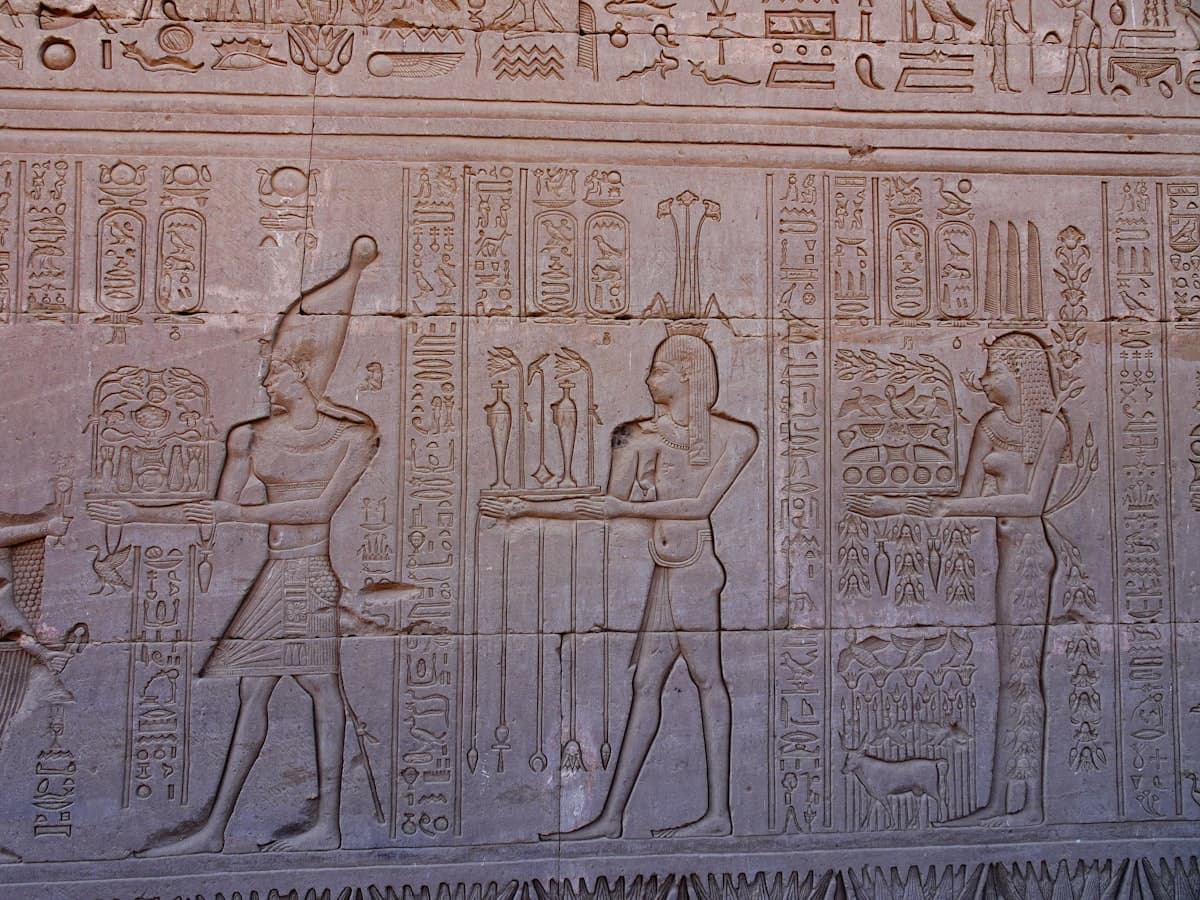
The Alexandria you encounter in a Cleopatra historical guide is not a single site but an argument: that one of the ancient world's greatest cities was systematically buried, flooded, and built over until almost nothing remained, and that understanding what happened to it tells you more about Egyptian civilization than most things you will see behind glass in Cairo.
Alexander founded the city in 331 BC, reportedly sketching its grid plan in barley flour on the ground because he had no chalk. Within three decades it had a population larger than any Greek city, a harbor protected by the island of Pharos connected to the mainland by a causeway called the Heptastadion, and a library that, at its height, held somewhere between 400,000 and 700,000 papyrus scrolls. That library was not burned in a single dramatic fire. Modern scholarship suggests it declined through a combination of funding cuts, the removal of texts to Rome by Caesar, a partial fire during Caesar's own occupation of Alexandria in 48 BC, and a slow institutional collapse over centuries. The version that survived into late antiquity was a smaller institution called the Serapeum library, which was destroyed by a Christian mob in 391 AD.
Cleopatra herself was not Egyptian by blood. She was the seventh queen to bear that name in the Ptolemaic dynasty, a Macedonian Greek royal family that had ruled Egypt since 305 BC, most of whom never bothered to learn the language. She was the first Ptolemy who did. She spoke nine languages according to Plutarch, including Egyptian, Ethiopian, Hebrew, and Aramaic. This linguistic fact matters more than any romance: it meant she could negotiate with priests, traders, and emissaries without interpreters, giving her a political flexibility her ancestors lacked.
What Survives and Where to Find It
The honest answer to what remains of Cleopatra's Alexandria above ground is: almost nothing, and what does remain is not labeled the way you might expect.
Pompey's Pillar is the largest single-piece column in the world after the ones in Rome. It stands 27 meters tall in the middle of a scrubby archaeological park on the Rhakotis hill, surrounded by sphinx fragments and rubble. It has nothing to do with Pompey. It was erected in 297 AD by the Roman prefect Publius, in honor of the Emperor Diocletian. Crusader-era visitors assumed it commemorated the Roman general Pompey, who was indeed murdered near Alexandria in 48 BC, and the name stuck. More importantly, the pillar stands on the ruins of the Serapeum, the great temple to the hybrid god Serapis that Ptolemy I invented specifically to give Greeks and Egyptians a shared deity. The original Serapeum held the daughter library of the Great Library. Beneath the pillar site are underground galleries you can still walk through.
The Catacombs of Kom el-Shoqafa are the most important and undervisited site in Alexandria. Cut into the bedrock in the second century AD, they represent a moment when Roman burial customs, Egyptian religious iconography, and Greek artistic styles collided into something entirely new. The main tomb chamber shows Anubis dressed as a Roman soldier. The god Thoth appears wearing Greek robes. The reliefs use Egyptian hieroglyphic framing while the figures have naturalistic Greco-Roman faces. This was not confusion. It was a deliberate visual theology made by people who lived in a city where those three traditions had coexisted for three centuries. The catacombs were discovered in 1900 when a donkey fell through the roof of the entrance shaft.
The Eastern Harbor, where Cleopatra's palace complex once stood, is underwater. A series of earthquakes between the fourth and eighth centuries AD caused the entire royal quarter to subside into the sea. French underwater archaeologist Franck Goddio began systematic excavation there in 1992 and has recovered thousands of objects including sphinxes, statues, and architectural fragments. You cannot dive it as a tourist without a permit and a specialized operator, but the Alexandria National Museum displays enough recovered pieces to make the scale of what lies beneath the harbor genuinely legible.
The Graeco-Roman Museum and What It Actually Contains
The Graeco-Roman Museum on Al-Mathaf Al-Romani Street holds the most concentrated collection of Ptolemaic and Roman-era Alexandria in existence, including objects that directly date to Cleopatra's reign. It has been undergoing renovation for years, with partial reopening and re-closings. Check its current status before building your itinerary around it, because being turned away at the door is a legitimate risk.
When it is open, the collections that matter most for the Cleopatra Alexandria historical guide are not the famous ones. Everyone photographs the mummies. What most visitors skip is the numismatic collection, which contains coins bearing Cleopatra's actual portrait, minted in Alexandria during her reign. These are primary documents. Her face on those coins is not the Hollywood version: she has a prominent nose, strong jaw, and an expression of decisive authority that reads as political rather than decorative. The coins also carry the faces of Mark Antony and Julius Caesar, documenting the alliances that kept the last independent Egyptian dynasty alive for two more decades than it had any right to survive.
Also in the collection: a large marble head of Alexander the Great from the third century BC, possibly the closest surviving likeness to the man who founded the city. And a series of Serapis cult objects that show how systematically the Ptolemies engineered religious identity as a tool of political stability.
The Connections: What Alexandria Became
The Arab general Amr ibn al-As took Alexandria in 641 AD after a fourteen-month siege. He is said to have written to Caliph Omar: "I have taken a city of which I can only say that it contains 4,000 palaces, 4,000 baths, 400 theatres, 1,200 greengrocers, and 40,000 Jews." Whether accurate or not, the account captures a city still functioning as an imperial metropolis six centuries after Cleopatra's death.
The Arab city shifted investment away from the old Ptolemaic harbor areas and toward the western canal that connected Alexandria to the Nile. The medieval Alexandria that Ibn Battuta described in the fourteenth century was still one of the Mediterranean's great ports, but its commercial center had migrated. The Fort of Qaitbay, built by the Mamluk sultan Qaitbay between 1477 and 1479 on Pharos Island, was constructed using stones cannibalized from the Lighthouse of Alexandria, one of the Seven Wonders of the Ancient World, which had been destroyed by earthquakes in the fourteenth century. You can see blocks with ancient Greek inscriptions embedded in Qaitbay's walls if you look at the lower courses carefully enough.
The Coptic community of Alexandria traces its founding to St. Mark, who tradition holds arrived in Alexandria around 42 AD, during the same century Cleopatra died. The Coptic Patriarchate was in Alexandria before it was in Cairo. The church at Abu Mena, 45 kilometers southwest of Alexandria, was built over the tomb of an early Christian martyr and became one of the most important pilgrimage sites in the early Christian world, attracting visitors from as far as Western Europe. It is now a UNESCO World Heritage Site in danger, literally sinking into waterlogged ground.
Common Mistakes
Treating the Bibliotheca Alexandrina as a historical connection. The modern library, opened in 2002 and designed by Norwegian firm Snohetta, is an impressive piece of contemporary architecture and a functioning research institution. It is not, in any meaningful sense, a continuation of the ancient Library of Alexandria, despite what its promotional materials imply. The ancient library's holdings were papyrus scrolls in Greek, Demotic, and other ancient languages, organized by Zenodotus and Callimachus using classification systems that influenced how libraries work to this day. The modern institution shares a geographic proximity and a symbolic aspiration. Visit it if you are interested in contemporary Arab intellectual life. Do not visit it expecting to feel something about Cleopatra.
Skipping Kom el-Shoqafa because it sounds like a cemetery. It is a cemetery. It is also the most visually extraordinary site in Alexandria, and it takes forty minutes. The hybrid iconography in the main burial chamber is something you will not see replicated anywhere else in Egypt.
Booking a Cleopatra-branded day tour from Cairo. These tours spend approximately ninety minutes in Alexandria, hit the Bibliotheca Alexandrina and Qaitbay, and return you to Cairo by evening. This is not a historical experience. It is a photograph opportunity. Alexandria requires overnight stays to understand.
Expecting visible ruins in the city center. Modern Alexandria was largely built in the nineteenth and early twentieth centuries, first by Muhammad Ali Pasha's urban projects and then by the cosmopolitan commercial boom that Lawrence Durrell captured in the Alexandria Quartet. The Ptolemaic city is underground, under the sea, or in museum collections. Adjust your expectations before you arrive.
Paying for the Cleopatra Beach resort excursion offered by most Corniche hotels under various names. Cleopatra Beach, a small cove west of Alexandria, has an ancient association with the queen that is entirely unverifiable and almost certainly invented by nineteenth-century tourism. The beach itself is crowded, the water quality is variable, and the historical connection is marketing.
Missing the Alexandria National Museum in favor of more famous sites. It is housed in a converted Italian-style palace on Tariq Al-Horreya Street, and its three floors move systematically from Pharaonic through Ptolemaic, Roman, Coptic, and Islamic Alexandria. The underwater archaeology section on the ground floor contains recovered objects from the submerged royal quarter. This is where the physical evidence for Cleopatra's Alexandria is most coherently presented.
Practical Tips
Alexandria's sites are spread across a city of five million people. Do not attempt to walk between them. The distances look manageable on a map and are not, particularly in summer humidity. Microbuses are cheap and frequent once you know the routes; your hotel can advise on which numbers to take. A private driver for a full day costs EGP 600 to 900 and is worth it if you are covering multiple sites.
Dress conservatively in the older neighborhoods around the Serapeum site and the catacombs. Alexandria is more religiously observant than its cosmopolitan reputation suggests. Women traveling alone report less harassment here than in Cairo, but the usual awareness applies.
The Corniche itself, the six-kilometer waterfront road, is best experienced at 6am before traffic. The Mediterranean light at that hour is specific and worth witnessing: it falls flat and silver on the water in a way that explains why painters and writers kept returning to this city.
If you read one thing before arriving, read E.M. Forster's Alexandria: A History and a Guide, written during his wartime posting here in 1915. It is out of copyright and available free online. Forster was a meticulous researcher, and his sections on the Ptolemaic and early Christian city are still more useful than most contemporary guidebooks.
Frequently Asked Questions
The Weekly Dispatch
More on Egypt, every Friday.
Cultural depth and places most guides never mention.
No spam. Unsubscribe anytime.