Cleopatra's Alexandria: The Historical Guide You Actually Need
Cleopatra's palace is underwater. Literally. 47 square km of ancient Alexandria sank into the sea, and you can dive it. The city above ground tells the rest.

Quick Facts
- Best time to visit
- October to April. Mediterranean humidity makes summer visits uncomfortable without the compensating reward of desert light.
- Entrance fee
- Greco-Roman Museum EGP 300 (approx $6.25 USD), students EGP 150. Catacombs EGP 300 (approx $6.25 USD). Kom el-Dikka EGP 200 (approx $4.20 USD). Bibliotheca Alexandrina EGP 120 foreigners (approx $2.50 USD). Underwater dive tours from EGP 2,500 (approx $52 USD).
- Opening hours
- Most sites daily 9am to 5pm. Catacombs close at 4:30pm. Bibliotheca Alexandrina: Sunday to Thursday 10am to 7pm, Friday and Saturday 12pm to 4pm.
- How to get there
- Train from Cairo Ramses Station: EGP 90 to EGP 150 (approx $2 to $3.20 USD), 2.5 hours. Taxis between Alexandria sites: EGP 40 to EGP 80. Corniche tram: EGP 3 but very slow.
- Time needed
- Two full days minimum for main sites. Three days if including underwater dive excursion or Abu Qir day trip.
- Cost range
- Budget EGP 800 to EGP 1,200 per day. Mid-range EGP 2,500 to EGP 4,000 per day including accommodation.
Quick Facts
Best time to visit: October through April. Alexandria sits on the Mediterranean and summer humidity is unpleasant without the reward of Luxor's dramatic light.
Entrance fees: Bibliotheca Alexandrina: EGP 70 (approx $1.50 USD), foreigners EGP 120 (approx $2.50 USD) Greco-Roman Museum: EGP 300 (approx $6.25 USD), students EGP 150 Kom el-Dikka Roman Theatre: EGP 200 (approx $4.20 USD), students EGP 100 Catacombs of Kom el-Shoqafa: EGP 300 (approx $6.25 USD), students EGP 150 Underwater archaeology dive tours (Franck Goddio expedition site): booked via licensed Alexandria dive operators, starting around EGP 2,500 (approx $52 USD) including gear
Opening hours: Most sites daily 9am to 5pm. Bibliotheca Alexandrina opens Sunday to Thursday 10am to 7pm, Friday and Saturday 12pm to 4pm. Catacombs close at 4:30pm sharp.
How to get there: Cairo to Alexandria by train is the only sensible choice. The Spanish air-conditioned express from Ramses Station runs roughly EGP 90 to EGP 150 (approx $2 to $3.20 USD) depending on class. Travel time is around 2.5 hours. Taxis between Alexandria's main sites cost EGP 40 to EGP 80 using meters. The tram is EGP 3 and runs along the Corniche but is extremely slow.
Time needed: Two full days minimum to cover the Corniche, Kom el-Dikka, the Catacombs, the Greco-Roman Museum, and Bibliotheca Alexandrina. Add a third day if you want the underwater dive site or a day trip to Abu Qir.
Cost range: Budget EGP 800 to EGP 1,200 per day, mid-range EGP 2,500 to EGP 4,000 per day including accommodation.
---
Why This Place Matters
Cleopatra VII never sat in the Pyramids of Giza and gazed romantically across the desert. She was born in Alexandria, ruled from Alexandria, and died in Alexandria. The city the Greeks built on a spit of Egyptian coastland in 331 BC was, for three centuries, the largest city in the world by some estimates, larger than Rome until Augustus absorbed it into his empire after Cleopatra's death in 30 BC. At its peak, roughly a million people lived here, and the Great Library held an estimated 700,000 scrolls, including works by Euclid, who taught here, and Eratosthenes, who calculated the circumference of the earth from here with an error margin of less than 2 percent.
This is the city that invented the idea of a universal library. And almost none of it is visible above ground.
In 365 AD, an earthquake generated a tsunami that destroyed much of the ancient city and killed tens of thousands of people across the eastern Mediterranean. Over subsequent centuries, the coastline subsided. The royal quarter where Cleopatra lived, loved Julius Caesar, and bore his son Caesarion sank beneath the waters of the Eastern Harbor. The lighthouse, one of the Seven Wonders of the Ancient World, eventually collapsed and its stones were used to build the Qaitbay Citadel you can visit today, a 15th-century Mamluk fort standing on the same finger of land where the lighthouse stood.
What you are visiting in Alexandria is not ruins in the traditional sense. It is a living city built directly on top of, and in many cases directly out of, one of the ancient world's great capitals. This is the essential context for the Cleopatra Alexandria historical guide: the queen herself is absent, her palace is submerged, but the weight of what happened here is present in almost every stone.
---
What Survives Above Ground: Kom el-Dikka and the Roman Quarter
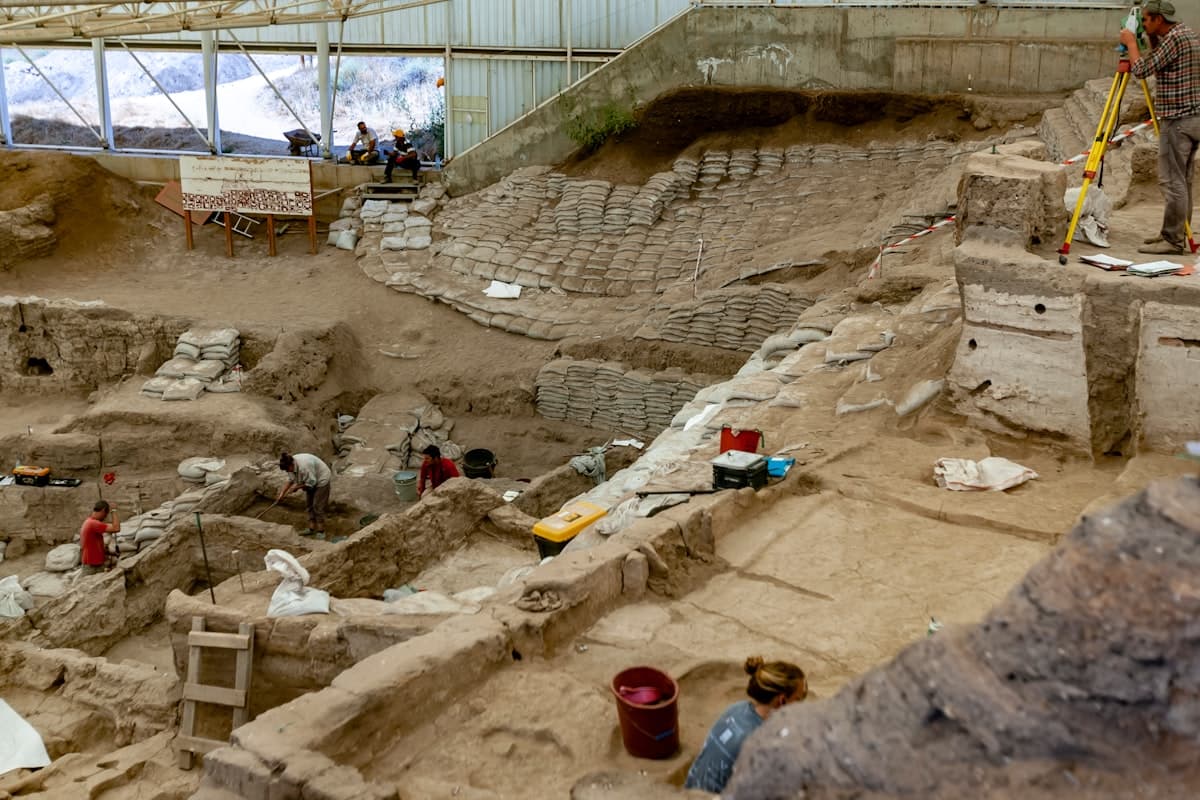
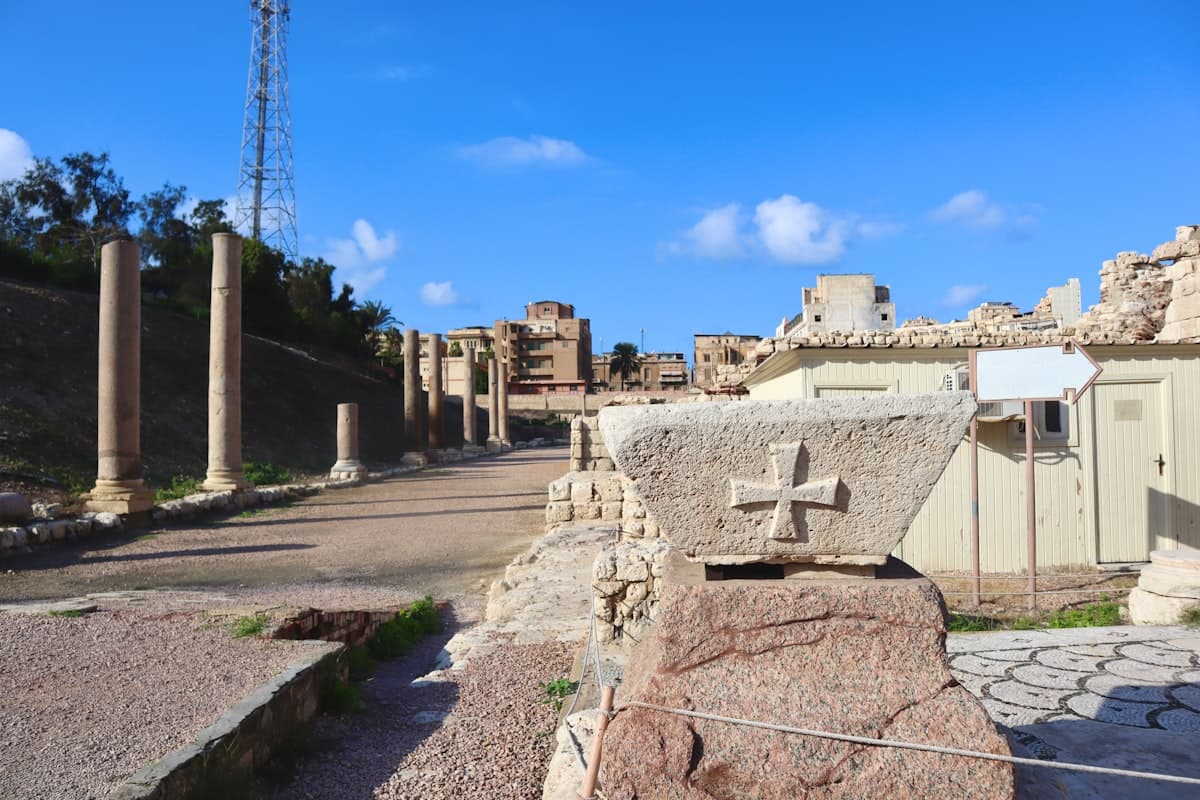
The most complete surviving ancient structure in Alexandria is Roman, not Ptolemaic, and most visitors spend less than an hour here when they should spend three. Kom el-Dikka, excavated by Polish archaeologists beginning in 1960, contains a well-preserved Roman theatre, the only one of its kind in Egypt, with white marble seating for around 600 people. It was used as a lecture hall in late antiquity, which matters because Alexandria by the 4th century AD had become the most important center of Neoplatonist philosophy in the world. Hypatia of Alexandria, the mathematician and philosopher murdered by a Christian mob in 415 AD, likely lectured in spaces like this one.
Behind the theatre, still being excavated, lie the baths, the villas, the cisterns. The villa floors are covered in geometric mosaics that the site barely advertises. You often have them almost entirely to yourself. Ask the site attendant to show you the mosaic of the bird, which is in a fenced section not on the standard visitor path.
The cisterns beneath the city deserve a note. Alexandria sits on a porous limestone shelf above a network of Roman-era cisterns so extensive that 19th-century explorers used small boats to navigate them. The city's water supply in antiquity came from a canal connected to the Nile, stored in these cisterns. Some can be entered from Kom el-Dikka. They are cool, they are strange, and they are almost always empty of other visitors.
---
The Catacombs of Kom el-Shoqafa and the Evidence of Everything Meeting
If you want to understand Cleopatra's Alexandria, and by extension the world that produced her, go to the Catacombs of Kom el-Shoqafa on your first morning, before the tour buses arrive around 10:30am. They were discovered accidentally in 1900 when a donkey fell through a hole in the ground.
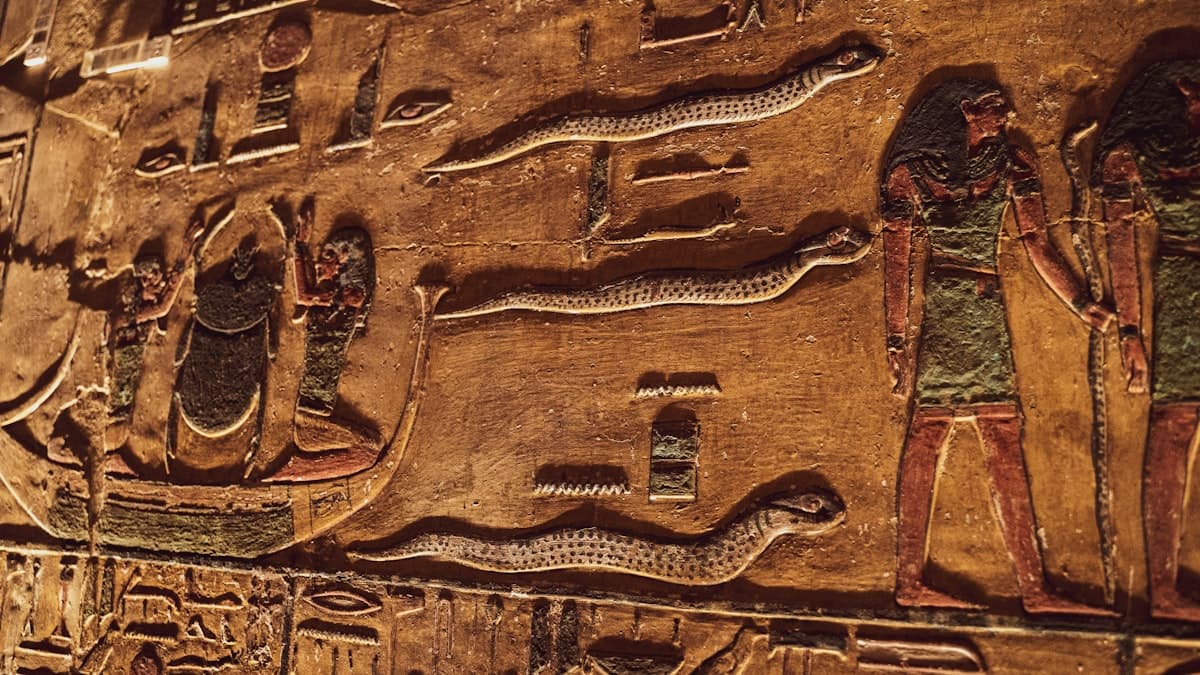
The catacombs are a three-level funerary complex cut into the rock, dating from the 2nd century AD, which makes them post-Cleopatra but built by the same city she knew. They are the single most concentrated example of what scholars call the Alexandrian synthesis: a fusion of Egyptian, Greek, and Roman religious and artistic traditions so complete that the same figure is simultaneously Anubis and Hermes, depicted in Roman soldier's armor, standing in a tomb carved with pharaonic reliefs, entered through a hall built with Greek columns.
Look at the guardian serpents at the tomb entrance. They wear the double crown of Upper and Lower Egypt. They also have the caduceus staff of Hermes. No other site in Egypt shows you so clearly how Cleopatra's world actually worked, not as Egyptian or Greek or Roman but as all three at once, which is exactly how Cleopatra herself operated. She was the first Ptolemaic ruler to actually speak Egyptian. Her ancestors had ruled Egypt for 275 years without learning the language.
The lowest level is partially flooded and inaccessible, but the two accessible levels are large enough to feel genuinely labyrinthine. Bring a flashlight even though the site has electric lighting. The corners are dark.
---
Underwater: The Sunken Palace Quarter and What the Sea Kept
In 1996, French underwater archaeologist Franck Goddio began systematic excavation of the Eastern Harbor. What he found was Antirhodos, the royal island where Cleopatra's palace complex stood. The site has yielded sphinxes, a colossal statue of a Ptolemaic king, columns, pavements, and the remains of a temple to Isis, which was Cleopatra's patron goddess and the role she publicly performed.
None of it is in a museum you can walk into. Some recovered pieces are in the Greco-Roman Museum, which reopened after extensive renovation and contains the best surviving collection of Ptolemaic-era sculpture and everyday objects in the world. The colossal statues are there. So is a remarkable collection of terracotta figurines showing ordinary Alexandrian life: musicians, actors, children, gods in the process of becoming other gods.
For the underwater site itself, licensed dive operators in Alexandria offer excursions to the submerged ancient city. The visibility depends entirely on weather and harbor conditions, which can be poor. Do not book this as the centerpiece of your trip. Book it as a bonus if conditions are right. The site is marked with buoys and the dives are shallow, around 4 to 8 meters, so even a basic open water certification is sufficient.
The experience is unusual enough that it is worth the attempt even in mediocre visibility. You are swimming over a city.
---
The Connections: What Alexandria Holds That Cairo Does Not
The Qaitbay Citadel stands where the Lighthouse of Alexandria stood. The lighthouse, completed around 280 BC, was estimated at between 100 and 140 meters tall, making it the second tallest structure in the ancient world after the Great Pyramid. Its mirror reportedly reflected ships 50 kilometers out to sea. After the earthquake damage and eventual collapse, the Mamluk Sultan Qaitbay used the remaining stone blocks as building material for his fort in 1477. Some of the original granite blocks from the lighthouse are still visible in the lower walls. Running your hand across a stone that once formed part of a structure that guided ships two thousand years ago is a specific kind of contact with the past that very few sites offer.
The Bibliotheca Alexandrina, the modern library opened in 2002 on the approximate site of the ancient library, is worth visiting not for nostalgia but for its architecture and for a specific museum inside it: the Antiquities Museum within the library complex contains artifacts found during the library's construction, including fragments that predate the Greek founding of the city. Alexandria was not empty before Alexander arrived. There was an Egyptian village called Rhakotis here, and its working-class Egyptian population became the backbone of the city's labor force. Their neighborhood, according to Strabo, was kept deliberately separate from the Greek and Jewish quarters.
The division of ancient Alexandria into distinct ethnic quarters is one of the most important and least discussed facts about Cleopatra's world. The city she ruled was genuinely multi-ethnic and genuinely segregated, and the tension between those two facts shaped its entire political history.
---
Common Mistakes
Skipping the Greco-Roman Museum for the Bibliotheca Alexandrina. The Bibliotheca is architecturally impressive and intellectually stimulating, but if you have limited time, the Greco-Roman Museum contains the irreplaceable objects. The colossal Ptolemaic statues recovered from the harbor, the syncretic religious objects, the everyday material culture of Cleopatra's city: this is what the historical guide is actually about.
Buying a Cleopatra tour from any hotel in Cairo. These tours visit the Citadel for 20 minutes, drive past the Corniche, and call it Cleopatra's Alexandria. They are not wrong that Cleopatra lived here. They are wrong that you need them to tell you that.
The sound and light show at Qaitbay Citadel. It costs EGP 250 and tells you nothing. The citadel at dusk on your own, with the harbor going gold behind it, is free and better.
Arriving at the Catacombs after 10:30am on any day between October and March. Tour groups from cruise ships reach the catacombs by mid-morning. The site is small and the corridors are narrow. Get there at 9am.
Expecting the ancient city to be legible. Alexandria's ancient layer is mostly underground or underwater. Visitors who come expecting Karnak-scale visible ruins leave disappointed. Come instead to understand what is absent and why. The absence is the story.
Not eating at a fish restaurant in Anfushi. The historical district just west of the Citadel has working restaurants that have been grilling fish in the same way for decades. A full meal costs EGP 200 to EGP 350 per person. This is not a tourist experience. It is what the city actually tastes like.
Overlooking Abu Qir. Twelve kilometers east of Alexandria, the town of Abu Qir sits above the submerged ancient city of Canopus, where Egyptians, Greeks, and later Romans came to worship the god Serapis and where miraculous healings were reported. It is also where Napoleon's fleet was destroyed by Nelson in 1798 in the Battle of the Nile, which ensured that Egypt remained under Ottoman control rather than French. The bay still has French cannon on the seabed. No museum in Alexandria explains this adequately.
---
Practical Tips
Alexandria's traffic is its own particular problem. The Corniche road is often gridlocked between 4pm and 8pm. Walk it instead: the seafront path from the Citadel to the Bibliotheca is about 6 kilometers and takes 75 minutes at a comfortable pace. The light over the harbor in late afternoon is worth the walk by itself.
The train from Cairo is always preferable to private car for this journey. The road via the Desert Road takes around the same time on a good day and considerably longer on a bad one, and Cairo traffic before you escape the city can add an hour each way.
For accommodation, stay along the Corniche itself or in the Raml Station neighborhood, which is central, walkable, and has the best concentration of the city's old coffee houses. Try to find one of the remaining Alexandrian patisseries for morning coffee. The city had a significant Greek and Italian community well into the 20th century and the pastry culture survived them.
Wear comfortable shoes. The ancient sites involve uneven stone and unpaved ground. The Catacombs involve spiral staircases in dim light.
If you read one book before coming: E.M. Forster wrote a history of Alexandria in 1922 that remains precise, readable, and not easily replaced. It is short. It is out of copyright and freely available. Read it on the train.
Frequently Asked Questions
The Weekly Dispatch
More on Egypt, every Friday.
Cultural depth and places most guides never mention.
No spam. Unsubscribe anytime.