El Alamein World War 2 Egypt Guide: Beyond the Desert Graves
Eleven thousand men are buried at El Alamein. Most visitors spend 90 minutes and leave knowing less than they arrived with. Here is the full picture.

Audio Guide: El Alamein World War 2 Egypt Guide: Beyond the Desert Graves
Quick Facts
- Best time to visit
- October to March. October is ideal for the anniversary commemorations and bearable temperatures. Summer heat exceeds 38°C with no shade at the memorial sites.
- Entrance fee
- El Alamein War Museum: EGP 100 (approx $2 USD). Commonwealth Cemetery: free. German Military Cemetery: free. Italian Memorial: free.
- Opening hours
- War Museum: daily 8am to 5pm. Cemeteries: accessible during daylight hours, no formal closing time.
- How to get there
- Private taxi from Alexandria: EGP 400 to 500 one way, 90 minutes. West Delta Bus from Alexandria: EGP 50 to 70, stops at El Alamein on the Marsa Matruh route. Private driver for the full day from Alexandria: EGP 1,200 to 1,500.
- Time needed
- 3 hours minimum for museum plus Commonwealth Cemetery. Full day recommended to cover all three memorial sites and drive the perimeter.
- Cost range
- Budget day from Alexandria: EGP 500 to 800 including bus transport and entry. Mid-range with private driver: EGP 1,500 to 2,000.
Quick Facts
Best time to visit: October to March. The Western Desert in summer reaches 38°C and the exposed memorial grounds offer no shade. October is ideal: the light is soft, the heat is bearable, and the anniversary commemorations (late October) bring veterans' families and military delegations that add weight to the place.
Entrance fees: The El Alamein War Museum costs EGP 100 (approx $2 USD). The Commonwealth War Cemetery is free and open daily. The German Military Cemetery is free. The Italian Memorial is free. The combined experience costs almost nothing financially, which makes the emotional expenditure feel disproportionate.
Opening hours: The War Museum is open daily from 8am to 5pm. The cemeteries are accessible during daylight hours.
How to get there: El Alamein sits 106km west of Alexandria on the coastal highway. A private taxi from Alexandria costs EGP 400 to 500 one way and takes roughly 90 minutes. The West Delta Bus Company runs Alexandria to Marsa Matruh buses that stop at El Alamein; the fare is EGP 50 to 70. Do not arrive by bus unless you have confirmed onward transport: the site is spread across several kilometers and taxis here are not a given.
Time needed: Three hours minimum if you visit the museum, the Commonwealth Cemetery, and one of the Axis memorials. A full day if you drive the battlefield perimeter road, stop at the Italian Memorial, and sit long enough in each cemetery to actually read the headstones.
Cost range: Budget day EGP 500 to 800 including transport from Alexandria. Mid-range EGP 1,500 to 2,000 with a private driver who knows the site layout.
---
Why This Place Matters
In the summer of 1942, the German Afrika Korps under Erwin Rommel stood 106 kilometers from Alexandria. The British had already begun burning their files. King Farouk was reportedly preparing to negotiate with the Germans. Cairo's Greek and Jewish communities were buying tickets out. The fall of Egypt would have meant the fall of the Suez Canal, the Middle East oil routes, and possibly India. The Second Battle of El Alamein, fought between October 23 and November 11, 1942, changed all of that.
Winston Churchill said, without exaggeration, that before El Alamein the Allies never had a victory, and after El Alamein they never had a defeat. That is the weight this strip of coastal desert carries.
But here is what most visitors do not know: the site itself is not a natural defensive position. There was no geographical reason for the front to stop here specifically, except that the Qattara Depression to the south, a vast salt flat that drops 134 meters below sea level, made flanking impossible. Rommel's preferred tactic was the wide desert flank. The depression removed it. The battle was fought on a narrow 64-kilometer corridor because the geology of the Western Desert left no other option. A salt flat decided the fate of the war in North Africa.
Egypt's own position during this period is rarely discussed at the memorials. The country was technically neutral under British occupation, and Egyptian public opinion was fractured: some nationalists saw a German victory as a potential path to independence, while the Jewish and Coptic communities had rather different calculations. The desert battlefield was 106 kilometers from a city of three million people with a very complicated relationship to the men dying in the sand for it.
---
What You Will Actually See
The Commonwealth War Cemetery
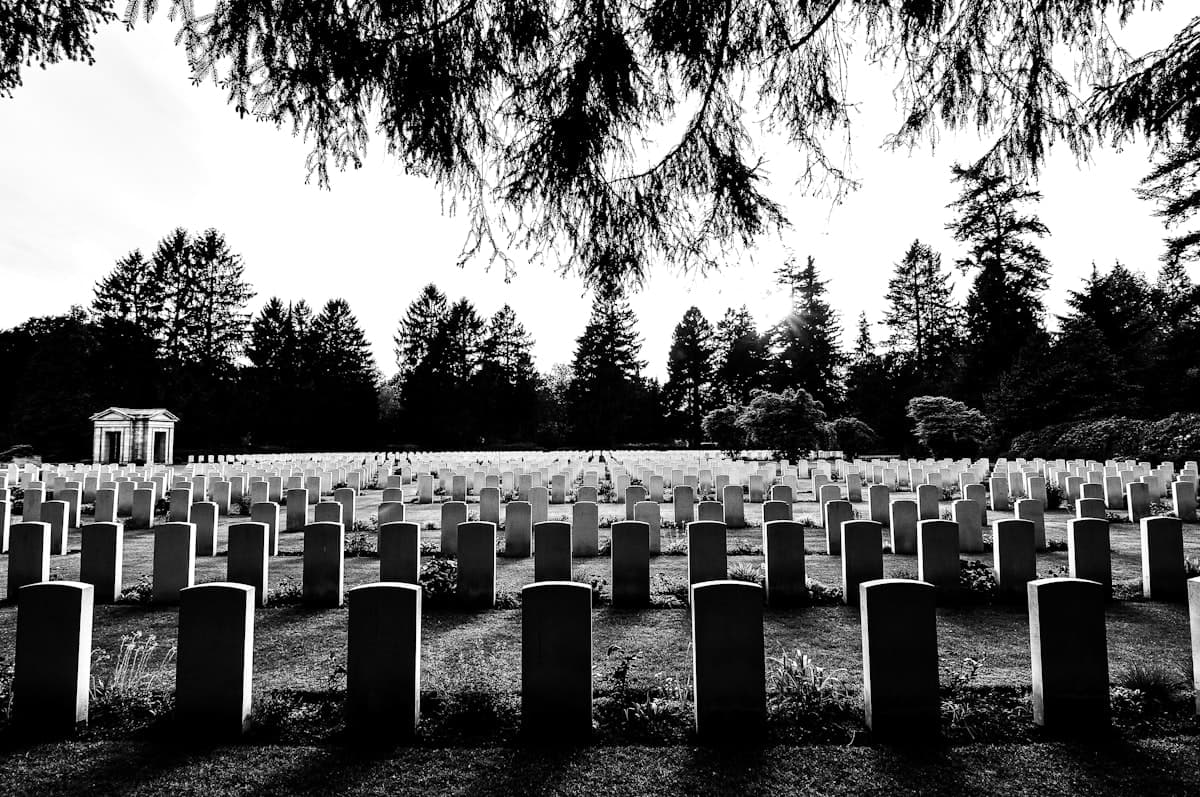
The Commonwealth War Cemetery contains 7,367 graves. It is maintained by the Commonwealth War Graves Commission, an organization founded in 1917 that tends to 1.7 million graves across 153 countries and has never, in over a century of operation, missed a burial. The grass here is cut. The headstones are clean. The register books are updated. In a region where ancient monuments crumble for lack of funding, this level of maintenance is quietly remarkable.
Walk slowly. The headstones tell stories if you read them properly. The ages: 19, 21, 18, 34, 22. The regiments: the Argyll and Sutherland Highlanders, the Royal Australian Artillery, the South African Infantry, the New Zealand Engineers. El Alamein was a genuinely imperial battle. Men from Johannesburg, Wellington, Sydney, Glasgow, Calcutta, and Kingston died in the same sand for the same objective. Their headstones stand in the same rows, which was not always how they were treated while alive.
Some headstones carry no name. Just a rank and the phrase: "Known Unto God." There are 815 such graves at El Alamein.
The cemetery sits close to the road and is easy to find. Give it more than the fifteen minutes most tour groups allow. Sit down. Read a full row. The names are the history; the plaques on the walls are just the summary.
The El Alamein War Museum
The museum opened in 1965 and shows its age, but not in a way that diminishes it. The exhibits include actual tanks, field artillery, aircraft wreckage, uniforms, personal letters, maps, and equipment recovered from the battlefield. The Italian and German galleries are as detailed as the Allied one, which is an editorial choice worth noticing.
The tank outside the museum entrance is a Valentine infantry tank, a British design that was considered underpowered from its introduction but served throughout the North Africa campaign because there was nothing better available in sufficient numbers. It saw action at El Alamein and is a more honest monument to the Allied war effort than any polished plaque: functional, imperfect, present.
What the museum does not adequately explain is the logistics of the battle. Montgomery's plan involved 195,000 Allied troops, 1,029 tanks, and 750 aircraft. The supply chain ran from Alexandria, over a hundred kilometers of desert road, to a front that consumed ammunition at a rate the logistics staff had not anticipated. The Allied victory was partly military and partly an administrative achievement. The museum shows you the weapons. It does not quite show you the spreadsheets that made them usable.
The German and Italian Memorials
The German Military Cemetery on a low hill contains 4,280 graves, many marked by flat basalt stones that cover multiple men. The architecture is severe: dark stone, geometric forms, no softness. It does not apologize, but it does not glorify either. This is what a country that lost the war does with its dead when it has thought carefully about the question.
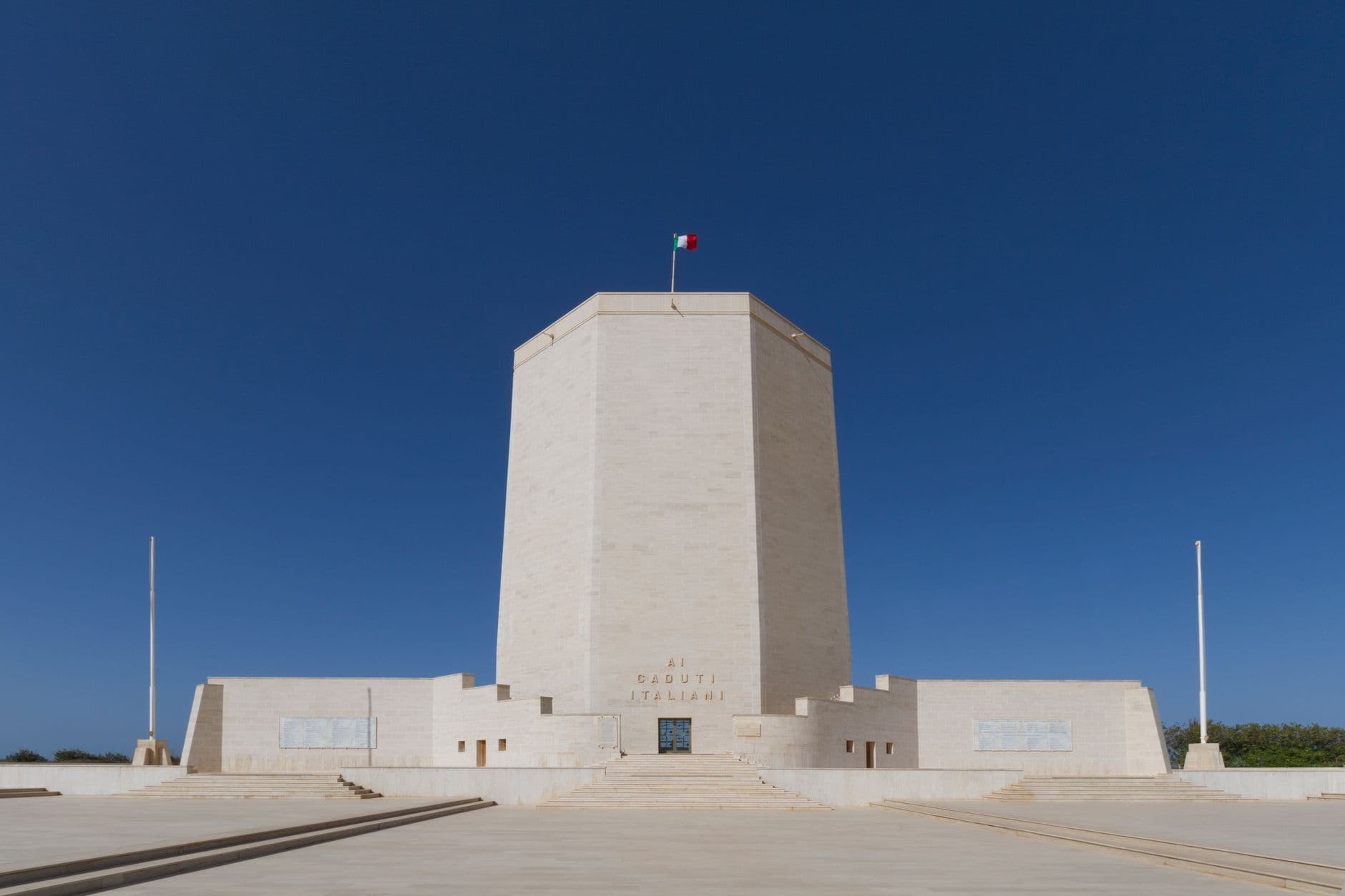
The Italian Memorial is something else entirely. It is an enormous marble tower visible from kilometers away, housing the remains of 4,633 Italian soldiers in a space that feels closer to a church than a cemetery. Italy treated its El Alamein dead differently: this is a monument to sacrifice framed in a religious and national register rather than a military one. Whether that framing is more honest or less honest than the German approach is a question worth sitting with on the drive back.
---
The Connections
El Alamein is 106 kilometers from Alexandria, which means it is 106 kilometers from one of the greatest libraries ever built, from the tomb of Alexander the Great (still unlocated beneath the modern city), and from the site of the Ptolemaic court that translated the Hebrew Bible into Greek. The Western Desert has always been the place where civilizations either held or did not.
The ancient Egyptians used the Qattara Depression's western edge as a trade and transit route toward Libya. The Romans garrisoned this coastline. The Arab conquest of Egypt in 641 CE moved along this same coastal corridor. Napoleon's forces in 1798 did not reach this far, but his campaign transformed Egypt's relationship to European military power in ways that made British occupation possible, which is what put British soldiers in this desert in 1942.
There is also a quieter Egyptian connection. The labor that built Allied supply infrastructure, the roads, the depots, the communications lines, was substantially Egyptian. These men are not in the museum. They are not in the cemeteries. The El Alamein World War 2 Egypt guide you will find in most travel literature does not mention them. Their contribution was documented by the Egyptian labor corps records, most of which remain undigitized in the Egyptian National Archives in Cairo.
After 1952, when the Free Officers revolution removed the monarchy, the new Egyptian government found itself in an awkward position regarding El Alamein. The battle had been fought partly to preserve British imperial interests. Celebrating it openly was politically difficult. The current museum, opened under Nasser, strikes a careful balance: it acknowledges the battle's scale without positioning Egypt as a grateful beneficiary of Allied intervention.
---
Common Mistakes
Spending all your time at the Commonwealth Cemetery and skipping the Axis memorials. The German and Italian sites are a twenty-minute drive apart and require effort to reach without a car. Make the effort. A battlefield only makes sense when you understand both sides of it, and the architectural choices each nation made in commemoration tell you something precise about how they processed defeat.
Coming on a day trip from Cairo. The drive from Cairo is over 300 kilometers each way. You will spend six hours in a car for ninety minutes at the site. Come from Alexandria, which is 106 kilometers away and an excellent base. The Corniche hotels in Alexandria are reasonably priced and the city itself rewards two or three days.
Arriving without water or food. There is a small café near the museum that serves tea and soft drinks. That is the full catering operation at El Alamein. Pack lunch.
Hiring a guide from the museum entrance. The informal guides who approach visitors at the museum entrance vary enormously in quality and almost always steer you toward a memorized script rather than actual engagement with the site. If you want a specialist guide, book one in advance through a reputable Alexandria-based operator who can provide documented expertise in Second World War history.
Skipping the El Alamein Hotel Sound and Light Show. There is a sound and light show at El Alamein that costs roughly EGP 200 and runs on selected evenings. Skip it entirely. It is a generic production that tells you less than thirty minutes with a good book. Spend those EGP 200 on dinner in Alexandria and read Antony Beevor's account of the North Africa campaign on the beach instead.
Underestimating the emotional weight. El Alamein is not Luxor. There are no vendors, no camel rides, no one trying to take your photograph for payment. This is a place where people come to find the name of a grandfather on a wall. Calibrate your behavior accordingly.
Missing the October commemorations. If your dates are flexible, the late October anniversary period brings formal ceremonies attended by diplomatic delegations from Commonwealth countries, Germany, and Italy. The Commonwealth War Graves Commission organizes the main service. It is one of the few places in Egypt where you can watch four former enemies commemorate their shared dead together. The logistics require advance planning but the experience is without parallel.
---
Practical Tips
The most practical decision you can make about El Alamein is to hire a private driver from Alexandria for the day. Budget EGP 1,200 to 1,500 for a driver who will wait while you visit each site. The savings of taking the bus are real but the costs in flexibility and time are greater.
Bring sunscreen regardless of the season. The Western Desert light is reflective even in October and the memorial grounds have almost no shade.
The museum register books, which list all the Commonwealth dead by name and grave location, are available at the cemetery entrance. Use them. Finding a specific grave takes five minutes with the register and an hour without it.
No formal dress code applies, but the cemeteries are active memorial sites. Shorts are fine; loud music from a phone speaker is not.
Combine El Alamein with a night in Marsa Matruh, 290 kilometers further west along the coast, if you have the time. The beach there is genuinely good and the drive along the Mediterranean coast is one of the more underrated journeys in Egypt.
Frequently Asked Questions
The Weekly Dispatch
More on Egypt, every Friday.
Cultural depth and places most guides never mention.
No spam. Unsubscribe anytime.