El Alamein World War 2 Egypt Guide: The Desert War's Full Story
In 1942, eleven thousand men died in a strip of Egyptian desert 60km wide. Most visitors spend 90 minutes here. They miss everything that matters.

Quick Facts
- Best time to visit
- October to March; late October for anniversary commemorations on the 23rd
- Entrance fee
- El Alamein War Museum: EGP 100 (approx $2 USD). All three military cemeteries: free entry
- Opening hours
- War Museum daily 9am to 5pm. Cemeteries have no set closing time; best before 3pm
- How to get there
- Private taxi from Alexandria approx EGP 600 to 900 return. Minibus from Alexandria Moh. Naguib station approx EGP 30 per person (drops at highway). From Cairo: 3-hour drive, approx EGP 1,200 to 1,800 by private car
- Time needed
- 4 to 5 hours for all sites. Full day if combining with Sidi Abd el Rahman or continuing to Marsa Matruh
- Cost range
- Budget EGP 400 to 700 per person from Alexandria including transport and entry. Mid-range EGP 1,500 to 2,500 from Cairo with private driver
Eleven thousand men died in the second Battle of El Alamein in eleven days. The battlefield stretched across roughly 60 kilometers of Egyptian desert between the sea and the Qattara Depression, a vast salt flat that dropped 134 meters below sea level and was utterly impassable for armored vehicles. That geological accident, a quirk of the Sahara's geography, is the reason the battle was fought here at all. Without the Qattara Depression, Rommel could have simply gone around.
Most visitors to this stretch of the Western Desert spend ninety minutes at the Commonwealth Cemetery, take a photograph, and leave. This guide is for people who want the full picture: what actually happened, what you will see at each site, and what the experience of standing in this place reveals about Egypt in ways that go well beyond the summer of 1942.
Quick Facts
Best time to visit: October to March. Summer temperatures in the Western Desert regularly exceed 38°C and the sites have minimal shade. October is ideal because the anniversary of the second battle falls on October 23, bringing commemorations and a quieter, more reflective atmosphere than the main tourist season.
Entrance fees: The El Alamein War Museum costs approximately EGP 100 (around $2 USD) for adults. The military cemeteries, including the Commonwealth, German, and Italian cemeteries, are free to enter and maintained by their respective national war graves commissions.
Opening hours: El Alamein War Museum: daily 9am to 5pm. The cemeteries have no fixed closing time but are best visited before 3pm for reasonable light and temperature.
How to get there: El Alamein sits 106 kilometers west of Alexandria along the coastal highway. A private taxi from Alexandria costs approximately EGP 600 to 900 return depending on waiting time. Minibuses from Alexandria's Moh. Naguib station run regularly for around EGP 30 per person but drop you on the highway, requiring a walk or tuk-tuk to the sites. From Cairo, the journey is around three hours by car; most visitors combine it with a day or overnight in Alexandria.
Time needed: A serious visit to all three cemeteries plus the war museum requires four to five hours minimum. Combine with Sidi Abd el Rahman beach or an overnight in Marsa Matruh to make the journey worthwhile.
Cost range: Budget EGP 400 to 700 for the day including transport from Alexandria, entry, and lunch at a local spot near the museum. Mid-range EGP 1,500 to 2,500 if hiring a private car and driver from Cairo.
Why This Place Matters
The Western Desert Campaign is usually taught as a British story: Montgomery versus Rommel, the Eighth Army, the turn of the tide. What the standard narrative omits is that El Alamein was also an Egyptian story, and that its outcome determined whether Egypt would remain nominally independent or become a theater of direct Nazi occupation.
In the summer of 1942, Rommel's Afrika Korps reached El Alamein having driven the British back more than 1,500 kilometers from Libya. Cairo was close enough that German officers were reportedly booking hotel rooms in anticipation. King Farouk made private inquiries about his options. The Egyptian upper classes began hedging their bets. In a remarkable document now held in the Egyptian National Archives, Egyptian nationalist politicians debated whether a German victory might be preferable to continued British occupation. The irony was that an Axis victory would almost certainly have brought harsher occupation, not independence.
The second battle, from October to November of 1942, was the first major Allied ground victory of the war in any theater. Churchill said, famously and with only slight exaggeration, "Before Alamein we never had a victory. After Alamein we never had a defeat." What is less often quoted is that among the Allied forces fighting here were soldiers from Australia, New Zealand, South Africa, India, Greece, and Free France, along with a contingent of Palestinian Jewish soldiers who would, five years later, be fighting against the British in a different desert entirely.
What You Will Actually See
The Commonwealth War Cemetery
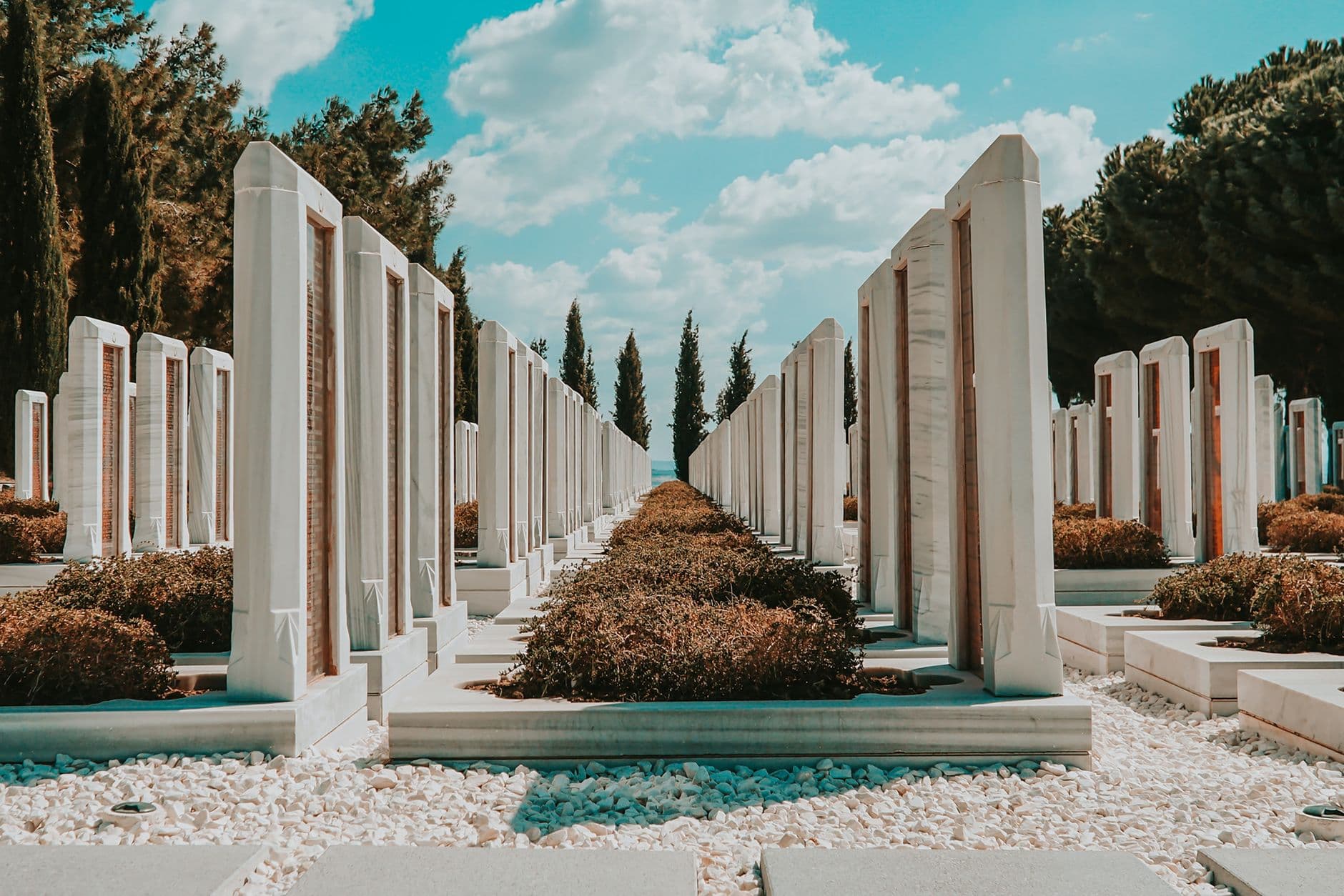
The Commonwealth Cemetery contains 7,367 graves. It is maintained by the Commonwealth War Graves Commission to the same standard as every one of its facilities worldwide, which means the grass is cut, the headstones are level, and someone is always working. In a country where maintenance of public spaces is often aspirational, the precision of this place lands with particular force.
The headstones are Portland stone, pale and uniform. Each carries a name, regiment, date of death, age, and often a line chosen by the family. The ages are the thing that stops you. Nineteen. Twenty-one. Twenty-three. A substantial number of headstones read simply "A Soldier of the 1939-1945 War, Known Unto God," because the desert swallowed the evidence of who they were.
The cemetery was designed by Sir Hubert Worthington and opened in 1954. What most visitors do not notice is that the design borrows explicitly from classical Egyptian funerary architecture: the processional approach, the central axis, the sense of a threshold between living and dead space. Worthington was aware of where he was building.
The German Cemetery at Tel el-Eisa
The German cemetery is four kilometers from the Commonwealth site and receives perhaps one-tenth the visitors. This is a mistake. The German cemetery holds 4,280 soldiers and its design philosophy is completely different: dark basalt stones, low to the ground, grouped in clusters rather than individual rows. It feels heavier. The architecture communicates loss rather than order.
Among the dead here is a soldier whose headstone reads "Rommel-Soldat," a term used informally for members of the Afrika Korps. The German War Graves Commission, the Volksbund Deutsche Kriegsgraberfursorge, maintains the site in partnership with the Egyptian government, a relationship that has required considerable diplomatic management over the decades.
Tel el-Eisa, "Hill of Jesus" in Arabic, was itself a significant defensive position before the battles, and the site has a layer beneath the military history. Archaeological surveys conducted in the 1990s identified fragmentary evidence of ancient activity in the area, consistent with the Western Desert's role as a trade corridor between Egypt and Libya for at least four thousand years.
The Italian Memorial and Cemetery
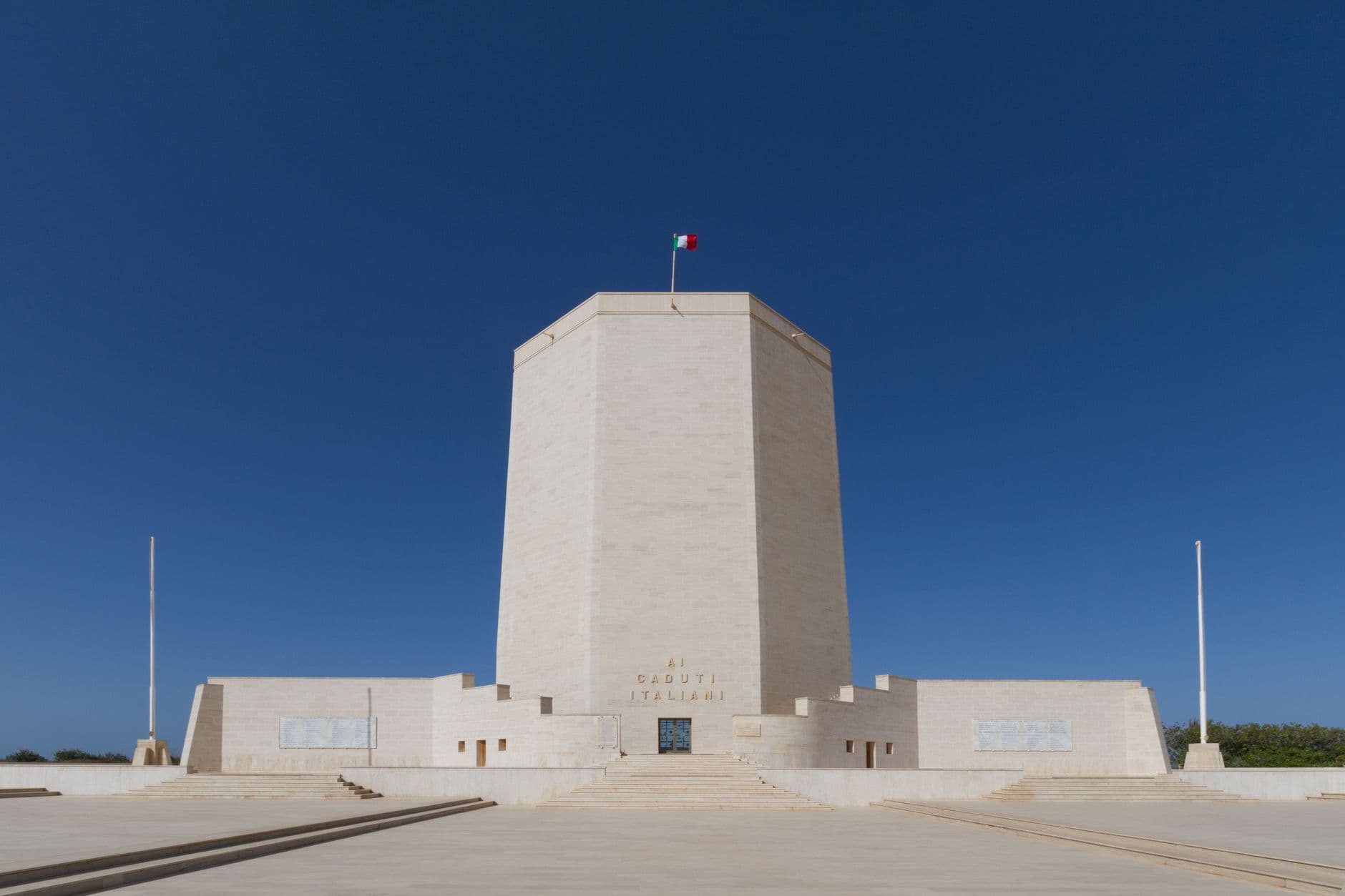
The Italian memorial is the most architecturally assertive of the three: a white marble tower visible from the coastal highway, designed to be seen. It holds the remains of 4,634 Italian soldiers in an ossuary below a chapel, and the scale of the structure reflects Mussolini's original intention to build a monument to an expected victory. Construction continued after the defeat, and the result is a building whose grandeur sits in uncomfortable tension with its context.
Inside the chapel, the floors are inlaid marble and the walls carry the names of the dead. The maintenance is less rigorous than the Commonwealth or German sites, which tells its own story about national memory and political will.
The El Alamein War Museum
The museum opened in 1956 and has been partially updated since, though its presentation still owes something to that era's approach to military history: a lot of hardware, relatively little human context. The courtyard displays tanks, artillery pieces, and vehicles from both sides, including a Grant tank, a Matilda, and a German Panzer III. These are not reconstructions. They are the actual machines, recovered from the desert where they were abandoned or destroyed.
The galleries inside cover the North African campaign from 1940 to 1943 with maps, photographs, and artifacts. The Egyptian-language captions and the English-language captions occasionally describe the same events in noticeably different ways, particularly around the question of Egyptian agency during the occupation period. This is worth paying attention to.
The Connections
El Alamein does not exist in isolation from the rest of Egypt's history, though it is usually presented as if it does.
The coastal road that runs past the battlefield is built on a route that has connected Egypt to the Maghreb for millennia. Alexander the Great used a version of this road when he marched west to consult the Oracle at Siwa in 331 BC. The same corridor was used by Arab armies bringing Islam into Egypt in the 7th century, and by Ottoman forces moving in the opposite direction during the same period's counter-campaigns.
Sidi Abd el Rahman, the small coastal settlement near El Alamein where Rommel had his forward headquarters, was a site of local religious significance before the war, named for a Sufi sheikh whose tomb still stands. During the battle, the tomb was used as a field hospital landmark by both sides. The sheikh's followers continued visiting throughout the fighting, which says something about Egyptian civilian experience of the Desert War that rarely appears in British or German accounts.
Alexandria, less than two hours east, is the city whose fate depended on the outcome of these battles. The city's Graeco-Roman history, its Coptic churches, its Jewish quarter (once one of the largest in the Mediterranean world), its Corniche: all of it was under direct threat in the summer of 1942. Walking Alexandria's seafront and then driving to El Alamein in the same day produces a kind of understanding that reading alone cannot.
Common Mistakes
Seeing only the Commonwealth Cemetery. Most tours stop here and leave. The German and Italian sites are essential counterpoints. Military history that only presents one side's grief is not history, it is commemoration, and commemoration without context teaches nothing.
Coming in July or August. The desert in midsummer is genuinely hostile. The cemeteries have almost no shade, the museum is poorly ventilated, and the emotional weight of the place is harder to absorb when you are physically uncomfortable. The October commemorations are the correct time to visit.
Skipping the museum because it looks basic. The tanks in the courtyard are real artifacts, and the maps inside the galleries are among the clearest visual representations of the campaign's geography available anywhere. The museum is under-designed, not under-interesting.
The sound and light show at the museum, if offered during your visit, is not worth attending. It costs additional entry and delivers a dramatically narrated version of the campaign that any serious reader already knows. The cemeteries at dusk, in silence, cost nothing and deliver considerably more.
Treating this as a half-day add-on from Alexandria. The drive west from Alexandria takes you through a stretch of Egyptian coastline that most tourists never see: small fishing settlements, Roman-era cisterns visible from the road near Burg el Arab, the satellite city of Borg El Arab that Egypt built in the 1980s as an industrial and administrative center. If you are driving this road, leave time to stop.
Ignoring the civilian history. Bedouin communities in the Western Desert were displaced during the campaign and their land was seeded with mines that killed and maimed for decades afterward. Egypt began systematic demining programs in the 1990s, and some agricultural land in the area was only cleared and returned to use in the 2000s. This is part of the El Alamein World War 2 Egypt story that no museum currently tells adequately.
Arriving without water. The coastal desert is dry and the sites are spread across several kilometers. Bring more water than you think you need.
Practical Tips
Hire a driver rather than taking a minibus if you plan to visit all three cemeteries and the museum. The sites are not walkable between them and tuk-tuks near the highway are unreliable.
Dress conservatively. The cemeteries are places of grief for living families who still visit. Commonwealth War Graves Commission sites receive relatives of the dead from around the world throughout the year, not just at commemorations.
If you visit in late October, check the dates of the annual El Alamein commemoration ceremony. It is attended by military attaches from several countries and is brief, formal, and genuinely moving. The Egyptian military's participation reflects the diplomatic complexity of the site: Egypt was not an Allied combatant, but its territory was.
Combine the visit with Marsa Matruh, two hours further west, if you have an extra day. Marsa Matruh is a functioning Egyptian coastal city with good seafood and a harbor that Rommel used as a resupply base. The juxtaposition of ordinary Egyptian summer life with the desert war's geography is clarifying.
Photography is permitted in all three cemeteries. Be thoughtful. The headstones are not props.
Bring a notebook. The names, the ages, the family inscriptions: they accumulate. Something about the desert light and the silence makes this a place where people find themselves writing.
Frequently Asked Questions
The Weekly Dispatch
More on Egypt, every Friday.
Cultural depth and places most guides never mention.
No spam. Unsubscribe anytime.