El Alamein World War 2 Egypt: The Complete Cultural Guide
More than 11,000 Commonwealth soldiers are buried at El Alamein. Most tourists stop at the museum and leave. The three military cemeteries, each built by a different nation, tell entirely different stories about how countries grieve.

Quick Facts
- Best time to visit
- October to April. October is historically resonant and comfortable at 22 to 26°C. Avoid July and August when coastal humidity and heat above 35°C make extended time at the exposed cemeteries unpleasant.
- Entrance fee
- El Alamein Military Museum: EGP 100 (approx $3 USD), students EGP 50. All three war cemeteries are free of charge.
- Opening hours
- Museum: daily 9am to 4pm. Cemeteries: no formal hours, accessible at any time. Italian memorial interior: approximately 9am to 3pm when attendant is present.
- How to get there
- Microbus from Alexandria: EGP 30 to 50, 90 minutes. Private taxi from Alexandria: EGP 300 to 500 return with waiting time. Rental car from Alexandria recommended for flexibility. No direct service from Cairo without changing in Alexandria.
- Time needed
- 4 to 5 hours for all three cemeteries and the museum. Full day if combining with Sidi Abd el Rahman or the coastal area.
- Cost range
- Budget EGP 400 to 700 per person including transport from Alexandria. Mid-range EGP 1,200 to 2,000 with private car hire.
The Desert That Swallowed Armies
The German war cemetery at El Alamein contains 4,280 graves. The Commonwealth cemetery contains 7,367. The Italian cemetery holds 4,634. Do the math: more than 16,000 men are buried within a few kilometers of each other in the Egyptian desert, and on a Tuesday afternoon in February, you may be the only living person walking among them. This is not a battlefield that has been turned into a theme park. It has not been softened or commercialized into comfortable narrative. What it has been is largely ignored, which is part of why it remains one of the most affecting places in Egypt.
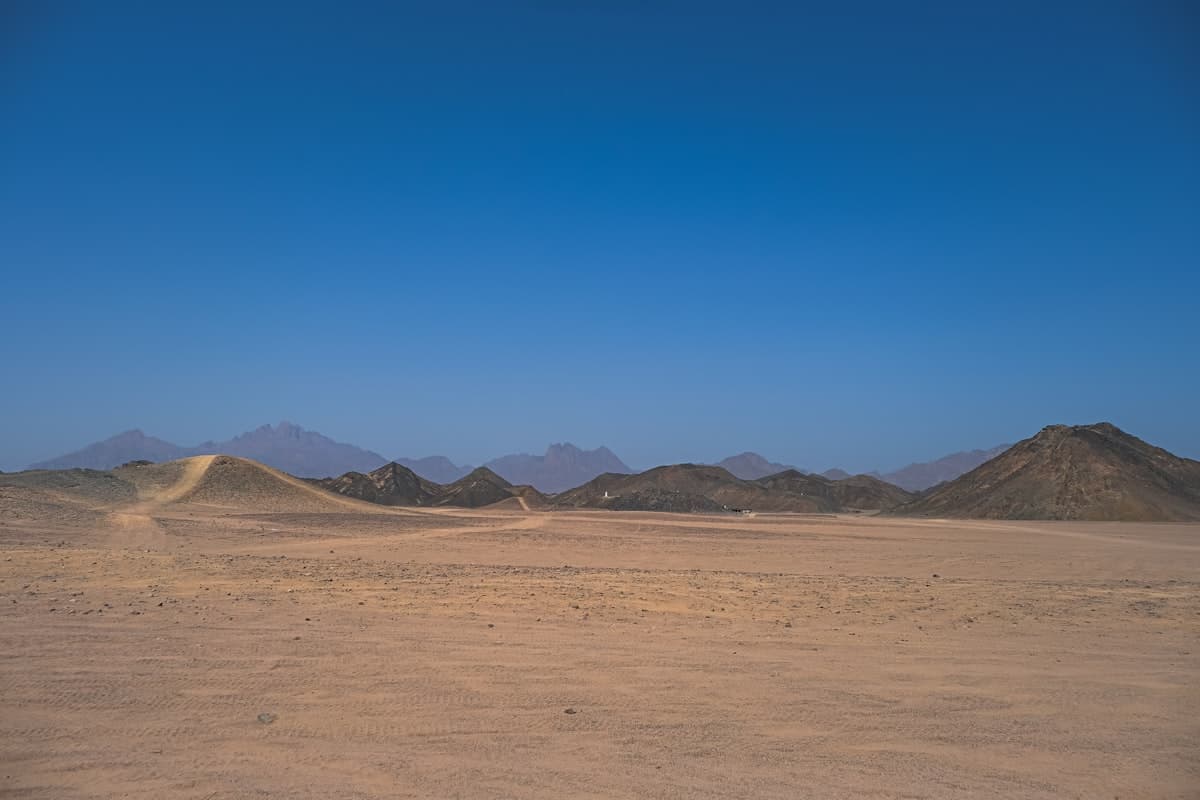
El Alamein sits 106 kilometers west of Alexandria on the Mediterranean coast. In October and November of 1942, this stretch of desert became the pivot point of the entire North African campaign. General Bernard Montgomery's Eighth Army broke through Rommel's lines here, beginning the chain of events that would end with the Allied liberation of North Africa and, eventually, the invasion of southern Europe. Churchill called it "the end of the beginning." What it looks like, standing in it now, is a flat expanse of scrub and sand that gives nothing away.
Quick Facts
Best time to visit: October to April. Summer temperatures regularly exceed 35°C and the coastal humidity makes it genuinely unpleasant. October is historically resonant, coinciding with the anniversary of the Second Battle of El Alamein (October 23 to November 11, 1942).
Entrance fees: El Alamein Military Museum: EGP 100 (approx $3 USD), students EGP 50 Commonwealth War Cemetery: Free (maintained by the Commonwealth War Graves Commission) German War Cemetery: Free Italian War Memorial and Cemetery: Free
Opening hours: The museum is open daily from 9am to 4pm. The cemeteries have no formal opening hours and can be visited at any time, though the Italian memorial has an attendant who keeps informal hours from roughly 9am to 3pm.
How to get there: From Alexandria, take a microbus or private taxi west along the coastal road (about 1.5 to 2 hours). Microbuses from Midan El Gumhuriyya in Alexandria cost around EGP 30 to 50. A private taxi will run EGP 300 to 500 for the return trip with waiting time. From Cairo, buses run to Alexandria's Sidi Gaber station (EGP 45 to 80), from which you connect west. Renting a car from Alexandria is the most practical option if you want to visit all three cemeteries and the museum in one day.
Time needed: A genuine visit to all three cemeteries and the museum requires four to five hours minimum. Allow a full day if you are combining it with the nearby lagoon at El Alamein or want to drive further west to Sidi Abd el Rahman.
Cost range: Budget EGP 400 to 700 per person including transport from Alexandria. Mid-range EGP 1,200 to 2,000 if hiring a private car with driver.
Why This Place Matters
The Second Battle of El Alamein was not simply a military engagement. It was the moment when the Axis advance toward the Suez Canal, and beyond it the oil fields of the Middle East, was permanently stopped. Had Rommel broken through, the strategic consequences for Egypt, for British imperial supply lines, and for the entire Middle Eastern theater would have been severe. Cairo knew this. In October 1942, the Egyptian capital was close enough to panic that British embassy staff were burning documents, and the phrase "Ash Wednesday" was used to describe the falling paper.
What is less commonly known is that El Alamein as a defensive position was chosen partly because of geography that has nothing to do with modern military logic. The northern edge of the line was anchored on the Mediterranean coast. The southern edge, roughly sixty kilometers inland, was anchored on the Qattara Depression, a vast natural basin that drops nearly 134 meters below sea level and is filled with salt flats and quicksand impassable to armored vehicles. Rommel could not go around. He had to go through. Montgomery made him pay for that.
The town of El Alamein itself barely existed before the war. It was a small railway station. The name appears on maps of the period almost apologetically. Today it is a growing resort town with new developments spreading east, though the war sites remain physically distinct from the tourist infrastructure.
The Three Cemeteries: Three Philosophies of Loss
The Commonwealth War Cemetery is the first place most visitors stop, and it earns that priority. The graves are arranged in careful rows across a manicured garden that the Commonwealth War Graves Commission maintains to a standard that feels almost excessive in the surrounding desert context. Every grave marker is identical in size and material, regardless of rank. A private and a lieutenant colonel lie under stones of the same dimensions. This was a deliberate policy established after the First World War, based on the principle that death creates an equality that life does not.
The register at the entrance contains every name. Spend time with it. The nationalities are striking: British, Australian, New Zealander, South African, Indian, Greek, Free French. The Eighth Army was an empire assembled against another empire. Some graves carry no name at all, only the words "Known unto God," which is an Episcopalian phrase chosen by the poet Rudyard Kipling, who was himself a member of the Imperial War Graves Commission and whose own son's body was never identified after the First World War.
The German cemetery is a different experience entirely. The gravestones are flat and dark, volcanic basalt rather than pale limestone, and they lie close to the ground rather than standing upright. The effect is sombre in a way that feels intentional, even penitential. Many graves hold two soldiers buried together, their names carved side by side, because the original burials had been so chaotic that individual identification was impossible. The German War Graves Commission did not begin its work at El Alamein until 1959, fourteen years after the war's end, because West Germany was not permitted to conduct overseas grave registration work until its re-admission to international bodies.
The Italian monument is the most architecturally ambitious of the three: a white stone chapel and ossuary built into a low hill, looking vaguely Rationalist in its design, which is the aesthetic of Italian Fascism translated into mourning. Inside, the walls are covered with names. The structure contains the remains of approximately 4,800 Italian soldiers, many of them consolidated from smaller graves scattered across the desert. Italy was fighting a war its soldiers did not universally believe in, and the monument has a quality of sorrow that is distinct from the German and Commonwealth sites, though it is also the least visited.
The Museum and What It Gets Right (and Wrong)
The El Alamein Military Museum opened in 1965 and has been renovated several times since, most recently in ways that have added signage in English without adding much interpretive depth. The outdoor collection of tanks, artillery pieces, and aircraft is the most immediately striking element. There is a German Panzer IV, a British Valentine tank, a 25-pounder field gun, and a Stuka dive bomber, all weathered to different degrees by sixty years of desert exposure.
The indoor galleries cover the North African campaign from the Italian invasion of Egypt in 1940 through the El Alamein battles to the final Axis surrender in Tunisia in May 1943. The Egyptian military context is handled carefully: Egypt was nominally neutral during most of this period, though the Anglo-Egyptian Treaty of 1936 required Egypt to grant Britain military access. King Farouk and parts of the Egyptian officer class had complicated sympathies, some of them actively pro-Axis, which the museum does not explore. This is understandable, but it means the political and Egyptian dimensions of the battle are largely absent.
The museum is worth two hours of your time, primarily for the hardware and the maps. The maps showing the shifting front lines between July and November 1942 give the battle a spatial clarity that standing on the flat desert does not.
Skip the sound and light show. It runs on selected evenings, costs EGP 200, and adds nothing to what the cemeteries themselves communicate silently and for free.
The Connections
El Alamein sits on a coast that has been contested for roughly three thousand years. The Libyan coast west of Alexandria was an active frontier during the New Kingdom period, when pharaohs of the Nineteenth Dynasty, including Ramesses III, repelled successive waves of "Sea Peoples" and Libyan tribes pushing east. The defensive logic of that ancient frontier, using the Mediterranean to the north and impassable terrain to the south, is structurally identical to the logic Montgomery employed in 1942. Geography does not change.
Alexandria, sixty kilometers to the east, is itself a palimpsest of every power that has fought over the eastern Mediterranean: Greek, Roman, Byzantine, Arab, Ottoman, French, British. The British military cemeteries in Alexandria's Hadra district predate El Alamein by decades, containing casualties from the First World War and the earlier British occupation of Egypt from 1882. El Alamein is the last chapter in a very long story of foreign armies deciding Egypt's fate on Egyptian soil.
The coastal road between Alexandria and El Alamein passes through territory that Rommel's army occupied for months. The small town of Sidi Abd el Rahman, about fifteen kilometers west of El Alamein, was briefly Rommel's headquarters. The hotel there, an old resthouse, still operates and has photographs on its walls.
Common Mistakes
Visiting only the Commonwealth cemetery. Most organized tours stop here, take photographs, and leave. The German and Italian sites are equally significant and add roughly ninety minutes to your day. Without all three, you are getting a partial and implicitly nationalistic version of the battle.
Arriving without water or sun protection. The cemeteries have no shade structures and no vendors. The museum has one kiosk. In any month except the mildest of winter, the sun is intense. This is not a minor inconvenience: heat exhaustion on an exposed site with no transport is a genuine problem.
Treating the military museum as the main event. It is context, not destination. The cemeteries are where the visit actually happens.
Going on a Friday during summer. Egyptian domestic tourism to El Alamein has grown, particularly among Alexandrians visiting the nearby beach resorts. Friday afternoons in July and August can be unexpectedly crowded at the museum, though the cemeteries remain quiet.
Not looking up a name before you go. The Commonwealth War Graves Commission website (cwgc.org) allows you to search by name, regiment, and nationality. If you arrive knowing you are looking for someone specific, or even just a specific regiment, the register becomes a document rather than a list.
Underestimating the drive back to Alexandria in winter. Coastal fog on the desert road west of Alexandria can be severe in January and February, reducing visibility to near zero. If you are renting or hiring a car, leave El Alamein before 4pm.
Combining El Alamein with a beach day at Sidi Abd el Rahman. This is a popular Egyptian domestic combination and I understand the logic, but it is a jarring tonal shift. Give the war sites a full day, separately.
Practical Tips
The best way to approach the site is from west to east: start at the German cemetery, then walk or drive to the Italian memorial, then the Commonwealth cemetery, then the museum. This sequence moves you from the most somber to the most structured, and ends with historical context rather than beginning with it.
There is no formal guide service at the cemeteries, but the custodians at each site are knowledgeable and often speak some English. At the Commonwealth cemetery, the register is kept in a stone shelter near the entrance and contains every name with grave coordinates. The Italian memorial's attendant will unlock the interior chapel if you ask.
Photography is permitted everywhere. Drone photography requires permits you are unlikely to obtain easily. Be respectful at the grave sites, which sounds obvious but needs saying: the Commonwealth and German cemeteries in particular receive visitors who treat them as backdrops.
If you are traveling from Alexandria as a day trip, the earliest possible start is best. Leave by 7am, reach El Alamein by 9am, and you will have the sites almost entirely to yourself for the first two hours.
There is one good local restaurant near the museum, a simple fish and grilled meat place that has been operating for decades. It has no formal name on its signage. Ask your driver or any local. Lunch there, after the morning at the cemeteries, is the right way to end the visit.
Frequently Asked Questions
The Weekly Dispatch
More on Egypt, every Friday.
Cultural depth and places most guides never mention.
No spam. Unsubscribe anytime.