El Alamein World War 2 Egypt: The Complete Visitor's Guide
In 1942, more soldiers died per square mile at El Alamein than almost anywhere else in the war. The sand still gives up shell casings. Most visitors spend two hours. That is not enough.

Quick Facts
- Best time to visit
- October to April. October is ideal for good weather, smaller crowds, and proximity to the October 23 battle anniversary commemorations.
- Entrance fee
- Commonwealth, German, and Italian cemeteries: Free. El Alamein Military Museum: approx EGP 100 (under $2 USD). Subject to change.
- Opening hours
- Military Museum daily 8am to 5pm. Cemeteries open at all daylight hours with no formal closing time.
- How to get there
- West Delta bus from Alexandria EGP 30 to 50 (90 min). Private taxi from Alexandria EGP 400 to 600 return including waiting. Self-drive from Cairo via Desert Road approximately 3.5 hours.
- Time needed
- Full day minimum. Half-day if visiting only the Commonwealth cemetery and museum, though this misses the Italian and German memorials.
- Cost range
- Budget EGP 400 to 700 per day from Alexandria including transport, lunch, and museum entry. Cemeteries are free.
Quick Facts
Best time to visit: October to April. Summer temperatures on the Mediterranean coast reach 38°C, and the exposed memorial grounds offer no shade.
Entrance fees: Commonwealth War Cemetery: Free, open daily German War Memorial: Free, open daily Italian War Memorial: Free, open daily El Alamein Military Museum: Approximately EGP 100 (approx $2 USD), subject to change El Alamein Museum ticket includes outdoor tank and artillery display
Opening hours: Military Museum daily 8am to 5pm. The cemeteries have no set closing time but are best visited in daylight.
How to get there: El Alamein sits 106 km west of Alexandria on the coastal road. From Alexandria's Sidi Gaber or Mohamed Naguib bus station, West Delta buses run to El Alamein for roughly EGP 30 to 50. A private taxi from Alexandria costs EGP 400 to 600 for the round trip including waiting time. From Cairo, the drive is approximately 290 km via the Desert Road to Alexandria and then west along the coast, about 3.5 hours. There is no train station at El Alamein itself.
Time needed: A full day. The three national cemeteries plus the museum plus driving between them adds up faster than any map suggests. A half-day visit leaves you rushing, and this place deserves more than rushing.
Cost range: Budget EGP 400 to 700 per day including transport from Alexandria, lunch, and museum entry. The cemeteries are free. The money goes on getting there and getting back.
---
Why This Place Matters
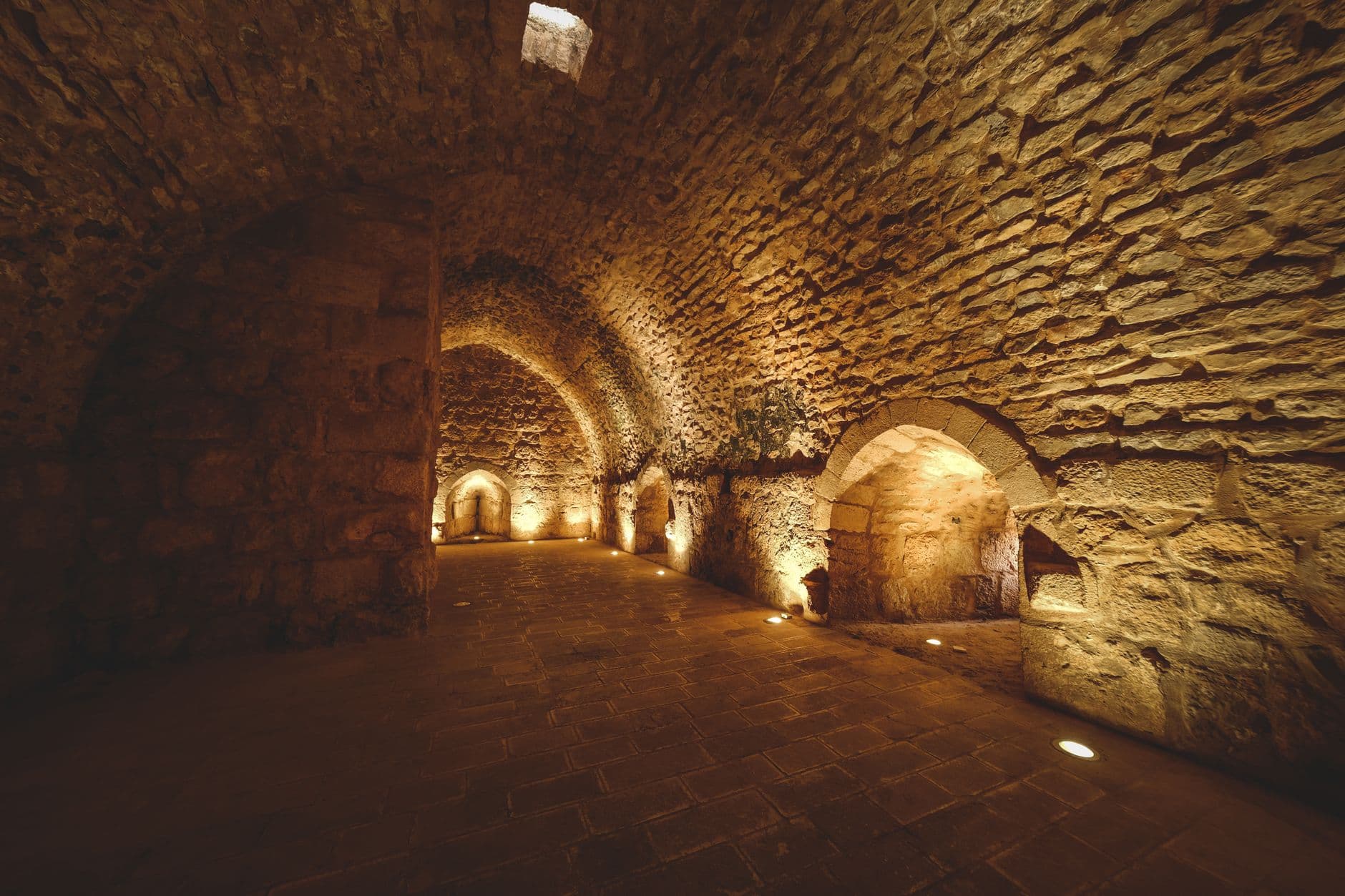
In the summer of 1942, Erwin Rommel's Afrika Korps was 106 kilometres from Alexandria. The British had already begun burning documents in Cairo. The city's Greek and Jewish communities were buying train tickets east. What stopped the German advance at a small railway halt called El Alamein was partly geography: a 64-kilometre gap between the Mediterranean coast and the impassable Qattara Depression, a salt flat sitting 133 metres below sea level, too soft to support tanks. There was nowhere left to go around.
What followed across two major battles in 1942, the first defensive in July and the second offensive in October and November, killed or wounded roughly 70,000 men across both sides in a narrow strip of desert that had never, before this, mattered to anyone. The Commonwealth buried 7,240 of its dead here. Germany and its allies lost between 30,000 and 59,000 men killed, wounded or captured in the Second Battle alone. Italy buried its dead in a vast white memorial that most visitors drive past without stopping.
For Egypt, this was a near-miss of an entirely different kind than the one in the history books. A German victory at El Alamein would have handed Rommel the Suez Canal, cut Britain's supply lines to India and the Far East, and positioned the Axis to link up with German forces pushing south through the Soviet Caucasus. The entire strategic geometry of the war would have shifted. Churchill, who called the Second Battle of El Alamein the end of the beginning, was not using hyperbole. He needed it that badly.
And yet almost nothing about the modern town of El Alamein, a resort strip of summer apartments and seafood restaurants, acknowledges any of this. You turn off the highway and suddenly you are at a white-walled cemetery, quiet except for the sea wind, and the distance between the holiday Egypt on the coast road and what happened in this sand is genuinely disorienting.
---
What You Will Actually See: The Three Cemeteries
The Commonwealth War Cemetery is the one most visitors to El Alamein find first, and it is, without sentimentality, one of the most carefully considered spaces in Egypt. The Commonwealth War Graves Commission maintains it, as it maintains 1.7 million graves across 153 countries, to a standard that involves replacing individual headstones that have shifted by more than a few millimetres. The graves here are Portland stone, set in rows across a garden that manages to look both formal and human. The inscriptions are personal: family members were invited to choose words, and many did.
What most visitors do not know is that 102 of the graves are unidentified. Their headstones read: "A Soldier of the 1939-1945 War, Known Unto God." The phrase was chosen by Rudyard Kipling, whose own son John was killed at the Battle of Loos in 1915 and whose body was not identified until 1992. Kipling wrote the Imperial War Graves Commission's commemorative inscriptions while spending years privately searching for his son. That context, once you know it, makes the phrase heavier.
The German memorial sits on a low hill about 3 kilometres from the Commonwealth cemetery. It does not look like a war memorial in any conventional sense. It is a squat desert fortress in local stone, more bunker than monument, and inside, the names are carved into the walls of a dim interior that smells of old stone and, faintly, candle wax. Around 4,200 German and Italian soldiers are buried here in communal crypts, not individual graves. The design choice reflects both the practicality of burying so many in one structure and a postwar German reluctance to build anything that could read as triumphalist.
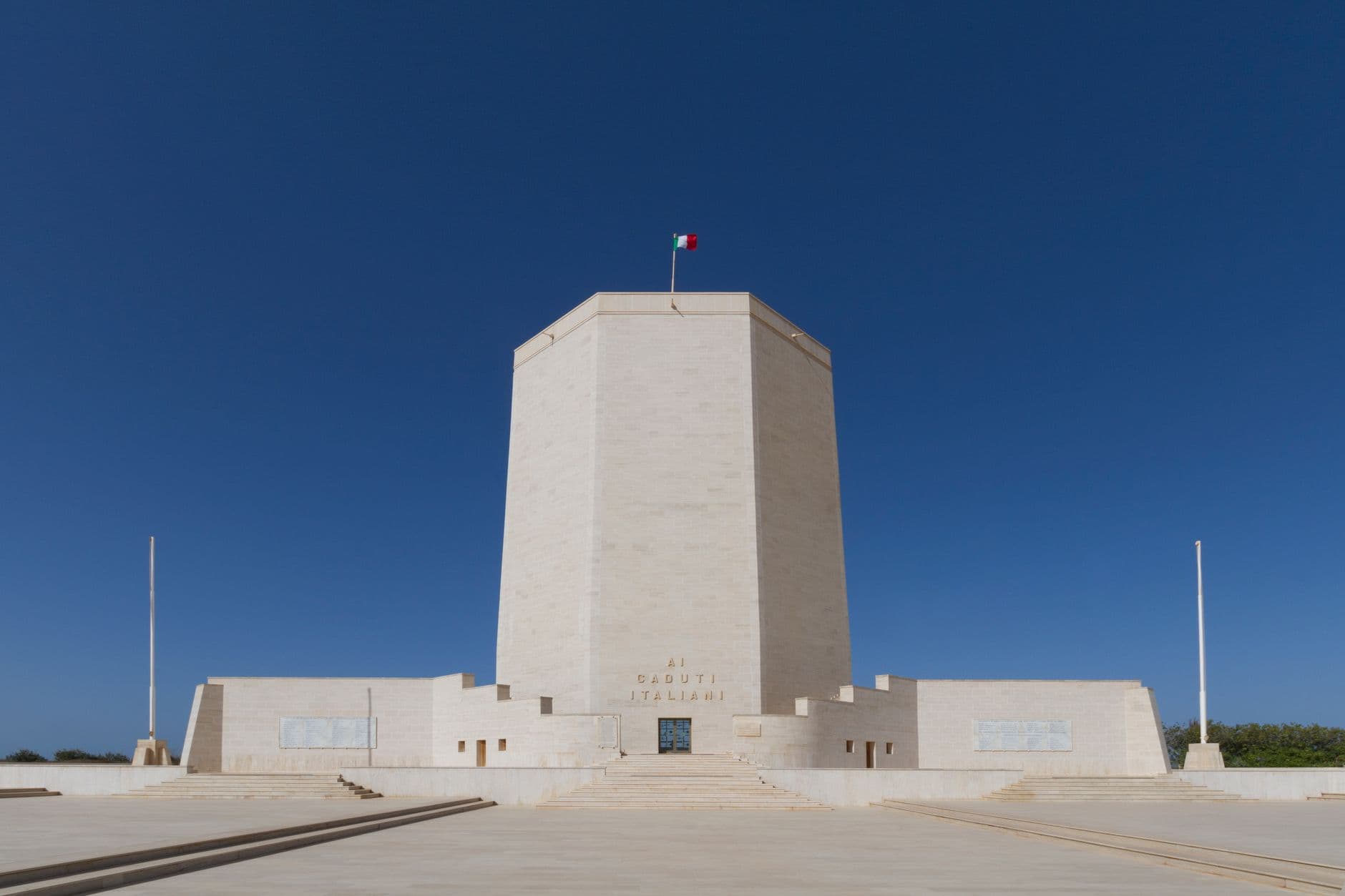
The Italian memorial is the largest structure on the battlefield and the least visited. It is a white lighthouse-tower visible from the highway, rising 27 metres, designed by the architect El Flaminio Pelliccia and inaugurated in 1959. Inside the tower, a staircase winds past marble tablets naming the Italian dead. The base contains a crypt. On most visits there will be no other tourists. Bring water, because there is no shade and no facilities.
---
The Military Museum and the Ground Itself
The El Alamein Military Museum opened in 1965 and has been intermittently updated since, though the core display feels closer to 1965 than to now. This is not entirely a criticism. The maps are large and clear, the tank models are accurate, and the room dedicated to the Egyptian perspective on the battle, including Egypt's formal neutrality and the complicated politics of a country under British occupation fighting to keep the Germans out, is more honest than most military museums anywhere in the world would be about such contradictions.
Egypt was, in 1942, technically independent under King Farouk but occupied by British forces under a 1936 treaty. Some Egyptian army officers, including a young Anwar Sadat, were in contact with German intelligence, not out of sympathy for Nazism but out of the calculation that any enemy of Britain might help end the occupation. Sadat was arrested in 1942 for this. He later became president of Egypt. The museum does not dwell on this, but it does not pretend it did not happen.
Outside the museum, a collection of tanks, artillery pieces, and armoured vehicles from both sides sits on a concrete pad. A German 88mm anti-tank gun is here, and understanding what that weapon did to Allied armour explains more about why this battle cost so many lives than any of the interior displays. The 88mm gun was designed as anti-aircraft artillery and proved devastatingly effective against tanks. British tank crews in the Western Desert developed a specific dread of it.
The battlefield itself, the open desert between the cemeteries and south toward the Qattara Depression, is not a manicured site. It is working desert, and it still contains unexploded ordnance. Do not walk off-road, not as cautious tourist advice but as a serious instruction. The Egyptian military periodically clears areas but estimates suggest that tens of thousands of mines and shells remain in the desert around El Alamein. People are still injured.
---
The Connections: El Alamein in Egyptian Time
El Alamein feels isolated from the rest of Egyptian history, and that feeling is misleading. The coastal road running west from Alexandria, the one that passes the battlefield, follows an ancient route. Greek settlers moved along it when they founded Cyrene in what is now Libya in 631 BCE. Alexander the Great marched his army west along this coast after founding Alexandria in 331 BCE. Arab armies moved east along it during the 7th-century conquest of Egypt.
Alexandria itself, 106 kilometres east, is the city that makes El Alamein's strategic importance legible. Alexandria handled the majority of British supply traffic into Egypt and the Middle East. The port and the Suez Canal to the east were the two assets that made Egypt worth fighting over in 1942. Rommel knew this. Churchill knew this. The proximity of the battlefield to the city, an hour and a half by modern road, is a fact that does not register until you make the drive and watch the distance disappear.
The Western Desert campaign also embedded itself into Egyptian political life in ways that outlasted the war. The Free Officers movement that overthrew King Farouk in 1952, bringing Nasser and eventually Sadat to power, drew heavily from officers who had served in or around the Western Desert and who had watched British commanders treat the Egyptian military as an irrelevance in a war fought on Egyptian soil. The revolution of 1952 is not unrelated to the experience of 1942. Nothing in Egypt exists in isolation.
---
Common Mistakes
Visiting only the Commonwealth cemetery. This is what tours do. It is also the least complete way to understand the battle. The German memorial gives you the scale of the losses on the other side, and the Italian memorial, almost entirely unvisited, offers a silence that the busier Commonwealth site cannot. Plan for all three.
Expecting a landscape that looks like a battlefield. The desert around El Alamein looks like desert. There are no preserved trenches, no maintained earthworks, no dramatic terrain features that will help you visualise what happened. The battle happened across hundreds of square kilometres of flat sand. The museum maps do more work than the ground itself.
Skipping the museum because it looks dated. The exterior is not encouraging. Go in anyway. The maps of both battles are the clearest overview you will find, and the geopolitical context section, especially the material on Egypt's position as a nominally neutral, actually occupied country hosting a war between foreign powers, is worth an hour of anyone's time.
The sound and light show, if you find one advertised. No permanent sound and light show runs at El Alamein as of the most recent information available, but local operators occasionally offer evening tours described in those terms. They consist of standing in the dark near a museum that is closed. Do not pay for this.
Combining El Alamein with a full Alexandria day in a single itinerary. Travel content regularly suggests this. It is possible in the sense that a 12-hour day makes it technically possible. It is not possible in the sense that doing it means you will see nothing properly. El Alamein alone is a full day from Alexandria. Alexandria alone is a full day. Do not try to do both.
Underestimating the heat between May and September. The Mediterranean coast is cooler than Cairo but the cemeteries and the outdoor museum exhibits are fully exposed. The German memorial has some shade inside. The Italian memorial has none anywhere. In July and August this is a significant problem, not a minor discomfort.
Not reading anything before you arrive. This is a battlefield where the strategic consequences were global. Arriving without context, expecting the ground to explain itself, means you will leave with very little. Antony Beevor's account in his broader World War II history, or John Bierman and Colin Smith's "Alamein," give you enough to turn the flat sand into something three-dimensional. Read one of them on the bus from Alexandria.
---
Practical Tips
The best base for El Alamein is Alexandria, not Cairo. The drive from Cairo is manageable but long, and you will spend the first and last hour and a half of your day on the Desert Road seeing nothing. From Alexandria, the coastal road is faster and the city itself has enough to justify a two-night stay.
Bring food and water from Alexandria. The town of El Alamein has restaurants aimed at summer holiday crowds and a petrol station. Options between the memorial sites are limited. There is no reliable cafe near the cemeteries.
The Commonwealth War Graves Commission registers all burials, and if you have a family connection to the Western Desert campaign, the CWGC website allows you to search by name and find the exact grave location and its GPS coordinates before you arrive.
October is the ideal month. The anniversary of the Second Battle of El Alamein is October 23, and commemorations sometimes take place at the cemeteries involving veterans' organizations from Commonwealth countries. The weather in October is good, the summer crowds are gone, and the quality of light in the morning on the white memorial stones is worth experiencing slowly.
There is no dress code requirement at the military cemetery or the German memorial. The Italian memorial has a chapel inside, and modest dress is appropriate there. In practice, the site receives few visitors and no one will stop you regardless.
If you are driving yourself, a GPS or downloaded offline map is useful. The signs for individual memorials on the highway are present but not always easy to spot at speed. The Commonwealth cemetery sits directly on the northern side of the highway with a clear entrance. The German memorial requires a short turn inland. The Italian memorial is visible from the road but the access road is unmarked.
Frequently Asked Questions
The Weekly Dispatch
More on Egypt, every Friday.
Cultural depth and places most guides never mention.
No spam. Unsubscribe anytime.