El Alamein World War 2 Egypt: The Desert War You Don't Know
Eleven thousand soldiers are buried within two miles of each other at El Alamein. Most tourists drive past on the way to a beach resort. Here is what they miss.

Quick Facts
- Best time to visit
- October to April. The desert sites have no shade and summer temperatures reach 38C. October 23 anniversary ceremonies are small but worth noting.
- Entrance fee
- Military Museum EGP 100 (approx $3 USD). Italian Memorial EGP 50 (approx $1.50 USD). Commonwealth and German cemeteries free.
- Opening hours
- Military Museum daily 8am to 5pm. Cemeteries open dawn to dusk year-round.
- How to get there
- Microbus from Alexandria Midan el-Gumhuriyya: EGP 30 to 50, about 90 minutes. Private taxi from Alexandria: EGP 400 to 600 one way. Self-drive from Cairo: approximately 3 hours via Desert Road and coastal highway.
- Time needed
- Full day minimum. Museum plus three memorial sites plus Tel el-Eisa ridge: 5 to 6 hours.
- Cost range
- Site entry under EGP 200 total. Transport from Alexandria EGP 60 to 600 depending on mode. Food EGP 80 to 150 per person at local restaurants.
El Alamein World War 2 Egypt: The Desert War You Don't Know
Eleven thousand soldiers are buried within two miles of each other on the Egyptian coast, separated by nationality in death the way they were separated by ideology in life. The Commonwealth graves face northeast. The German graves face south. The Italian memorial looks out to sea. Nobody planned the geometry. It happened because three countries lost a battle in the same stretch of desert and buried their dead where they fell. El Alamein is one of the most densely contested pieces of ground in modern military history, and most people who pass it are on their way to a beach resort 90 kilometers further west.
This is not a guide that will tell you El Alamein changed the course of the war, though it did. It will tell you what you will actually see when you get there, what the museums get right and wrong, why the Italian memorial is architecturally superior to anything Egypt built in the same era, and why you should budget a full day rather than the two hours most Cairo tour operators sell.
Quick Facts
Best time to visit: October to April. Summer temperatures on the coast reach 38C and the desert sites have no shade. Entrance fees: El Alamein Military Museum: EGP 100 (approx $3 USD). Commonwealth War Cemetery: free, open during daylight hours. German War Cemetery: free. Italian Memorial: EGP 50 (approx $1.50 USD). Prices are accurate as of late 2023 and subject to revision. Opening hours: Military Museum daily 8am to 5pm. Cemeteries open dawn to dusk year-round. How to get there: From Alexandria, take a microbus from Midan el-Gumhuriyya toward Marsa Matruh and ask to be dropped at El Alamein. Journey is roughly 1.5 hours, cost EGP 30 to 50. Taxis from Alexandria run EGP 400 to 600 one way. Driving is straightforward on the coastal highway. From Cairo, the drive is approximately 3 hours via Alexandria or the Desert Road. Time needed: Full day. The museum, three memorials, and the battlefield ridge at Tel el-Eisa justify five to six hours if you are paying attention. Cost range: The sites themselves cost almost nothing to enter. Budget EGP 300 to 500 for transport from Alexandria, food from roadside restaurants EGP 80 to 150 per person.
Why This Place Matters
Between June 1942 and November 1942, two armies fought across the same 65 kilometers of Mediterranean coastal desert four times. The First Battle of El Alamein in July 1942 stopped Rommel's advance toward Alexandria when the Afrika Korps was eight days away from the city. The Second Battle, which began October 23, 1942, ended with Rommel's retreat across Libya and eventually out of North Africa entirely. Churchill said, without exaggeration, "Before Alamein we never had a victory. After Alamein we never had a defeat."
What that statement obscures is the cost. The Commonwealth forces lost 13,560 men killed, wounded, or captured in the Second Battle alone. The Germans lost approximately 59,000. The Italians, whose role is almost entirely absent from English-language accounts, lost around 34,000 men, many of them poorly equipped infantry who had been fighting in the desert since 1940 and received none of the logistical attention given to Rommel's German units.
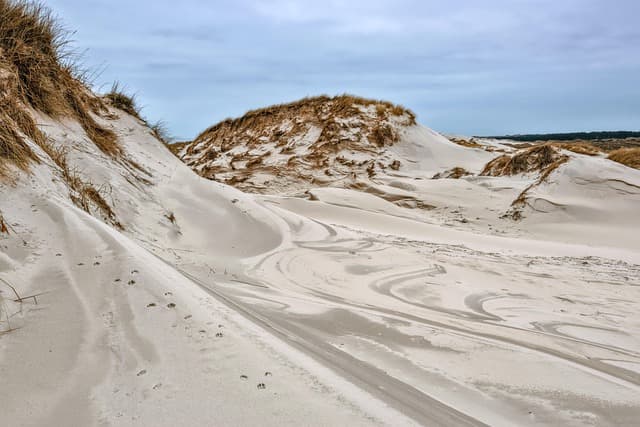
The desert itself shaped the battle in ways that are invisible to modern visitors. El Alamein was the one point on the North African coast where the terrain made flanking impossible. To the north, the Mediterranean. To the south, the Qattara Depression: a vast salt flat 134 meters below sea level, too soft for armor and too wide to cross. Rommel's entire strategy for two years had been the flanking maneuver. Here, for the first time, he could not use it. Montgomery knew this. He chose Alamein precisely because he could force a battle of attrition that Rommel's overstretched supply lines could not survive.
What You Will Actually See
The Commonwealth War Cemetery
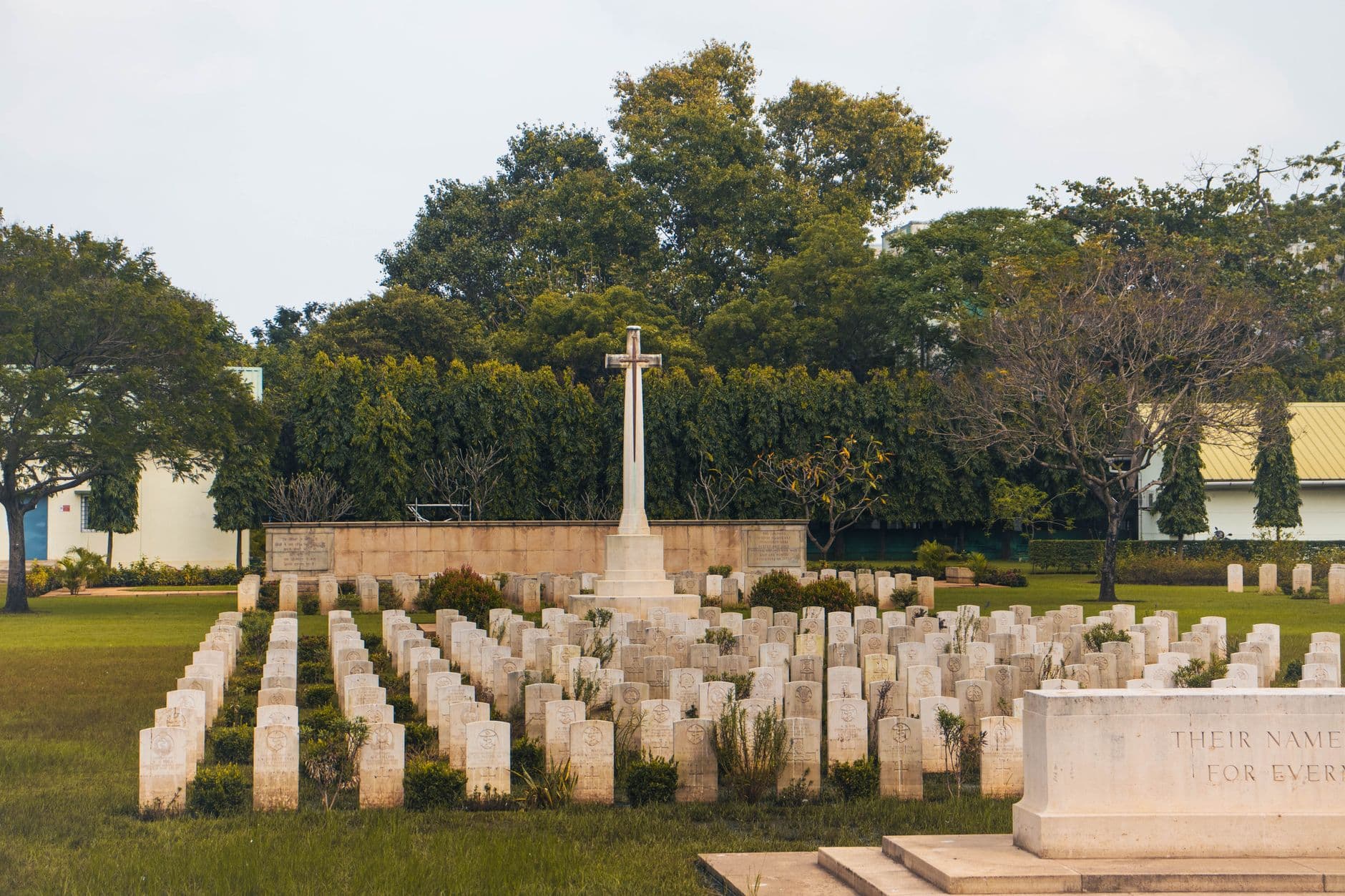
The cemetery sits directly off the coastal highway, announced by a low white wall and a garden of roses that the Commonwealth War Graves Commission maintains year-round. Gardeners are employed specifically to keep the grass and flowers alive in the desert. The organization has done this continuously since 1943, employing local Egyptian staff in roles that have passed from father to son in some families for two generations.
The graves are Portland stone, uniform in height and spacing, each one marked with the soldier's name, regiment, age, and a religious symbol chosen by the family. Walk slowly enough and the ages start to register: nineteen, twenty-two, seventeen, twenty. The youngest Commonwealth soldier buried here was fifteen, a fact the cemetery register confirms but does not advertise. He had falsified his age to enlist.
The register at the entrance lists every name. Use it. The graves of South African, Australian, New Zealand, Indian, and British soldiers are intermingled, not separated by nationality, which reflects Commonwealth policy. This was deliberate: a political statement about shared sacrifice that was genuinely radical for 1943.
The German War Cemetery
Three kilometers from the Commonwealth cemetery, the German memorial is architecturally heavier, built in dark basalt and designed to feel permanent rather than peaceful. It contains 4,280 graves, many marked with flat stones at ground level because upright crosses were considered too reminiscent of battlefield markers. The design reflects West Germany's postwar discomfort with military commemoration: how do you honor soldiers who died for a regime you have subsequently repudiated?
Inside the low stone building at the entrance, a room contains the names of all German dead in the North African campaign. The visitors' book, which you can read, contains entries in German, English, Arabic, and occasionally Hebrew, some of the Hebrew entries left by Israeli tourists who drive down from Tel Aviv. The guest book is worth reading. It tells you more about what Alamein means to different people than any museum placard.
The El Alamein Military Museum
The museum opened in 1965 and has been partially renovated since, which means it exists in two overlapping eras simultaneously. The outdoor tank park is genuinely excellent: a collection of Allied and Axis armor including a working Sherman tank, Italian M13/40 medium tanks, and a German 88mm anti-aircraft gun that was repurposed as an anti-tank weapon with devastating effectiveness. The 88mm gun is why the museum is worth visiting. Standing next to one, you understand immediately why it dominated the battlefield: it could penetrate any Allied tank at ranges up to 2,000 meters, and it could be set up and broken down in under four minutes.
The indoor exhibits are less impressive. The maps are outdated, some of the captions contain factual errors about unit dispositions, and the display on the Italian role in the campaign is so thin it borders on revisionism. The Italians fielded 80,000 men in the Second Battle. They are allocated roughly four display cases.
The museum gift shop sells models, books, and reproduction medals. The books in English are limited. Bring your own: John Bierman and Colin Smith's "The Battle of Alamein" is the most readable single-volume account.
The Italian Memorial
The Italian memorial is the most architecturally significant structure at El Alamein, and almost nobody discusses it in this context. Designed by Paolo Caccia Dominioni di Sillavengo, an Italian officer who fought at Alamein, was captured, and returned after the war specifically to design the memorial and recover the remains of Italian soldiers buried in scattered desert graves, the building is a chapel and ossuary combined. Dominioni personally led excavations across the battlefield from 1949 to 1959, recovering over 5,000 sets of remains. He buried them in crypts beneath the chapel floor.
The architecture is rationalist Italian with North African influences: a square tower, minimal ornament, a quality of silence that the other memorials do not quite achieve. It sits on a slight rise looking out over the Mediterranean. There is no sound system, no recorded commentary. You walk through it alone or nearly so. This is where you should spend the most time.
The Connections
El Alamein does not exist in isolation from the longer history of this coast. The road you drive to reach it, the ancient coastal route connecting Egypt to Libya, follows the same line used by every army that moved between Africa and the Levant: Macedonian, Roman, Arab, Ottoman, Napoleonic, and then British and German. The coastal strip was always the viable corridor. The desert was always the obstacle.
Alexandria, 105 kilometers east, was in a genuine state of panic during July 1942 when Rommel reached El Alamein. British command documents show that demolition orders were prepared for Alexandria harbor. The Egyptian royal court began making quiet approaches to Germany. King Farouk, who was not a committed Axis sympathizer but was a determined British antagonist, calculated which way to lean based on battlefield results. The First Battle of El Alamein was not just a military victory. It was the event that kept Egypt formally in the Allied camp.
The parallel with other foreign armies on Egyptian soil is not subtle. Egypt has been a strategic prize for four millennia: Hyksos, Persian, Macedonian, Roman, Arab, Ottoman, French, British, and then, for eighteen months in 1941 to 1942, nearly German. The defeat at El Alamein was the last time a foreign army threatened to take Egypt by force. Egyptians are ambivalent about commemorating this fact because British victory at El Alamein extended British occupation of Egypt until 1956.
Common Mistakes
Taking a half-day tour from Alexandria. Every tour operator in Alexandria offers a four-hour El Alamein excursion. Four hours is enough to walk through the Commonwealth cemetery and spend forty-five minutes in the museum. It is not enough to reach the Italian memorial, visit the German cemetery, or walk the Tel el-Eisa ridge where the opening phase of the First Battle was fought. Go independently and give yourself a full day.
Skipping the Italian memorial because it is slightly off the main cluster. This is the best-designed structure at El Alamein by a significant margin, and the story of Dominioni's decade of recovery work is the most human story the battlefield contains. It is 2 kilometers from the museum. Take the detour.
Buying the sound and light show package from Cairo tour operators. There is no operational sound and light show at El Alamein. Operators who sell this are describing a planned project or confusing El Alamein with other sites. Do not pay for it.
Going in July or August. The coast is crowded with Egyptian summer tourists, the roads are backed up from Alexandria, and the battlefield sites have no shade. The experience is substantially worse than an October visit.
Expecting the museum to cover the Italian campaign fairly. It does not. The Italian military experience in North Africa is one of the most misrepresented narratives of the Second World War. The Folgore Parachute Division, which fought at El Alamein without adequate anti-tank weapons, fuel, or food, received a tribute from Montgomery himself after the battle. You will not learn this at the museum. Look it up before you arrive.
Driving past Tel el-Eisa. The ridge 10 kilometers east of El Alamein town was the site of the Australian 9th Division's assault in July 1942, described by Rommel in his diaries as the most dangerous moment of the entire North African campaign. There is a small Commonwealth marker but no formal site. It is worth stopping for ten minutes to understand the terrain.
Practical Tips
Bring water. The desert sites have no vendors and no shade, and even in October the sun on the white cemetery stones creates reflected heat that dehydrates you faster than you expect.
Respect the cemeteries. This is obvious and apparently not obvious: visitors occasionally picnic inside the Commonwealth cemetery or allow children to run across the graves. This is not appropriate. The sites are maintained as active places of mourning by families who still travel to visit them.
The town of El Alamein itself has a few cafeterias and small restaurants serving grilled fish and kofta near the waterfront. Quality is variable but prices are low, around EGP 80 to 120 for a full meal.
There is no formal accommodation in El Alamein town. The nearest reasonable hotels are in Marsa Matruh (90 km west) or Alexandria (105 km east). Most visitors make it a day trip from Alexandria.
If you are a specialist in Second World War history, consider contacting the Commonwealth War Graves Commission in advance. They maintain detailed records and can provide information about specific graves and units that is not available on site.
The battlefield itself, the open desert south and west of town, can be walked but still contains unexploded ordnance. Locals report finding shells regularly. Do not walk into the desert beyond marked areas, particularly south of the highway.
Frequently Asked Questions
The Weekly Dispatch
More on Egypt, every Friday.
Cultural depth and places most guides never mention.
No spam. Unsubscribe anytime.