El Alamein World War 2 Egypt: The Full Battlefield Guide
More soldiers died at El Alamein than in the entire Pacific campaign of 1942. Most visitors spend two hours here. That is not enough to understand what happened, or why Egypt was the hinge of the war.

Quick Facts
- Best time to visit
- October to April. October is ideal: no summer heat, no resort traffic on the coastal road, and the cemeteries are quiet.
- Entrance fee
- El Alamein War Museum approximately EGP 100 (under $2 USD). Commonwealth, German, and Italian cemeteries are free to enter.
- Opening hours
- War Museum daily 8am to 5pm. Cemeteries accessible throughout the day with no formal closing time.
- How to get there
- Microbus from Alexandria Mowis station, EGP 30 to 40 per person, 90 minutes. Private taxi from Alexandria EGP 400 to 600 return. By car from Cairo approximately 3 hours via Desert Road and coastal highway.
- Time needed
- 4 hours minimum for museum and three cemeteries. Full day recommended to include desert flank positions and a proper walk of each site.
- Cost range
- Budget EGP 600 to 900 per day including transport from Alexandria, entrance fees, and food. Mid-range EGP 1,500 to 2,500 with private driver and overnight in Marsa Matruh.
Quick Facts
Best time to visit: October to April. Summer temperatures on the exposed coastal plateau regularly hit 38°C with no shade worth mentioning.
Entrance fees: The El Alamein War Museum costs approximately EGP 100 (roughly $2 USD). The Commonwealth War Cemetery, the German War Cemetery, and the Italian Memorial are all free to enter. Confirm museum pricing at the gate, as government-set fees shift without notice.
Opening hours: The War Museum is open daily from 8am to 5pm. The cemeteries have no official closing time but visiting after dark is not advised for practical reasons of navigation and respect.
How to get there: El Alamein sits 106 kilometres west of Alexandria on the coastal highway. The cheapest route is a microbus from Alexandria's Mowis station, which runs throughout the morning for around EGP 30 to 40 per person. A private taxi from Alexandria costs EGP 400 to 600 return, negotiated before departure. Driving from Cairo takes roughly three hours via the Desert Road to Alexandria and then the coastal highway. There is no train service to El Alamein itself.
Time needed: The full circuit of museum, Commonwealth Cemetery, German Cemetery, and Italian Memorial takes a minimum of four hours. Combine it with a visit to the Ruweisat Ridge positions or the tank traps along the southern desert flank and you need a full day.
Cost range: Budget EGP 600 to 900 for a day trip from Alexandria including transport, entrance, and food. Mid-range EGP 1,500 to 2,500 if using a private driver and staying overnight in Marsa Matruh.
---
Why This Place Matters
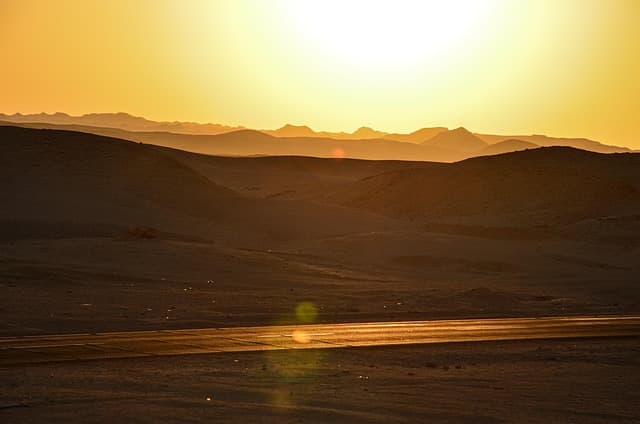
In the autumn of 1942, the city of Cairo was forty kilometres behind the Allied line. British officers at Shepheard's Hotel were burning their papers. The Egyptian royal family was reportedly considering which side to back. Rommel's Afrika Korps had driven east from Libya in one of the fastest armoured advances in military history, and the only thing standing between Nazi Germany and the Suez Canal was a narrow forty-kilometre strip of desert between the Mediterranean coast and the Qattara Depression.
The Qattara Depression is the detail that most people have never heard, and it is the reason El Alamein was where the battle had to happen. A vast below-sea-level salt basin the size of New Zealand, the Depression made any southern flanking movement by tank forces physically impossible. For the first time in the North African campaign, Rommel could not go around. He had to go through.
Between July and November 1942, three separate battles were fought in this strip. The final battle, beginning on October 23rd, involved 195,000 Allied troops, 1,029 tanks, and an artillery barrage from 882 guns that opened the engagement with a sound audible in Alexandria. When it ended twelve days later, the Afrika Korps had lost 59,000 men killed, wounded, or captured. Allied losses were 13,560 killed or wounded. Churchill, who had staked his political survival on the outcome, famously wrote: "Before Alamein we never had a victory. After Alamein we never had a defeat."
What the El Alamein World War 2 Egypt story does not always acknowledge is what all of this meant for Egypt itself. The country was under British occupation, not alliance. Egyptian soldiers did not fight at El Alamein in significant numbers. The battle was fought over Egyptian soil between European and Commonwealth armies for global strategic interests that Egyptian politicians had only indirect influence over. That context is absent from the cemeteries. It is worth carrying it yourself.
---
The War Museum: What You Will Actually See
The museum building is a Soviet-era aesthetic brutalist box that does no favours to its contents, but the contents are real and worth your attention. The courtyard outside holds a collection of tanks, artillery pieces, and armoured vehicles from all three major combatant nations, weathered down to their metal bones by sixty years of salt air. The German 88mm anti-tank gun sitting in the open air is not a reproduction. It was recovered from the desert. Running your hand along it produces a specific kind of unease that reading about the war never quite delivers.
Inside, the museum traces the full North African campaign from 1940 through 1943 with maps, personal effects, photographs, and equipment. The maps are the most valuable thing here. If you spend twenty minutes studying them before walking the battlefield, the landscape outside will make sense in a way it otherwise will not. El Alamein is flat, featureless, and disorienting. The maps tell you where the minefield belts were, where the corridors were cut through them, and why men died in the specific places where they died.
One display case holds objects recovered from the battlefield during clearance operations: a German soldier's personal photographs, an Allied soldier's New Testament with his name pencilled inside the cover, a mess tin with a bullet hole through it. Nobody records whose they were. They sit in a museum case in a country those men almost certainly never expected to be in, and that is the whole story in miniature.
The Commonwealth War Cemetery
Thirty-eight hundred and forty Commonwealth soldiers are buried here, in graves that stretch in perfect white rows toward the sea. The gardening is extraordinary. The Commonwealth War Graves Commission, which maintains 1.7 million graves in 153 countries, employs Egyptian groundskeepers at El Alamein who maintain grass and flowering plants in a coastal desert environment year-round. The green against the pale stone against the blue Mediterranean behind it has a specific quality that no photograph fully captures.
The graves record regiment, rank, age, and often a short phrase chosen by the family. Walking the rows you encounter a New Zealand private aged nineteen, an Indian Army sepoy whose family inscription is in Urdu, a South African soldier, a Palestinian soldier serving under the British Mandate. The demographic spread of the Commonwealth in a single cemetery is its own kind of history lesson. About six hundred graves are marked "Known Unto God" because identification was impossible. The sand preserved some bodies for decades. Others were found with no identification at all.
The German War Cemetery, three kilometres west, feels completely different. The grave markers are low dark basalt crosses, two names each, set into ground that is noticeably less maintained than the Commonwealth site. Around 4,200 Germans are buried here, but the cemetery also contains an ossuary holding the remains of approximately 8,500 more soldiers whose individual burial was not possible. The German War Graves Commission did not begin its work in North Africa until 1959, when the politics of postwar Germany made it possible. The result is a cemetery that feels heavier and less certain of itself, which may be the accurate emotional register.
---
The Italian Memorial and the Desert Margins
The Italian Memorial, a few kilometres east of the Commonwealth Cemetery, is architecturally the most significant structure at El Alamein. A white marble chapel and tower built in the 1950s, it holds the remains of around 4,800 Italian soldiers and is the finest piece of architecture on the battlefield. It is also the least visited of the three main sites, which is a function of tour itineraries rather than of merit.
Italy's role at El Alamein is consistently underrepresented in Anglophone accounts. The Italian Folgore Parachute Division, fighting on foot in the southern desert sector after losing its vehicles, held its position against the Allied breakthrough for three days after the German line had already collapsed. When Folgore finally surrendered, it had approximately 30 percent of its original strength remaining. The British commander, Bernard Montgomery, described them in his dispatch as having fought with great courage. The division had roughly 5,000 men at the start of the battle. Around 300 walked out.
If you drive south from the coast road into the desert behind El Alamein, you will find the landscape still marked by the war in ways the official sites do not show. Rusted wire, fragmentary trench lines, and occasional depressions that were German and Italian strongpoints are visible from the track. Do not leave the track. The Egyptian government estimates that 17 million mines were laid during the North African campaign. Clearance has been ongoing since 1945 and is not complete. Every few years, a Bedouin herder or a farmer clearing new land loses a leg or a life to ordnance that has been in the sand for eighty years.
---
The Connections
El Alamein sits on a coastline that has been strategically significant since the seventh century BCE. The ancient city of Paraetonium, now Marsa Matruh forty kilometres west, was where Alexander the Great stopped on his way to consult the oracle at Siwa in 331 BCE, and where Cleopatra VII allegedly retreated with Mark Antony after their defeat at the Battle of Actium in 31 BCE. The coastal strip between Egypt and Libya has always been a corridor for armies moving between Africa and the Mediterranean world, and El Alamein is simply the most recent chapter in that pattern.
The British involvement in Egypt in 1942 was itself built on a century of occupation that began with the construction of the Suez Canal in 1869 and the subsequent British financial intervention in Egyptian debt in 1882. The same logic that drove Britain to fight at El Alamein, which was the defence of the Canal as the artery of the empire, was the logic that had kept Egypt under British military presence for sixty years before a single shot was fired in the Western Desert. When Egypt finally achieved full sovereignty under Nasser in 1952, the memory of El Alamein was part of the reckoning: the country had been a battlefield for other people's wars for generations.
The postwar transformation of the El Alamein coastline into a resort destination carries its own irony. The strip of Mediterranean coast immediately east of the battlefield is now one of Egypt's most developed summer resort zones, a sprawl of compounds, hotels, and second homes built by Cairo's upper-middle class over the past thirty years. On August weekends, the coastal highway approaching El Alamein is gridlocked with Cairo families heading to their beach houses. The battlefield and the beach resort exist three kilometres apart and almost never acknowledge each other.
---
Common Mistakes
Spending all your time at the Commonwealth Cemetery and skipping the German and Italian sites. The Commonwealth Cemetery is the best maintained, but the German ossuary and the Italian Memorial tell parts of the story that the Allied site cannot. The full picture requires all three.
Taking the El Alamein War Museum's sound and light show. It runs at certain times and costs extra. It tells you nothing that the museum's maps and objects do not already tell you, but with added narration that manages to be both melodramatic and vague. Read the museum displays carefully instead. Forty minutes of real attention to the maps will give you more than any narration.
Not studying the battle before you arrive. El Alamein is flat, beige, and completely illegible if you arrive without context. The landscape gives nothing away. Spend two hours with a basic account of the three battles before you go, or the ground will mean nothing to you.
Walking into the desert beyond the marked paths. This is not a dramatic safety warning, it is a practical one: mines remain in the ground. The cleared areas around the official sites are safe. Everything else is not guaranteed. Stay on established tracks.
Booking a half-day tour from Alexandria. Every packaged half-day tour from Alexandria gives you ninety minutes on site, which is enough time to photograph the graves and buy a postcard. This is a place that repays slow movement. Go independently, go early, and give yourself the full day.
Expecting visitor infrastructure. There is one small cafe near the museum. Bring water, bring food, and do not assume you can buy anything beyond the museum gate.
Treating this as a purely military history stop. The most interesting question at El Alamein is not tactical. It is why a battle for Egyptian territory involved almost no Egyptians, and what that meant for the country that came after. That question has no exhibit. You have to ask it yourself.
---
Practical Tips
Leave Alexandria no later than 8am if you are going by microbus, as the frequency drops by mid-morning. The microbus drops you on the main coastal highway; the museum and cemeteries are signposted from there and walkable from each other, though the distances between sites are easier with a car.
October is the ideal month. The light is strong but the heat is bearable, and the summer resort crowds on the coast have gone home. January and February bring occasional cold winds off the Mediterranean and can feel raw on the exposed plateau, but the cemeteries are eerily empty and atmospheric in a way August cannot offer.
Wear shoes you do not mind getting dusty. The ground between sites is compacted sand and gravel. There is no shade between the cemeteries. A hat is not optional.
The museum attendants speak limited English but are genuinely helpful with the maps if you show specific interest. Carry a printed or downloaded map of the battle positions; the museum's own maps are not available for purchase.
If you are coming from Cairo, the most efficient structure is to drive to Alexandria the night before, stay there, visit El Alamein the following morning, and return to Alexandria or Cairo in the afternoon. Trying to do El Alamein as a same-day Cairo trip is possible but long: allow a minimum of eight hours including driving time.
Frequently Asked Questions
The Weekly Dispatch
More on Egypt, every Friday.
Cultural depth and places most guides never mention.
No spam. Unsubscribe anytime.