El Alamein World War 2 Egypt: The Full Guide
Over 11,000 men are buried at El Alamein. Most tourists drive past on the way to Marsa Matruh. The ones who stop find something Egypt almost never offers: silence.

Quick Facts
- Best time to visit
- October to April. October is ideal: cool, clear light, no summer beach traffic on the coastal road. Avoid July to August.
- Entrance fee
- War Museum EGP 60 (approx $1.25 USD), students EGP 30. All cemeteries and memorials free.
- Opening hours
- War Museum daily 8am to 5pm, Ramadan 9am to 3pm. Cemeteries open during daylight hours with no fixed close.
- How to get there
- 106 km west of Alexandria via coastal road. Private car from Alexandria EGP 600 to 900 return. West Delta bus from Alexandria to Marsa Matruh stops at El Alamein, EGP 30 to 50. No train stop. Self-drive rental from Alexandria most practical for visiting all four sites.
- Time needed
- 3 to 4 hours for museum and all three cemeteries. Full day if driving the western desert battle positions.
- Cost range
- Budget EGP 400 to 700 per day including transport and entry. Mid-range EGP 1,500 to 2,000 with Alexandria accommodation.
Quick Facts
Best time to visit: October to April. Summer temperatures on the Mediterranean coast reach 35°C and the desert sites offer no shade.
Entrance fees: El Alamein War Museum: EGP 60 (approx $1.25 USD), students EGP 30 Commonwealth War Cemetery: Free, open daily German War Cemetery: Free, open daily Italian Memorial: Free, open daily El Alamein Military Museum (newer annex): EGP 100 (approx $2 USD)
Opening hours: The War Museum opens daily 8am to 5pm. The cemeteries have no fixed closing time but are best visited during daylight. Ramadan hours at the museum typically shift to 9am to 3pm.
How to get there: El Alamein sits 106 km west of Alexandria on the coastal road. From Cairo, the drive is approximately 290 km, around 3.5 hours via the Desert Road to Alexandria and then west along the coast. A private car from Alexandria costs roughly EGP 600 to 900 return, negotiated with a driver. West Delta buses run from Alexandria's Mou'af el Gedid station to Marsa Matruh and stop at El Alamein for around EGP 30 to 50. From Cairo, a bus to Marsa Matruh passes through and costs EGP 80 to 120. There is no train stop. Renting a car in Alexandria for a day and driving yourself is the most practical option if you want to visit all four memorial sites without rushing.
Time needed: Three to four hours minimum to do the museum and all three cemeteries properly. A full day if you drive the desert battle positions west of town.
Cost range: Budget EGP 400 to 700 per day including transport and entry. Mid-range EGP 1,500 to 2,000 if combining with a night in Alexandria.
---
Why This Place Matters
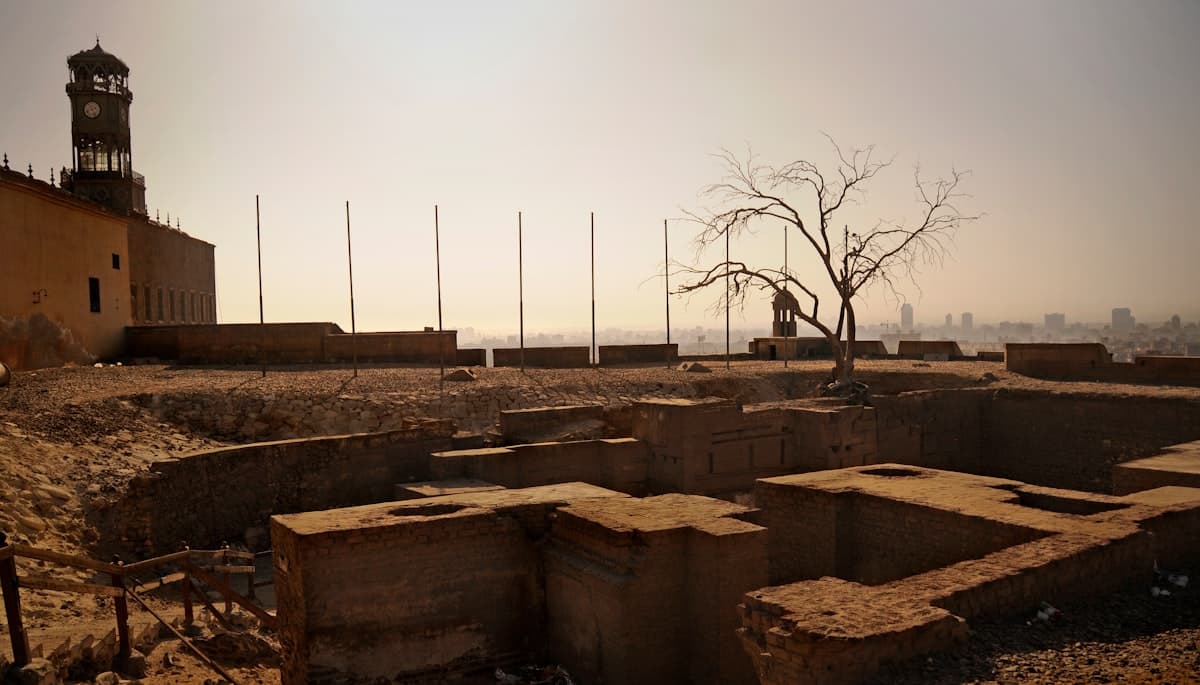
In the summer of 1942, Rommel's Afrika Korps stood 106 kilometres from Alexandria. If they had broken through at El Alamein, they would have reached the Suez Canal within days, severing Britain's supply line to India and cutting off the oil fields of the Middle East. Churchill called the Second Battle of El Alamein, fought between October and November 1942, "the turning of the hinge of fate." He was not being rhetorical. The battle preceded the Allied landings in North Africa and began the long roll-back of Axis forces that ended in Berlin.
What most visitors to Egypt do not know is how close it actually came. In July 1942, during the First Battle of El Alamein, the British Eighth Army was retreating so fast that the British Embassy in Cairo began burning its files. Cairenes called it "Ash Wednesday" because the sky over Garden City filled with the smoke of burning documents. Shops began hoarding goods. Some Egyptian officers, including a young captain named Anwar Sadat, were in contact with the Germans, calculating that a Rommel victory might end the British occupation of Egypt. The political complexity of that moment, where an anti-colonial resistance movement considered aligning with a fascist army, is rarely part of the battlefield tour. It should be.
The desert here was not empty before the war and it was not empty after. This coastline has been a strategic corridor for three thousand years. Alexander the Great marched through it on his way to found Alexandria. The Romans built road stations along it. Arab armies used the same passage in the seventh century. When Rommel chose El Alamein as his attack point in 1942, he was, without knowing it, selecting a position that military commanders had recognised as decisive since the Pharaonic period.
---
What You Will Actually See
The town of El Alamein itself is small and functional, existing largely because of the battle rather than despite it. The main cluster of sites sits within two kilometres of each other on the coast road.
The El Alamein War Museum is the logical starting point. Built in 1956 and expanded since, it houses tanks, artillery pieces, ammunition, uniforms, and maps that give you the spatial logic of the battle before you stand in the desert trying to reconstruct it. The tanks outside, a Sherman and a German Panzer IV, are weathered and real. Inside, the diorama models are dated but the personal objects are not: letters, mess kits, photographs, the ordinary material of ordinary men dropped into an extraordinary position. The museum labels are in Arabic and English, though the English translations are sometimes approximate. Plan an hour here.
The Commonwealth War Cemetery is maintained by the Commonwealth War Graves Commission to a standard that feels almost shocking in its precision. Every headstone is level. The grass is irrigated. The register at the entrance lets you look up any of the 7,367 men buried here by name, regiment, and date of death. Of those, 815 are unidentified: their stones read "A Soldier of the 1939-1945 War, Known Unto God." The Commission was founded after World War One and operates on the principle that rank does not determine burial: a private lies next to a colonel under an identical stone. That policy was revolutionary in 1917 and remains quietly radical. Walk to the back of the cemetery and you begin to understand the scale through arithmetic: row after row after row, each stone a specific age, most of them between 19 and 26.
The German War Cemetery is two kilometres west and holds 4,280 German soldiers, with basalt lava crosses rather than the white Commonwealth stones. The aesthetic is intentionally sombre, almost penitential. Unlike the Commonwealth cemetery, the German memorial carries a particular weight: Germany's Volksbund Deutsche Kriegsgraberfursorge, the organisation that maintains German war graves abroad, was only permitted to operate in Egypt after a bilateral agreement in 1959. For more than a decade after the war ended, these men lay in temporary graves while the politics of defeat and responsibility were negotiated.
The Italian Memorial is the most architecturally ambitious of the three. A white marble chapel and ossuary built in 1959 on a small rise above the coast, it holds the remains of 4,634 Italian soldiers. The interior contains a mosaic depicting the desert campaign and a crypt where the bones of the unidentified were collected from scattered graves across the Western Desert. The Italian government funded it entirely. It is the least visited of the three memorial sites and often entirely empty, which gives it a quality the others, good as they are, cannot quite replicate.
---
The Battle Beyond the Cemeteries
If you have a car and four hours, drive west along the coastal road toward Marsa Matruh. The original battle lines ran roughly north to south from the coast to the Qattara Depression, a vast salt flat 200 metres below sea level that made a southern flanking movement impossible. That geographical fact, one shallow depression in the Sahara, is part of why the battle happened where it did and why Montgomery was able to hold and then attack on a narrow front.
At kilometre markers along the road, you will occasionally see concrete blockhouses, rusted wire, and the remains of defensive positions. These are not maintained. They are simply there, half-buried by sand. The desert here still contains unexploded ordnance. The Egyptian military estimates that the Western Desert holds the highest concentration of landmines in the world, a legacy of both world wars and subsequent conflicts. Do not walk off marked paths or into unmarked desert. This is not a precaution for cautious tourists. It is the reason Egyptian farmers in this region have been losing limbs since 1945.
The ridge of Tel el Eisa, just north of El Alamein town, was taken and retaken multiple times during the summer fighting of 1942. Australian forces held it at enormous cost. The 9th Australian Division suffered 5,800 casualties at El Alamein, a figure that sent a political shockwave back to Canberra and accelerated the repatriation of Australian troops from the Middle East to face Japan in the Pacific. The ripple effects of this stretch of Mediterranean coast reshaped the entire Allied strategic posture in Asia.
---
The Connections
The Western Desert is not a place where Egypt's own history seems to intrude, but it does, quietly. The ancient Siwa Oasis, 560 kilometres further west, was where Alexander the Great consulted the oracle of Amun in 331 BC and was declared the son of a god, a moment that legitimised his claim to Egypt and changed his own conception of himself. The coastal road that connects Alexandria to Siwa, roughly the same road Montgomery's supply convoys used in 1942, has been a military and trade artery since at least the Late Period of Pharaonic history.
Closer to El Alamein, the ruins of Taposiris Magna sit about 65 kilometres east on the coast. This Ptolemaic temple site, currently the focus of excavations searching for the tomb of Cleopatra VII, was built in the third century BC and served as a lighthouse station for ships approaching Alexandria. The limestone ridge on which it stands is the same geological feature that makes the El Alamein position defensible: a raised coastal shelf with desert to the south and sea to the north. Commanders from Ptolemy to Rommel recognised the same terrain logic separated by two thousand years.
Alexandria itself, one hour east, holds the other half of this story. The city's Greco-Roman Museum contains material from the period when this coastline was one of the most consequential corridors in the Mediterranean world. Visit it before or after El Alamein and the continuity of strategic geography becomes impossible to ignore.
---
Common Mistakes
Treating this as a half-hour stop between Alexandria and Marsa Matruh. The cemeteries alone warrant two hours if you are paying attention. People who give this place forty-five minutes come away with nothing more than they had from a photograph.
Visiting only the Commonwealth Cemetery and skipping the German and Italian sites. The German cemetery carries a different emotional register and the Italian memorial is architecturally the most considered of the three. Visiting all three together is the only way to understand the full human arithmetic of the battle.
Doing the sound and light show at the War Museum if one is offered during your visit. It adds nothing that the museum itself does not already give you and runs significantly late into the evening.
Skipping the museum entirely in favour of the cemeteries. The spatial maps inside the museum are genuinely useful. Without them, standing in the desert west of town is just standing in the desert. Ten minutes with the battle maps reorients everything you see outside.
Hiring a tour from Cairo that combines El Alamein with Alexandria in a single day. This itinerary sounds efficient and is actually punishing. You spend six hours in a minibus and forty-five minutes at each site. Cairo to El Alamein to Alexandria with any depth requires at least one night in Alexandria.
Walking off the marked areas near the old battle positions. The landmine risk in the Western Desert is not a formality. Since 1945, the Egyptian government estimates more than 8,000 civilians have been killed or injured by unexploded ordnance in the region. Stay on asphalt and marked paths.
Bringing no water or food. El Alamein town has a few cafes and a petrol station with snacks, but nothing near the cemeteries. The Italian memorial in particular has no facilities at all. Bring two litres of water per person and something to eat.
---
Practical Tips
The best base for El Alamein is Alexandria, not Cairo. Staying two nights in Alexandria lets you do El Alamein as a half-day or full-day trip without the punishing return drive to Cairo. Alexandria has accommodation at every price point and a food scene worth the extra night.
October is the ideal month. The coast has a breeze, the light is clear, and the summer crowds at Alexandria's beaches are gone, which means the coastal road is quiet. Avoid July and August entirely if you can: the road between Alexandria and Marsa Matruh fills with Egyptian summer vacationers and what should be a ninety-minute drive can take three hours.
The Commonwealth War Graves Commission registers for El Alamein and every other Commonwealth cemetery in Egypt are searchable online before your visit at cwgc.org. If you have any family connection to the North Africa campaign, whether Commonwealth, German, Italian, or American, search the names before you go. Finding a name on a stone that you already know from a register is a different experience from finding it cold.
There is no audio guide at the War Museum. A local guide hired in Alexandria for the day costs EGP 800 to 1,200 and makes an enormous difference to the experience, particularly at the battle positions west of town where there is almost no interpretation in situ.
Dress respectfully near the memorial sites. This is not a religious requirement but a practical one: the cemeteries are still active memorial grounds and are visited by families of the fallen, by veterans' organisations, and by military delegations. Shorts and loud behaviour are out of place here in a way that is simply self-evident once you arrive.
Frequently Asked Questions
The Weekly Dispatch
More on Egypt, every Friday.
Cultural depth and places most guides never mention.
No spam. Unsubscribe anytime.