El Alamein WW2 Egypt Guide: The Desert War's Forgotten Depth
More soldiers died at El Alamein than in the entire Pacific campaign's first year. Most visitors spend 90 minutes. The site rewards six hours.

Quick Facts
- Best time to visit
- October to March. Desert heat from June to September reaches 40°C with no shade at most memorial sites.
- Entrance fee
- Commonwealth, German, and Italian Cemeteries: free. War Museum: EGP 100 (approx $2 USD), students EGP 50.
- Opening hours
- War Museum daily 8am to 5pm (winter), 8am to 6pm (summer). Cemeteries have no formal closing time; visit in daylight.
- How to get there
- 106km west of Alexandria on the Desert Road. Hired car from Alexandria EGP 700 to 1,000 for the day. West Delta bus EGP 20 to 25 but drops on highway. Private taxi from Alexandria EGP 400 to 600 return.
- Time needed
- Full day. War Museum 1.5 hours, Commonwealth Cemetery 1 hour, German Cemetery 45 minutes, Italian Memorial 45 minutes, transit between sites 1 hour.
- Cost range
- Budget EGP 300 to 500 including bus and entrance fees. Mid-range EGP 800 to 1,200 with hired car from Alexandria.
Quick Facts
Best time to visit: October to March. Summer heat on the open desert plateau reaches 40°C and there is almost no shade at any of the three memorial complexes.
Entrance fees: Commonwealth War Cemetery: free. German War Cemetery: free. Italian Memorial: free. El Alamein War Museum: EGP 100 (approx $2 USD), students EGP 50.
Opening hours: War Museum daily 8am to 5pm (winter), 8am to 6pm (summer). The cemeteries have no formal closing time but visit during daylight.
How to get there: El Alamein sits 106km west of Alexandria on the Desert Road. A private taxi from Alexandria runs EGP 400 to 600 return with waiting time. The West Delta bus from Midan el-Gumhuriyya in Alexandria reaches El Alamein in about 90 minutes for EGP 20 to 25, but drops you on the highway and the sites are spread over several kilometers. For serious visitors, a hired car from Alexandria for a full day costs EGP 700 to 1,000 and is the only practical option if you want to see everything.
Time needed: The War Museum alone deserves two hours. Add the Commonwealth Cemetery (one hour minimum if you read the headstones), the German Cemetery (45 minutes), and the Italian Memorial (45 minutes). Allow a full day.
Cost range: Budget EGP 300 to 500 for the day including transport from Alexandria. Mid-range EGP 800 to 1,200 with a hired car and a proper lunch stop in El Alamein town.
---
Why This Place Matters
By October 1942, the German Afrika Korps under Rommel was 106 kilometers from Alexandria. Had El Alamein fallen, the Suez Canal and the entire British position in the Middle East collapsed with it. The oil fields of the Persian Gulf, the supply routes to Soviet Russia through Iran, and the strategic balance of the entire war pivoted on a strip of Egyptian desert that is roughly the width of Manhattan.
This is not the Western Front. There are no trenches here, no shell-cratered forests, no preserved villages. What the desert offers is scale and silence. The battles of El Alamein between July and November 1942 involved over 300,000 troops from more than a dozen countries, fighting across a front that stretched 64 kilometers from the Mediterranean coast to the impassable Qattara Depression. That geographic constraint, the Depression drops 133 meters below sea level and is effectively uncrossable by armored vehicles, is what made El Alamein defensible at all. Without the Qattara, there would have been no battle. There would have been no line to hold.
Egyptians remember this differently from Europeans or Australians. The country was technically neutral, under British occupation since 1882, its king widely rumored to favor the Germans as a way to end that occupation. When Rommel reached El Alamein in June 1942, some Cairo residents genuinely could not decide which outcome to hope for. The British burned classified documents in the city. The smoke from that bonfire, visible over Cairo for hours, became known as "Ash Wednesday" in the expatriate community. It was a Wednesday in late June and it signaled, unmistakably, that the British themselves believed Egypt might fall.
---
What You Will Actually See
The Commonwealth War Cemetery
There are 7,240 graves here. Walk any row and you will read headstones from Britain, Australia, New Zealand, South Africa, India, and what is simply listed as "A Soldier of the Second World War, Known Unto God." That phrase appears on 815 graves at El Alamein, men identified by regiment or unit but not by name. The Commonwealth War Graves Commission maintains every grave identically, regardless of rank: a private buried beside a general, both with the same Portland stone marker, the same dimensions, the same font.
The cemetery was designed by J. Hubert Worthington and opened in 1954. Walk to the back wall and look south. The desert stretches without interruption. This is not landscaped or manicured in the way of a European cemetery. The edge of the formal garden meets the open desert within fifty meters, and the juxtaposition is not subtle. The men buried here died on ground that looks, from this spot, exactly as it looked in 1942.
One headstone stops most visitors who read it carefully. Rifleman Bhanbhagta Gurung of the 2nd Gurkha Rifles, age 21. The date of death is listed as 27 May 1942. He is 21 years old. He is in the Western Desert of Egypt, 6,000 kilometers from Nepal. His headstone bears the Gurkha crossed-kukri insignia and the words his family chose: "He died that we might live." The Gurkha regiments at El Alamein came from what is now Nepal and India. Many of the families who sent boys there had no clear sense of where Egypt was.
The German War Cemetery
Four kilometers from the Commonwealth Cemetery sits the Deutscher Soldatenfriedhof, and the difference in design is a direct statement about two countries processing the same war very differently.
Where the Commonwealth Cemetery uses upright white Portland stone in rows under shade trees, the German cemetery is dark. The markers are low, flat basalt crosses, set close together, often two names per cross. The color is almost black. The trees are sparse. The cumulative effect is intentional: this is a place for mourning, not commemoration. Germany in the 1950s, when the cemetery was completed, was not in a position to celebrate its war dead the way a victorious nation might. The architecture reflects that.
The cemetery holds 4,280 German soldiers, but the numbers inside the low perimeter wall are compressed. Two names share many of the crosses because the German dead were concentrated from scattered field graves across the desert into this single site. One name appears on a cross in the far corner that serious students of the campaign recognize: Oberleutnant Heinz Werner Schmidt, Rommel's personal aide. He survived the war and wrote one of its most readable memoirs. His cross here marks a fellow officer buried from his unit, not Schmidt himself. But finding that name in this context illustrates how intimate and specific this desert war was.
The Italian Memorial
Of the three major monuments at El Alamein, the Italian Memorial is the most architecturally ambitious and the least visited by non-Italian tourists. It is also the one that most clearly makes the visitor uncomfortable in productive ways.
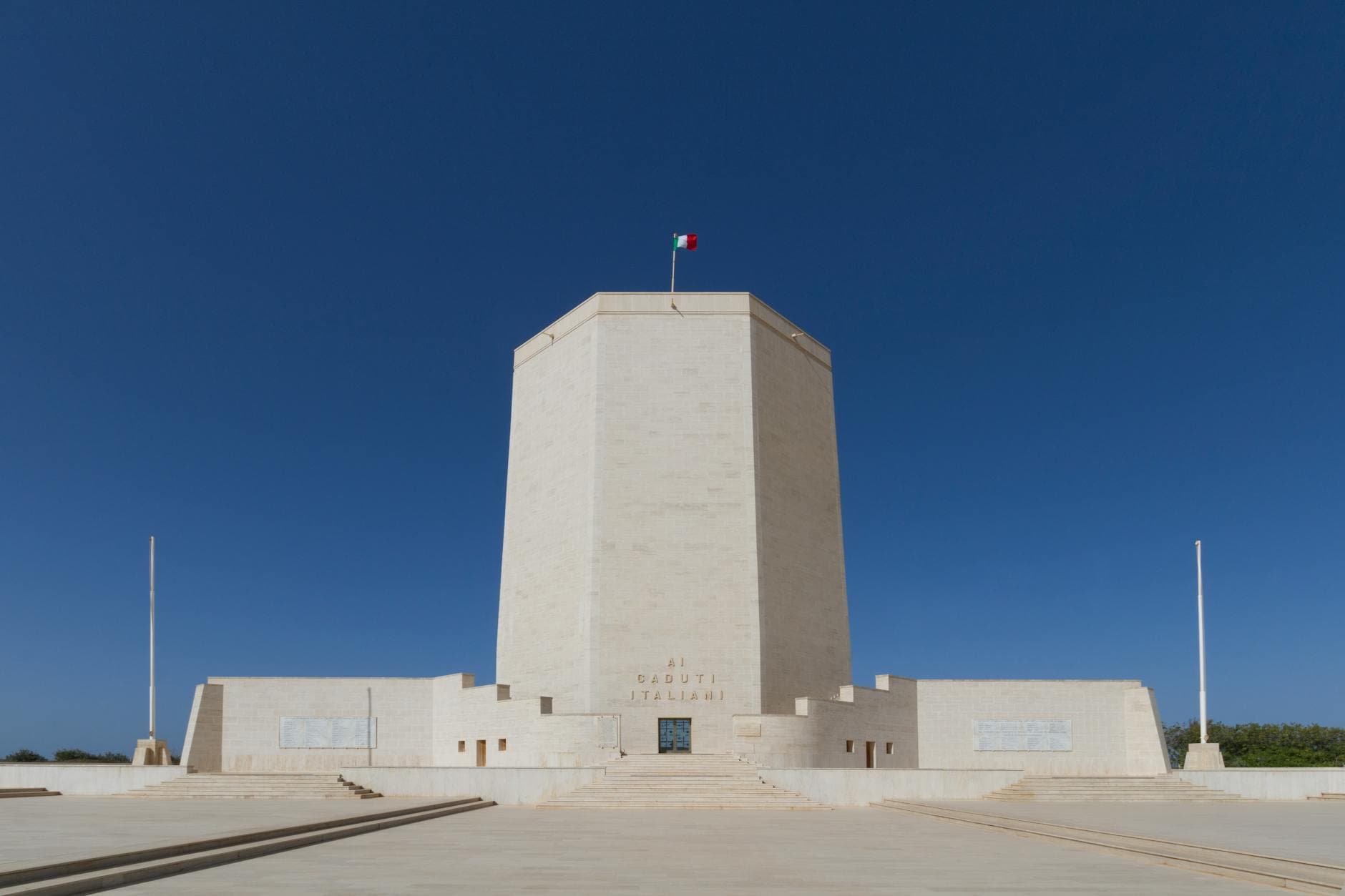
The memorial is a tower of Botticino marble, 30 meters high, visible from the coastal road. Inside, a central ossuary contains the remains of 4,800 Italian soldiers. The walls of the approach corridor are lined with the names of nearly 40,000 Italians who died in the North Africa campaign, not just at El Alamein but across Libya and Tunisia. The scale stops you. Italy lost more men in North Africa proportionally than either Germany or Britain, partly because Italian forces were often less well-equipped than their British counterparts, and partly because they fought for six years in the desert while Germany committed fully only from 1941.
The chapel inside the tower contains mosaics that read as straightforwardly Catholic in iconography, grieving Madonnas, the imagery of sacrifice and redemption. There are no swastikas here, no Fascist symbols. The Italian government made a specific choice about what to erase and what to preserve from this history. Whether that represents honest memorial or selective memory is a question worth sitting with.
---
The Connections: El Alamein in Egyptian Time
Most visitors treat El Alamein as an isolated episode, a European war that happened to land in Africa. The longer view is more complicated.
The Desert Road connecting Alexandria to El Alamein follows, roughly, the route of ancient trade caravans between Egypt and Cyrenaica, modern Libya. Alexander the Great marched an army across this coastline in 331 BC heading west, not east, after founding Alexandria. The Romans built a series of coastal forts along the same strip to control movement between the African provinces. The Arab conquest reached Egypt via a different route, through Sinai, but the western desert remained a military and strategic frontier for every power that held Egypt.
El Alamein itself, as a named place, appears in no historical source before the twentieth century. It was a minor railway halt on the line the British built across the northern coast. The name means, loosely, "the two worlds" in Arabic, a phrase that may refer to the junction of the desert and the sea. The town that exists today, increasingly developed as a resort destination with new compounds and a marina, sits awkwardly beside the graveyards in ways that can feel discordant until you remember that Egyptians have been building on and around their dead for five thousand years. The necropolis and the living city were never as separate in Egyptian urban thinking as they are in European tradition.
The Qattara Depression, which made the El Alamein line possible, was studied in the 1970s and 1980s as a potential hydroelectric project. Engineers proposed channeling Mediterranean water into the Depression, which sits 133 meters below sea level, to generate electricity as it fell. The project was never built. The Depression remains what it was in 1942: an absolute geographical boundary that shaped one of the decisive moments of the twentieth century.
---
Common Mistakes
Visiting only the Commonwealth Cemetery. Most tour groups from Alexandria stop here, photograph the white headstones, and leave. The German and Italian sites require driving four and six kilometers further west respectively and are almost always empty of crowds. They are not secondary experiences. They are essential to understanding the same battle from three different national perspectives.
Spending serious time at the War Museum. This is the contrarian take: the El Alamein War Museum, despite charging an entrance fee and billing itself as the essential introduction to the battle, is poorly curated, the labels are largely in Arabic with inadequate English translation, the artifacts are not arranged in any clear chronological sequence, and the tank and artillery displays outside are presented without context. You will not understand the battle better for having spent two hours here. Read Antony Beevor's account of the North Africa campaign before you arrive. It costs the same as two museum tickets and does the interpretive work the museum fails to do.
Ignoring the individual headstone inscriptions. The Commonwealth War Graves Commission allowed families to choose an inscription of up to 66 characters for the base of each stone. These are some of the most compressed and devastating pieces of writing you will encounter anywhere in Egypt. A mother's words to a son she never saw again, cut into Portland stone, in the Western Desert. Don't walk past them.
Arriving at midday in summer. All three memorial sites are exposed. There is shade in the Commonwealth Cemetery's planted garden, almost none elsewhere. The Italian Memorial's marble tower creates a wind tunnel effect that offers a degree of relief, but by noon from June through September the heat makes sustained attention impossible.
Assuming the battle is fully excavated. The desert around El Alamein still contains unexploded ordnance. Rommel's forces laid an estimated half a million mines across a minefield that the British called "the Devil's Garden." Clearance has been ongoing since 1945 but is not complete. Do not walk into the open desert beyond the established cemetery and memorial grounds. This is not a theoretical warning.
Missing the Muslim graves. In the Commonwealth Cemetery, alongside the Christian, Jewish, and Hindu sections, there are rows of graves for Muslim soldiers from undivided India. The headstones use a different symbol. Most visitors do not register them. The Indian Army at El Alamein included Sikh, Hindu, and Muslim soldiers in the same units, fighting under British command, in a country that was neither theirs nor Britain's.
---
Practical Tips
The most efficient base for El Alamein is Alexandria, not Cairo. The drive from Cairo to El Alamein is approximately three hours each way on the Desert Road, making a day trip from Cairo punishing and rushed. Stay one night in Alexandria, visit El Alamein the following morning, and you have the time the place deserves.
Hire a driver who knows where the German and Italian sites are. Many Alexandria taxi drivers know the Commonwealth Cemetery but are vague about the others. Confirm before departing that your driver can locate all three cemeteries and the museum, and agree on waiting time explicitly.
Bring water for at least three hours in warm weather. There are no functioning kiosks at any of the cemetery sites. El Alamein town has a small cafe near the museum but opening hours are irregular.
For the El Alamein World War 2 experience to mean anything beyond a checkbox, the preparation matters more than at almost any other site in Egypt. The Karnak Temple speaks for itself. The Valley of the Kings speaks for itself. El Alamein is silent desert and flat stone markers, and the story lives entirely in what you bring to it.
Frequently Asked Questions
The Weekly Dispatch
More on Egypt, every Friday.
Cultural depth and places most guides never mention.
No spam. Unsubscribe anytime.