French Egyptology History Guide: Egypt Through the Eyes of Its Obsessors
Napoleon brought 167 scientists to Egypt in 1798. One found the Rosetta Stone. Another measured every monument. France has never really left.

Quick Facts
- Best time to visit
- October to April. Winter light in Luxor is exceptional and the temperature allows extended outdoor time at excavation sites. Summer heat above 40°C makes outdoor work at Karnak and Saqqara genuinely punishing.
- Entrance fee
- Egyptian Museum EGP 300 (approx $6 USD), mummy room EGP 180 extra. Grand Egyptian Museum EGP 700 (approx $14 USD), Tutankhamun galleries EGP 1,100 (approx $22 USD). Karnak EGP 450 (approx $9 USD). Luxor Museum EGP 200 (approx $4 USD). IFAO bookshop free.
- Opening hours
- Egyptian Museum daily 9am to 5pm. Grand Egyptian Museum daily 9am to 10pm. Karnak daily 6am to 5:30pm. Luxor Museum daily 9am to 2pm and 5pm to 10pm. IFAO bookshop Saturday to Thursday 9am to 4pm.
- How to get there
- Cairo Metro to Sadat station for Egyptian Museum (EGP 7). Taxi or ride-share to GEM from central Cairo EGP 60 to 120. Luxor by EgyptAir or Air Cairo from Cairo EGP 800 to 2,000 return, or overnight sleeper train from Ramses Station EGP 400 to 700. West Bank Luxor by local ferry EGP 3 each way.
- Time needed
- Minimum two days to follow the French Egyptology thread seriously: one day Egyptian Museum and IFAO in Cairo, one day Karnak and Luxor Museum. Add a half day for Saqqara and the Serapeum. A full immersion trip requires five to seven days.
- Cost range
- Budget EGP 600 to 1,000 per day covering entry fees, local transport, and street food. Mid-range EGP 2,000 to 3,500 per day with private guide and restaurant meals. A private Egyptologist-level guide in Luxor costs EGP 800 to 1,500 for a half day and is worth it at Karnak specifically.
Quick Facts
Best time to visit: October to April, when Cairo and Luxor are cool enough to spend hours in archives, museums, and excavation sites without the summer heat turning every outdoor site into an endurance test.
Key institutions and entrance fees: Egyptian Museum, Tahrir Square: EGP 300 (approx $6 USD); mummy room EGP 180 extra Grand Egyptian Museum (GEM), Giza: EGP 700 (approx $14 USD) general admission; Tutankhamun galleries EGP 1,100 (approx $22 USD) Luxor Museum: EGP 200 (approx $4 USD) Institut Français d'Archéologie Orientale (IFAO), Cairo: library open to researchers by appointment, free
Opening hours: Egyptian Museum daily 9am to 5pm. Grand Egyptian Museum daily 9am to 10pm (last entry 9pm). Luxor Museum daily 9am to 2pm and 5pm to 10pm.
How to get there: Cairo Metro Line 1 or 2 to Sadat station drops you 200 meters from the Egyptian Museum (EGP 7 flat fare). Shared taxi from central Cairo to Giza plateau for GEM costs EGP 20 to 40. For Luxor, EgyptAir or Air Cairo flights from Cairo run EGP 800 to 2,000 return; sleeper train from Ramses Station costs EGP 400 to 700.
Time needed: Two days minimum to trace the French Egyptology thread: one day for the Egyptian Museum and IFAO neighborhood in Cairo, one day in Luxor where the French excavated Karnak for over a century.
Cost range: Budget EGP 600 to 1,000 per day covering entry fees, local transport, and street food. Mid-range EGP 2,000 to 3,500 per day adding a private guide and sit-down meals.
---
Why This Matters: One Army Changed How the World Reads the Past
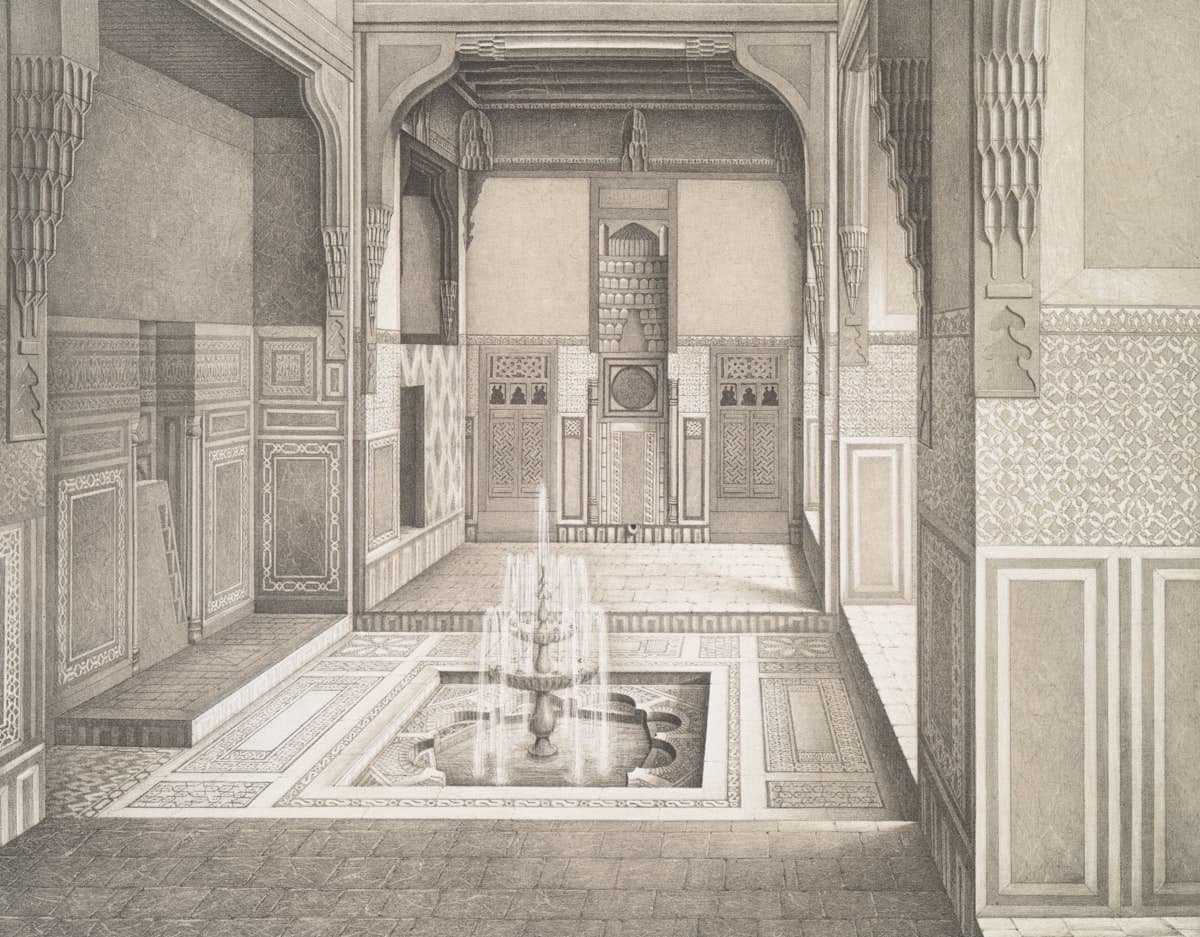
Napoleon Bonaparte arrived in Egypt in July 1798 with 38,000 soldiers and 167 civilians: mathematicians, engineers, chemists, artists, linguists, and physicians. No conquering army before or since has brought its own research department. The soldiers were largely irrelevant to history. The scientists were not.
Within three years, this Commission des Sciences et Arts had measured, drawn, and catalogued nearly every major ancient monument in Egypt. Their findings, eventually published between 1809 and 1829 as the 23-volume Description de l'Égypte, gave Europe its first systematic visual record of Pharaonic civilization. The volumes ran to 3,000 illustrations and weighed, in their full elephant folio edition, approximately 300 kilograms. Libraries had to commission special furniture to hold them.
The French Egyptology history does not begin with Napoleon, and it does not end with him. But his expedition created the intellectual scaffolding on which everything since has been built. When Jean-François Champollion deciphered hieroglyphics in 1822, he was working from copies made by Napoleon's scholars. When Auguste Mariette founded the Egyptian Antiquities Service in 1858, making Egypt the first country in history to create a government body to protect its ancient monuments, he did so as a Frenchman operating inside an Egyptian khedivate that had not yet learned to refuse. When Gaston Maspero reopened the Deir el-Bahri royal mummy cache for study in 1886, he catalogued 40 royal mummies that had been hidden by ancient priests 3,000 years earlier, every tag and annotation written in French.
To travel Egypt through the lens of French Egyptology is not to follow colonialism's footnotes, though that accounting must happen too. It is to understand how a single national obsession, sustained over two centuries, assembled the tools the world now uses to understand the ancient Egyptians themselves.
---
The Rosetta Stone Was Found in Egypt, Decoded in Paris, and Has Never Come Back
In July 1799, a French military officer named Pierre-François Bouchard was supervising construction work at Fort Julien near the town of Rashid, which the French called Rosette. A soldier's pickaxe struck a large dark stone inscribed in three scripts: hieroglyphics, Demotic, and Greek. Bouchard recognized immediately that a stone carrying the same text in a known language and an unknown one might be the key to decipherment.
The French lost the stone to the British in 1801 when Napoleon's Egyptian campaign collapsed. It went to London, where it has remained in the British Museum ever since. But the French had made plaster casts before surrendering it, and it was from those casts that Champollion worked. His 1822 letter to the Académie des Inscriptions announcing the decipherment of hieroglyphics is 54 pages long and still readable as one of the great intellectual performances in the history of scholarship.
Champollion visited Egypt only once, in 1828, leading a joint French-Tuscan expedition that was the first to actually read the inscriptions on the walls of temples and tombs. At Karnak he reportedly wept, sat down on the floor of the hypostyle hall, and could not be moved for some time. Later he wrote that the ancient Egyptians had conceived architecture at a scale that made the Greeks look like children playing with blocks. He died four years after returning to France, at 41, possibly from a stroke brought on by the exertion of the trip.
In Luxor today, the Centre Franco-Égyptien d'Étude des Temples de Karnak (CFEETK) continues work at Karnak that has been ongoing since 1967, itself the heir to a French mission that began in 1895. The center's open-air museum on the northeast side of the Karnak precinct contains reconstructed blocks from demolished structures that French archaeologists have been piecing together for decades. Most visitors walk past the entrance without noticing it. Entry is included in your Karnak ticket.
---
The Institut Français and the Neighborhood That Reads Ancient Egypt
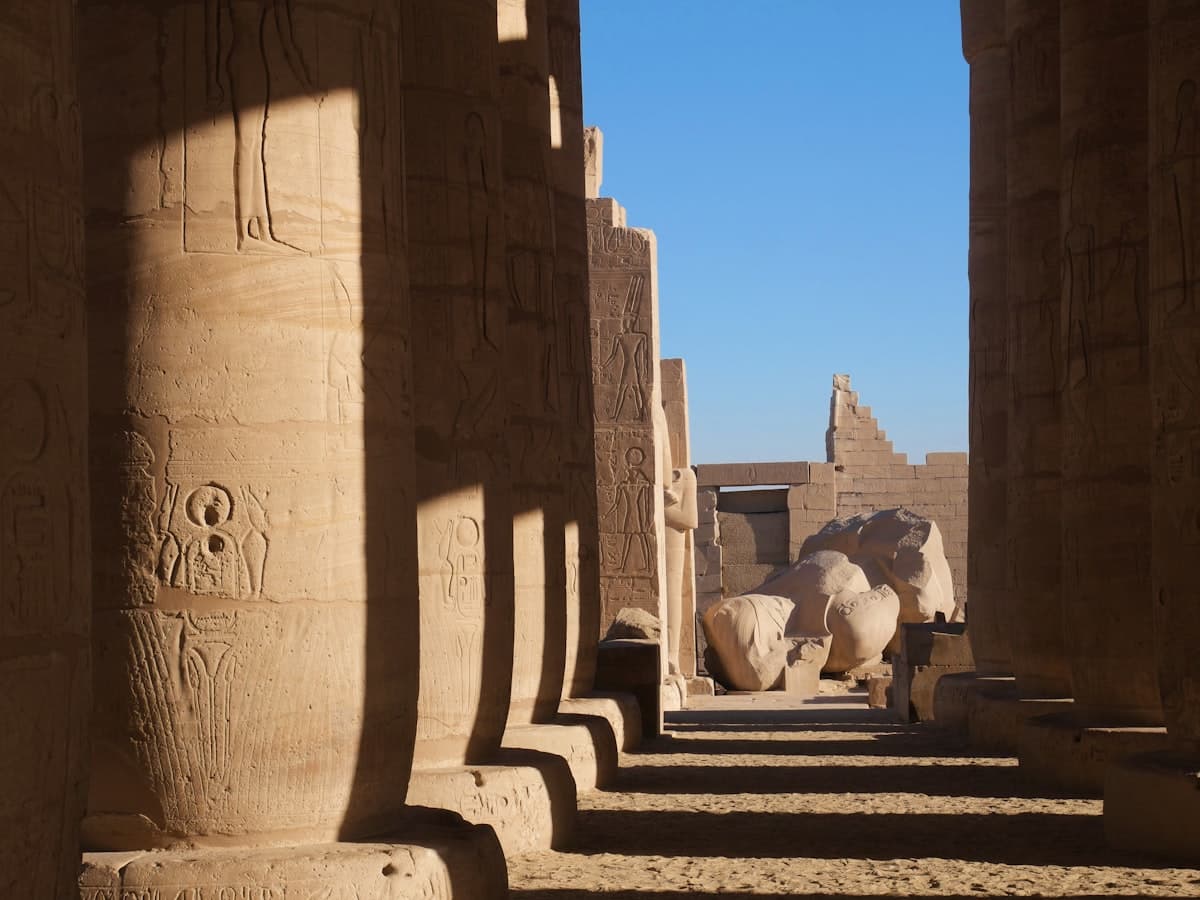
In the Munira district of Cairo, about 15 minutes' walk south of Tahrir Square, there is a walled compound on the corner of Sharia el-Sheikh Aly Yousuf that most taxi drivers have never been asked to find. This is the Institut Français d'Archéologie Orientale, founded in 1880 by Gaston Maspero under the patronage of the French Ministry of Public Instruction. It is simultaneously a research library, a publishing house, an active archaeological mission, and the longest continuously operating foreign academic institution in Egypt.
The IFAO library holds approximately 80,000 volumes, including original field notebooks from 19th-century excavations that have never been digitized. Its publishing arm, active since 1902, has produced over 500 academic volumes, most of them still available for purchase in the small on-site bookshop. These are not coffee table books. They are excavation reports, epigraphic surveys, and linguistic analyses, priced for institutions but occasionally yielding, if you browse the discounted shelf, something genuinely useful for EGP 50 to 150.
Researchers with institutional affiliations can arrange library access by emailing in advance. Independent travelers cannot browse the stacks, but the bookshop is open to the public Saturday through Thursday, 9am to 4pm. For a traveler serious about the French Egyptology history in Egypt, an hour in that bookshop is worth more than three hours in any gift shop near the pyramids.
The neighborhood itself carries layers worth noting. The street outside IFAO runs over what was once the Khalij, the ancient canal that connected the Nile to the Red Sea, first dug by Senusret III around 1878 BC, reopened by the Persian king Darius I around 500 BC, expanded by the Romans, used by Arab traders after the 7th-century conquest, and finally filled in by the Khedive Ismail in 1897 because it was breeding mosquitoes. The ground you walk on here is not metaphorically layered. It is literally so.
---
What the French Actually Excavated, and What They Took
The honest accounting of French Egyptology history includes what was extracted and where it ended up. Under the Antiquities Service that Mariette founded and Maspero ran, the official position was that all antiquities belonged to Egypt. In practice, the system of partage, by which excavating nations kept a portion of their finds, meant that French institutions accumulated significant collections throughout the 19th and early 20th centuries. The Louvre's Egyptian antiquities collection today numbers approximately 50,000 objects, roughly 6,000 of them on permanent display.
Marilette himself is buried on the grounds of the Egyptian Museum in Cairo, under a bronze statue. This is not a small irony: the man who formalized the protection of Egypt's antiquities is commemorated inside the museum he founded, by the country he excavated. The Egyptian government has never requested his removal, which tells you something about the complexity of how Egypt processes this history.
What remains in Egypt from the French missions is in some ways more interesting than what left. The Luxor Museum contains the reconstructed Wall of Amenhotep III, reassembled from 283 blocks found inside the third pylon at Karnak by a French mission in 1989. The blocks had been used as fill by a later pharaoh, Horemheb, and sat inside the pylon for 3,300 years before the French found and extracted them. The wall, now fully restored, shows Amenhotep receiving tribute from 38 foreign rulers. It is one of the most complete New Kingdom painted relief sequences anywhere in Egypt, and most visitors to Luxor skip the Luxor Museum entirely because it is not on the standard tour.
Skip the sound and light show at Karnak. It costs EGP 350, lasts 75 minutes, runs at the expense of Karnak's silence, and tells you nothing you cannot learn from a single afternoon of reading. The light is garish, the narration is generic, and the experience of standing in the hypostyle hall at dawn with three other people, before the buses arrive, is irreplaceable in a way that no theatrical production can simulate.
---
The Connections: From Napoleon's Scientists to the GEM
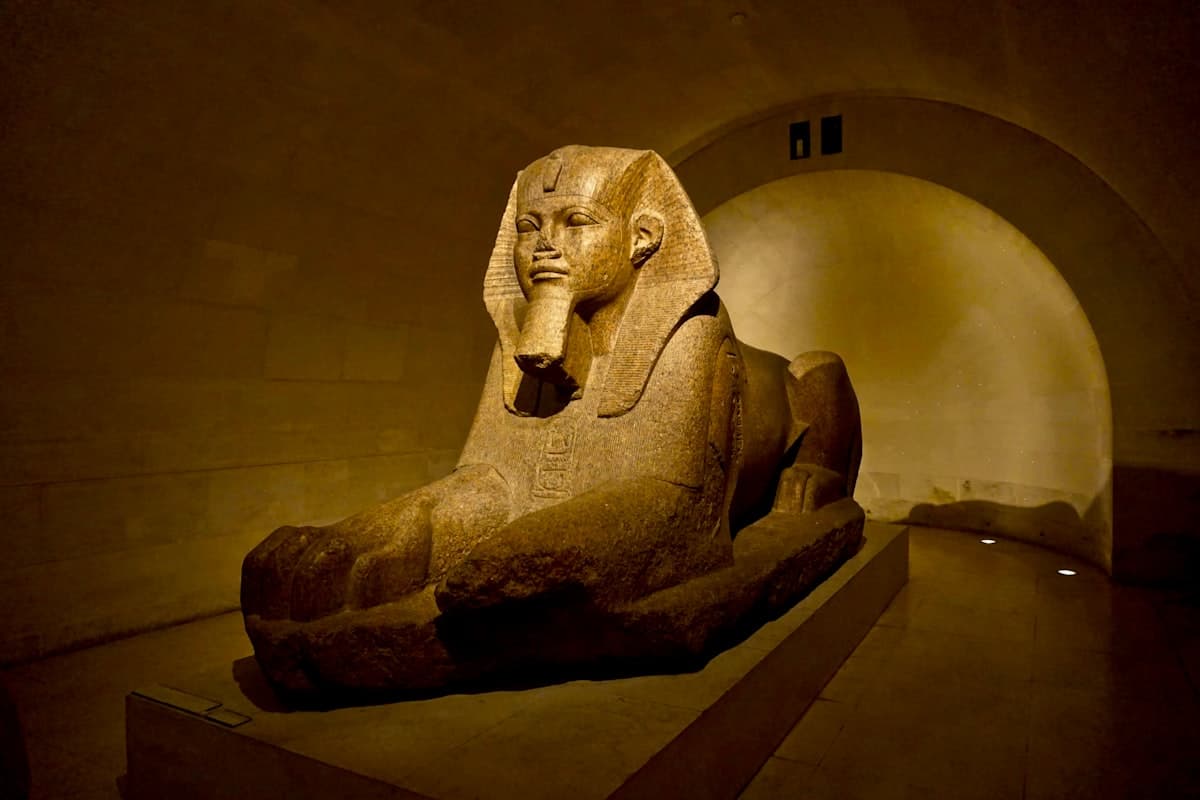
The Grand Egyptian Museum, which opened fully in 2023 after 20 years of construction, is in many ways the institutional rebuke to two centuries of French and European custodianship. Egypt is now housing its own antiquities at a scale and quality that makes every European museum's Egyptian wing look provisional. The GEM cost approximately $1 billion USD to build, and it sits 2 kilometers from the Giza pyramids at coordinates that ensure the pyramids are visible from its entrance ramp.
The Tutankhamun galleries at GEM contain all 5,398 objects from the tomb, finally together in one place. Howard Carter, who found the tomb in 1922, was British, not French. But the scientific framework he used to excavate and document the tomb, the stratigraphic method, the photographic record, the conservation protocols, derived directly from methods developed by French archaeologists at Karnak and Saqqara in the preceding decades. The chain of influence runs forward and backward in ways that make nationalist accounting of Egyptology difficult and, ultimately, beside the point.
The IFAO currently runs active excavations at 18 sites across Egypt, from the Faiyum to the Eastern Desert. Their work on Coptic and Islamic manuscripts at Kellia and Baouit has been as significant as anything done on Pharaonic sites. This is the part of French Egyptology history that tends to get erased in the popular imagination: the French were not only interested in pyramids. They mapped the entire textual heritage of Egypt from the Pharaonic through the early Islamic periods, and much of what we know about early Christianity in Egypt comes from French excavations in the Wadi Natrun.
---
Common Mistakes
Treating the Egyptian Museum as a checklist. The Egyptian Museum has 120,000 objects. You cannot see it all, and attempting to do so produces a kind of archaeological blindness where everything blurs into undifferentiated ancientness. Choose three rooms, learn them deeply. The Amarna room on the first floor, containing the tell-tale elongated statuary of Akhenaten's heretical reign, takes 30 minutes and will change how you understand everything else.
Skipping IFAO because it is not a tourist attraction. The bookshop alone justifies the trip. The publications available there, particularly the series on Deir el-Medina, the village of the workmen who built the Valley of the Kings tombs, are unlike anything sold near archaeological sites.
Hiring a guide at the Karnak gate who does not read hieroglyphics. Many licensed guides in Luxor give accurate but thin information: dates, kings, dynasties. A guide who can actually read the walls will show you things invisible to everyone else. Ask before you hire. The CFEETK at Karnak occasionally offers public tours by their own researchers: check their website or ask at the Karnak ticket office.
Assuming the Louvre's Egyptian collection and Egypt's collections tell the same story. They do not. Paris has the Dendara zodiac ceiling, removed from a temple in Upper Egypt in 1821 and replaced with a plaster copy. If you stand under the copy at Dendara and know the original is on the Rue de Rivoli, the feeling is specific and worth having before you visit either.
Visiting Saqqara without knowing that Mariette found the Serapeum there in 1851. The Serapeum, the underground burial vaults of the sacred Apis bulls, is one of the most disorienting ancient spaces in Egypt. It is not crowded. The granite sarcophagi weigh up to 70 tonnes each. Mariette found one still sealed, containing a mummy with a gilded face mask. It is now in the Louvre. The empty vault is still there.
Taking a standard day tour that combines pyramids, Egyptian Museum, and Khan el-Khalili in six hours. This is not Egyptology. This is attrition. Each of those places requires half a day minimum. The tour operators selling this itinerary know it is inadequate and sell it anyway.
Ignoring Champollion's own travel account. His letters from Egypt, written in 1828 and 1829 and partially translated into English, are available in secondhand form. Reading them before you go is a different kind of preparation than a guidebook, because you encounter a man who was reading the walls for the first time, making mistakes in real time, and correcting himself in the next letter.
---
Practical Tips
Book GEM tickets online at gem.gov.eg at least two days in advance. Walk-up availability exists but the Tutankhamun galleries sell out on weekends. Arrive at 9am when the doors open: the Tutankhamun halls are genuinely empty for the first 45 minutes.
For the IFAO bookshop, carry cash in Egyptian pounds. Cards are sometimes accepted but not always. The shop is closed on Fridays and Egyptian public holidays.
The CFEETK open-air museum at Karnak is accessed through the main Karnak entrance (your ticket covers it) on the northeast side of the precinct, past the sacred lake. It is not signposted in English. Look for the low reconstructed wall sections and the French-language information panels.
Luxor's West Bank, where French missions have worked since the 19th century, is best reached by local ferry from the Corniche (EGP 3 each way) followed by bicycle hire on the other side (EGP 50 to 80 per day). This gives you freedom to stop at sites that tour buses skip, including Deir el-Medina, where the French have been excavating since 1917 and the workers' own tombs are more intimate and more personal than any royal tomb in the Valley of the Kings.
For context before you travel, the Description de l'Égypte is available in facsimile editions and partially online through the Bibliothèque nationale de France's Gallica archive, free of charge. An hour with its plates, specifically the architectural drawings of Karnak and the illustrations of Dendera, will change what you see when you stand in front of the originals.
Frequently Asked Questions
The Weekly Dispatch
More on Egypt, every Friday.
Cultural depth and places most guides never mention.
No spam. Unsubscribe anytime.