French Egyptology History Guide: Egypt's Debt to France
France didn't just excavate Egypt. It invented the academic framework the world still uses to read it. The story is messier, and more interesting, than any museum label admits.
Quick Facts
- Best time to visit
- October through March. Cairo is manageable for museum-heavy days and Upper Egypt sites are cool enough for extended outdoor time. July and August make outdoor ruins genuinely punishing.
- Entrance fee
- Egyptian Museum Cairo: EGP 450 (approx $9 USD), students EGP 225. Luxor Museum: EGP 400 (approx $8 USD). Karnak Temple: EGP 450 (approx $9 USD). IFAO library: free by appointment.
- Opening hours
- Egyptian Museum: daily 9am to 5pm. Luxor Museum: daily 9am to 1pm, then 5pm to 10pm. Karnak: daily 6am to 5:30pm winter, 6am to 6pm summer.
- How to get there
- Cairo: Tahrir Metro Station (Lines 1 and 2, EGP 8 per ride) puts you 15 minutes on foot from the Egyptian Museum. Luxor: fly from Cairo (from EGP 600 one way) or take the overnight train (EGP 120 to 400 depending on class) from Ramses Station.
- Time needed
- One full day in Cairo for the Egyptian Museum plus Khedival Cairo architecture. Two full days in Luxor minimum to cover the East Bank institutions and Karnak properly.
- Cost range
- Budget EGP 600 to 1,000 per day covering entry fees, local transport, and street food. Mid-range EGP 2,000 to 3,500 per day with a specialist guide and sit-down meals.
Quick Facts
Best time to visit sites connected to French Egyptology: October through March, when Cairo and Luxor are cool enough to spend serious time in museums and outdoor ruins without the punishing summer heat.
Key institutions and entrance fees: Egyptian Museum, Cairo: EGP 450 (approx $9 USD), students EGP 225 Luxor Museum: EGP 400 (approx $8 USD), students EGP 200 Karnak Temple Complex: EGP 450 (approx $9 USD) Institut Français d'Archéologie Orientale (IFAO) library, Cairo: free to researchers, by appointment French Institute Cairo events: free or low-cost, check programme in advance
Opening hours: Egyptian Museum daily 9am to 5pm. Luxor Museum daily 9am to 1pm and 5pm to 10pm. Karnak daily 6am to 5:30pm in winter, 6am to 6pm in summer.
Getting there: Cairo's Egyptian Museum is a 15-minute walk from Tahrir Metro Station (Line 1 or 2, EGP 8 per ride). For Luxor sites, rent a bicycle in town for EGP 50 to 80 per day or take a taxi to Karnak for EGP 30 to 50 from central Luxor.
Time needed: Allow a full day in Cairo for the Egyptian Museum plus the surrounding Downtown French-influenced architecture. Luxor deserves two days minimum if you want to understand the French excavation legacy properly.
Cost range: Budget EGP 600 to 1,000 per day covering transport, entry fees, and food. Mid-range EGP 2,000 to 3,500 per day including a guide.
---
Why This Matters: The Invasion That Produced a Science
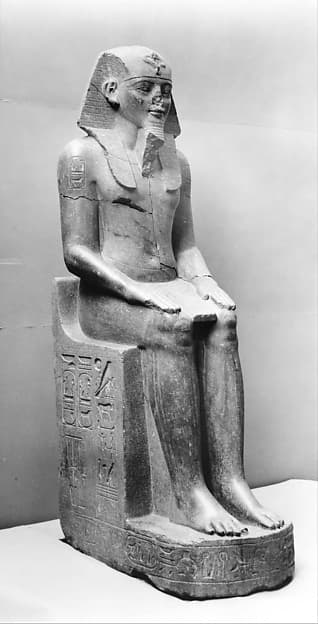
Napoleon Bonaparte brought 167 scientists, artists, engineers, and linguists to Egypt in 1798. He brought them alongside 38,000 soldiers. The soldiers lost. The scientists changed the world.
The Description de l'Égypte, the monumental encyclopaedia that those savants produced between 1809 and 1828, ran to twenty-three volumes. It catalogued everything from Nile flora to temple reliefs to Bedouin customs at a level of precision that no European had attempted before. It did not simply describe Egypt. It reframed Egypt as a subject of systematic inquiry, an idea that could be measured, drawn, and eventually decoded. Every academic Egyptology department on earth traces its intellectual lineage to that project.
But the story of French Egyptology is not simply a gift from Europe to the world. It is also the story of how a foreign military power extracted knowledge from a country it had occupied, how Egyptian workers whose names were never recorded did the physical labour of excavation while French scholars got the credit, and how the colonial framework of that original project shaped what questions Egyptology still asks today. Understanding this history is not incidental to visiting Egypt. It is the key to reading what you see.
The single most consequential outcome of the French expedition was Jean-François Champollion's decipherment of hieroglyphics in 1822. Champollion was not in Egypt when he did it. He was in Paris, working from the Rosetta Stone, which British forces had seized from the French at the Battle of Alexandria in 1801 and shipped to London, where it remains in the British Museum. The first great achievement of French Egyptology was thus completed from stolen material now held by a rival power. Egypt's own script was decoded without Egypt having any say in the matter.
---
Cairo: Reading the French Imprint on the City
Downtown Cairo, the neighbourhood known as Khedival Cairo or Wust al-Balad, was designed in the 1860s under Khedive Ismail with explicit instructions to produce "a Paris on the Nile." Ismail sent his architects to study Haussmann's renovations of Paris and brought back not just the wide boulevards but the specific building typology: the corner chamfer, the wrought-iron balcony, the mansard-influenced roofline. The result is a district that reads as European to a casual eye but is in fact a specifically Egyptian negotiation with French urban form.
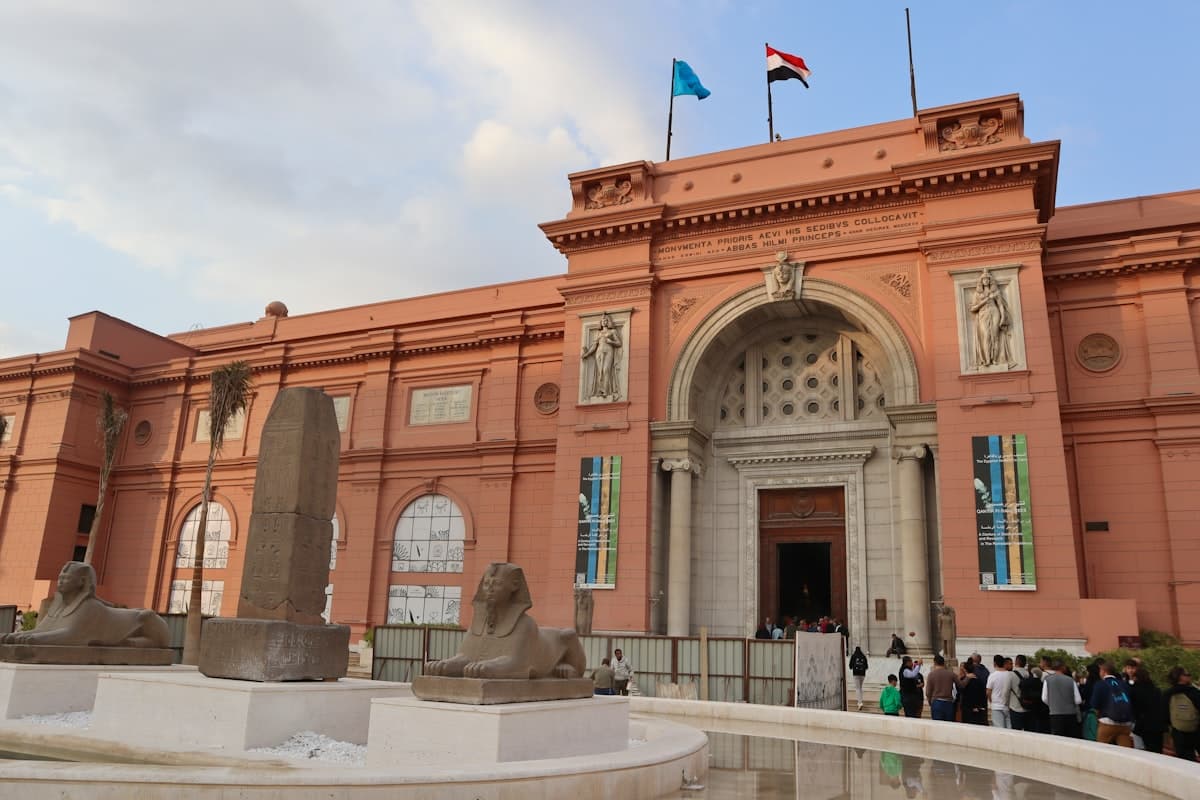
Walk Talaat Harb Street from Tahrir Square to Talaat Harb Square. Most of what you see was built between 1890 and 1940 by Egyptian, Syrian, Jewish, and Greek architects trained in Paris or in Parisian-influenced schools. The Egyptian Museum at the top of the square, opened in 1902, was designed by French architect Marcel Dourgnon after an international competition. Dourgnon won. The museum that resulted is neoclassical on the outside and essentially a warehouse on the inside, a storage problem Egypt has been trying to solve ever since.
The Institut Français d'Archéologie Orientale, on Qasr al-Aini Street in Garden City, has been continuously operating in Cairo since 1880. It is one of the oldest foreign research institutions in Egypt and its library holds primary documents from nineteenth-century French excavations that are not available anywhere else. Researchers can visit by appointment. The building itself, a cool, shuttered villa from the late Ottoman period, is worth seeing.
What Most Visitors Walk Past in the Egyptian Museum
The Champollion connection runs through the Egyptian Museum in ways the signage rarely makes explicit. The Rosetta Stone itself is in London, but the museum holds dozens of objects that Champollion personally examined during his 1828 to 1829 Egypt expedition, the only time he ever came to the country whose ancient language he had deciphered six years earlier. He spent fourteen months here, mostly in Upper Egypt, and his letters from that trip describe the experience of reading temple walls in real time, watching the language become three-dimensional around him. He died in Paris three years after returning, aged forty-one, almost certainly from the strain of the work.
Auguste Mariette, the French archaeologist who founded the Egyptian Museum's predecessor institution in 1858, is buried inside the current museum building in a sarcophagus in the garden. His statue stands outside. He also established the Antiquities Service, the organisation that controlled all excavation permits in Egypt until 1952, ensuring that for nearly a century the scientific framework governing Egypt's own past was administered by a Frenchman.
---
Luxor and Upper Egypt: The Excavation Landscape
If Cairo is where French Egyptology built its institutions, Upper Egypt is where it did its most consequential physical work. The French expedition of 1798 to 1801 produced detailed drawings of Karnak, Luxor Temple, and the Theban tombs that were, for several decades, the most accurate architectural records of those sites in existence. Those drawings, published in the Description de l'Égypte, became the reference images that trained an entire generation of European Egyptologists who had never visited Egypt.
At Karnak, the section of the complex most transformed by French scholarly attention is the open-air museum in the northwest corner, which displays reconstructed elements of chapels dismantled and reused as fill by later pharaohs. French archaeologists from the Centre Franco-Égyptien pour l'Étude des Temples de Karnak have been working here continuously since 1967, and the ongoing reconstruction of the White Chapel of Senusret I (built around 1950 BC and reassembled from 315 separate blocks found stuffed inside a later pylon) is largely their work. Most tour groups walk through this open-air museum in eight minutes. It deserves forty.
The Luxor Museum, which opened in 1975 and was designed by Egyptian architect Mahmoud El-Hakim, is a direct response to the French and European model of display. Where the Egyptian Museum accumulates, Luxor edits. Fewer objects, far better context, labels that attempt to explain significance rather than simply assert it. The cache of New Kingdom statuary found buried under the Luxor Temple courtyard in 1989, twenty-two extraordinarily preserved pieces including a standing Amenhotep III, is displayed here in conditions that would satisfy any European museum. Admission is EGP 400 and it is where you should start.
---
The Connections: Layers Under Layers
The French Egyptology history guide to Egypt cannot be told without acknowledging that the French were not working on a blank canvas. They were the latest layer in an Egypt that had already been interpreted, claimed, and reinterpreted by Greeks, Romans, Arabs, and Ottomans.
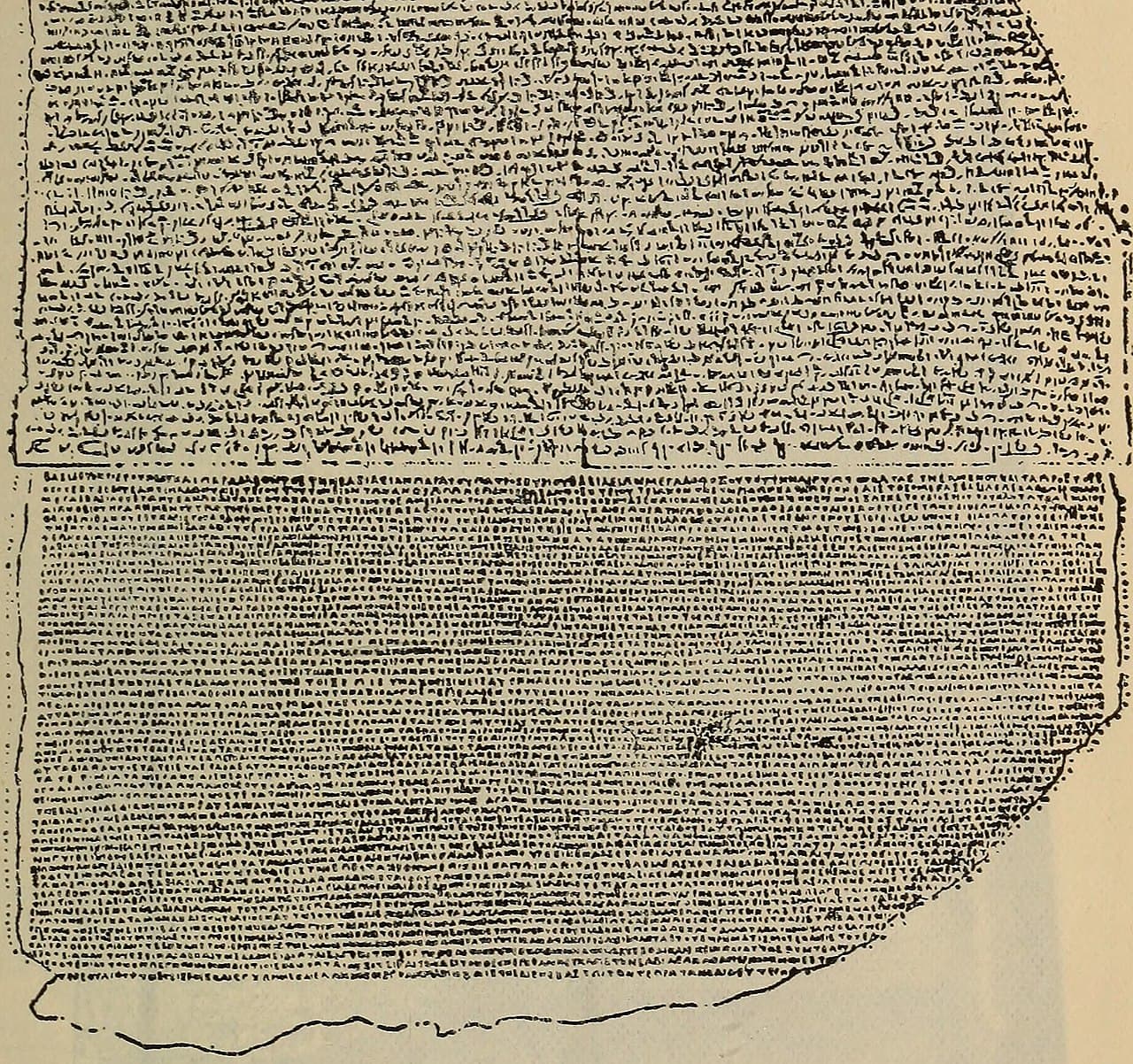
The Rosetta Stone itself is a perfect object for this argument. It is a decree from 196 BC, written in three scripts, Greek, Demotic, and hieroglyphic, by Egyptian priests legitimising the rule of Ptolemy V, a Macedonian Greek king. The stone was then lost for centuries and found in 1799 by French soldiers demolishing a wall in Rashid (Rosetta) to build a fort. Those soldiers were occupying a city that had been Ottoman for 280 years. Champollion deciphered it using the Greek text as his key. The British took it as war booty. It is now in London. Every nation that has touched it has considered itself the rightful interpreter of Egypt's past.
The IFAO in Cairo sits in Garden City, a neighbourhood developed on land that was a Fatimid-era garden, built over earlier Roman structures, built in turn over a Pharaonic canal system. The French institute studying ancient Egypt occupies ground that contains twelve centuries of non-French history in its foundations.
In Luxor, the Winter Palace Hotel, where Howard Carter (British, not French, but funded partly through French academic networks) retreated after finding Tutankhamun's tomb in 1922, still operates. A room overlooking the Nile runs around EGP 4,500 to 6,000 per night. The bar is accessible without staying there and the terrace in late afternoon, when Luxor's particular gold-pink light comes off the water, is one of the better free experiences in the city.
---
Common Mistakes
Treating the Egyptian Museum as a highlight rather than a starting point. The museum's chaotic layout and poor signage mean that without prior reading, most visitors leave having absorbed almost nothing. Spend two hours reading about the New Kingdom before you go. You will see three times as much.
Booking a tour that visits Karnak for ninety minutes. This is the most common tour itinerary in Luxor and it is a waste of everyone's time. Karnak is 247 acres and contains work from more than thirty pharaohs spanning 2,000 years. You need at least three hours, ideally returning at different times of day.
Paying for the sound and light show at Karnak. It costs EGP 350, runs forty-five minutes, and tells you almost nothing that this article does not cover. The recorded narration is theatrical in the worst sense. The temple at night, seen simply by wandering the exterior at dusk after closing, is more affecting and free.
Skipping the IFAO's public events. The French Institute runs lectures, film screenings, and exhibitions in Cairo that are open to the public, often free or under EGP 100, and frequently address current excavation findings that have not yet been published. Check their programme online before your trip.
Assuming all the French Egyptological legacy is ancient history. The Centre Franco-Égyptien at Karnak employs Egyptian and French archaeologists working simultaneously on active sites. You can sometimes see this work in progress. Ask the site guards near the open-air museum, politely and in Arabic if you can manage it, and you may be pointed toward ongoing work.
Not visiting the Luxor Museum before Luxor Temple. Luxor Temple without context is a forest of columns. After the Luxor Museum, it becomes a specific argument about royal theology, festival procession routes, and the reuse of sacred space across three thousand years.
---
Practical Tips
The best single-day itinerary for tracing the French Egyptology history in Egypt in Cairo: Egyptian Museum in the morning (arrive at 9am, before the tour groups), lunch in Wust al-Balad at one of the old coffee houses on Hoda Shaarawy Street, then a walk through Khedival Cairo's French-influenced architecture in the afternoon, ending at Tahrir Square at sunset when the light makes the whole district look like a faded postcard from 1910.
For Luxor, stay at least three nights on the East Bank. Start each morning early: the Luxor Temple at 6am, before the cruise ship crowds arrive, is a genuinely different experience from the same temple at 10am. The light at that hour is specific to the place, a horizontal gold that makes limestone glow from within rather than reflect.
For serious French Egyptology research, the IFAO library in Cairo holds materials unavailable elsewhere. Contact them at least four weeks in advance by email to arrange researcher access. Bring institutional affiliation if you have one, though independent scholars with a specific project are sometimes accommodated.
Photography: inside the Egyptian Museum, photography fees have changed repeatedly. As of the most recent visit, basic phone photography is permitted without extra charge in most halls but flash and professional equipment require a permit purchased at the ticket desk for EGP 50. Confirm at the gate.
The ongoing Grand Egyptian Museum at Giza, when fully open, will house the complete Tutankhamun collection along with significantly better interpretive materials. Its French Egyptological connections are less direct than Cairo's existing institutions, but its existence is partly a response to a century of European museums holding Egyptian objects while Egyptian museums struggled with funding and space. That context matters when you visit.
Frequently Asked Questions
The Weekly Dispatch
More on Egypt, every Friday.
Cultural depth and places most guides never mention.
No spam. Unsubscribe anytime.