French Egyptology History Guide: Egypt's Debt to Napoleon's Scholars
Napoleon brought 167 scientists to Egypt in 1798. They produced a 23-volume encyclopedia that invented modern Egyptology. Here is where to find their footprints.

Quick Facts
- Best time to visit
- October through February for Cairo and Luxor. Avoid July and August when temperatures in Luxor exceed 42 degrees Celsius and museum crowds in Cairo peak with Gulf visitors.
- Entrance fee
- Egyptian Museum Tahrir: EGP 450 (approx $9 USD), students EGP 225. Grand Egyptian Museum: EGP 900 (approx $18 USD) main galleries, EGP 1,200 (approx $24 USD) with Tutankhamun halls. Karnak Temple: EGP 450 (approx $9 USD). Dendera Temple: EGP 350 (approx $7 USD). Luxor Temple: EGP 400 (approx $8 USD).
- Opening hours
- Egyptian Museum: daily 9am to 5pm. Grand Egyptian Museum: daily 9am to 9pm, Friday until 10pm. Karnak and Luxor Temples: daily 6am to 5pm (winter), 6am to 6pm (summer). Dendera: daily 7am to 5pm.
- How to get there
- Cairo: Metro Line 1 to Sadat station (EGP 8) for Egyptian Museum. Uber or taxi to GEM from central Cairo EGP 150 to 250. Luxor: accessible by overnight train from Cairo (EGP 400 to 900 for sleeper class) or 1-hour flight (EGP 1,200 to 2,500). Dendera from Luxor: private car EGP 500 to 700 round trip.
- Time needed
- Egyptian Museum minimum 3 hours. Grand Egyptian Museum full day. Karnak 3 to 4 hours minimum. Dendera 2 hours at the site plus 4 hours travel. Full French Egyptology itinerary: 6 days minimum across Cairo, Luxor, and Dendera.
- Cost range
- Budget EGP 800 to 1,200 per day including transport, entry fees, and street food. Mid-range EGP 2,500 to 4,000 per day with a qualified Egyptologist guide, sit-down meals, and comfortable transport.
Quick Facts
Best time to visit: October through February, when Cairo's heat is manageable and museums are less crowded than summer school holidays.
Egyptian Museum entrance fee: EGP 450 (approx $9 USD), students EGP 225. The Grand Egyptian Museum (Giza plateau) costs EGP 900 (approx $18 USD) for the main galleries, plus EGP 1,200 (approx $24 USD) to access the Tutankhamun halls.
Opening hours: Egyptian Museum, Tahrir Square: daily 9am to 5pm. Grand Egyptian Museum: daily 9am to 9pm (Friday until 10pm).
How to get there: Cairo Metro Line 1 to Sadat station (EGP 8, approx $0.16) deposits you directly at Tahrir Square for the Egyptian Museum. For the GEM, taxis from central Cairo cost EGP 150 to 250 (approx $3 to $5); Uber runs slightly higher.
Time needed: The Egyptian Museum deserves three hours minimum. The GEM requires a full day to do justice. If you are tracing French Egyptology specifically, combine both with a morning at the Institut d'Égypte in Downtown Cairo and expect a long, rewarding two days.
Cost range: Budget EGP 800 to 1,200/day including transport, entry fees, and food. Mid-range EGP 2,500 to 4,000/day if adding a licensed Egyptologist guide, which for this particular journey is money genuinely well spent.
---
Why French Egyptology Matters: The Invasion That Became a Science
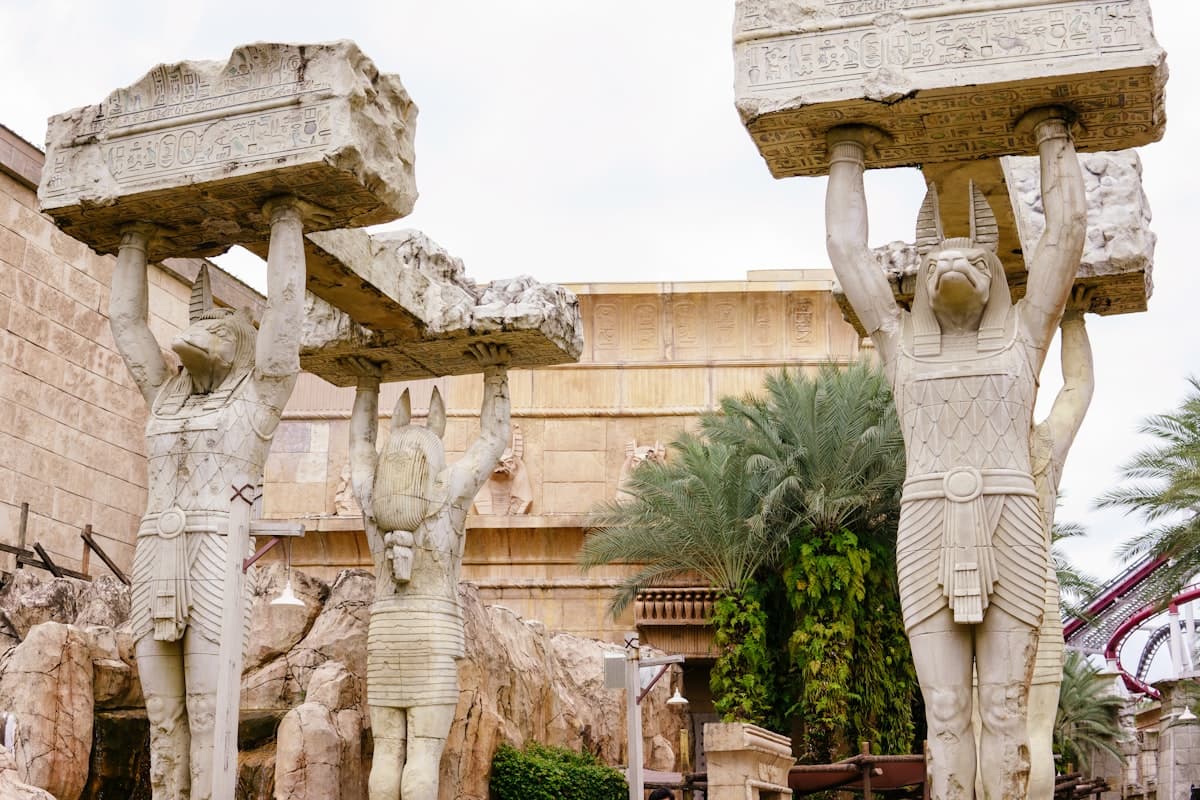
In July 1798, Napoleon Bonaparte landed 35,000 troops on Egyptian soil. He also brought 167 civilians: mathematicians, chemists, engineers, botanists, artists, and architects. He called them the Commission des Sciences et des Arts. History would come to know their output as the Description de l'Égypte, a 23-volume encyclopedia of Egyptian geography, monuments, flora, fauna, and antiquities published between 1809 and 1828. It is not an exaggeration to say this document invented Egyptology as a discipline.
Before Napoleon's scholars arrived, European knowledge of ancient Egypt consisted largely of classical Greek and Roman accounts, biblical references, and the reports of Jesuit missionaries who were often more interested in Coptic Christianity than in hieroglyphs. The French expedition changed this fundamentally. They measured, drew, and catalogued everything they could reach, from the temples of Upper Egypt to the Roman fortifications of Alexandria. When a French soldier named Pierre-François Bouchard discovered a granite stele at Rosetta in August 1799, he understood immediately that it might be significant. He was right. The Rosetta Stone, decoded by Jean-François Champollion in 1822, broke the cipher of hieroglyphic writing and opened three thousand years of recorded Egyptian history to modern understanding.
The irony is that France does not possess the Rosetta Stone. The British took it in 1801 when they forced the French surrender, and it has sat in the British Museum ever since, a source of ongoing diplomatic friction. Egypt wants it back. So, occasionally and quietly, does France.
For any traveler engaged with the French Egyptology history of Egypt, Cairo is the primary destination. But the story extends to Luxor, Aswan, and Alexandria in ways that most itineraries miss entirely.
---
The Institut d'Égypte and Downtown Cairo: Where the Science Began
Napoleon founded the Institut d'Égypte in Cairo on August 22, 1798, less than a month after landing. He modeled it on the Institut de France in Paris and installed it in a confiscated palace in the neighborhood now known as Downtown Cairo. The original building burned in the 2011 revolution, a loss that made international headlines because the fire destroyed an estimated 200,000 rare books and manuscripts. The rebuilt Institut operates today at the same site on Sheikh Rihan Street, and while it functions primarily as a research institution rather than a tourist destination, it accepts visitors during specific open days and is worth contacting directly if French Egyptology is your subject.
The more accessible French imprint on Downtown Cairo is architectural. Baron Haussmann's renovation of Paris in the 1850s and 1860s directly inspired Khedive Ismail's redesign of Cairo's western districts between 1867 and 1882. Ismail wanted a city that would announce Egypt's modernity to European visitors attending the 1869 opening of the Suez Canal, itself a French engineering project conceived by Ferdinand de Lesseps. Walk the grid of streets between Tahrir Square and Ramses Square and you are walking through a Paris translation, complete with wrought-iron balconies, limestone facades, and corner buildings that terminate vistas. The cafes are better here than in Paris, and the prices are considerably lower.
For the specific traces of the 1798 expedition, the Egyptian Museum in Tahrir Square holds objects that French scholars first catalogued. The museum's organization, when it opened in 1902 under the direction of Gaston Maspero (French-born, appointed Director General of the Antiquities Service), reflected French scholarly priorities that still shape how Egyptology is taught worldwide. Maspero is buried in Paris, but his intellectual descendants run Egyptology departments from Chicago to Berlin.
---
Champollion's Egypt: From the Rosetta Stone to Luxor's Walls
Jean-François Champollion never visited Egypt until 1828, six years after he decoded hieroglyphs in a Paris library using three languages on a single stone. When he finally arrived on the Nile and entered the temples of Luxor and Karnak for the first time, he reportedly wept. He was thirty-seven years old. He had spent his adult life reading words written on walls he had never seen.
In Luxor, the French Egyptology history becomes physically immediate. The obelisk that stands today in the Place de la Concorde in Paris was removed from Luxor Temple in 1833 by the French consul Bernardino Drovetti's successor network, formally gifted by Khedive Muhammad Ali to King Charles X, and transported to France on a specially constructed ship called the Luxor. Its twin still stands in front of Luxor Temple. If you stand between the pylons at the temple entrance and look at the single obelisk, you are looking at half of what was there. The missing half is in Paris. Egypt did not forget.
The Karnak Temple complex, 3 kilometers north of Luxor Temple, contains the work of French epigraphers in almost every corridor. The Centre Franco-Égyptien d'Étude des Temples de Karnak (CFEETK) has operated continuously since 1967, documenting and conserving the site. Their work is not visible to most tourists but it is why Karnak's painted reliefs have survived as well as they have. The French Egyptology investment in this site is ongoing, not historical.
At Luxor, the sound and light show costs EGP 400 and provides nothing that a thirty-minute read of the temple's own information panels will not give you. The panels, installed by Egyptian and French epigraphers working jointly, are better sourced. Skip the show.
---
The Description de l'Égypte: Reading the Book in the Places It Describes
The full Description de l'Égypte is available digitally through the Bibliothèque nationale de France's Gallica archive, free of charge. If you download the relevant volumes before your trip and carry a tablet, you can stand in front of monuments that French scholars drew in 1799 and compare their illustrations to what survives today. This is not a nostalgic exercise. It is a before-and-after document of two centuries of damage, conservation, theft, and change.
The Dendera Temple complex, four hours north of Luxor by road (approximately EGP 500 to 700 for a private car), features prominently in the Description. The French illustrators drew the famous Dendera zodiac, a circular bas-relief calendar set into the ceiling of a small chapel on the temple roof. Napoleon's scholars recognized it as remarkable. In 1820, a French engineer named Sébastien Louis Saulnier hired workmen to cut the zodiac from the ceiling and remove it to Paris, where it was sold to Louis XVIII for 150,000 francs. The ceiling at Dendera now has a plaster replica. The original is in the Louvre. It is one of the most consequential acts of cultural removal in Egyptology's early history, and the Louvre describes it as an acquisition. Egypt calls it something else.
Entry to Dendera costs EGP 350 (approx $7 USD). It receives a fraction of Karnak's visitors despite being, architecturally, one of the best-preserved temple complexes in Egypt. The Hathor columns in the hypostyle hall retain original paint. The colors are not faded metaphors for color. They are color: ochre, blue, green, in the particular underwater quality of light that filters through the temple's high stone grilles.
---
The Connections: From Napoleon to Nasser
The French Egyptology history guide for Egypt cannot end in the nineteenth century because the story does not. When Egypt nationalized the Suez Canal in 1956, Nasser specifically invoked the memory of the thousands of Egyptian laborers who died building it under French supervision between 1859 and 1869. The canal and the Egyptological enterprise were two sides of the same French engagement with Egypt: one intellectual, one extractive, both transformative.
The Egyptian Museum in Tahrir Square was designed by the French architect Marcel Dourgnon, who won the 1895 international competition for the commission. The building's neoclassical facade, its barrel-vaulted entrance hall, its arrangement of objects in roughly chronological order: all of this reflects French curatorial logic of the late nineteenth century. The Grand Egyptian Museum, opened on the Giza plateau in 2023 after two decades of construction, was designed by the Irish firm Heneghan Peng. It arranges objects differently, by dynasty and theme, in a building that faces the pyramids. The shift from Dourgnon's European rationalism to a post-colonial framing is deliberate and worth considering as you move between the two buildings.
At the GEM, Room 3 contains the reconstructed army of Tutankhamun's shabtis alongside the chariot that Howard Carter excavated in 1922. Carter was British, but the concession to excavate the Valley of the Kings had been granted to Lord Carnarvon under rules established by the French-run Antiquities Service. The French administrative framework made Carter's discovery possible and then largely took credit for the scholarship that followed. This is a recurring pattern in early Egyptology.
---
Common Mistakes
Treating the Egyptian Museum as a pre-GEM warm-up. The two museums hold different objects. The old museum contains artifacts the GEM has not yet transferred, including the entire Amarna collection and the Royal Mummy Room. They are not interchangeable, and treating the original museum as a rough draft is a mistake many travelers make.
Skipping the Nubian Museum in Aswan. The Nubian Museum, opened in 1997, documents the UNESCO campaign to rescue monuments before the Aswan High Dam flooded Nubia in the 1960s. France contributed significantly to this campaign, relocating the Temple of Amada and others. The museum is EGP 200 (approx $4 USD) and contains objects that put the French preservation work in specific political and human context.
Believing the Rosetta Stone story begins with Champollion. Thomas Young, an English polymath, correctly identified that the cartouches in hieroglyphic text contained royal names before Champollion published his full decipherment. The French Egyptology narrative tends to minimize Young's contribution. Both men deserve credit, and reading both sides of this academic argument before you visit makes the Champollion rooms at the GEM considerably more interesting.
Paying for guided tours at Karnak without verifying the guide's credentials. The CFEETK-trained guides at Karnak are a different category from the licensed tourist guides who work the main circuit. Ask specifically for a guide with knowledge of the Franco-Egyptian epigraphic project. They exist, they charge more, and they are worth it.
Visiting Luxor Temple in the afternoon. The French illustrators of the Description de l'Égypte worked in morning light. The temple faces east. Go at 6am when entry opens and the stones carry the color of early light rather than the flat glare of midday.
Purchasing the coffee-table Description de l'Égypte reprints sold near the Egyptian Museum. They are attractive and expensive and contain a fraction of the original content. The full Gallica digital archive is free and complete. Download it before you leave home.
Conflating French Egyptology with French colonialism and then stopping there. The relationship is more complicated. Many of the French scholars of 1798 were genuinely horrified by the military campaign they accompanied. Dominique Vivant Denon, whose drawings formed the visual core of the Description, spent the campaign arguing with French generals about the destruction of monuments. The intellectual history and the political history overlap but are not identical, and collapsing them loses something true about both.
---
Practical Tips
For a dedicated French Egyptology itinerary, plan a minimum of six days: two in Cairo (Egyptian Museum, GEM, Institut d'Égypte neighborhood), two in Luxor (Karnak, Luxor Temple, West Bank tombs catalogued by French scholars), and two in Aswan or a day trip to Dendera and Abydos from Luxor.
The Bibliothèque nationale de France's Gallica archive (gallica.bnf.fr) provides free digital access to the complete Description de l'Égypte. Download the volumes relevant to your itinerary before you leave. The image resolution is high enough to compare engravings to current monuments with real precision.
If you read French, the CFEETK publishes annual research bulletins available on their website documenting current work at Karnak. Even a partial read before visiting gives you a map to parts of the site most tourists walk through without understanding.
Crowds at the GEM peak between 11am and 2pm. Arrive at opening (9am) and work forward chronologically. By the time the tour groups arrive, you will be in the New Kingdom galleries, which are large enough to absorb the volume.
For the French Egyptology history guide to Egypt to make complete sense, read at least one biography of Champollion before you go. Andrew Robinson's Cracking the Egyptian Code is accessible, accurate, and short enough to finish on the flight.
Frequently Asked Questions
The Weekly Dispatch
More on Egypt, every Friday.
Cultural depth and places most guides never mention.
No spam. Unsubscribe anytime.