French Egyptology History Guide: From Napoleon to Now
Napoleon brought 167 scientists to Egypt in 1798. They didn't find what he wanted. They found everything else. Here's what they left behind.

Quick Facts
- Best time to visit
- October to March. Cairo and Upper Egypt sites are comfortable for full days of walking and reading. Summer heat between June and September makes extended outdoor site visits genuinely difficult and shortens the hours when sites are at their best.
- Entrance fee
- Egyptian Museum Cairo EGP 450 (approx $9 USD). Dendara Temple EGP 200 (approx $4 USD). Valley of the Kings EGP 360 (approx $7 USD) for three tombs. Saqqara main site EGP 300 (approx $6 USD), Serapeum additional EGP 100. Coptic Museum Cairo EGP 150 (approx $3 USD).
- Opening hours
- Egyptian Museum daily 9am to 5pm. Dendara daily 7am to 5pm. Valley of the Kings daily 6am to 5pm. Saqqara daily 8am to 5pm. Coptic Museum daily 9am to 5pm, closed Friday mornings.
- How to get there
- Cairo sites: Metro Line 1 or 2 to Sadat Station for the Egyptian Museum and Institut d'Égypte neighborhood. Dendara: taxi from Luxor approximately EGP 400 to 500 round trip or day tour from EGP 300. Saqqara: taxi from Cairo approximately EGP 200 to 300 round trip. West Bank Luxor sites: Nile ferry EGP 5, then microbus or taxi EGP 20 to 50 to Valley of the Kings.
- Time needed
- Minimum five days to follow the French Egyptology thread through Cairo and Upper Egypt. Two days Cairo (Egyptian Museum, Institut d'Égypte, Coptic Museum, Saqqara). One day Dendara from Luxor base. One to two days Luxor West Bank including Valley of the Kings and Karnak.
- Cost range
- Budget EGP 800 to 1,200 per day covering sites, local transport, and food. Mid-range EGP 2,000 to 3,500 per day if adding specialist Egyptologist guide (EGP 500 to 800 for two to three hours, strongly recommended for this subject). Train Cairo to Luxor approximately EGP 300 to 600 depending on class.
Quick Facts
Best time to visit: October to March, when Cairo and Luxor are cool enough to spend real time in archives, libraries, and outdoor sites without the midday collapse that hits between June and September.
Key sites covered in this guide: Institut d'Égypte reconstructed building, Cairo (free, open to researchers by appointment); Egyptian Museum, Cairo, EGP 450 (approx $9 USD), daily 9am to 5pm; Dendara Temple, Qena, EGP 200 (approx $4 USD), daily 7am to 5pm; Valley of the Kings, Luxor, EGP 360 (approx $7 USD) for three tombs, daily 6am to 5pm.
How to get there: Cairo's Institut d'Égypte is a short walk from Tahrir Square, accessible by Metro Line 1 or 2 to Sadat Station. Dendara is 70km north of Luxor: hire a taxi from Luxor for roughly EGP 400 to 500 round trip, or join a day tour from EGP 300. The Valley of the Kings requires a ticket from the Luxor West Bank ferry crossing, EGP 5 each way, then a microbus or taxi to the site.
Time needed: To follow the French Egyptology thread seriously across Cairo and Upper Egypt, plan a minimum of five days. Cairo alone warrants two full days if you include the Egyptian Museum, the Institut d'Égypte neighborhood, and the Bulaq district where the first Egyptological printing press operated.
Cost range: Budget EGP 800 to 1,200 per day in Cairo covering sites, transport, and food. Mid-range EGP 2,000 to 3,500 per day if adding guided specialist tours or hiring a Egyptologist guide (highly recommended for this topic specifically).
---
Why French Egyptology Matters: The Invention of a Science
Before August 1799, no living person on earth could read a hieroglyph. Every inscription carved across thousands of temples, tombs, and papyri in Egypt was completely illegible. A soldier in Napoleon's army named Pierre-François Bouchard changed that possibility when he found a granodiorite slab near the town of Rashid, which Europeans called Rosetta. He didn't know what it was. Neither did anyone else for another 23 years.
The French Egyptology history that began with Napoleon's 1798 expedition, the so-called Expédition d'Égypte, is one of the strangest stories in the history of knowledge. Napoleon brought 167 scientists, artists, engineers, and scholars to Egypt alongside 36,000 soldiers. The military campaign failed within three years. The British destroyed the French fleet at the Battle of the Nile, Napoleon abandoned his army in secret, and the French eventually surrendered Egypt to the Ottomans in 1801. But the scholars stayed, measured, drew, and published. Their twenty-three-volume Description de l'Égypte, completed in Paris between 1809 and 1828, remains one of the most ambitious documentation projects in history. It recorded a country that was about to change forever.
Think about what French Egyptology did to Egypt as a concept: before 1798, the West regarded Egyptian monuments primarily through the lens of biblical narrative or classical Greek accounts. The French scholars were the first to treat Egypt's material remains as subjects of systematic scientific inquiry. That shift, from wonder to method, created the discipline we now call Egyptology, and France embedded itself at the center of that discipline for two centuries.
---
The Rosetta Stone Problem: What France Lost and What It Left
The Rosetta Stone is in London. It has been in London since 1802, when the British took it as a condition of the Treaty of Alexandria that ended French control of Egypt. This is the central irony of French Egyptology history: France created the conditions for deciphering ancient Egyptian script, but the key artifact ended up in the British Museum, where it remains today despite periodic Egyptian requests for its return.
What France did keep was the intellectual infrastructure. Jean-François Champollion, a scholar who had never been to Egypt when he published his decipherment of hieroglyphs in September 1822, used copies of the Rosetta Stone's inscriptions made by the expedition's scholars, combined with his extraordinary knowledge of Coptic, which is the late form of the ancient Egyptian language that survived in Christian liturgy. Coptic Christians in Egypt had been keeping the sound of the pharaohs' language alive in their churches for over a thousand years, and Champollion understood this. He recognized that Coptic gave him the vowels that hieroglyphs didn't write. Without Egypt's Coptic community, the decipherment might have taken another generation.
When Champollion finally came to Egypt in 1828, he wept at Karnak. His letters describe a man overwhelmed by the confirmation of everything he had worked out from paper copies. He spent months there, moving through the temples reading inscriptions that no one had read since the Roman period. He died in Paris in 1832, aged 41, possibly from the strain of the Egyptian journey. His Egyptian grammar and dictionary were published posthumously. His notes on Karnak alone fill multiple volumes.
In Cairo, the Institut d'Égypte that Napoleon founded in 1798 was reconstituted in 1859 and survived until December 2011, when it was set on fire during clashes near Tahrir Square. An estimated 200,000 books and documents burned or were destroyed. The building has since been restored, a fact that receives almost no attention in Western coverage of the Arab Spring. Visit it on Qasr al-Aini Street and understand that this is where Egyptian and French scholars have worked side by side for over 160 years. The rebuilding of the library's collection is ongoing.
---
Dendara: The Temple That Gave France a Zodiac
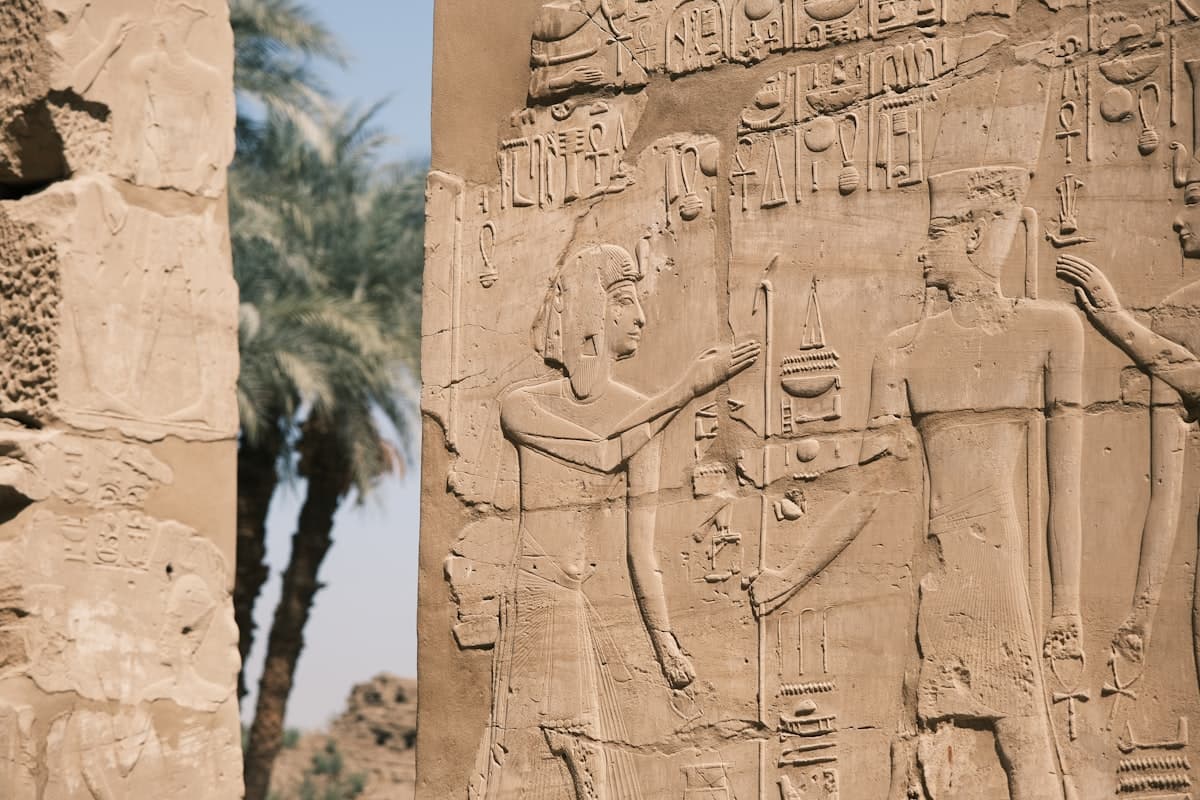
In 1820, a French antiquities dealer named Sébastien Louis Saulnier paid workers to remove a massive sandstone ceiling panel from the pronaos of the Hathor Temple at Dendara. The panel contained a circular zodiac, carved during the Ptolemaic period, that French scholars had first documented during the Napoleonic expedition. It took the workers four months to cut it out. The zodiac arrived in Paris in 1821 and was purchased by Louis XVIII for 150,000 francs. It is now in the Louvre.
What remains at Dendara is a plaster cast, a copy of a copy. This matters for how you experience the temple. The ceiling above you in the outer hypostyle hall shows the empty mounting where the original sat. French Egyptology history is literally written into the gaps and absences of Egyptian monuments, not only in their documentation.
The Hathor Temple at Dendara is one of the best-preserved temple complexes in Egypt, partly because it was completed late, during the Ptolemaic and early Roman periods, between roughly 54 BCE and 20 CE. The Romans who built the outer gate of the complex included a relief of Cleopatra VII and her son Caesarion, the child she had with Julius Caesar. It is the largest surviving image of Cleopatra anywhere in the world, and most visitors photograph it without knowing who they are looking at. She is on the southern exterior wall, the back of the temple, and she is shown making offerings to Hathor on a scale that implies divine status.
The underground crypts at Dendara, accessible through low passages that require crouching, contain some of the finest carved reliefs in Egypt. French expedition artists documented these crypts in detail. You are seeing what they saw, minus the zodiac.
---
The Connections: How French Egyptology Shaped Modern Egypt
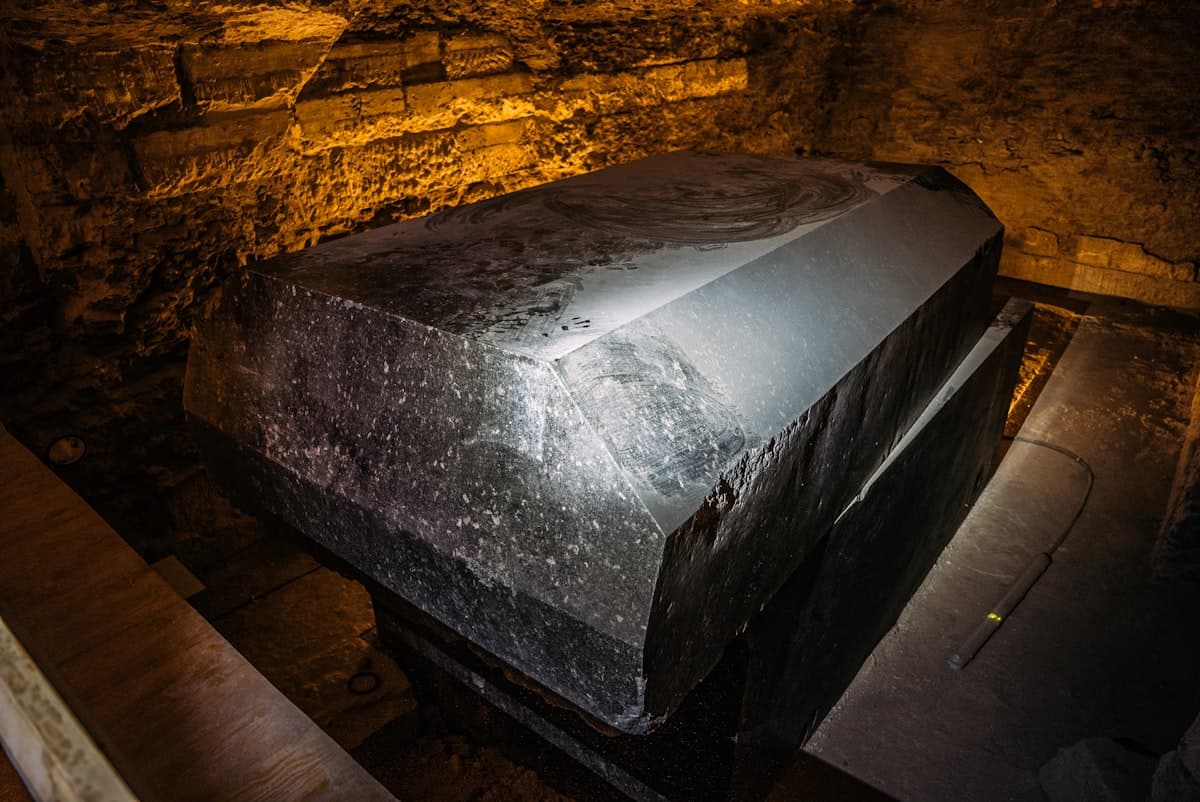
The French legacy in Egyptian archaeology is not simply about excavation and removal. Auguste Mariette, a French scholar who came to Egypt in 1850 ostensibly to acquire Coptic manuscripts for the Louvre, instead discovered the Serapeum at Saqqara, the underground burial complex for the sacred Apis bulls, whose granite sarcophagi weigh up to 70 tonnes each. He stayed in Egypt for the rest of his life.
In 1858, Mariette was appointed by the Egyptian government under Khedive Said to head the new Egyptian Antiquities Service. He was the first director of what became the institution that still controls all Egyptian archaeological sites. He founded the Egyptian Museum's predecessor collection in Bulaq in 1863. His tomb is in the garden of the Egyptian Museum in Tahrir Square, the institution he built. When you pay EGP 450 to enter that museum, you are entering a building that exists because a French scholar refused to let excavated objects leave Egypt any more than he could prevent.
Mariette spent enormous energy fighting the trade in antiquities, including objects removed by other Europeans, though critics note that the Serapeum excavation itself was conducted with methods that destroyed significant contextual information. The French Egyptology history is not a clean narrative of preservation. It is a history of knowledge, extraction, protection, and competition running simultaneously.
The connection to Coptic Egypt runs deep here too. Champollion's decipherment relied on the Coptic Church's preservation of ancient Egyptian sounds. The Serapeum that Mariette discovered sits beneath a desert plateau also containing the Step Pyramid of Djoser, built 4,600 years ago, and the remains of a monastery where early Christian monks lived among the ruins. At Saqqara, you are standing in a place where Pharaonic, Greco-Roman, early Christian, and Islamic Egypt physically overlap within a few hundred meters.
---
Common Mistakes
Treating the Egyptian Museum as a Mariette museum. Most visitors rush to Tutankhamun's gold and ignore the building itself. Mariette's tomb in the garden is overlooked by almost everyone. The ground floor's collection of Old Kingdom statues, including the seated scribe and the wooden statue known as the Sheikh el-Beled, represents some of the finest work in any museum on earth. These were Mariette's finds.
Skipping Dendara because it's not Karnak. Dendara has better-preserved color, more accessible crypts, and the Cleopatra relief that almost no one can identify. The drive from Luxor takes about 75 minutes and the site is rarely crowded before 9am. It is worth getting up for.
Paying for the Sound and Light Show at Karnak. It costs EGP 350, runs 45 minutes, and tells you nothing about the French scholarly tradition or anything else that a good book won't cover more accurately. The EGP 350 is better spent on a knowledgeable local guide for one hour inside the temple during daylight.
Assuming the Louvre is where the Egyptian story ended. Several significant objects removed during the 19th century are in collections outside Paris, including fragments from Dendara now in Cairo, Alexandria, London, and Berlin. The dispersal is genuinely complicated and the Egyptian Museum's ongoing acquisitions program means the story is still moving.
Missing the Champollion connection at the Cairo Coptic Museum. The Coptic Museum in Old Cairo holds papyri in the Coptic script that are directly relevant to understanding how Champollion achieved his decipherment. The museum is EGP 150 (approx $3 USD), open 9am to 5pm daily except Friday mornings, and is built partly on Roman towers from the fortress of Babylon. Most visitors on the French Egyptology trail never come here.
Attempting the Serapeum at Saqqara without a flashlight. The underground galleries are large, partially lit by electric bulbs that regularly fail, and the granite sarcophagi are in dark side chambers. Bring your own light source or you will see almost nothing of what Mariette excavated in 1851.
---
Practical Tips
For serious engagement with French Egyptology history in Egypt, the best starting point is the Egyptian Museum before any site visit. Spend morning one in the museum with a focus on Old Kingdom and Ramesside material, understanding what the Napoleonic scholars first documented. The museum's library, accessible to researchers by arrangement, holds early editions of the Description de l'Égypte.
The neighbourhood around the Institut d'Égypte on Qasr al-Aini Street is walkable from Tahrir Square. The building's reconstruction after 2011 is visible from the street. A small display inside, when the building is open for academic events, covers the history of the original 1798 foundation.
For Dendara specifically, Tuesday and Wednesday mornings see the lowest visitor numbers. Arrive before 8am, when the light through the outer hypostyle hall is at its best and the temperature is still manageable. Bring water. There is a small cafeteria outside the main gate but nothing inside.
At Saqqara, the Serapeum ticket is separate from the main site entrance, an additional EGP 100 (approx $2 USD). Hire a site guide at the entrance for EGP 200 to 300 for two hours. The guides here know the Mariette story in detail and the underground galleries are disorienting without someone who has been there many times.
For Upper Egypt, the French Archaeological Institute in Cairo (IFAO) has a Luxor base that occasionally runs public lectures during winter season. Their research on the Valley of the Kings has been ongoing since 1898. The IFAO website publishes free digital editions of their journals, which are among the best primary sources for anyone wanting to go beyond the tourist narrative of French Egyptology's role in modern Egypt.
Frequently Asked Questions
The Weekly Dispatch
More on Egypt, every Friday.
Cultural depth and places most guides never mention.
No spam. Unsubscribe anytime.