Greek Heritage in Alexandria: A Ptolemaic Egypt Guide
Alexandria was Greek for longer than it has been Arab. Most of its Ptolemaic city lies 6 meters underwater. Here is what survived, and why it still matters.
Quick Facts
- Best time to visit
- October to April. Mediterranean humidity drops, temperatures are comfortable for walking between sites, and the quality of light between November and February is exceptionally clear.
- Entrance fee
- Graeco-Roman Museum EGP 200 (approx $4 USD). Pompey's Pillar and Serapeum EGP 180 (approx $3.50 USD). Catacombs of Kom el-Shoqafa EGP 180 (approx $3.50 USD). Alexandria National Museum EGP 120 (approx $2.50 USD). Student discounts of 50% apply with valid ID.
- Opening hours
- Most sites daily 9am to 5pm. Graeco-Roman Museum closed Tuesdays. Hours may extend to 6pm in summer months. Confirm by phone before visiting on Fridays.
- How to get there
- Spanish train from Cairo Ramses Station: EGP 90 to 140 second class, approximately 2 hours 15 minutes. Within Alexandria: white taxis EGP 30 to 60 per ride, blue tram EGP 5 per trip. Private driver for full-day Ptolemaic circuit: EGP 600 to 900.
- Time needed
- 2 full days for the core Ptolemaic circuit. 3 days if adding Bibliotheca Alexandrina, Qaitbay Citadel, and the Royal Jewelry Museum.
- Cost range
- Budget EGP 600 to 900 per day including transport, entry fees, and street food. Mid-range EGP 1,800 to 2,800 per day with a licensed guide and sit-down meals.
Quick Facts
Best time to visit: October to April, when Mediterranean humidity drops and the light is clean rather than hazy.
Entrance fees: Graeco-Roman Museum: EGP 200 (approx $4 USD), students EGP 100 Pompey's Pillar and Serapeum: EGP 180 (approx $3.50 USD), students EGP 90 Catacombs of Kom el-Shoqafa: EGP 180 (approx $3.50 USD), students EGP 90 Royal Jewelry Museum: EGP 120 (approx $2.50 USD) Alexandria National Museum: EGP 120 (approx $2.50 USD)
Opening hours: Most sites open daily 9am to 5pm. The Graeco-Roman Museum reopened in 2023 after a twenty-year restoration and now closes Tuesdays.
Getting there: From Cairo, the air-conditioned Spanish train from Ramses Station costs EGP 90 to 140 for second class and takes two hours and fifteen minutes. Taxis within Alexandria run EGP 30 to 80 between major Ptolemaic sites. A private driver for a full-day Greek heritage circuit costs EGP 600 to 900 depending on negotiation.
Time needed: Two full days minimum to do this circuit without rushing. Three days if you want to spend real time in the Graeco-Roman Museum.
Cost range: Budget EGP 600 to 900 per day including transport and entry. Mid-range EGP 1,800 to 2,800 per day with a guide.
---
The City That Existed Before It Was Built
Alexander the Great spent exactly one night in the city that bears his name. He arrived in 331 BC, sketched the street grid in the sand using grain when his architects ran out of chalk, and left the next morning. He never came back. He died in Babylon eight years later, and his body was eventually brought to Alexandria and placed in a golden sarcophagus that has not been seen since the third century AD. The location of Alexander's tomb is the greatest unsolved mystery in Mediterranean archaeology, and it is almost certainly somewhere beneath the modern city you are walking through right now.
This is the essential truth about the Greek heritage Alexandria carries: almost none of the Ptolemaic city is visible above ground. The ancient capital, a metropolis that at its height housed 500,000 people and was almost certainly the largest city in the world, lies six meters below the modern street level and, in large sections, beneath the harbor. Divers have mapped Ptolemaic columns, sphinxes, and temple foundations in the waters off the Qaitbay Citadel. The Royal Quarter, where Cleopatra VII held court, is underwater. The Mouseion, the ancient research institution that the Library of Alexandria served, is underneath apartment blocks in Shallalat Gardens.
What this means for you as a traveler is that Greek heritage Alexandria requires a different mode of engagement than most ancient sites. You are not walking through ruins. You are reading a city that has buried its oldest self and kept building.
---
Why This Place Matters: Three Centuries of Greek Egypt
The Ptolemaic period lasted from 305 BC, when Alexander's general Ptolemy declared himself king, to 30 BC, when Cleopatra VII died and Rome absorbed Egypt. That is 275 years in which Egypt was ruled by a Macedonian Greek dynasty that made a calculated, sustained effort to present itself as both Greek and Pharaonic simultaneously.
This political performance is the most intellectually interesting thing about the Ptolemaic legacy. The Ptolemies built Greek-style public institutions, including gymnasia, theatres, and philosophical schools, for their Greek and Macedonian settler class. They also built in purely Pharaonic style for the Egyptian priestly class, whose cooperation they needed to legitimize their rule. Ptolemy III, for instance, added to the temple at Edfu, far up the Nile, in a style indistinguishable from New Kingdom construction. Only the cartouches reveal the Greek name beneath the Pharaonic imagery.
The result was not a fusion culture so much as a bilingual civilization. Alexandria operated in Greek. The rest of Egypt operated in Demotic and later Coptic. The Rosetta Stone, now in the British Museum, is the most famous artifact of this administrative bilingualism: a single priestly decree written in three scripts to serve two populations.
What the Greek heritage Alexandria has preserved, imperfectly and partially, is the material evidence of this experiment. The Ptolemies invented the model of the Hellenistic city as a center of knowledge, and every subsequent ruler of Alexandria, whether Roman, Byzantine, Arab, or Ottoman, tried to inherit or erase that reputation.
---
The Graeco-Roman Museum: Where the Synthesis Became Visible
The Graeco-Roman Museum on Mathaf al-Romani Street is not glamorous. The building, completed in 1892, feels institutional in ways that newer museums have trained travelers to find uncomfortable. Go anyway. After a twenty-year closure for restoration, the collection is now properly displayed and the labels have been substantially improved.
The piece you need to find is the Serapis head in Room 6. Serapis was a deity invented by Ptolemy I around 280 BC as a deliberate religious merger: he combined Osiris, the Egyptian god of the afterlife, with the Greek Apis bull cult, and gave the result a Greek face, a grain basket crown, and associations with both healing and the underworld. The Serapis cult was spread by Ptolemaic diplomacy across the entire Mediterranean world. By the second century AD, Serapis had temples in Rome, Carthage, Corinth, and Delos. The god was a purely political invention that became a genuine mass religion. The marble head in Room 6, with its idealized Greek features and the modius grain crown, is looking at you from the front line of one of antiquity's most successful propaganda campaigns.
Also look for the collection of terracotta figurines of Harpocrates, the child version of Horus recast in Hellenistic style as a chubby Greek infant with a finger to his lips. His gesture, which in Egyptian iconography indicated infancy, was misread by Greek settlers as a sign of secrecy. The god of silence in the Western tradition descends from this misreading. Every use of the word "hush" traces a line back to a translation error in Ptolemaic Alexandria.
Entry: EGP 200. Allow two to three hours minimum. Closed Tuesdays.
---
Pompey's Pillar, the Serapeum, and What Is Actually Underground
Pompey's Pillar has nothing to do with Pompey. The Roman general Pompey was indeed murdered in Egypt in 48 BC, but the 26-meter red granite column that dominates the site now was erected in 297 AD by the Roman prefect Publius, in honor of the Emperor Diocletian, who had just suppressed a revolt in Alexandria. Medieval crusaders arriving by sea saw the column, assumed it must mark the tomb of the most famous Roman associated with Egypt, named it incorrectly, and the wrong name stuck for fifteen centuries.
The column itself is more impressive than it has any right to be when described in words. It is the largest ancient monolith in the world outside Egypt's own obelisks, and it was cut from a single piece of Aswan granite, transported 900 kilometers north, and erected on a platform that was once the Ptolemaic Serapeum, the main temple of Serapis in Alexandria. The sphinx statues scattered around the base were brought from elsewhere and have no original relationship to the site. Do not let this bother you.
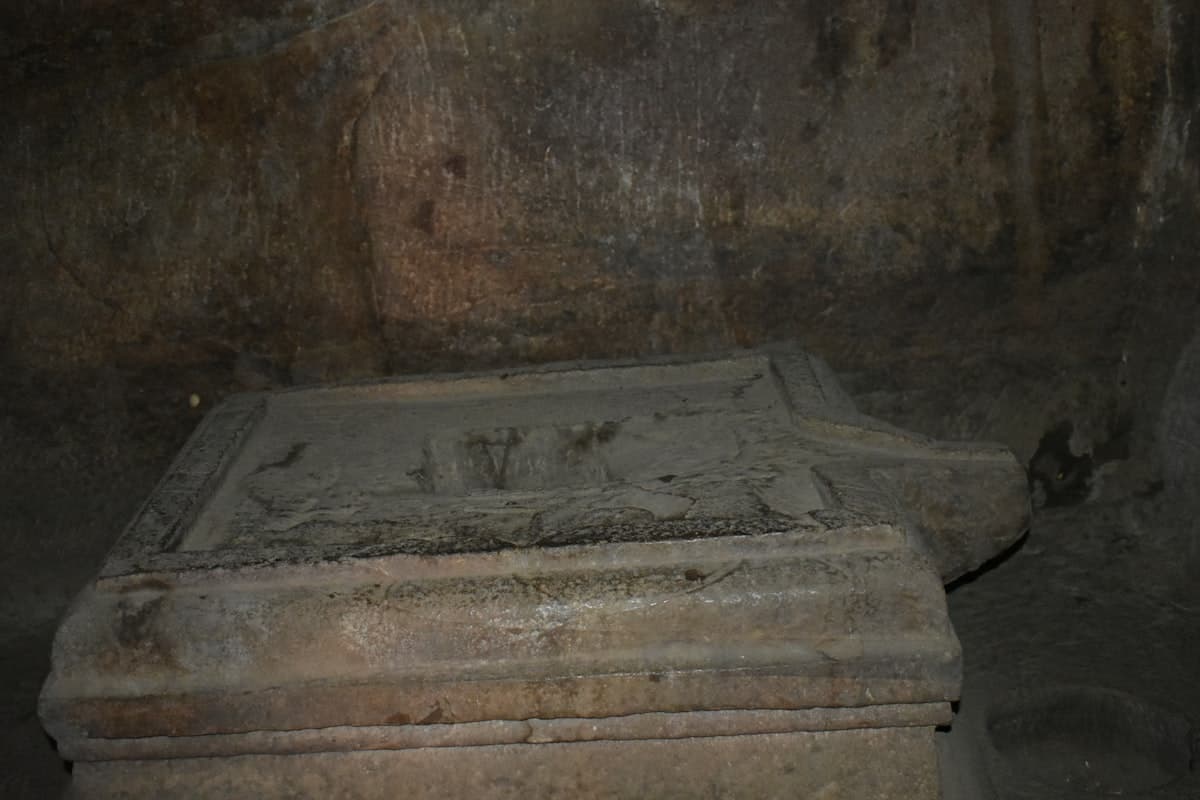
What matters most at this site is underground. The subterranean galleries of the Serapeum, accessible via a staircase near the column, contain the rock-cut tunnel system where sacred Apis bulls were mummified and stored during the Ptolemaic period. The tunnels are dark, low-ceilinged, and largely empty now, but they connect Alexandria's Greek religious heritage directly to the ancient Egyptian cult practices that the Ptolemies absorbed and transformed. Standing in a granite niche in the dark where a bull god once lay wrapped in linen bandages is one of the stranger sensory experiences this city offers.
Entry: EGP 180. The tunnels are accessible but bring a small torch. Combine this visit with the nearby Catacombs of Kom el-Shoqafa, a fifteen-minute walk away.
---
The Catacombs: Where Greek, Roman, and Egyptian Beliefs Died Together
The Catacombs of Kom el-Shoqafa were accidentally discovered in 1900 when a donkey fell through the ground into the entrance shaft. They date to the first and second centuries AD, which puts them outside the strictly Ptolemaic period, but they are the most complete surviving example of the cultural synthesis that the Ptolemies initiated.
The decoration is impossible to categorize simply. Egyptian gods stand in Greek architectural frames wearing Roman military armor. Anubis, the jackal-headed embalming deity, appears in the reliefs dressed as a Roman legionary. The funerary beds in the main burial hall have Greek-style reclining figures carved in a purely Roman artistic convention, but their faces carry Egyptian wigs and the walls behind them show Pharaonic scenes from the Book of the Dead. The people who were buried here were probably wealthy Alexandrian Greeks who had lived under Roman rule long enough that their religious beliefs had become genuinely plural. They did not experience this as contradiction.
The triclinium, the banquet room near the entrance where families ate memorial meals with their dead, is the most human room in Alexandria. The stone couches are still there. People sat there and ate and talked to the dead through the walls, which is a practice that feels less strange the longer you sit with it.
Entry: EGP 180. The lowest level floods seasonally and is sometimes inaccessible. Ask at the entrance before descending.
---
The Connections: Nothing in Alexandria Is From Only One Time
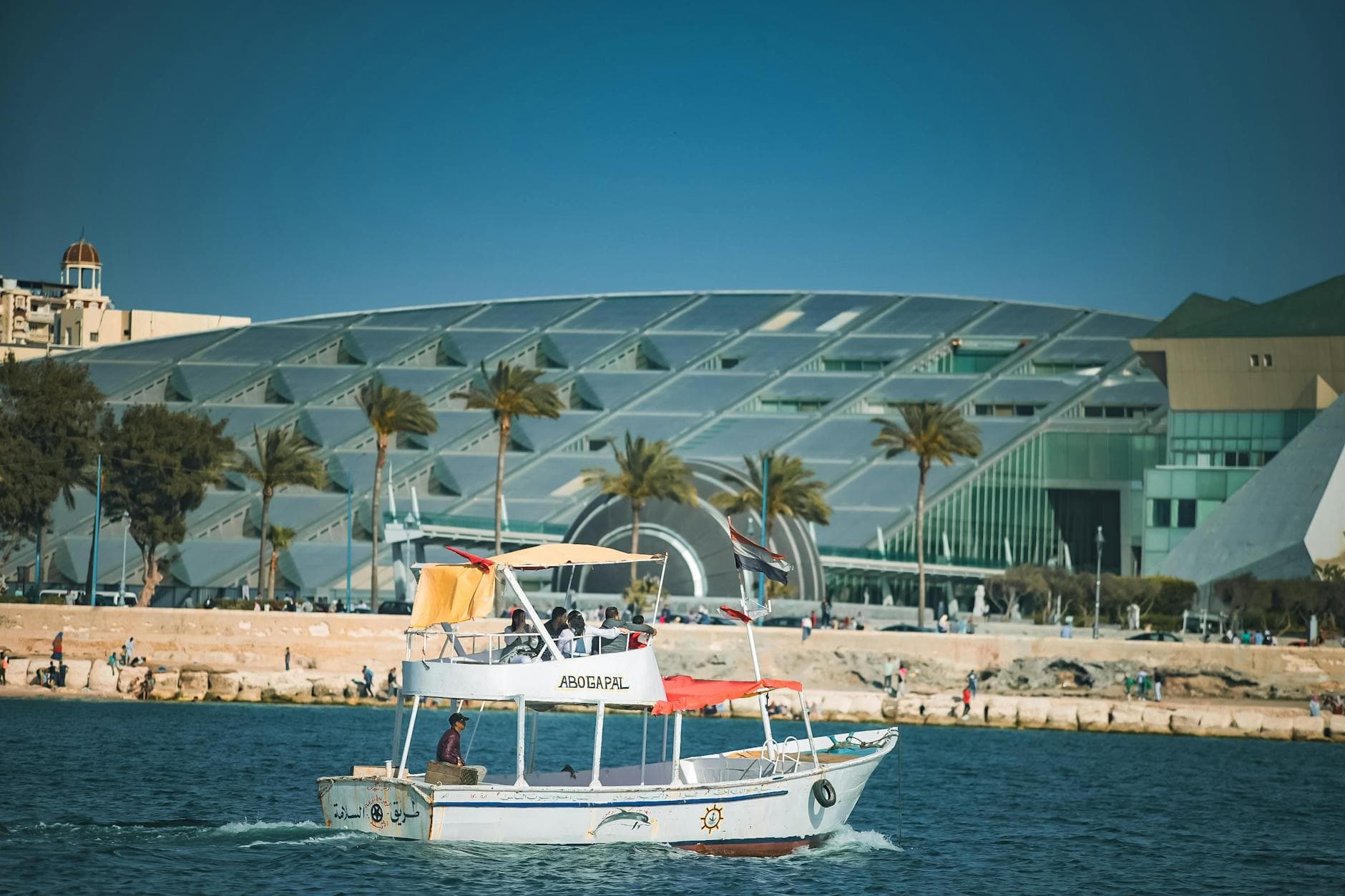
The site of the ancient Library of Alexandria is now occupied by the Bibliotheca Alexandrina, the modernist library inaugurated in 2002. The ancient library held, according to ancient sources, between 400,000 and 700,000 papyrus scrolls. It was not burned in a single dramatic fire by Julius Caesar, as the popular story goes. Caesar's fire in 48 BC burned a warehouse near the harbor containing scrolls awaiting export. The Library itself declined slowly over several centuries, defunded, neglected, and finally stripped of its scholars. The Bibliotheca Alexandrina is a conscious attempt to inherit the institution's name, and it is worth visiting for the architecture alone, though the collection cannot compete with its predecessor.
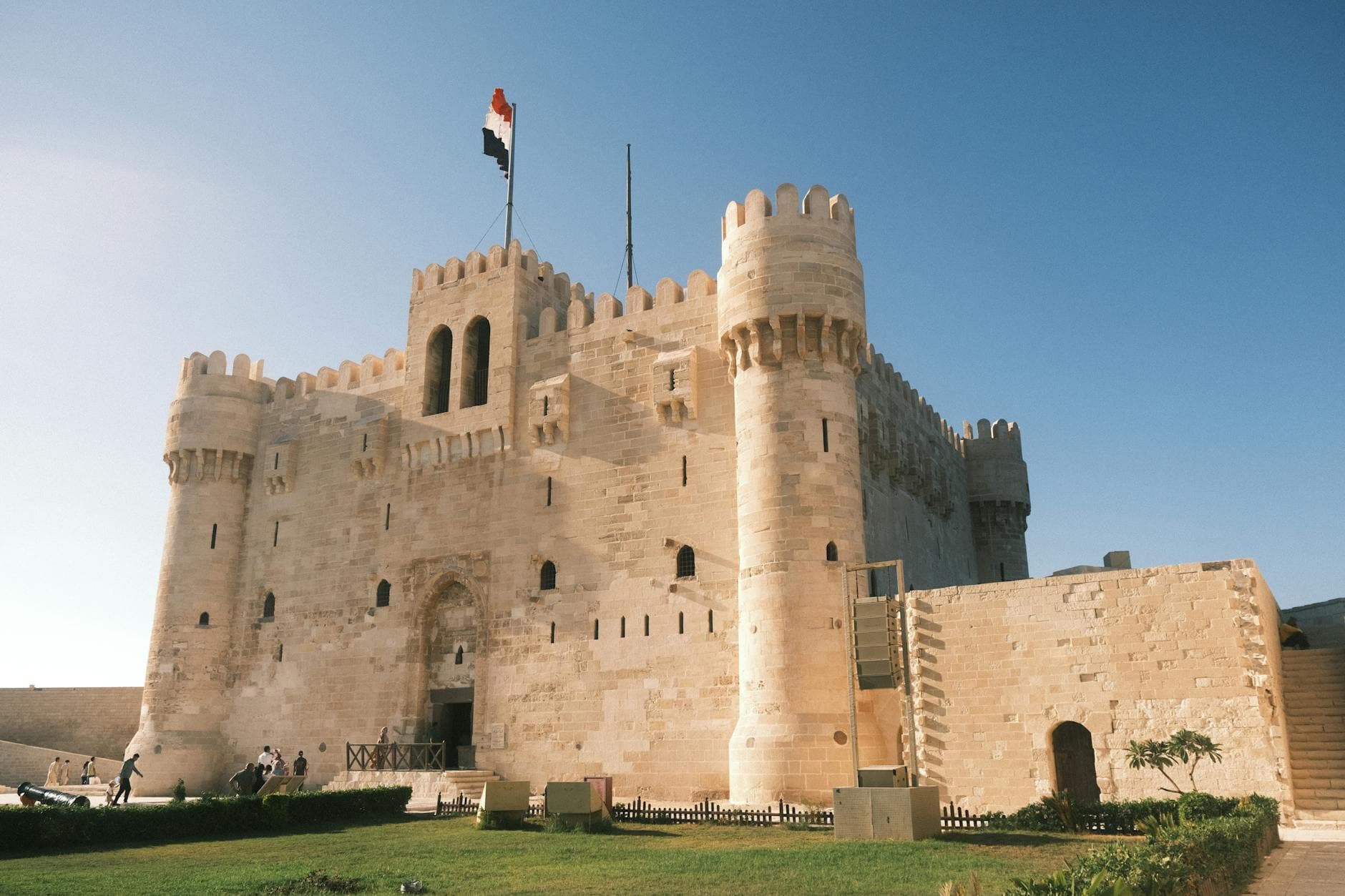
The Qaitbay Citadel, the medieval fort at the harbor entrance, was built in 1477 on the foundations of the Pharos lighthouse, one of the Seven Wonders of the ancient world. The lighthouse stones, including some blocks from Ptolemaic construction, were used in the fort's walls. A Mamluk military structure and a Ptolemaic wonder occupy the same footprint. Underwater archaeologists working near the citadel have found colossal statues of Ptolemaic rulers, including what may be a representation of Cleopatra VII, resting on the harbor floor where the earthquake of 365 AD deposited them.
The Alexandrian Jewish community, once one of the largest in the ancient world, produced Philo of Alexandria in the first century AD: the philosopher who first systematically combined Greek philosophy with Hebrew scripture and created the intellectual framework that early Christian theology would later use. His library was on the same streets you are walking. The Eliyahu Hanavi Synagogue, still standing in central Alexandria, is from the nineteenth century but marks a community that stretches back to the Ptolemaic period, when the Torah was translated into Greek in Alexandria at the request of Ptolemy II.
---
Common Mistakes
Spending too little time at the Graeco-Roman Museum. Most visitors give it ninety minutes. The collection justifies a full three-hour visit, and rushing it is how you miss the Serapis head, the Tanagra figurines, and the mummy portraits, which are among the most psychologically direct objects in any Egyptian museum.
Visiting only the above-ground sites. The subterranean sections of both the Serapeum and the Catacombs are the most interesting parts of their respective sites. If you skip the tunnels because they are dark or physically awkward, you are leaving the actual story behind.
Taking the Underwater Archaeology Museum boat tour. At EGP 250 per person for a forty-minute boat ride over murky harbor water with no visibility into the submerged ruins, this is the most expensive way to see nothing Alexandria currently offers. Skip it and use the money for a proper lunch at Mohamed Ahmed on Shukri Street instead.
Treating the Bibliotheca Alexandrina as a replacement for the ancient library. It is not. It is a modern public library with a good contemporary art space and a Manuscript Museum worth seeing. Visit it as what it is, not as what it wishes it were.
Ignoring the Alexandria National Museum on Tariq al-Horriya Street. This is consistently undervisited and contains a well-organized collection that spans Pharaonic, Ptolemaic, Roman, and Islamic Alexandria in one building. The Ptolemaic statuary floor is less crowded than the Graeco-Roman Museum and occasionally better labeled.
Going on Friday morning. Most sites have reduced hours or delayed openings on Fridays. Plan your heaviest visiting days for Sunday through Thursday.
Hiring an on-site guide without negotiating scope in advance. Several guides at Pompey's Pillar will walk you around the surface ruins and call the tour complete. Before engaging anyone, confirm explicitly that the underground galleries are included in the fee.
---
Practical Tips
Alexandria's Ptolemaic sites are spread across the western and central city. A route that runs Graeco-Roman Museum, then Pompey's Pillar and Serapeum tunnels, then Catacombs of Kom el-Shoqafa covers the core circuit in one long day or two comfortable half-days.
The city is navigable by white taxi (always negotiate before entering, budget EGP 30 to 60 for cross-city rides) or by the blue tram, which is genuinely useful and costs EGP 5 per trip but runs slowly.
The best base for this circuit is the area around Raml Station or the Corniche near the Eastern Harbor. Mid-range hotels in this area run EGP 1,200 to 2,000 per night. The four- and five-star options on the Corniche are significantly overpriced for what they offer.
Alexandria's climate is noticeably different from Cairo's. Bring a layer even in spring and autumn. The Mediterranean humidity means that October and March, which feel mild in Cairo, can feel cold and damp in Alexandria by evening.
For food near the Ptolemaic circuit, Mohamed Ahmed on Shukri Street serves the best ful and ta'meya breakfast in the city for under EGP 100. Kadoura on the Corniche is the standard recommendation for seafood and it is a standard recommendation for a reason, but book by phone a day ahead if you are going on a weekend.
Frequently Asked Questions
The Weekly Dispatch
More on Egypt, every Friday.
Cultural depth and places most guides never mention.
No spam. Unsubscribe anytime.