Greek Heritage in Alexandria: The Ptolemaic City Beneath Your Feet
Alexandria was the most important Greek city ever built, yet almost none of it survives above ground. The real city is six meters below the one you are walking through.

Quick Facts
- Best time to visit
- October to April. Spring (March to April) offers the best light and mild temperatures. Avoid July and August when the city fills with Egyptian vacationers and coastal humidity is high.
- Entrance fee
- Catacombs of Kom el-Shoqafa: EGP 180 (approx $3.70 USD). Pompey's Pillar and Serapeum: EGP 100 (approx $2 USD). Kom el-Dikka: EGP 100 (approx $2 USD). Bibliotheca Alexandrina: EGP 70 (approx $1.50 USD).
- Opening hours
- Most sites daily 9am to 4pm. Catacombs last entry 4:30pm. Bibliotheca Alexandrina Saturday to Thursday 10am to 7pm, Friday 2pm to 7pm.
- How to get there
- From Cairo by train: EGP 90 to 250 depending on class from Ramses Station, journey 2 to 2.5 hours. Within Alexandria: taxis between Ptolemaic sites cost EGP 30 to 60 per journey. The corniche microbus runs EGP 2 for the full seafront route.
- Time needed
- Two full days minimum for principal Ptolemaic sites. Three days if including Bibliotheca manuscript collections and Shatby necropolis.
- Cost range
- Budget EGP 600 to 1,000 per day including accommodation, entry fees, and local transport. Mid-range EGP 1,800 to 3,000 per day. Private Egyptologist guide: EGP 400 to 700 for a half day.
At its peak, Alexandria held a library of 700,000 scrolls, a lighthouse that sailors could see from 50 kilometers at sea, and a royal quarter that consumed one third of the entire city. None of these things exist anymore. What does exist is stranger and more interesting: a city that was comprehensively buried, built over, flooded, and forgotten, and is now being excavated from underneath a working Egyptian metropolis while people park their cars above the dig sites.
This is the core paradox of Greek heritage Alexandria Egypt travelers encounter: you are visiting a ghost city. The Ptolemaic Alexandria that made the ancient world stop and stare is largely invisible. What you see instead are fragments, basements, and the archaeological ghosts of something that was once the second largest city on earth. Understanding this before you arrive is not a reason to stay home. It is the reason to pay closer attention than you would anywhere else.
Quick Facts
Best time to visit: October to April. Alexandrian summers are humid and grey in a way that feels oppressive rather than dramatic. Spring light in March and April is exceptional.
Key sites and entrance fees: Catacombs of Kom el-Shoqafa: EGP 180 (approx $3.70 USD), students EGP 90 Greco-Roman Museum (check current reopening status, under renovation since 2005 but partially accessible): EGP 100 (approx $2 USD) Pompey's Pillar and Serapeum site: EGP 100 (approx $2 USD) Royal Jewelry Museum (Ptolemaic foundations visible): EGP 100 (approx $2 USD) Bibliotheca Alexandrina (modern, but houses significant Ptolemaic artifact collection): EGP 70 (approx $1.50 USD)
Opening hours: Most sites daily 9am to 4pm. Catacombs close at 4:30pm. Arrive before 2pm to avoid the final rush.
How to get there: Alexandria is 2.5 hours from Cairo by Spanish Talgo train (EGP 90 to 130 second class, EGP 180 to 250 first class from Ramses Station). Within Alexandria, taxis between major Ptolemaic sites cost EGP 30 to 60. The corniche microbus runs the full seafront for EGP 2.
Time needed: Two full days minimum to visit the principal sites without rushing. Three days if you want the Bibliotheca's manuscript collections and the less-visited sites like Kom el-Dikka.
Cost range: Budget EGP 600 to 1,000 per day including accommodation, transport, and entry fees. Mid-range EGP 1,800 to 3,000 per day.
Why This Place Matters
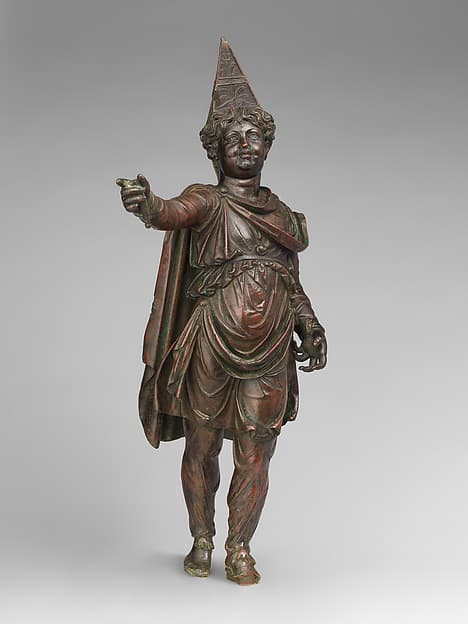
Alexander the Great founded the city in 331 BC and left almost immediately, never to return alive. His body was brought back decades later and entombed here in a mausoleum that every subsequent ruler of the ancient world, including Julius Caesar and Augustus, made a point of visiting. Nobody has found the tomb. It is almost certainly still under the city, possibly beneath the Nabi Daniel mosque in the old downtown, possibly offshore.
What the Ptolemies built here was not merely a city but a deliberate project of cultural synthesis. They were Macedonian Greeks who ruled Egypt for 275 years, and their solution to governing a population that did not share their language, religion, or aesthetic was to invent new ones that belonged to everyone. The god Serapis, whose cult spread across the entire Mediterranean world, was created in a committee meeting in Alexandria around 280 BC. He was assembled from Osiris, Apis, Zeus, and Hades, given a Greek face and an Egyptian crown, and installed in a temple on the hill that is now Pompey's Pillar. This was not cultural appropriation. It was state theology engineered for a multicultural empire.
The Library, the Mouseion (the world's first research institution, from which we derive the word museum), the medical school where Herophilos performed the first documented human dissections, the observatory where Eratosthenes calculated the circumference of the earth to within 1 percent accuracy using two sticks and the angle of the sun: all of this was concentrated in one city, most of it within walking distance of the royal palace. Alexandria was not a city that happened to be important. It was an institution that happened to need streets.
What Survives and Where to Find It
The Catacombs of Kom el-Shoqafa are the most important Ptolemaic site most visitors spend the least time in. This is wrong. The catacombs date to the 2nd century AD, technically into the Roman period, but they are the fullest expression of the Alexandrian synthesis that the Ptolemies invented. Carved three levels into the rock beneath a residential neighborhood, they fuse Egyptian funerary symbolism with Greek architectural forms in a way that is genuinely disorienting. Anubis wears Roman armor. The god Thoth carries a caduceus. The capitals of the columns are half Corinthian, half lotus.
The catacombs were discovered in 1900 when a donkey fell through the ground into the upper chamber. They were a family tomb that expanded over generations into a complex that eventually held hundreds of bodies in niches carved along every corridor wall. You descend a spiral staircase cut directly into the limestone, passing a triclinium where families held funerary banquets beside their dead, and arrive at a burial hall that demonstrates more clearly than any textbook what three centuries of Greek rule actually produced: not Hellenism replacing Egyptian religion, but both traditions becoming genuinely inseparable.
At Kom el-Dikka, the excavated Roman-era city district shows you the urban grid that overlays the earlier Ptolemaic street plan. The odeon here, a small theater seating 800 people, is the only ancient theater preserved above ground in Egypt. It was in active use as late as the 7th century AD. Beneath it, and beneath the adjacent villas with their polychrome mosaics, the Ptolemaic city lies at a depth that archaeologists are only beginning to work through systematically. The Polish mission that has worked this site since 1960 estimates that less than 5 percent of ancient Alexandria has been properly excavated.
Pompey's Pillar and the Serapeum: What You Are Actually Looking At
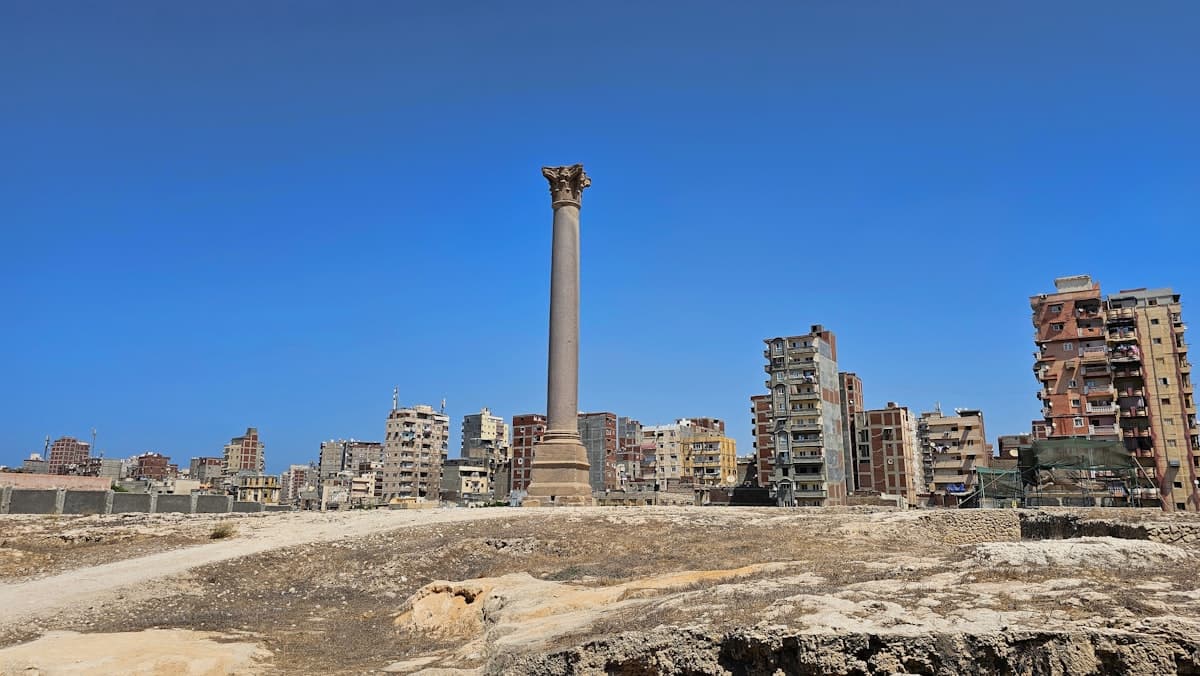
The pillar has nothing to do with Pompey. It was erected in 297 AD in honor of the Roman emperor Diocletian, who sent grain to Alexandria during a famine. The association with Pompey, who was murdered in Egypt in 48 BC, was invented by medieval European crusaders who needed a famous Roman ruin to point at. The name stuck for 800 years.
What the pillar actually marks is the site of the Serapeum, the great temple of Serapis that was one of the most visited religious sites in the ancient Mediterranean. The temple was destroyed in 391 AD by a Christian mob acting on orders from the Patriarch Theophilus, who had received permission from the Emperor Theodosius to demolish pagan temples throughout the empire. The event is documented by four separate ancient sources and is one of the most precisely dated acts of religious destruction in antiquity. The pillar survived because it was a civic monument, not a cult object.
Below the pillar, the underground galleries of the Serapeum are accessible and largely ignored by visitors who photograph the pillar and leave. These rock-cut tunnels once held the overflow collection of the Library, thousands of papyrus scrolls stored in niches cut into the walls. The niches are empty now but still visible. You are standing in a room that was a branch library of the most important archive in the ancient world. There is no interpretive sign that explains this adequately.
The Connections
The Greek heritage Alexandria Egypt visitors experience today is inseparable from what came after it. When the Arab general Amr ibn al-As took the city in 641 AD, he reportedly wrote to the Caliph Omar describing a city of four thousand palaces, four thousand baths, and four hundred theaters. Whether or not the numbers are exact, Alexandria in the 7th century was still recognizably a Ptolemaic-Roman city with its grid streets and marble colonnades largely intact.
The medieval Arab city was built directly on top of and from the materials of the Greek one. The columns of the Ptolemaic royal quarter became the columns of early mosques. The limestone from the Serapeum foundations appeared in medieval fortifications. The Qaitbay fort on the eastern harbor, built in 1477 by the Mamluk sultan Qaitbay, stands on the exact foundations of the Pharos lighthouse, and some of the massive granite blocks visible in its seawall are almost certainly original lighthouse masonry that was toppled by earthquakes and reused where it fell.
The modern city continues this layering. The corniche road was built over the silted harbor basin where Cleopatra's royal barge docked. The Shatby neighborhood, named after a local family, sits above an extensive Ptolemaic necropolis that has been excavated piecemeal since the 1890s and still yields burials when foundations are dug for new buildings. Alexandria does not preserve its Greek past so much as it continues to metabolize it.
Common Mistakes
Spending your first morning at Pompey's Pillar. It is the most-visited Ptolemaic site and the least rewarding for the time. A single column with some sphinx fragments in an open lot tells you almost nothing about Ptolemaic Alexandria. Go to the Catacombs first, where the civilization is actually legible, and come to the pillar later if you want to check it off.
Skipping the Greco-Roman Museum because of renovation rumors. The museum has been under extended renovation since 2005, but sections have periodically reopened with selected artifacts on display. Call ahead or check with your hotel before writing it off entirely. The collection, when accessible, is the densest concentration of Ptolemaic material objects in existence, including a statue of Serapis with the grain-basket crown that defined how the god was depicted across the empire.
Booking a half-day city tour that covers six sites. Every Ptolemaic site in Alexandria requires you to slow down and look at things that are not immediately obvious. A tour that gives you twenty minutes at the Catacombs is not a tour. It is a checklist exercise.
Paying for an Underwater Archaeology boat tour unless you have specific interest in maritime archaeology. The sunken royal quarter in the Eastern Harbor is genuinely significant, the palaces and harbors of Cleopatra's Alexandria are down there in fragments, but the visibility is poor and the experience without diving equipment is not proportionate to the cost, which runs EGP 400 to 700 depending on operator.
Neglecting the Bibliotheca Alexandrina's antiquities collection in favor of the architecture. The building is famous. The small but serious collection of Ptolemaic artifacts in the basement is not. This includes a genuine papyrus fragment and a scale model reconstruction of the ancient city that is the clearest visual explanation of what you are standing above.
Arriving in July or August. Alexandria's summer reputation as a cool alternative to Cairo is accurate for Egyptians escaping 40-degree desert heat. For someone visiting Greek heritage sites, the grey humidity and thick tourist density from Egyptian vacationers make focused archaeological visiting genuinely unpleasant.
Treating Cleopatra as a personality and not a policy. Every site guide will invoke her name. Cleopatra VII, the last Ptolemaic ruler, spoke nine languages including Egyptian, making her the first of her dynasty to do so after 250 years. She was a working theologian, a military strategist, and a monetary policy reformer. The romanticized version of her story that dominates English-language tours actively obscures the most interesting facts about what she actually did.
Practical Tips
Alexandria's Ptolemaic sites are spread across the city rather than concentrated in one district. The Catacombs are in the western residential neighborhood of Karmouz, Pompey's Pillar is ten minutes south by taxi, and Kom el-Dikka is in the city center near the main train station. Budget for taxis between them: EGP 30 to 50 per journey is reasonable, and most drivers know the sites.
Hire a local Egyptologist rather than relying on site guides. The difference between a trained Egyptologist and the men who approach you near the ticket booths is not just knowledge but interpretive depth. A good private guide in Alexandria costs EGP 400 to 700 for a half day and will change what you understand about everything you see. Ask your hotel for a recommendation or contact the Alexandria branch of the Egyptian Tourist Authority for a registered guide list.
The Catacombs are physically demanding if you have any claustrophobia or knee problems. The spiral descent is steep and the lower levels are genuinely confined. There is no shame in stopping at the first level, which contains the most important carved reliefs, and viewing the lower galleries from the photographs in the adjacent small museum.
Bring water and a torch or phone flashlight. Several underground areas at Kom el-Shoqafa are poorly lit and the additional light lets you see detail in the carved reliefs that you will completely miss otherwise.
For serious Greek heritage Alexandria Egypt research, the Alexandria archive at the Bibliotheca holds digitized records of every excavation conducted in the city since 1895. Public access is available on written request. If you are a researcher or deeply interested visitor, this is worth the administrative effort.
Frequently Asked Questions
The Weekly Dispatch
More on Egypt, every Friday.
Cultural depth and places most guides never mention.
No spam. Unsubscribe anytime.