Greeks in Egypt: Alexandria's Greek History Full Guide
Alexandria was Greek for longer than it has been Arab. Most visitors never find the city that Cleopatra actually ruled. Here is where it still exists.

Quick Facts
- Best time to visit
- November to March. Mediterranean humidity makes July and August genuinely uncomfortable. November offers clear light and thin crowds. March has excellent visibility for the underwater harbour tours.
- Entrance fee
- Greco-Roman Museum EGP 200 (approx $4 USD), Kom el-Dikka EGP 150 (approx $3 USD), Catacombs of Kom el-Shoqafa EGP 180 (approx $3.50 USD), Pompey's Pillar EGP 100 (approx $2 USD). Combined day visiting all four sites costs roughly EGP 630 (approx $13 USD).
- Opening hours
- Most sites 9am to 5pm daily. Catacombs close at 4:30pm, last entry 3:30pm. Greco-Roman Museum hours vary by gallery access during renovation; confirm before visiting.
- How to get there
- High-speed train from Cairo Ramses Station to Alexandria Misr Station: 2 hours, EGP 150 to 230. Taxi from Misr Station to Kom el-Dikka area: EGP 40 to 60. Microbus between sites within the city: EGP 5 to 10.
- Time needed
- Two full days minimum to cover the main Greco-Roman sites with enough time to actually read what you are looking at. Add a third day to connect the Greek layer to the Coptic churches in Anfushi and the Ottoman mosques built over Ptolemaic foundations.
- Cost range
- Budget EGP 600 to 900 per day including basic accommodation near the Eastern Harbour. Mid-range EGP 1,800 to 2,800 per day. The Cecil Hotel (Sofitel) runs approximately EGP 3,500 per night for the historical waterfront location.
Quick Facts
Best time to visit: October to April, when Alexandria's Mediterranean humidity drops and the light on white limestone turns soft rather than bleaching.
Key entrance fees: Greco-Roman Museum: EGP 200 (approx $4 USD), students EGP 100. Currently undergoing phased reopening after a 20-year renovation; confirm open galleries before visiting. Kom el-Dikka Roman theatre and excavations: EGP 150 (approx $3 USD) Catacombs of Kom el-Shoqafa: EGP 180 (approx $3.50 USD) Pompey's Pillar site: EGP 100 (approx $2 USD) Royal Jewelry Museum (housed in a former Greek-era palace): EGP 100 (approx $2 USD)
Opening hours: Most sites run 9am to 5pm daily. The Catacombs close promptly at 4:30pm; arrive no later than 3:30pm if you want more than a rushed visit.
How to get there: Alexandria is 225km from Cairo. The Spanish-built high-speed train from Ramses Station takes 2 hours and costs EGP 150 to 230 depending on class. Microbuses between major sites inside Alexandria cost EGP 5 to 10. Taxis from Misr Station to the Kom el-Dikka area cost roughly EGP 40 to 60.
Time needed: Two full days to do the Greek and Greco-Roman layer properly. Three days if you want to connect it to the Coptic and Islamic overlays that sit on top of the same streets.
Cost range: Budget EGP 600 to 900 per day including accommodation in the Eastern Harbour area. Mid-range EGP 1,800 to 2,800 per day.
---
Why This Place Matters
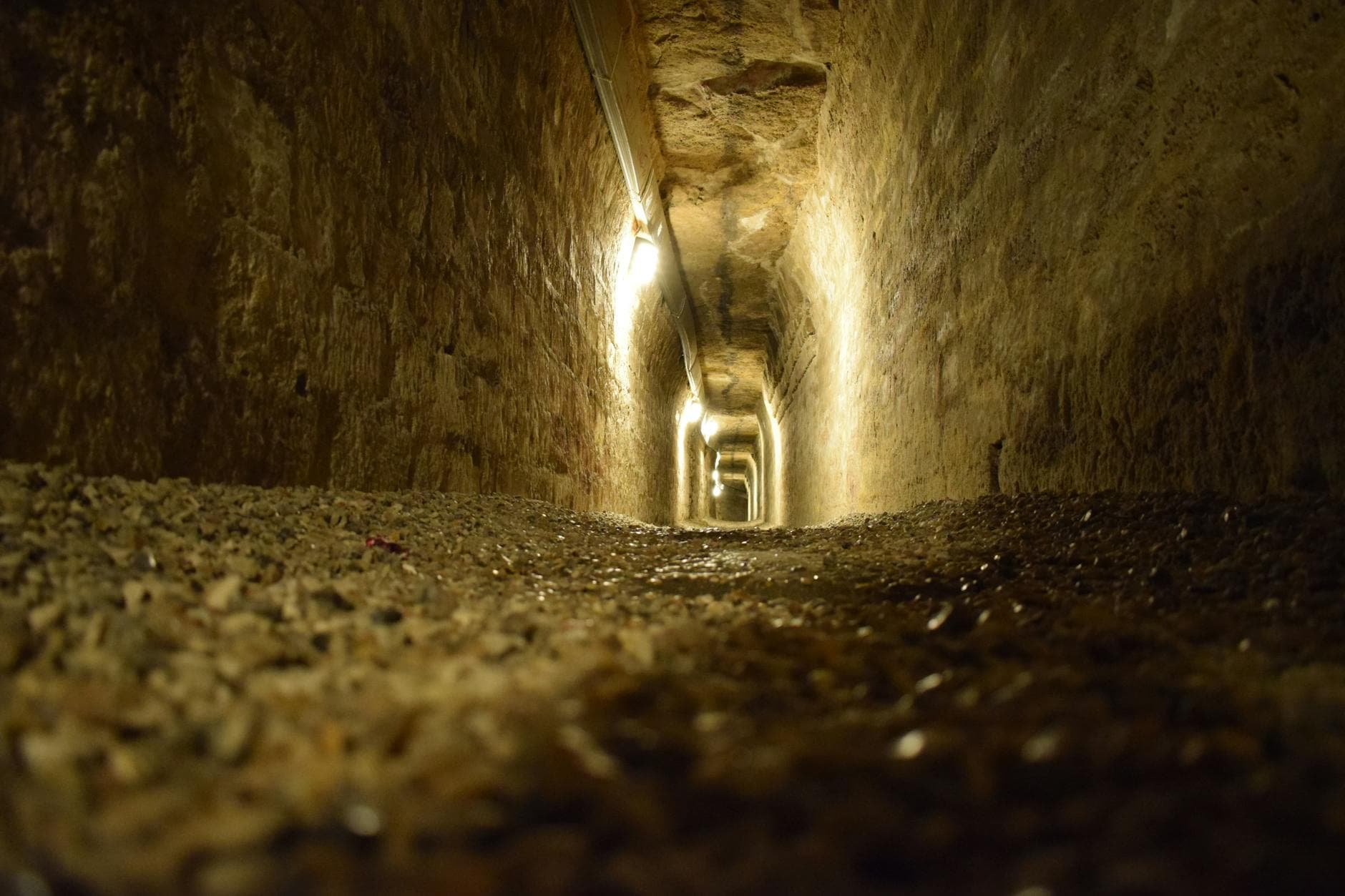
Alexandria was a Greek city for nearly a thousand years before the Arab conquest of 641 CE. Most visitors to Egypt encounter this fact as a footnote. It is not a footnote. When Alexander the Great founded the city in 331 BCE, he was not building a colonial outpost. He was building what his architect Dinocrates designed as the new intellectual capital of the Mediterranean world, with streets aligned on a grid so precise that the main east-west boulevard, the Canopic Way, was wide enough to allow sunlight to reach the pavements on both sides simultaneously. That street still exists beneath modern Horreya Road. You are walking on it every time you take a taxi between Misr Station and the Eastern Harbour.
For a guide to the Greeks in Egypt and Alexandria's history to mean anything, you have to accept one disorienting truth: almost nothing that made the ancient city famous survives above ground. The Library of Alexandria is gone. The Lighthouse, one of the Seven Wonders of the Ancient World, collapsed into the sea in stages between the 9th and 14th centuries. The palace quarter where Cleopatra VII received Julius Caesar and later Mark Antony now lies underwater in the Eastern Harbour, visible to divers but not to most tourists. What you are visiting in Alexandria is the archaeology of a city that was, for roughly three centuries, the largest and most intellectually productive city on earth. That is a different thing from visiting the city itself, and being honest about the distinction is the only way to understand what you are actually seeing.
The Greek presence in Egypt did not begin with Alexander. Greeks were trading in the Delta from at least the 7th century BCE, and the Pharaoh Psamtik I settled Greek mercenaries at Naukratis, a trading colony in the Delta, around 620 BCE. Herodotus visited Egypt in the 5th century BCE and recorded Greek communities already embedded in Egyptian life. Alexander's founding of Alexandria was less a beginning than a culmination: he was making permanent and monumental what had been provisional and commercial for three hundred years.
---
What the Ptolemies Actually Built, and What Survives
The dynasty Alexander left behind, the Ptolemies, ruled Egypt for 275 years, from 305 BCE to Cleopatra's death in 30 BCE. They were Macedonian Greeks who spoke Greek, governed in Greek, and treated Egyptian religion with a calculated respect that was simultaneously genuine and strategic. Ptolemy III Euergetes added the intercalary day to the Egyptian calendar in 238 BCE, a reform that the Egyptians ignored for another two centuries but that eventually became the basis of the Julian calendar. Every leap year you have ever lived through traces back to a Ptolemaic administrative decision made in Alexandria.
The physical layer the Ptolemies left is fragmented but not absent. The best place to begin is Kom el-Dikka, which sounds like a single site but is actually three overlapping things: a Roman theatre, a residential district, and beneath both of those, the edge of the Ptolemaic city. The theatre is Roman, built in the 2nd century CE, but its orientation follows a Ptolemaic street grid. Thirteen of its original marble tiers survive, still white enough to sting your eyes on a clear morning. It is the only well-preserved Roman theatre in Egypt, and almost no one visits it, because it is not the Pyramids and it is not Luxor. The site also contains what archaeologists call the 'auditoria,' a series of small lecture halls believed to be remnants of the educational institutions that succeeded the Library. The mosaic floors in two of the auditoria, geometric patterns in red, black, and white, are still in place under protective covers. Ask the site guard to lift them. Most guides do not mention they exist.
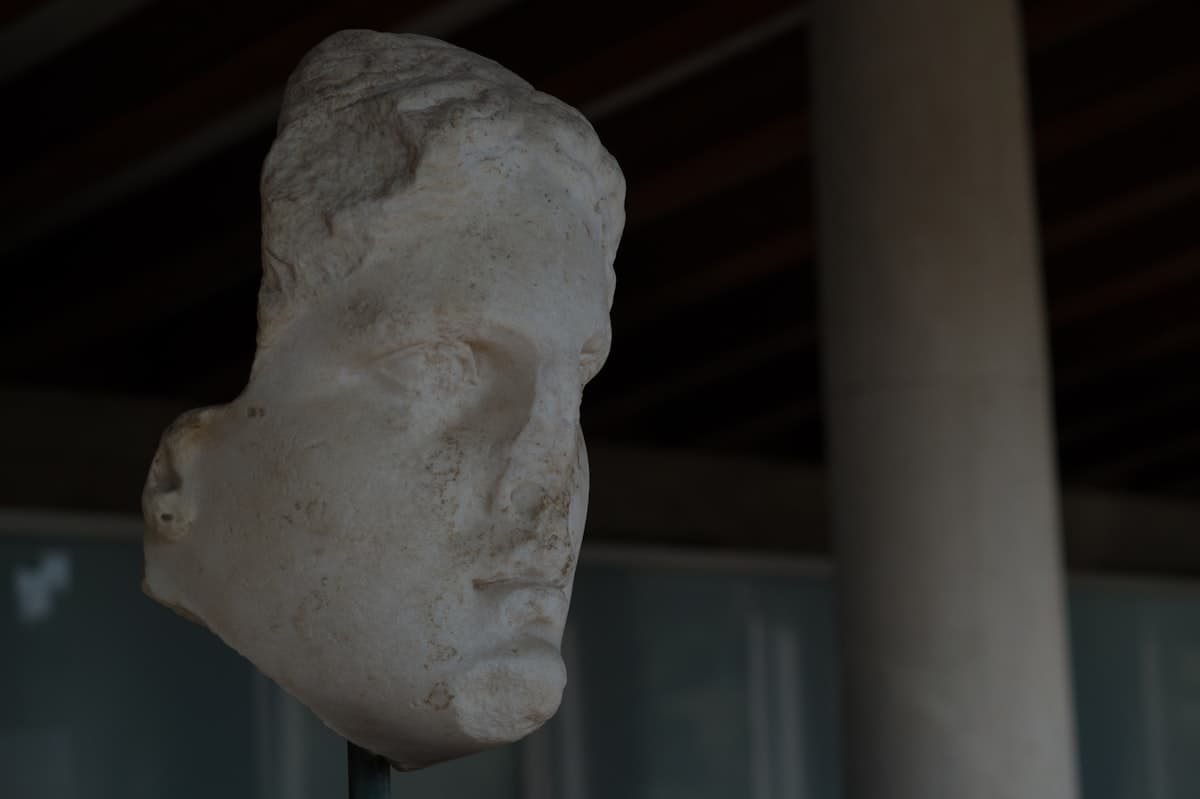
The Greco-Roman Museum, when its renovated galleries are fully accessible, contains the most concentrated physical record of what the blended Greek-Egyptian culture actually produced. The Serapis head is the key object: Ptolemy I commissioned a new syncretic deity, Serapis, who combined the Egyptian gods Osiris and Apis with Greek divine attributes, specifically to give his Greek and Egyptian subjects a god they could worship together. The cult spread across the entire Mediterranean. There are Serapis temples documented as far west as Roman Britain. The head in the museum is roughly 60cm high, marble, with the modius grain basket on top that identifies the god. It was found during construction work in downtown Alexandria in 1895. The neighborhood it was found under had been continuously inhabited for 2,300 years.
---
The Catacombs and the Point Where Cultures Stopped Pretending to Be Separate
The Catacombs of Kom el-Shoqafa are the most important site in Alexandria that most visitors spend the least time understanding. They date from the 1st and 2nd centuries CE, which makes them neither fully Greek nor fully Roman nor fully Egyptian but all three simultaneously, which is precisely what makes them worth an hour of careful looking rather than twenty minutes of photographing.
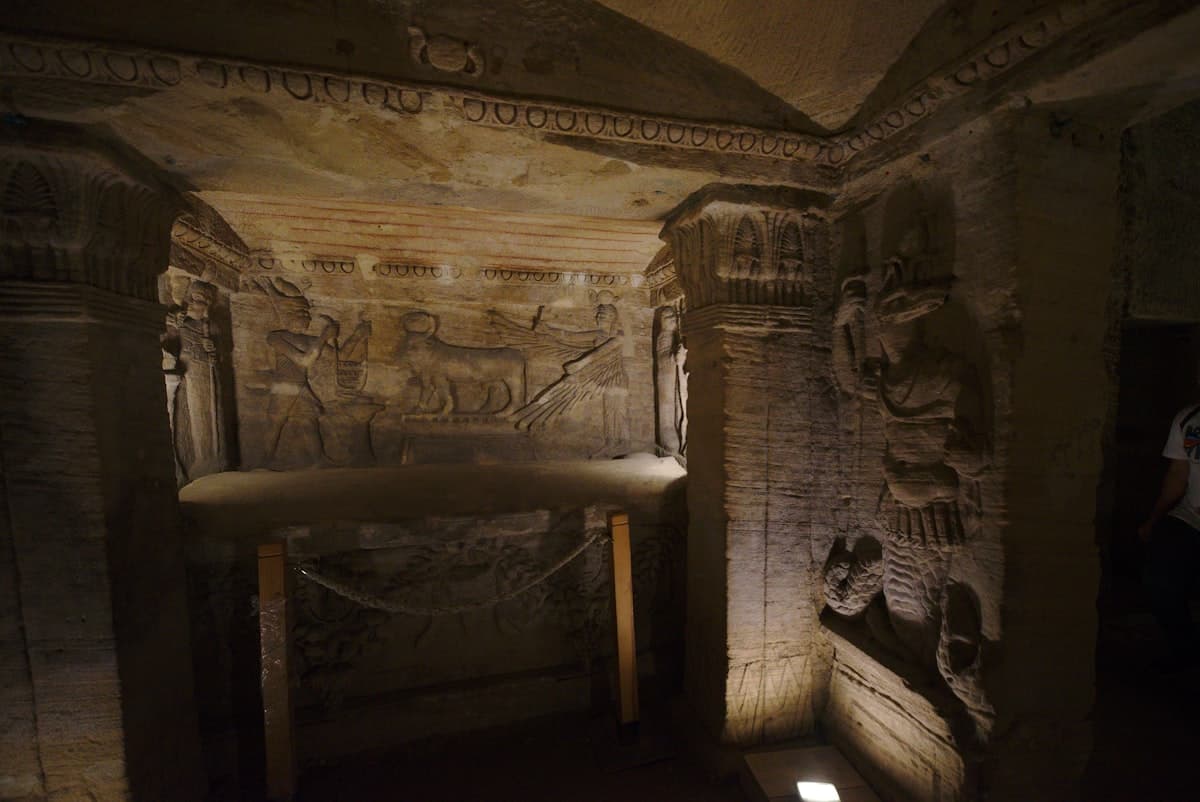
The catacombs were rediscovered in 1900 when a donkey fell through the roof of the entrance shaft. Three levels cut into the bedrock, the deepest now partly flooded, were found intact. The main burial chamber contains figures that demonstrate cultural fusion at a level that no diplomatic text or administrative decree can match. The guardian figures at the tomb entrance are Egyptian in pose, rigid and frontal in the manner of New Kingdom tomb painting, wearing the double crown of Upper and Lower Egypt. Their faces are Greek. Their armour is Roman. These are not artistic mistakes or cultural confusions. They are a deliberate statement by a family that had been living in a city where Greek, Egyptian, and Roman identities had been layering over each other for three hundred years. The serpents carved beside the entrance are Agathodaimon serpents, a Greek protective deity, but they wear the double crown of Pharaoh. You are looking at the moment when syncretism stopped being a political policy and became simply the way people thought.
Descend to the Triclinium, the funerary banquet hall on the second level. The stone couches where mourners reclined during funeral meals are still there, carved from the living rock. The painted plaster above them has faded but not entirely vanished. Bring a torch and look at the ceiling. The blue is still visible in places, the Egyptian sky-color that appears in tombs from Saqqara to the Valley of the Kings, here applied by artists who probably also painted Greek-style portrait panels for the same families.
---
The Connections: From Pharaonic Canal to Ottoman Port
Alexandria exists because of water management that predated the Greeks by centuries. The site Alexander chose was not empty. It contained the Egyptian town of Rhakotis, and more importantly, it sat between the Mediterranean and Lake Mareotis, connected by a canal system that the Pharaonic administration had maintained since at least the New Kingdom. The Ptolemies did not build a city from nothing; they scaled up and monumentalized an existing logistics node. The inner harbor the Ptolemies developed, now called the Eastern Harbour, was built over and beside Egyptian canal infrastructure.
The Serapeum, the great temple to Serapis that once rivaled the Library in its collection of scrolls, sat on a hill that is now marked by Pompey's Pillar. The pillar itself is Roman, not Pompey's, and not particularly worth the entrance fee on its own terms. It is a single column, red Aswan granite, 27 meters high, erected in honor of the Emperor Diocletian around 300 CE. What matters about the site is what is below it: the subterranean galleries of the Serapeum, cut from rock, where sacred Apis bulls were buried during the Ptolemaic period. You can walk into several of the galleries. The niches where the bull sarcophagi once sat are empty but still visible, and they connect this Greek-founded site directly back to the Memphis cult of Apis that had been running continuously since the New Kingdom.
The Attarine Mosque in the old city stands on the site of a church that the Crusaders identified as the tomb of Saint Alexander the Great, which was itself built over a Ptolemaic shrine. The mosque's minaret uses Byzantine-period column drums as structural material. When the Arab general Amr ibn al-As took Alexandria in 641 CE, he described it in a letter to the Caliph Umar as containing '4,000 palaces, 4,000 baths, 400 theatres.' The numbers are formulaic, but the astonishment behind them is real. The city the Arabs took was still, six hundred years after Cleopatra, recognizably the city the Ptolemies built.
---
Common Mistakes
Spending your first morning at the Bibliotheca Alexandrina. The new library is architecturally interesting and worth an afternoon on a second day, but it is a 21st-century building containing some good museum spaces, not a connection to the ancient Library. The two are separated by 1,600 years and a complete historical discontinuity. Visitors who start there leave with the impression that the Library story has a happy ending. It does not, and understanding why it does not is more useful than a well-designed atrium.
Skipping Kom el-Dikka because it looks minor on a map. It is the best-preserved urban archaeology in Alexandria and it is almost always uncrowded. Budget ninety minutes.
Taking a sunset felucca on the Eastern Harbour. The price for tourists has reached EGP 300 to 500 for thirty minutes, the boats are not maintained, and you will see nothing from the water that you cannot see better from the Corniche. This is money spent on a postcard you could take for free.
Not confirming Greco-Roman Museum gallery access before visiting. The museum has been in rolling renovation since 2005. Some galleries are open, some are not, and this changes. Email the museum or call before making it the centerpiece of your day.
Hiring a guide at the Catacombs entrance. The official site guides in the catacombs tend to rush the circuit in under twenty minutes because they are managing multiple groups. Buy the site booklet for EGP 30 at the ticket kiosk and go slowly on your own. The banquet hall on the second level and the relationship between the guardian figures and the tomb paintings are things you need time to read, not things you need someone to point at.
Missing the underwater archaeology entirely. The Bibliotheca Alexandrina's Center for Alexandrian Studies operates periodic guided dive and snorkel tours of the submerged Eastern Harbour, where Cleopatra's palace quarter lies. This requires advance booking and is not available every month, but it is the closest you will get to the city that actually mattered. Nothing else in Alexandria offers that.
Assuming the Corniche cafes facing the sea are in the old city. The Eastern Harbour waterfront you walk along was built on landfill and urban expansion that began in the 19th century. The Ottoman and Ptolemaic city is several hundred meters inland, under the current downtown grid. The atmospheric seafront is largely a 20th-century construction.
---
Practical Tips
Come in November or March. The summer humidity in Alexandria is serious; the city sits on the sea and the air in July feels physical. October is still warm but bearable, and the light in March has a clarity that makes the white and pale-stone buildings look the way they presumably looked when they were new.
Stay in the Eastern Harbour area, specifically between Saad Zaghloul Square and the Silsila promontory. This puts you within walking distance of Kom el-Dikka, the Greco-Roman Museum, and the old city street grid. The Cecil Hotel, which opened in 1929 and hosted everyone from Winston Churchill to Somerset Maugham, is now a Sofitel and not cheap at around EGP 3,500 per night, but it sits exactly on the old Ptolemaic waterfront and the view from its upper floors is a legitimate historical experience. Budget travelers should look at the smaller hotels on Sharia Alam al-Din, two blocks inland, for EGP 500 to 800 per night.
The Alexandria National Museum on Tariq al-Horreya Road covers the full sweep from Pharaonic to Greco-Roman to Coptic to Islamic Alexandria in three floors of a converted Italian-era palazzo. It is less crowded than the Greco-Roman Museum and its labeling is better. If you only have time for one museum, go here first.
Speak some Arabic if you have any. Alexandrians are not Cairenes. The city has a distinct character, more Mediterranean in pace and humor, and a hello in Arabic will open conversations that a tourist posture will not. The Greek community that numbered 100,000 in the 1920s is now fewer than fifty families, mostly elderly, centered on the Greek Orthodox Patriarchate on Sharia al-Batalsa. If you visit the patriarchate church, which is free and open most mornings, you are standing inside a living continuation of the Hellenic Alexandria that Cavafy wrote poems about, not a museum exhibit.
Frequently Asked Questions
The Weekly Dispatch
More on Egypt, every Friday.
Cultural depth and places most guides never mention.
No spam. Unsubscribe anytime.