Greeks in Egypt: Alexandria's Living Hellenic History Guide
Alexandria was founded in 331 BC and within two generations had surpassed Athens in population. The city the Greeks built still exists. Most visitors never find it.
Quick Facts
- Best time to visit
- October to April. The Mediterranean climate makes summer humidity uncomfortable and winter light on the Corniche is the best the city offers.
- Entrance fee
- Greco-Roman Museum EGP 200 (approx $4 USD), Kom el-Dikka EGP 180 (approx $3.50 USD), Catacombs of Kom el-Shoqafa EGP 180 (approx $3.50 USD), Pompey's Pillar EGP 100 (approx $2 USD). Student discounts are 50 percent at each site with valid ID.
- Opening hours
- Most sites daily 8am to 5pm. The Greco-Roman Museum occasionally closes individual galleries. Verify at the door.
- How to get there
- Train from Cairo Ramses Station to Alexandria Misr Station: EGP 60 to EGP 180 depending on class, approximately 2.5 hours. Within Alexandria, tram for EGP 1 per ride, minibuses for EGP 2 to EGP 5, or full-day taxi circuit for EGP 300 to EGP 400.
- Time needed
- Two full days for the main Hellenic and Greco-Roman sites. Add a half day for the Bibliotheca Alexandrina and the Alexandria National Museum.
- Cost range
- Budget EGP 600 to EGP 900 per day including entry fees and local food. Mid-range EGP 1,800 to EGP 2,800 per day with a harbor-view hotel and restaurant meals.
Quick Facts
Best time to visit: October to April, when Mediterranean humidity drops and the light over the Corniche turns the color of old marble at around 4pm.
Entrance fees: Greco-Roman Museum: EGP 200 (approx $4 USD), students EGP 100 Kom el-Dikka (Roman amphitheater and villas): EGP 180 (approx $3.50 USD), students EGP 90 Catacombs of Kom el-Shoqafa: EGP 180 (approx $3.50 USD), students EGP 90 Pompey's Pillar site: EGP 100 (approx $2 USD) Alexandria National Museum: EGP 150 (approx $3 USD)
Opening hours: Most sites open daily 8am to 5pm. The Greco-Roman Museum sometimes closes individual galleries without notice. Confirm before you go.
How to get there: From Cairo, take the Egyptian National Railways train from Ramses Station (EGP 60 to EGP 180 depending on class, roughly 2.5 hours). Within Alexandria, use the tram network for EGP 1 per ride or minibuses for EGP 2 to EGP 5 between sites. A full taxi circuit of Hellenic sites costs around EGP 300 to EGP 400 for the day.
Time needed: Two full days minimum to cover the Greek and Roman layers properly. Three days if you want to sit with each site rather than tick boxes.
Cost range: Budget EGP 600 to EGP 900 per day including food and entry fees. Mid-range EGP 1,800 to EGP 2,800 per day with a decent hotel near the Corniche.
---
Why This Place Matters

Alexander the Great visited Egypt once, stayed a few months, and never came back. He died in Babylon before the city bearing his name had finished laying its foundations. And yet Alexandria, the idea he sketched onto that strip of Mediterranean coast in 331 BC, became the most important city on earth for three centuries and arguably shaped more of Western intellectual history than Athens ever did.
This is the city where Euclid wrote his Elements, still the basis of geometry taught in schools today. Where Eratosthenes calculated the circumference of the earth with an error margin of less than two percent, using a stick and the angle of shadow at noon. Where the Library held somewhere between 400,000 and 700,000 scrolls at its peak, and where the Septuagint, the Greek translation of the Hebrew Bible, was produced by seventy-two Jewish scholars working in seventy-two days according to legend, or more likely over a century according to scholars. The point is that Alexandria at its height was a city where Jews translated scripture, Greeks built temples to Egyptian gods, and Egyptians navigated Greek bureaucracy in a language that was not their own.
For a guide to Greeks in Egypt and the Alexandria history they made, you need to understand that the Hellenic layer is not a layer at all. It is a sediment running through everything, fused to the Roman sediment above it and the Pharaonic sediment below, still visible in the street plan of the modern city if you know what you are looking at.
---
What Alexander Left and What the Ptolemies Built
Alexander's actual contribution to Alexandria was conceptual. He chose the site, reportedly walking out the city's walls himself in barley grain because chalk wasn't available, and then left. The real architects of Hellenic Alexandria were the Ptolemies, the Macedonian dynasty that ruled Egypt for nearly three hundred years after Alexander's death.
Ptolemy I understood something that most conquerors miss: you cannot rule Egypt without Egypt. So the Ptolemies did something no Greek rulers had done before. They adopted Egyptian religion wholesale. They built temples in the Egyptian style at Philae and Edfu and Dendera. They depicted themselves as pharaohs in hieroglyphs. They created the god Serapis deliberately, a synthetic deity combining Osiris and the sacred Apis bull with Greek visual iconography, specifically designed to be worshipped by both populations. Serapis had the body of a Greek god and the authority of an Egyptian one, and his cult spread from Alexandria across the entire Mediterranean world within two generations.
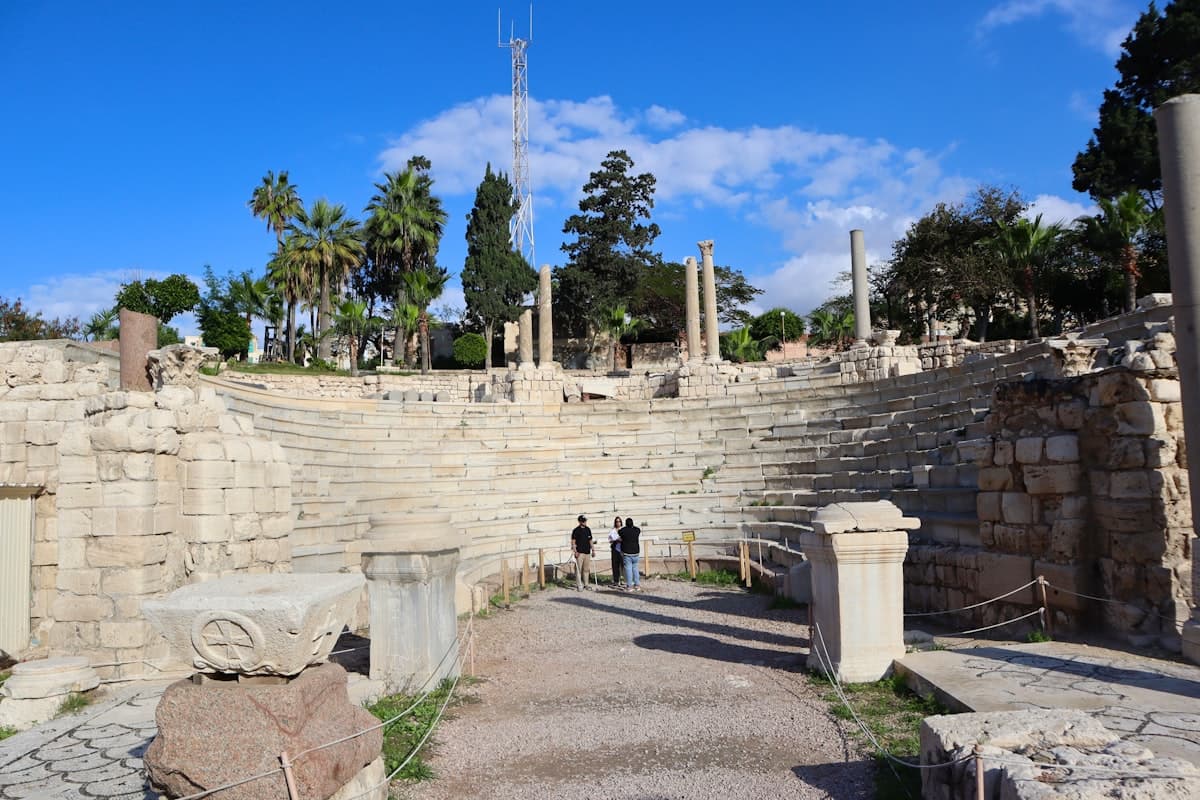
At Kom el-Dikka, in the middle of modern Alexandria's downtown, a Roman-era amphitheater survives, the only one ever found in Egypt. It seated around 800 people, which is intimate by Roman standards, and its marble tiers are original. Beneath and around it, archaeologists have excavated lecture halls, lecture halls with fixed stone seating arranged in semicircles for students, thirteen of them, which were almost certainly part of what remained of Alexandria's academic infrastructure after the Library itself was gone. When you sit in that amphitheater at 8am before the tour groups arrive, the sound carries perfectly across the empty marble. Whoever built it knew exactly what they were doing.
The Greco-Roman Museum, currently open after a long renovation, holds the most coherent collection of the hybrid art that emerged when these two civilizations actually merged rather than merely coexisted. Look for the terracotta figurines. They show Egyptian gods with Greek proportions, Isis in a himation, Harpocrates with a finger to his lips, Bes with something approaching a contrapposto stance. This was not appropriation in any modern sense. It was two artistic traditions discovering they were solving the same problems.
---
The Catacombs and the Moment Egypt Absorbed Greece
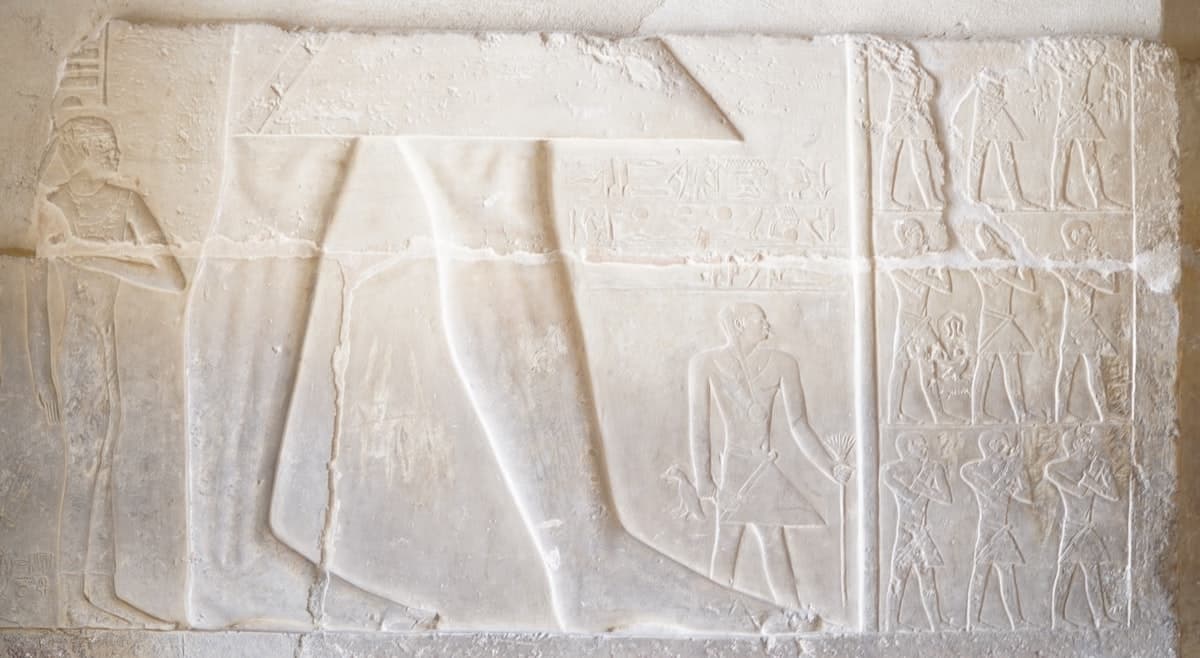
The Catacombs of Kom el-Shoqafa are, without any competitive field, the most important Greco-Roman site in Egypt and one of the most significant of their kind anywhere in the world. They were discovered in 1900 when a donkey fell through the ground into the first shaft. They descend three levels into the rock, with a banquet hall where families dined with their dead, and a main tomb chamber that demonstrates something vertiginous about how civilizations actually work.
The decoration of that main chamber is in the Egyptian style: falcons, cobras, the weighing of the heart, Anubis in his jackal form. But look at Anubis more carefully. He is wearing Roman armor. The sculptor was working in a fully Egyptian iconographic tradition, and simply dressed the figures the way soldiers actually looked in the second century AD, because by then Roman soldiers were what soldiers looked like. The mummies in the niches were wrapped in the Egyptian manner. Their portraits, where they survive, are painted in the Greek Fayum style. Their inscriptions are in Greek.
This is not a museum exhibit about cultural synthesis. It is cultural synthesis, built into rock, for the dead, when nobody was performing for anybody.
Allow at least ninety minutes here. The site gets tour groups between 10am and 1pm. Arrive when it opens at 8am and you will have the lower levels almost entirely to yourself.
---
The Connections: What the Greek City Became
The Ptolemaic royal quarter of Alexandria, the Brucheion, occupied the northeast corner of the city along the harbor. It is now underwater. Divers and marine archaeologists, led by Franck Goddio and his team, have mapped significant portions of it since 1996, recovering statues, sphinxes, and architectural fragments from as deep as eight meters below the surface. The Royal Quarters tour boats that operate from the Eastern Harbor let you look over the side at nothing visible, but the knowledge of what is down there changes how you feel about the harbor.
Pompey's Pillar, the most visible ancient monument in Alexandria, is both less and more interesting than it looks. It has nothing to do with Pompey, whose severed head was brought to Egypt in 48 BC after Julius Caesar's forces defeated him. The pillar was actually erected in 297 AD in honor of the Emperor Diocletian, who suppressed a revolt in Alexandria. It stands on the ruins of the Serapeum, the great temple of Serapis that was one of the architectural wonders of the ancient world. Christian mobs destroyed the Serapeum in 391 AD on orders from the Patriarch Theophilus, who built a church in its place. The church was later replaced by a mosque. The pillar survived all of it, 26.85 meters of red Aswan granite, because granite outlasts ideology.
The Alexandria National Museum, housed in a restored Italian-style palace on Tariq al-Horreya (which itself follows the line of the ancient east-west Canopic Way), tells the story continuously from Pharaonic through Ptolemaic through Roman through Coptic through Islamic Alexandria. The Ptolemaic hall has a black basalt statue of a Ptolemaic queen dressed as Isis that stops most people cold. It should. It is one of the finest things in Egypt and it sits in a mid-sized room in Alexandria with almost no visitors on a Tuesday morning.
For the Greeks in Egypt and Alexandria history that connects to the rest of the country: the Ptolemies built Edfu Temple, Philae Temple, the Dendera complex, and contributed to Karnak. Everything that looks purely Pharaonic in its carved reliefs and proportions but dates to between 300 and 30 BC is, technically, Greek dynasty construction. The same family that funded the Library of Alexandria also built the temple of Horus at Edfu in a style indistinguishable from work done a thousand years earlier. They were not preserving the past. They were asserting legitimate continuity with it.
---
Common Mistakes
Spending your first day at the Bibliotheca Alexandrina instead of the ancient sites. The modern Library is an architectural achievement and its exhibits are genuinely good, but it is a contemporary institution built on the approximate location of the ancient one. Go on your last afternoon when site fatigue has set in. The ancient sites need your best hours.
Skipping the Greco-Roman Museum because it has been closed so long. It has reopened. The collection inside it is the reason you came. A two-hour visit here provides the context that makes every other site legible.
Paying for the underwater archaeology boat tour from the Eastern Harbor. It costs EGP 400 to EGP 600 per person and shows you surface water above a site you cannot see. The operators are not dishonest, they will tell you exactly what you are looking at, which is nothing. The catalogue of what Goddio's team has recovered is free online and more informative than the boat.
Following a guide who takes you to Pompey's Pillar and calls it Pompey's Pillar without correction. Ask them who actually erected it and when. If they cannot tell you it was Diocletian in 297 AD, they have not read the inscriptions. The inscription is there, in Greek, on the base.
Visiting the Catacombs of Kom el-Shoqafa in a large group. The chambers are small and the acoustics turn thirty people into a noise problem. Hire a private guide or go independently at 8am.
Assuming the sites are within walking distance of each other. The ancient city was enormous. Kom el-Dikka, the Catacombs, and Pompey's Pillar form a triangle that spans two kilometers of modern urban Alexandria. Take the tram or a taxi between them.
Reading the guidebook summary of the Library of Alexandria and thinking you understand it. The Library was not destroyed in a single fire. It declined across several centuries through funding cuts, the removal of scrolls to Rome, and administrative neglect. The burning of part of it by Julius Caesar in 48 BC, the event most people know, destroyed perhaps 40,000 scrolls stored at the harbor. The main Library survived that fire by at least another century. The whole story is much sadder than the dramatic version.
---
Practical Tips
Wear shoes you can walk on uneven ancient surfaces in. The Catacombs specifically require descending a spiral staircase that is often damp. Sandals are a poor choice.
The Corniche tram is legitimately one of the cheapest transport experiences in the Mediterranean at EGP 1 per ride. It runs along the harbor and connects the eastern and western ends of the city. It is slow and that is the correct speed for looking at Alexandria.
Alexandria's restaurants near the Greek community sites around the former Attarine quarter serve some of the best seafood in Egypt. Lunch after the Catacombs, not before.
The best book to read before coming is E.M. Forster's Alexandria: A History and a Guide, written in 1922 when the Greek community still numbered over 100,000 people. It is out of copyright and available free online. Forster was working as a hospital visitor in Alexandria during the First World War and understood the city as a living Hellenic place rather than an archaeological problem. His chapter on the ancient city's street plan is still useful.
The Greek Orthodox Patriarchate of Alexandria still operates in the city and the Cathedral of the Evangelismos near Raml Station holds Sunday services. The Greek community of Alexandria peaked at roughly 100,000 in the 1950s and contracted to fewer than 1,000 after the Nasser-era nationalizations. Attending a service there is not a tourist experience. It is witnessing something that has continued for nearly two thousand years in a city that once had a third of its population speaking Greek.
Frequently Asked Questions
The Weekly Dispatch
More on Egypt, every Friday.
Cultural depth and places most guides never mention.
No spam. Unsubscribe anytime.