Italian Community Alexandria Egypt: History, Sites & Guide
At its peak, Alexandria had 25,000 Italian residents who built churches, banks, and a newspaper. Almost all of them vanished within a decade. Their city is still there.

Quick Facts
- Best time to visit
- October to April. The Mediterranean humidity is manageable, walking is comfortable, and the light on limestone facades in November and March is remarkable. July and August are punishing for street-level exploration.
- Entrance fee
- Latin Cemetery: free, open Saturday to Thursday 8am to 2pm. Church of St. Catherine: free, donation welcome. Alexandria National Museum (for context): EGP 120 (approx $2.50 USD), students EGP 60. Cotton exchange building: informal access, no fee.
- Opening hours
- Latin Cemetery: Saturday to Thursday 8am to 2pm, closed Friday and Sunday. Church of St. Catherine: daily, mass at approximately 7am and 6pm, caretaker access between. National Museum: daily 9am to 5pm.
- How to get there
- Train from Cairo Ramses Station to Alexandria Misr Station: EGP 95 to 190, approximately 2 hours. Taxi from Misr Station to Raml district: EGP 40 to 60. City tram (Corniche line): EGP 3. Taxi between sites within central Alexandria: EGP 20 to 40.
- Time needed
- Half-day (4 to 5 hours) for the central circuit: Midan Mansheya, Sharia Horreya, Cecil Hotel, Anfushi Tombs. Full day to include the Latin Cemetery and residential neighborhoods of Moharrem Bey and Ibrahimeya.
- Cost range
- Budget EGP 400 to 700 per day covering train, tram, coffee at Trianon, and lunch. Mid-range EGP 1,500 to 2,500 including a nicer restaurant and the National Museum.
Quick Facts
Best time to visit: October to April, when the Mediterranean humidity drops and walking the Corniche or entering unventilated buildings becomes bearable. Summer is genuinely punishing.
Entrance fees: Most Italian-heritage sites are free to enter or accessible from the street. The Greek Orthodox Patriarchate area and some private cemeteries require advance permission; the Latin Cemetery charges no entrance fee but gates open only 8am to 2pm, Saturday to Thursday. The National Museum of Alexandria (which holds relevant artifacts) charges EGP 120 (approx $2.50 USD); students EGP 60.
Opening hours: The Latin (Catholic) Cemetery on Shari' El Nabi Daniel opens Saturday to Thursday 8am to 2pm. The Church of St. Catherine on Midan Mansheya opens daily for mass around 7am and again at 6pm; visiting outside mass is possible with a polite request to the caretaker. The Cecil Hotel lobby is accessible any time.
Getting there: From Cairo, the intercity train takes roughly two hours from Ramses Station; tickets run EGP 95 to EGP 190 depending on class. From Alexandria's Misr Station, a taxi to the historic downtown quarter (Raml) costs EGP 40 to EGP 60. Tram line 1, which the Italians themselves rode, still runs along the Corniche for EGP 3.
Time needed: A focused half-day (four to five hours) covers the key sites on foot. A full day allows you to reach the Latin Cemetery and the neighborhoods of Moharrem Bey and Ibrahimeya, where Italian residential architecture survives in varying states of repair.
Cost range: Budget EGP 400 to 700 per day covering transport, a coffee at a historic café, and lunch. Mid-range EGP 1,500 to 2,500 including a meal at a restaurant occupying a former European villa.
---
Why This Matters: A City That Was Two Cities at Once
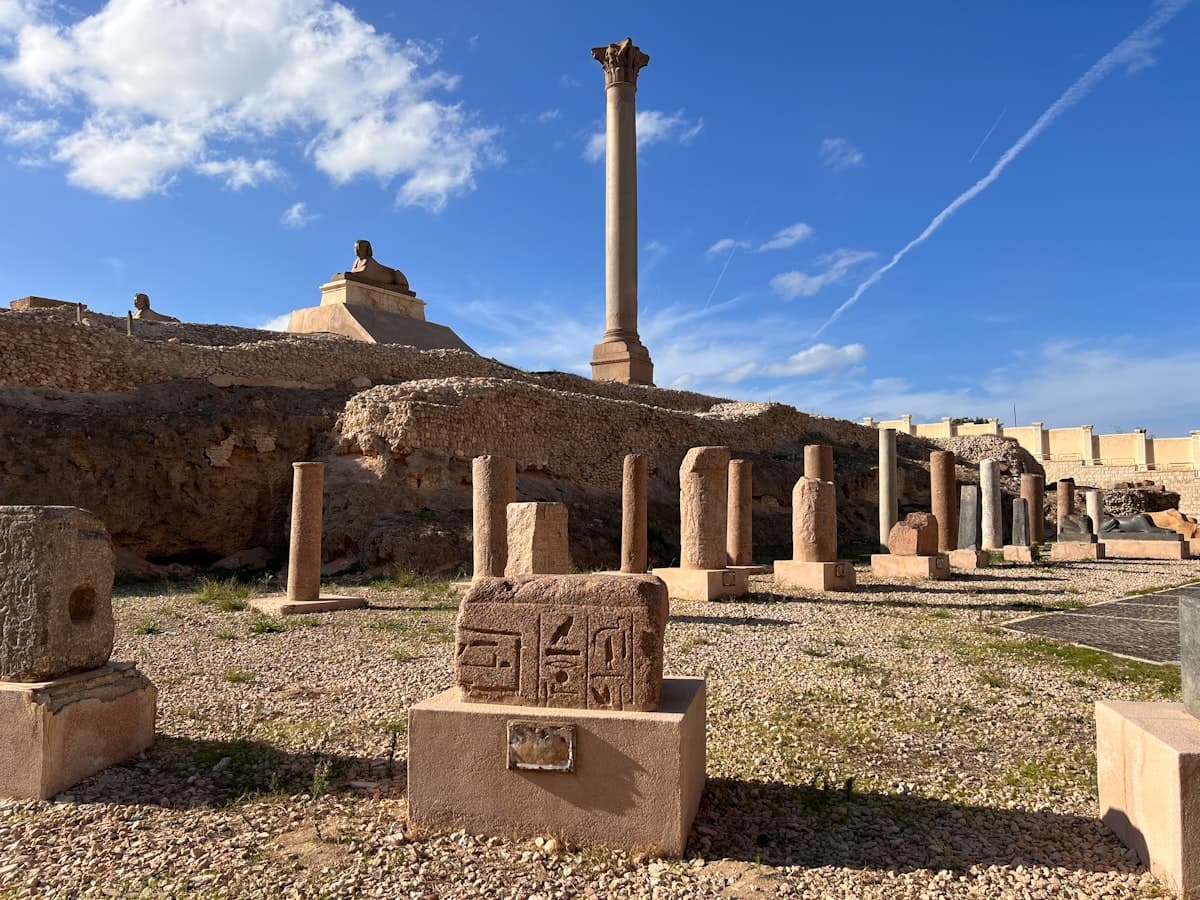
Between roughly 1860 and 1961, Alexandria contained a fully functional Italian city layered over the Egyptian one. At the community's height in the 1920s and 1930s, approximately 25,000 Italians lived in Alexandria, the largest Italian population in Africa outside of Libya. They published a daily newspaper, Il Messaggero Egiziano, ran their own schools (the Dante Alighieri Society founded one in 1906 that still operates), maintained a separate hospital, supported at least four churches, and controlled significant portions of the city's jewelry trade, construction industry, and import-export economy.
They were not a colonial population in the British administrative sense. Italy had no formal claim on Egypt. The Italians arrived under the framework of the Capitulations, the Ottoman-era treaty system that granted European nationals extraterritorial legal rights in Egypt: they paid reduced taxes, were tried in their own consular courts, and were largely exempt from Egyptian civil jurisdiction. This arrangement, which applied to Greeks, French, British, and others as well, created the cosmopolitan Alexandria that Cavafy wrote about and Durrell mythologized, and it also meant that when the Capitulations were abolished in 1937, and then Nasser nationalized foreign assets in 1956, the entire legal and economic foundation of this community disappeared inside fifteen years.
By 1971, fewer than 500 Italians remained in the city.
What they left behind is the built fabric of modern Alexandria: its wide boulevards laid out by Italian engineers, its neoclassical apartment blocks with wrought-iron balconies, its Catholic churches, its cemetery, and a particular style of seaside café culture that Alexandrian Egyptians absorbed so completely it no longer reads as foreign.
---
What You Will Actually See: The Buildings That Stayed
Midan Mansheya and the Church of St. Catherine
Midan Mansheya, now officially called Midan el-Tahrir, is the square where an assassination attempt on Nasser was made in 1954, but its physical form is almost entirely European. The square was laid out in the mid-nineteenth century and rebuilt repeatedly by Italian and Greek architects. The Church of St. Catherine, completed in 1836 and rebuilt after damage in 1882, served as the heart of the Alexandrian Italian Catholic community. The marble interior is cool and dim even in summer, and the proportions are those of a Roman basilica scaled down for a merchant community rather than a pope. Mass is still said in Arabic and occasionally in Italian when visiting clergy pass through.
The building across the square that now houses municipal offices was the site of the Credit Lyonnais building, but the block to its west retains facades designed by the Italian firm Loria and Mosseri in the 1910s. You can identify Italian-period construction by a specific detail: the use of Alexandrite limestone, a pale yellowish stone quarried near the city, combined with imported marble surrounds on windows and doors. Egyptian builders of the same period used brick. European builders used stone wherever they could afford it.
The Cecil Hotel and the Cotton Exchange Quarter
The Cecil Hotel on the Corniche opened in 1929 and was designed in a style its Italian builders would have called Liberty, the Italian version of Art Nouveau. Winston Churchill stayed here. Somerset Maugham stayed here. During World War II, British intelligence operated from the upper floors. What matters for the Italian community history guide is less the famous names than the context: the Cecil was built for, and largely patronized by, the Levantine European business class that had made Alexandria the world's largest cotton exchange by volume in the early twentieth century. Italian merchants controlled a significant share of that trade, and the neoclassical buildings around Sharia Salah Salem (formerly the Rue des Soeurs) were largely their offices.
The cotton exchange building itself, an enormous neoclassical structure completed in 1924, still stands on Midan el-Boursa. It has not been a functioning exchange since Nasser nationalized the cotton trade in 1961, but the trading floor, with its iron columns and clerestory windows, is intermittently accessible through the building's current commercial tenants. Ask the guard at the ground floor entrance. The answer is often yes if you are polite and not in a large group.
The Latin Cemetery on El Nabi Daniel Street
This is where the Italian community history of Alexandria becomes most legible, and most melancholy. The Latin Cemetery, shared between the Catholic and some Protestant communities, contains approximately 6,000 graves from the 1840s onward. The Italian section is the largest. Walking it, you encounter family names that appear repeatedly in the city's commercial history: Salvago, Aghion, Zananiri, Macrì. The tombs range from modest slabs to elaborate neo-Gothic mausoleums with carved angels and iron fences manufactured in Naples and shipped across the Mediterranean.
The most significant detail most visitors miss: the cemetery contains the graves of several Egyptian Jews, Coptic Christians, and one Muslim notable buried in the Catholic section by family request. The cosmopolitan Alexandria of the twentieth century was not a neat sorting of populations into separate boxes. It was, in practice, considerably messier and more interesting than the myth suggests. The cemetery's caretaker, an elderly man named Samir who has worked there for over thirty years, can point out the grave of a Greek merchant whose Egyptian wife had the tombstone inscribed in Arabic, French, and Greek. This kind of thing is everywhere if you slow down enough to look at the stones.
---
The Connections: Nothing in Alexandria Exists in Isolation
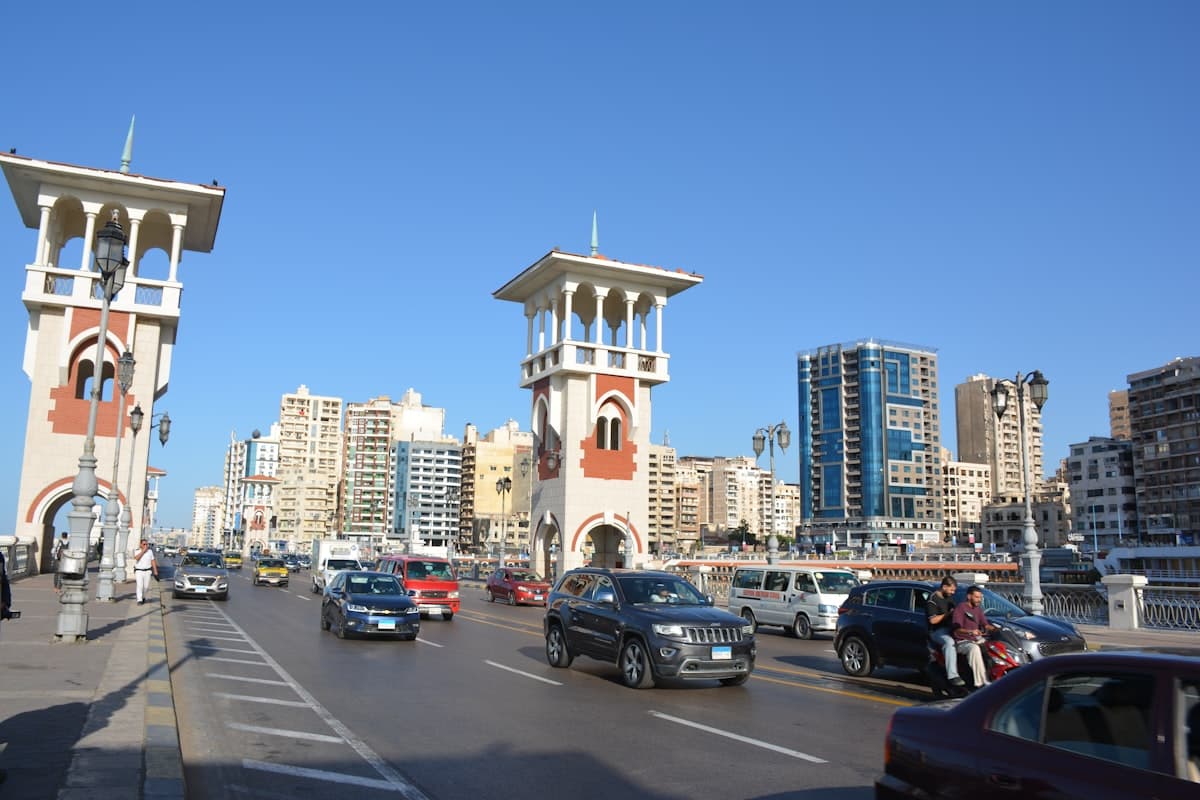
The Italian presence in Alexandria was itself built on earlier layers. The neighborhood of Anfushi, where some of the earliest Italian merchants settled in the 1840s, sits on the Heptastadion, the artificial causeway the Ptolemies built in the third century BC to connect the island of Pharos (where the lighthouse stood) to the mainland. The causeway silted over centuries of deposition and became the peninsula that is now the Anfushi neighborhood. When Italian engineers were laying water pipes in 1895, they found Ptolemaic rock-cut tombs directly beneath the streets. The tombs are now a site (the Anfushi Tombs, free to enter, often empty of visitors), and they show Ptolemaic Egyptians using both Egyptian hieroglyphic and Greek decorative traditions in the same chamber, which is exactly what the city's later cosmopolitanism was doing two thousand years afterward.
The Capitulations system under which Italian nationals lived in Alexandria was itself a revival of arrangements that went back to medieval Venetian and Genoese trading concessions in Alexandria's harbor. Genoa had a fondaco (a combined warehouse and residence for foreign merchants) in the Alexandrian port from the twelfth century. The same harbor. The same legal logic. The Italian presence in modern Alexandria was not an anomaly but the latest iteration of a Mediterranean trading relationship that is at least eight hundred years old.
The Dante Alighieri school founded in 1906 still operates on Sharia Horreya (formerly the Rue Rosette, the main European commercial boulevard). It now teaches mostly Egyptian children whose parents want Italian-language instruction. The school building is the original one.
---
Common Mistakes
1. Treating this as a walking tour of a single district. The Italian community was distributed across the entire central city and into residential neighborhoods like Moharrem Bey and Ibrahimeya. Limiting yourself to Mansheya and the Corniche means missing the residential architecture, which is often better preserved and more revealing of how people actually lived.
2. Expecting museum-quality presentation. There is no dedicated Italian Alexandria museum. The Alexandria National Museum has one room of material covering the Khedival period, which touches on the European communities. It is worth an hour. It is not worth building your day around.
3. Visiting the Latin Cemetery on a Friday. The cemetery is closed Fridays and Sundays. Arriving to find the gate locked and then having no alternative plan is the most common logistical failure tourists make at this site.
4. Buying the guided tour marketed as a 'cosmopolitan Alexandria walk.' Several operators sell a half-day version of this experience for EGP 800 to 1,200 per person. What you receive is a ninety-minute walk hitting three facades, a coffee stop at a café that was not historically significant, and a narrative that romanticizes the European community without engaging honestly with the Capitulations system or why everyone left. Read before you go. The walking is the point.
5. Skipping the Anfushi Tombs. Every visitor to Italian Alexandria should spend forty-five minutes in the Anfushi Tombs because they make the city's layered history physically legible in a way no café or building facade can. The tombs are genuinely not crowded, genuinely interesting, and free. They are consistently absent from Italian Alexandria itineraries because they are not Italian. That is precisely why they belong in this one.
6. Assuming the Cavafy Museum is about Italian Alexandria. Constantine Cavafy was Greek, not Italian, and his poems engage with a Hellenistic and Greek Alexandrian world that overlapped with but was distinct from the Italian community's experience. The museum (his actual apartment on Sharia Sharm el-Sheikh) is worth visiting. Understand what you are visiting.
7. Photographing building interiors without asking. Several of the surviving apartment buildings with intact Italian-period lobbies and staircases are occupied residential buildings. The residents are generally tolerant of curious visitors but not of cameras pointed at their daily lives. Ask the bawab (doorman). He will often let you look.
---
Practical Tips
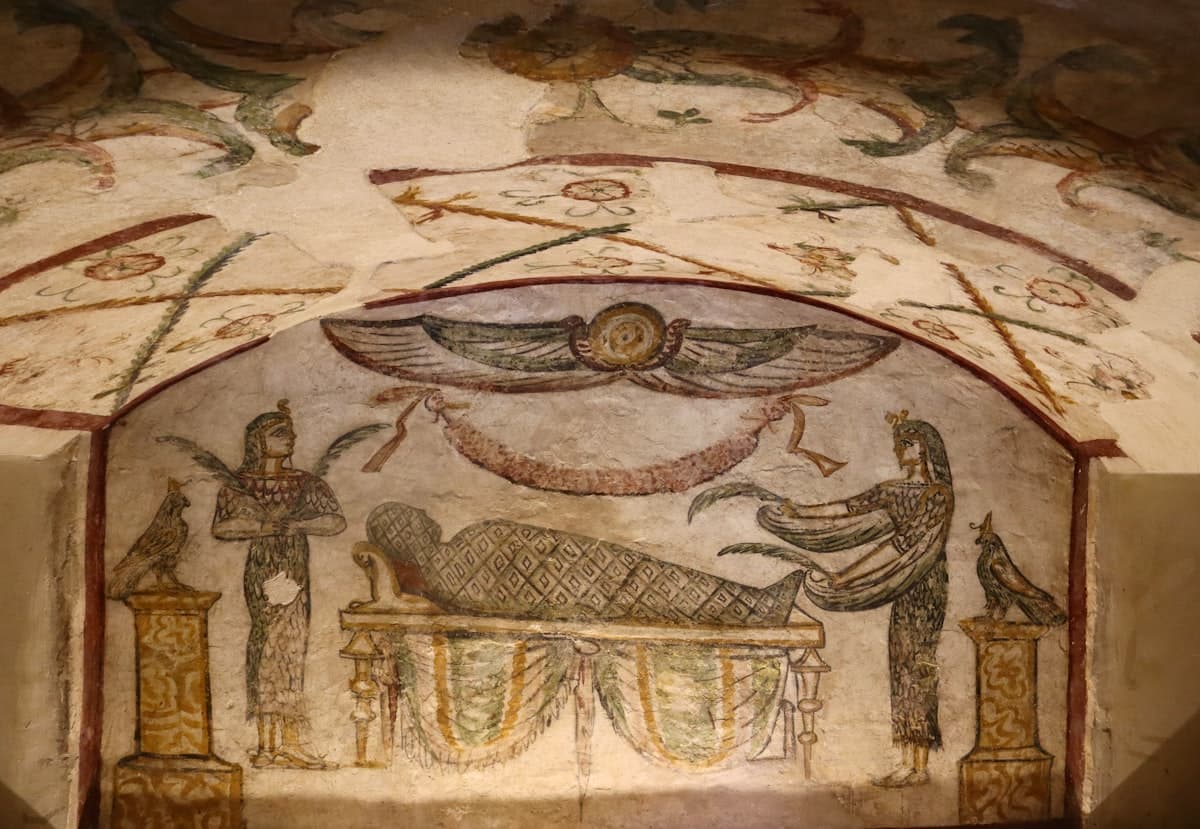
Alexandria's downtown becomes genuinely hot and glaring between noon and 4pm from May through September. The Italian-heritage walking circuit works best starting at 8am and finishing before lunch, then resuming after 4pm.
The city's tram, one of the oldest electric tram systems in Africa (inaugurated 1863), costs EGP 3 and runs the entire length of the Corniche. Taking it at least once is not nostalgic tourism. It is a functional way to move between the Raml district and the Anfushi neighborhood without dealing with taxi negotiation.
For a meal in an Italian-period building, the Trianon on Midan Orabi (formerly Place Mohamed Ali) has been operating since 1905 and retains its original interior. The food is Egyptian-Mediterranean. The pastry case is still worth examining. A coffee and pastry costs EGP 80 to 120. This is not a culinary pilgrimage. It is the most honest way to sit inside what this community actually created.
If your Arabic is limited, the National Museum staff and most cemetery caretakers speak enough English or French to communicate. The Dante Alighieri Society occasionally runs historical tours in Italian and English; check their Alexandria branch directly as schedules are irregular.
Bring a charged phone for photographs of architectural details. The ironwork, the balcony brackets, the window pediments: these are the documentary record of the community now that the people themselves are largely gone.
Frequently Asked Questions
The Weekly Dispatch
More on Egypt, every Friday.
Cultural depth and places most guides never mention.
No spam. Unsubscribe anytime.