Italian Community Alexandria Egypt: History, Streets & What Remains
At its peak, Alexandria had 60,000 Italian residents. They built the stock exchange, ran the tram system, and left a city most Egyptians have half-forgotten. Here is what survives.

Quick Facts
- Best time to visit
- October to April. Mediterranean winters are mild (15 to 22 degrees Celsius), the sea light is clear, and the city is not overwhelmed by domestic summer tourism. November is ideal for walking the streets without heat.
- Entrance fee
- Most sites are free or nominal. Latin Cathedral: free. Museum of Fine Arts: EGP 30 (approx $1 USD). Chatby Latin Cemetery: no formal fee, tip the warden EGP 20 to EGP 50. Antoniadis Garden: EGP 10 (approx $0.35 USD).
- Opening hours
- Saint Catherine's Cathedral: daily 8am to 6pm. Museum of Fine Arts: Tuesday to Sunday 9am to 5pm, closed Monday. Chatby Cemetery: irregular, arrive before 10am. Antoniadis Garden: daily 8am to 5pm.
- How to get there
- Egyptian National Railways from Cairo Ramses Station to Alexandria Misr Station: EGP 90 to EGP 230 depending on class, journey approximately 2 to 2.5 hours. From Misr Station, taxi to Raml Station (the heart of the old quarter): EGP 50 to EGP 80. Alexandria tram runs along the Corniche for EGP 2 per journey.
- Time needed
- Half day minimum for the key buildings and streets. Full day if including the Museum of Fine Arts, Chatby Cemetery, and a meal at Athineos. Two days if adding archival visits or the Italian Consulate.
- Cost range
- Budget EGP 400 to 700 per day including transport, meals at local restaurants, and site entrances. Mid-range EGP 1,200 to 2,000 per day including a taxi, a meal at a better restaurant, and a comfortable hotel in the downtown area.
Quick Facts
Best time to visit: October to April, when the Mediterranean keeps temperatures between 15 and 22 degrees Celsius and the sea light is sharp rather than bleached.
Entrance fees: Most sites connected to Alexandria's Italian community are streets, cemeteries, and church facades, which cost nothing. The Greek Orthodox Patriarchate museum nearby charges EGP 50 (approx $1 USD). The Latin Cathedral of Saint Catherine is free to enter during opening hours.
Opening hours: Saint Catherine's Cathedral is open daily from 8am to 6pm. The Latin Cemetery (Chatby Necropolis area) keeps irregular hours; arrive before noon and ask the warden directly. The Antoniadis Garden, built by a wealthy Alexandrian Greek but designed with heavy Italian influence, opens daily from 8am to 5pm.
How to get there: From Cairo, the Egyptian National Railways runs frequent services to Alexandria's Misr Station, roughly EGP 90 to EGP 230 depending on class. A taxi from Misr Station to the historic downtown (El-Manshiyya and Raml Station area, the core of the old Italian quarter) costs EGP 50 to EGP 80. The tram, which Italians actually built, still runs along the Corniche for EGP 2 per journey and is the correct way to move between the Latin Quarter, Chatby, and Roushdy.
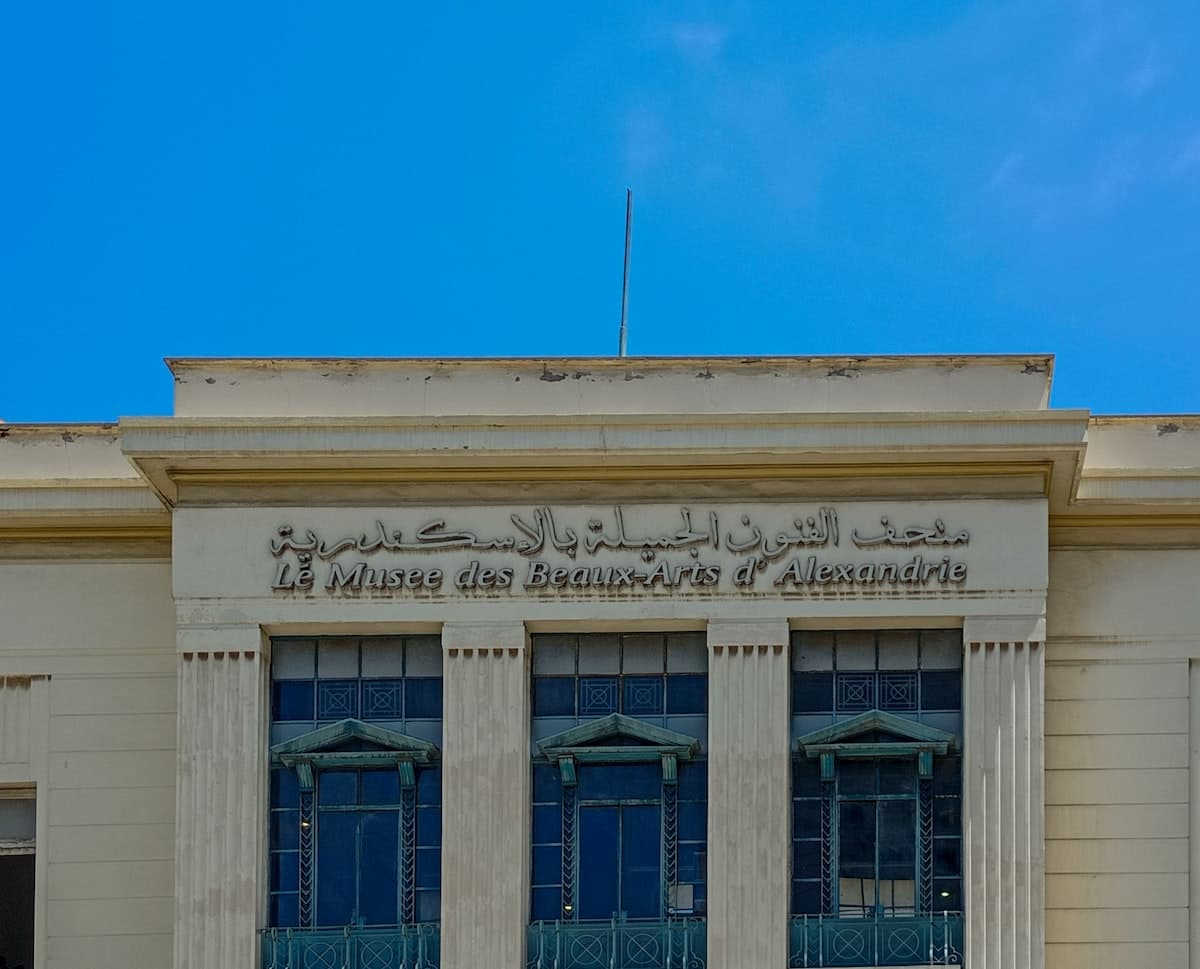
Time needed: A serious half-day for the buildings and streets alone. Add a full day if you include the cemeteries, the cafes that survive from the cosmopolitan era, and the Museum of Fine Arts (which holds work by Italian-Alexandrian painters almost no one outside the city knows).
Cost range: Budget EGP 400 to 700 per day. Mid-range, including a meal at one of the remaining old Alexandrian restaurants and a taxi, EGP 1,200 to 2,000.
---
Why This Place Matters
By 1927, Italians were the largest single European community in Alexandria, numbering somewhere between 55,000 and 65,000 people depending on which census you consult. They were not tourists, not diplomats, and not colonizers in the conventional sense. They were bakers, architects, pharmacists, tram engineers, and surgeons. They ran newspapers in Arabic and Italian simultaneously. They built the Alexandria Stock Exchange building on Talaat Harb Square, which still stands and still operates. They designed the tramway network that the Egyptian government runs to this day.
This is the fact most visitors to Alexandria miss entirely: the tram they casually board to reach the Bibliotheca Alexandrina was engineered in the 1860s under an Italian concession granted by Khedive Ismail, who was simultaneously financing the construction of the Cairo Opera House with Italian architects and filling his new Khedival Cairo with Haussmanian boulevards drawn up by urban planners he had poached from Italy. Modern Alexandria and modern Cairo are, in their bones, partially Italian cities.
The Italian community's presence in Alexandria predates the modern era significantly. Italian merchants had been trading through the city since the medieval period, and a Florentine consul was documented in Alexandria as early as the fifteenth century, negotiating cotton and spice routes under the Mamluk sultans. When Napoleon arrived in 1798 and then the British and French competed for influence in the nineteenth century, Italians occupied a peculiar middle position: useful to everyone, politically threatening to no one, and economically indispensable.
What happened to them is the real story. Between 1956 and 1961, Nasser's nationalization policies, the Suez Crisis, and growing pressure on foreign communities emptied Alexandria of almost every European family. Sixty thousand Italians became, within a decade, essentially zero. They left behind a city shaped by their hands, with their names slowly removed from the street signs and their institutions absorbed or shuttered.
---
The Architecture They Left Behind
Walk from Raml Station west along Saad Zaghloul Street and then turn north toward the sea. The building density of the early twentieth century is still here, though badly worn. What you are looking at is largely Italian work: the eclectic facades mixing neo-baroque with arabesque ornament, the wrought iron balconies, the tiled entrance halls that open onto interior courtyards in the Venetian manner adapted to Egyptian heat.
The Latin Cathedral of Saint Catherine on Nabi Daniel Street was designed by the Italian architect Francesco Mancini and completed in 1833, making it one of the oldest surviving Catholic churches in modern Egypt. The interior is plain by European standards, stripped of much of its original decoration during various political upheavals, but the proportions are elegant and the building still holds Mass. Sit inside it for twenty minutes before the crowds arrive in the morning. The sound of the call to prayer from the mosque on the next block drifts through the stone walls. This is Alexandria's particular acoustics: Latin liturgy, Islamic call, Mediterranean traffic, all layered on top of a city that sits on the ruins of one of the ancient world's greatest libraries.
The Alexandria Bourse, the old stock exchange building, was designed by Italian engineers and completed in the 1880s. The ground floor now contains a mix of commercial offices, but the facade, with its colonnaded neoclassical front, remains one of the most intact examples of Italian civic architecture in the city. Most visitors walk past it because no sign announces what it was. That absence is itself historical.
The Chatby district, east of downtown, holds the old Latin Cemetery where Italian families buried their dead for a century and a half. The tombs range from modest stone markers to elaborate family mausoleums with Italian inscriptions and marble busts. The cemetery is partly maintained and partly crumbling. Some of the inscriptions record deaths from the cholera epidemics of the 1880s that killed Europeans and Egyptians in roughly equal numbers. A few tombs belong to Italian engineers who died during the construction of the city's water infrastructure. They built Alexandria's first modern water treatment system and several of them did not live to see it operate.
---
The Human Stories Behind the Streets
The most important Italian institution in Alexandria that almost no one visits is the Circolo Italiano, the Italian cultural club that operated for decades in a building near the current Consulate General on Mina El-Basal Street. The building still stands in altered form. At its height in the 1930s and 1940s, the Circolo hosted lectures, concerts, and political debates that cut across the entire cosmopolitan city: Greeks, Jews, Armenians, Levantine Arabs, and Egyptians attended alongside Italians, because Alexandria ran on that kind of social porousness that is genuinely difficult to reconstruct now.
The Italian-Alexandrian community produced one figure who reshaped modern art in ways Egypt rarely receives credit for: Fortunato Depero spent time in Alexandria in the early twentieth century, and the city's influence on Futurism, the Italian avant-garde movement that obsessed over machinery and speed and light, is traceable partly through Alexandria's industrializing port. The tram, the cotton gin factories, the telegraph lines, the stock exchange ticker: this was the raw material of a modernism that then circled back into European culture.
The community also maintained a press. The newspaper "L'Imparziale" ran for decades, reporting on Alexandrian life in Italian while covering Egyptian politics with a specificity that embarrassed both the British occupiers and the Egyptian nationalists at various points. Copies survive in the Bibliotheca Alexandrina's archive section, and if you contact the library in advance, a researcher can sometimes arrange access. The reporting is extraordinary: street-level accounts of the 1919 revolution, descriptions of the port during the First World War, society pages that name families now entirely absent from the city.
The Italian community's relationship with the large Sephardic Jewish population of Alexandria was particularly close, partly because both groups occupied a similar legal status under Ottoman-era capitulations: foreign nationals with special protections that shielded them from Egyptian courts. When those protections ended and Egypt asserted full sovereignty, both communities faced the same pressure to leave. Several of the remaining old-quarter buildings that were once Italian properties passed to Jewish families and then, after 1956, to Egyptian government sequestration. The layers of ownership written into these buildings are a compressed history of the twentieth century.
---
The Connections
The Italian presence in Alexandria does not exist in isolation from the broader Egyptian story, and the connections run deeper than most Italian-community Alexandria Egypt history guides acknowledge.
Khedive Ismail, who commissioned Italian architects to remake Cairo and expanded the Italian concession in Alexandria during the 1860s, was educated in Paris but specifically hired Italians because he understood them as culturally European without being politically British or French. He was managing imperial competition with the same tools Egyptian rulers had used for millennia: play the foreigners against each other, extract their skills, keep sovereignty nominally intact. It worked until it didn't. The 1882 British bombardment of Alexandria, which the Italian community largely survived by staying neutral, destroyed much of the old Ottoman-era city and cleared the ground for the neoclassical rebuilding that Italians then contracted to do.
The Roman connection runs underneath all of this. Alexandria was a Roman city for six centuries before it was Islamic. The current street grid of central Alexandria follows, in some places almost exactly, the Ptolemaic and Roman grid that Greek and Roman engineers laid down. When Italian architects in the 1880s and 1890s designed the new boulevards, they were unconsciously or consciously retracing a pattern set two thousand years earlier by the civilization their own culture claimed as ancestor. The colonial Italian fantasy of inheriting Rome's Mediterranean empire had an architectural expression in Alexandria that is uncomfortable to look at directly but important to understand.
The Coptic connection is also present. The Coptic Orthodox community and the Italian Catholic community maintained respectful distance but occasional alliance, particularly in matters of opposing Protestant missionary activity. The Catholic Church's presence in Alexandria predates the Italian community by centuries: it traces back to Franciscan missions in the thirteenth century, and the Franciscans maintained a presence continuously through the Mamluk period, the Ottoman period, and into the modern era, which is part of why the Latin Cathedral survived when other foreign institutions did not.
---
Common Mistakes
Going only to the Bibliotheca Alexandrina and calling it done. The library is genuinely excellent and worth several hours. It is also emphatically not the Alexandria of the Italian community history guide you are trying to inhabit. The Bibliotheca sits on the site of the ancient library and is a modern building. The Italian quarter is two kilometers west, and most visitors never make it there.
Hiring a tour guide for this particular subject. Standard Alexandrian tour guides are trained on Pharaonic history and the Graeco-Roman Museum, not on cosmopolitan-era urban history. A guide who does not specifically know this period will waste your time explaining things you already know and miss the buildings that actually matter. Go independently with a good map, or contact the Alexandria Preservation Trust in advance, which occasionally offers specialized walks.
Visiting the Chatby cemetery without calling ahead. The gate is locked much of the day. The warden lives nearby and will open it if you ask, but you need to find him, which takes time. Arriving at 9am gives you the best chance. The cemetery is worth the effort: the Italian inscriptions and tomb architecture are among the most intact physical records of the community that remain anywhere in the city.
Taking the organized "cosmopolitan Alexandria" bus tour. These cost EGP 300 to EGP 500 per person, run on a schedule that gives you eleven minutes at each site, and are aimed at Egyptian domestic tourists nostalgic for a cosmopolitan era they experienced secondhand through films. The content is sentimental rather than analytical. Skip it entirely.
Eating at the cafes marketed as "vintage Alexandrian." Several establishments on Saad Zaghloul Street advertise their connection to the cosmopolitan era with old photographs on the walls and inflated prices. The food is mediocre. The one genuine exception is Athineos, which has been operating continuously since 1930 and whose pastries are documented in writing from Italian-Alexandrian memoirs. Go there specifically. Everywhere else claiming the vintage label is a reconstruction.
Expecting the buildings to be preserved. They are not. Alexandria has some of the worst building maintenance of any Mediterranean city with this density of architectural heritage. What you are visiting is a living city that has mostly moved on, not a museum. Adjust your expectations accordingly and the experience becomes more interesting, not less.
Overlooking the Museum of Fine Arts on Menasha Square. It holds the largest collection of Italian-Alexandrian painting in existence, including work by artists who lived and worked in the city during the cosmopolitan period and documented it with specificity no photograph achieves. Entrance costs EGP 30 (approx $1 USD). Almost no foreign visitors go. The collection rewards close attention.
---
Practical Tips
The best time to walk the old Italian quarter is early morning, before 9am, when the light comes in from the sea at a low angle and the streets are not yet crowded with traffic. The Mediterranean light in Alexandria in October and November is a particular thing: cooler than Cairo, softer than summer, with a salinity in the air that you register before you consciously notice the smell.
Wear shoes you can walk in for four or five hours. The streets are uneven, the sidewalks are frequently occupied by parked motorcycles or market stalls, and several of the key sites require navigating interior courtyards or cemetery grounds. This is not a place for sandals.
Bring cash. The small businesses and cemetery wardens operate on cash only. The EGP 50 notes are practical. Larger notes create problems.
If you want access to any archival material connected to the Italian-Alexandrian community, the Bibliotheca Alexandrina's manuscript and archive department requires an appointment made at least 48 hours in advance. The Italian Consulate General in Alexandria also maintains records and has, in the past, facilitated access to community documentation for researchers who contact them formally.
The Italian Cultural Institute in Cairo (not Alexandria) holds the most comprehensive library in Egypt on Italian-Alexandrian history, including out-of-print memoirs and community publications. If your interest is serious, a day in Cairo at the Institute before your Alexandria visit will frame everything you see there with more precision.
Frequently Asked Questions
The Weekly Dispatch
More on Egypt, every Friday.
Cultural depth and places most guides never mention.
No spam. Unsubscribe anytime.