Jewish Alexandria: Egypt's Synagogues and a Lost Community
At its peak, Alexandria's Jewish community numbered 80,000. Today, fewer than a dozen remain. The synagogues are still standing. This is their story.

Quick Facts
- Best time to visit
- October through April. The Mediterranean climate is mild and the light is clear. Avoid July and August when humidity makes unventilated historic buildings genuinely uncomfortable.
- Entrance fee
- Free (donations accepted). No formal ticketing. Bring passport for entry.
- Opening hours
- Sunday through Thursday, approximately 10am to 4pm. Subject to caretaker availability. Call ahead. Jewish holidays may affect access.
- How to get there
- Egyptian National Railways express from Cairo Ramses Station, approximately EGP 150 to 200 first class (around $3 to 4 USD), journey 2 to 2.5 hours. From Alexandria Misr Station, taxi to Nabi Daniel Street, EGP 50 to 80.
- Time needed
- 2 hours minimum for Eliyahu Hanavi alone. Half-day recommended to include the surrounding neighborhood walk and, with advance arrangement, the Jewish cemetery.
- Cost range
- Budget EGP 400 to 700 per day in Alexandria. Specialist Jewish heritage guide EGP 400 to 600 for half-day. Cecil Hotel EGP 3,500 to 5,000 per night if you want the full historical context.
At its peak in the 1940s, Alexandria's Jewish community numbered roughly 80,000 people. They ran department stores on Rue Fouad, summered in Montazah, spoke Arabic and French and Ladino in the same sentence, and worshipped in synagogues that rivaled anything in Cairo or Istanbul. By 1970, fewer than 1,000 remained. Today, the number is somewhere between five and twelve, depending on who you ask and what counts as remaining. The synagogues are still here. The community they served is almost entirely gone. Understanding why requires understanding what Alexandria actually was, and what Egypt chose to do with it.
Quick Facts
Best time to visit: October through April, when Alexandria's Mediterranean humidity drops and the light turns the color of pale gold. Summer in Alexandria runs hot and sticky, and the synagogues, being largely unventilated, are uncomfortable from June through September.
Eliyahu Hanavi Synagogue entrance fee: Free, though donations are accepted and genuinely needed. There is no formal ticketing system. Bring your passport.
Opening hours: Eliyahu Hanavi is officially open Sunday through Thursday, 10am to 4pm. In practice, access depends on the caretaker. Call ahead or ask your hotel to confirm: the synagogue's operating schedule changes with staffing. Friday and Saturday openings are rare outside of the High Holidays.
How to get there: From Cairo, take the Egyptian National Railways express service from Ramses Station. First-class tickets cost approximately EGP 150 to 200 (around $3 to 4 USD) and the journey takes two to two and a half hours. From Alexandria's Misr Station, take a taxi to the Manshiyya district near the Cecil Hotel. Fare should be EGP 50 to 80. The synagogue is on Nabi Daniel Street, one of the city's oldest named thoroughfares.
Time needed: Two hours minimum for Eliyahu Hanavi alone. A full half-day if you walk the surrounding streets and locate the other surviving Jewish sites: the Menasce family palace, the Cattaui building remnants, and the Jewish cemetery on the eastern edge of the city.
Cost range: Budget EGP 400 to 700 per day in Alexandria. The Jewish heritage circuit costs almost nothing in entrance fees but rewards spending on a knowledgeable local guide, which will run EGP 400 to 600 for a half-day.
---
Why This Place Matters

Alexandria's Jewish community is not a footnote to Egyptian history. It is, in many ways, the hinge on which the modern city turned.
Jews arrived in Alexandria almost with the city itself. Alexander the Great founded the city in 331 BCE, and Jewish settlers were among its earliest documented inhabitants. By the first century CE, Alexandria's Jewish population was estimated at around one million, comprising roughly a third of the entire city. The philosopher Philo of Alexandria, whose synthesis of Jewish scripture and Greek philosophy influenced Christian theology for centuries, lived and wrote here around 20 BCE to 50 CE. The Septuagint, the Greek translation of the Hebrew scriptures that became the basis for the Christian Old Testament, was produced in Alexandria. The rabbinical tradition holds it was translated on the island of Pharos, just offshore from where the famous lighthouse once stood.
This is not ancient history with no modern consequence. When Gamal Abdel Nasser nationalized the Suez Canal in 1956 and the subsequent political climate made Egypt's minorities increasingly vulnerable, it was this same community, 2,500 years in the making, that dispersed to Paris, to Rio, to New York, to Tel Aviv. The assets they left behind, the department stores, the apartment buildings, the synagogues, tell a story about what happens when a cosmopolitan city becomes a national project.
The Jewish Alexandria Egypt history that draws visitors today is not a triumphant one. It is a story about coexistence that lasted centuries and ended in a generation.
---
Eliyahu Hanavi: The Synagogue That Survived
Nabi Daniel Street runs through the heart of old Alexandria, and Eliyahu Hanavi Synagogue sits on it like a memory that refuses to dissolve. The building you see today was constructed in 1354 CE, though the site has held a synagogue since at least the eleventh century. It was substantially renovated in 1850 under the patronage of the Aghion family, one of Alexandria's great Jewish merchant dynasties, and the interior reflects that Victorian-era generosity: Carrara marble columns, ornate chandeliers, and a women's gallery that once held hundreds of worshippers now largely empty and carefully lit.
The synagogue seats approximately 700 people. On the High Holidays, when the community was at full strength in the 1930s and 1940s, it was not large enough and additional seating spilled into the courtyard. The last regular minyan, the quorum of ten Jewish men required for communal prayer, was held here sometime in the late 1980s. The dates are disputed because the people who would remember are scattered across three continents.
What strikes visitors immediately is not the scale but the specificity of care. The Torah scrolls are still here, encased and preserved. The wooden ark, the Aron Kodesh, dates to the nineteenth century renovation. Egyptian government conservators, working with international Jewish heritage organizations including the Memorial Foundation for Jewish Culture, completed a restoration in 2010 that stabilized the structure and repaired the roof, which had been leaking for years. The Egyptian government spent approximately $3 million USD on the restoration, a fact that surprises visitors who arrive expecting a site in complete disrepair.
The caretaker, when present, can show you the memorial plaques on the interior walls. Read them carefully. The names are an education in Alexandrian Jewish multiculturalism: Sephardic names from Spain, Ashkenazi names from Eastern Europe, Karaite names, Italian names. This was never a monolithic community. It was a compressed archive of Jewish diaspora history.
---
The Other Sites: What the Maps Don't Show
Eliyahu Hanavi is the only functioning, visitable synagogue in Alexandria, but it is not the only physical evidence of the community's presence.
The Synagogue of Mosseiri on Rue Menasce no longer exists as a religious building. The structure was converted after 1967 and the interior was entirely stripped. It is worth walking past regardless, because the exterior stonework is intact and the street itself, now called by a different name, retains the memory of the Menasce family, who were among the most powerful Jewish bankers and landowners in nineteenth-century Egypt. Yaqub Menasce financed portions of the original Alexandria-Cairo railway in the 1850s. A family that helped build the country's infrastructure was gone within a century of doing so.
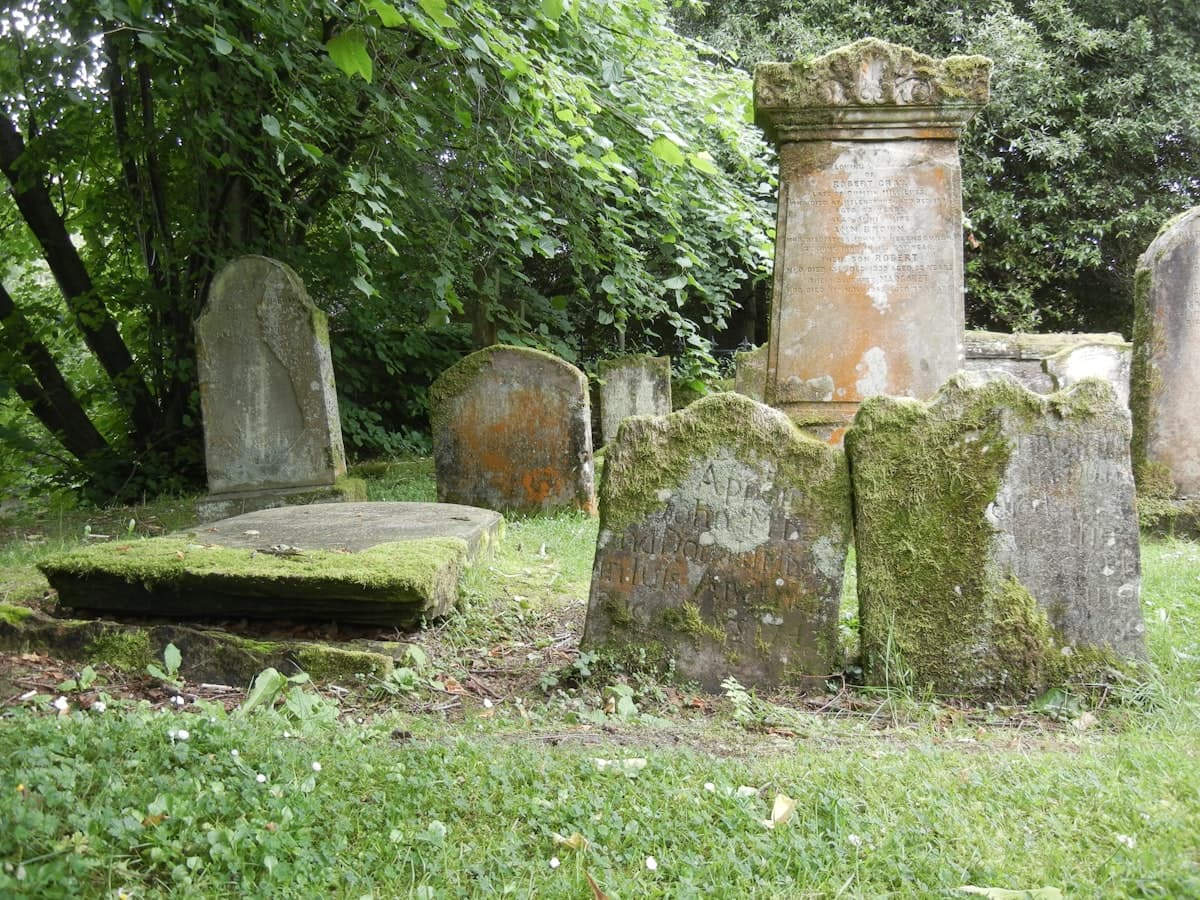
The Jewish cemetery on the Mahmoudiyya Canal road is accessible by prior arrangement and is the more emotionally direct of the two major sites. It holds approximately 2,500 graves, the oldest dating to the eighteenth century. The Alliance Israélite Universelle, the Paris-based Jewish educational organization that ran schools across the Middle East and North Africa, has provided some funding for maintenance, but the cemetery is understaffed and the condition of individual graves varies enormously. The inscriptions are in Hebrew, French, Arabic, Italian, and Greek, sometimes all five languages on a single headstone. This is what Alexandrian Jewish identity looked like: not a hyphenated identity but a genuinely plural one.
The Karaite Jewish community, a distinct sect that rejected rabbinic oral law and maintained separate synagogues, had a particularly strong presence in Alexandria. The Karaite synagogue on Kom el-Dik Street was demolished in the 1970s, but the Karaite community's history in Egypt predates Islam. Their presence here goes back at least to the ninth century CE, when Benjamin al-Nahawendi codified Karaite law. The Karaite Jews of Alexandria are almost entirely gone, most having emigrated to Israel, where the community now numbers around 40,000, primarily in the city of Ashdod.
---
The Connections
The story of Jewish Alexandria does not exist in isolation from the broader story of Alexandria's cosmopolitan minorities. The Greek Orthodox, the Italian Catholics, the Syrian Christians, the Armenians: all of them built parallel institutions, schools, hospitals, clubs, and cemeteries across the city in the nineteenth and early twentieth centuries. All of them experienced the same demographic collapse following 1952 and especially after 1956.
The Cecil Hotel, four hundred meters from Eliyahu Hanavi, was built in 1929 by a Jewish Alexandrian family and became the social center of cosmopolitan Alexandria. Winston Churchill stayed there. Somerset Maugham wrote about it. Al-Ahram, Egypt's state newspaper, described it in the 1940s as the meeting place of the eastern Mediterranean world. It is still a hotel. The ownership has changed entirely.
The Villa of Ptolemy, now under the waters of the Eastern Harbor following ancient seismic activity, was described by ancient sources as having a substantial Jewish neighborhood nearby. The underwater archaeology being conducted by the European Institute for Underwater Archaeology has not specifically targeted Jewish sites, but excavations in the harbor have confirmed the general density of the ancient city. The Alexandria that Philo knew was a city of papyrus scrolls and competing philosophies where the boundaries between traditions were genuinely porous, far more so than the sharp categories of later centuries suggest.
For visitors arriving from Cairo: the Ben Ezra Synagogue in Fustat, in Old Cairo, is the other surviving landmark of Egyptian Jewish history. It was there, in the nineteenth century, that the Cambridge scholar Solomon Schechter discovered the Cairo Geniza, a cache of approximately 300,000 medieval manuscript fragments that documented Jewish, Muslim, and Christian daily life in medieval Egypt with extraordinary intimacy. Letters, contracts, shopping lists, legal documents. The fragments are now held at Cambridge, at the Jewish Theological Seminary in New York, and in collections across twelve countries. Almost none of them are in Egypt. That absence is its own kind of story.
---
Common Mistakes
Arriving without calling ahead. Eliyahu Hanavi's opening hours are aspirational rather than guaranteed. The caretaker's availability determines access. Your hotel can make the call. Do not assume the door will be open because the internet says it will be.
Treating this as a single-site visit. The synagogue alone, without the cemetery, without the walk along Nabi Daniel Street, without looking at the Menasce-era buildings, gives you only a fragment of the picture. Budget half a day and walk.
Skipping a guide out of budget concerns. This is the one context in Alexandria where a specialist guide, rather than a general antiquities guide, changes the experience entirely. Several guides work specifically with Jewish heritage tourism and can access the cemetery and additional sites that require advance arrangement. The cost, EGP 400 to 600, is money genuinely well spent.
Expecting visible grief or formal commemoration. The site is not a memorial in the way that European Jewish heritage sites often are. It is a functioning building without a functioning community, maintained by Egyptians for reasons that are partly political, partly genuine historical pride, and partly practical. Do not project a narrative onto it that the site itself does not offer.
Visiting the Alexandrina library instead of the Jewish sites and calling it Alexandria's cosmopolitan history. The Bibliotheca Alexandrina is a fine contemporary building and a genuine cultural institution. It is not a substitute for engaging with the actual layered history of this city. The library is architecturally interesting and culturally bland. The afternoon you spend there is an afternoon not spent on Nabi Daniel Street.
Confusing Alexandrian Jewish history with Israeli history. Most Alexandrian Jews who left did not go to Israel. They went to France, to Brazil, to the United States, to Canada. The community diaspora is genuinely global, and the political framing that collapses this history into the Israeli-Palestinian conflict misrepresents what actually happened and why.
Not reading anything before you arrive. André Aciman's memoir "Out of Egypt" is the single best preparation for understanding what this city was and what it lost. It is also beautifully written. Read it on the train from Cairo.
---
Practical Tips
Alexandria is a two-and-a-half-hour train ride from Cairo, not a day trip if you want to do it properly. Stay at least one night. The Corniche hotels are adequate; the Cecil is worth the premium if you want the full historical experience, with rates running EGP 3,500 to 5,000 per night.
For the Jewish cemetery, contact the community liaison through the Alexandria Jewish Community Association before your visit. This is not bureaucratic obstruction. The cemetery requires a keyholder and advance notice is genuinely necessary. The association's contact information changes; your hotel or a local Jewish heritage guide can provide the current details.
Photography inside Eliyahu Hanavi is generally permitted if you ask the caretaker first. Photography of the Torah scrolls is sometimes restricted. Ask specifically.
The surrounding Manshiyya neighborhood is undergoing rapid development. Some of the early twentieth-century buildings that provide context for the Jewish community's Alexandrian life are being demolished or converted. Visit sooner rather than later if this matters to you, because it will look different in five years.
If you read French, the Archives of the Alliance Israélite Universelle in Paris has digitized a significant portion of its Alexandria correspondence and it is publicly accessible online. Reading a few letters from the Alexandria school before your visit makes the physical sites substantially more legible.
Frequently Asked Questions
The Weekly Dispatch
More on Egypt, every Friday.
Cultural depth and places most guides never mention.
No spam. Unsubscribe anytime.