Jewish Alexandria: Egypt's Synagogues, History and Vanished World
At its peak, Alexandria had 80,000 Jewish residents and 57 synagogues. Today, fewer than five Jews live in the city. The buildings are still there.

Quick Facts
- Best time to visit
- October through March. Mild temperatures suit the walking-heavy Jewish quarter itinerary, and the city is not crowded with Egyptian domestic summer tourists.
- Entrance fee
- Eliyahu Hanavi Synagogue: free with passport registration, by prior appointment. Bibliotheca Alexandrina: EGP 70 (approx $1.50 USD) general admission.
- Opening hours
- Eliyahu Hanavi Synagogue: Saturday mornings for community prayer, other days by appointment only. Bibliotheca Alexandrina: Saturday to Thursday 9am to 5pm, closed Friday.
- How to get there
- Egyptian National Railways Cairo to Alexandria: EGP 70 to EGP 200 (approx $1.50 to $4 USD). Taxi from Alexandria main station to Nabi Daniel Street: EGP 40 to EGP 60. City tram to Raml Station: EGP 5.
- Time needed
- Synagogue alone: 1 to 2 hours. Full Jewish Alexandria itinerary including quarter walk and Bibliotheca archive: 2 full days.
- Cost range
- Budget EGP 400 to 700 per day. Mid-range EGP 1,200 to 2,000 per day with specialist guide.
At its peak, Alexandria held 80,000 Jewish residents and 57 synagogues. Today, the official count of Jewish residents in the city is fewer than five. That is not a typo. It is one of the most dramatic demographic disappearances of the twentieth century, and almost nobody comes to Alexandria to reckon with it.
The buildings, remarkably, largely survive. Some are locked. Some are mosques. One is a national monument that the Egyptian government has spent millions restoring, while the community it was built for exists only in archives and in the memories of the very old, scattered across Tel Aviv, Paris, São Paulo, and Brooklyn.
This guide is not a lament. Alexandria has always been a city where civilizations arrive, layer on top of each other, and leave traces that the next inhabitants repurpose rather than erase. The story of Jewish Alexandria is part of that same continuous story, and it deserves to be read whole.
Quick Facts
Best time to visit: October through March. Alexandria in July and August is humid and relentlessly crowded with Egyptian summer tourists. The synagogues and the Jewish quarter are best explored on foot, and the Mediterranean winter light is far more appropriate for a city whose Jewish history synagogues and architecture are largely indoors or in narrow streets.
Eliyahu Hanavi Synagogue entrance: Currently free to enter with passport registration at the door, though donations are welcomed. Visits must be coordinated through the Jewish Community of Alexandria office; call ahead or email to confirm access, as opening times shift.
Opening hours: Eliyahu Hanavi Synagogue is generally open Saturday mornings for the handful of remaining community members, and by appointment for visitors on other days. Do not arrive unannounced and expect entry.
How to get there: From Cairo, take the Egyptian National Railways express service from Ramses Station; tickets run EGP 70 to EGP 200 depending on class, and the journey takes roughly two hours. From central Alexandria, the synagogue on Nabi Daniel Street is reachable by tram (Line 1 or 2 toward Raml Station, EGP 5) or by taxi for around EGP 30 from Raml Station.
Time needed: The synagogue itself takes one to two hours if you have a guide or do your own reading. Combine it with the Jewish quarter walk along Nabi Daniel, a visit to the Greco-Roman Museum (when open), and the nearby Coptic and Greek Orthodox churches that share the same street, and you have a full day.
Cost range: Budget EGP 400 to 700 per day. Mid-range EGP 1,200 to 2,000 per day including a licensed guide, which is strongly recommended here.
Why This Place Matters

Jews arrived in Alexandria before most of the world knew Alexandria existed. When Alexander the Great founded the city in 331 BCE, he reportedly invited Jews from the Egyptian interior to settle it, offering them full civic rights equal to Macedonian Greeks. Within two centuries, Alexandria had become the largest Jewish city in the ancient world. The Jewish philosopher Philo, who lived there in the first century CE and tried to reconcile Jewish theology with Greek philosophy, was read by early Christian theologians and shaped Western religious thought in ways that almost no one today connects back to a Mediterranean port city in Egypt.
The city's Jewish community was not static. Ancient Alexandrian Jews, Sephardic Jews expelled from Spain in 1492 who resettled in Ottoman Egypt, Karaite Jews who rejected the Talmud entirely, and Ashkenazi Jews who arrived in the nineteenth century from Eastern Europe all ended up in the same city, worshipping in different synagogues, speaking different languages, carrying different liturgies. The Alexandria that emerged by 1900 was one of the most cosmopolitan cities on earth, and its Jewish community was itself a world within a world.
Then came three ruptures in quick succession: the 1948 Arab-Israeli war, the 1952 revolution that brought Nasser to power, and the 1956 Suez Crisis, after which the Egyptian government expelled or nationalized the assets of British and French nationals, including thousands of Jews who held those passports. By 1960, the community of 80,000 had collapsed to around 8,000. By 1970, to fewer than 500. The last functioning Alexandrian rabbi left in 1960.
Eliyahu Hanavi: What the Restoration Tells You
The great synagogue on Nabi Daniel Street, Eliyahu Hanavi (the Prophet Elijah), is the gravitational center of Jewish Alexandria Egypt history. It was built in its current form in 1354, making it one of the oldest continuously used synagogues in Africa, though it was rebuilt and expanded significantly in the nineteenth century by the Aghion family, a Jewish banking dynasty so embedded in Egyptian commerce that they helped finance the construction of parts of modern Cairo.
What you walk into is a shock, in the best sense. The Egyptian government, working with international Jewish heritage organizations, spent years restoring the interior after decades of closure and water damage. The result is a space of marble floors, brass chandeliers, and wooden pews that feels, despite everything, still ready for use. Twenty-four granite columns divide the main hall. The women's gallery above runs around three sides. The Torah ark is original eighteenth-century woodwork, inlaid with ivory and mother of pearl in the same style you will find in Mamluk-era mosque furniture, because the craftsmen making both were often from the same guilds.
The caretaker, when I visited, was a Muslim man in his sixties whose grandfather had also been a caretaker of the synagogue. He knew the Hebrew names of every architectural element. He swept the marble floors with the focused attention of someone who understood that what he was maintaining was irreplaceable. He told me that on Shabbat mornings, the same five or six elderly Jewish women still come to pray. That number has not changed in fifteen years because it cannot go lower without disappearing entirely.
The synagogue's street, Nabi Daniel, is itself a layered artifact. The name refers to the Prophet Daniel, and there is a persistent, unconfirmed tradition that Alexander the Great himself is buried somewhere beneath this street. Archaeologists have found Ptolemaic remains under the buildings here. The mosque at the northern end of the street occupies a site that was a Ptolemaic temple. Alexandria does not distinguish between its layers; it just keeps building.
The Other Synagogues and What Happened to Them
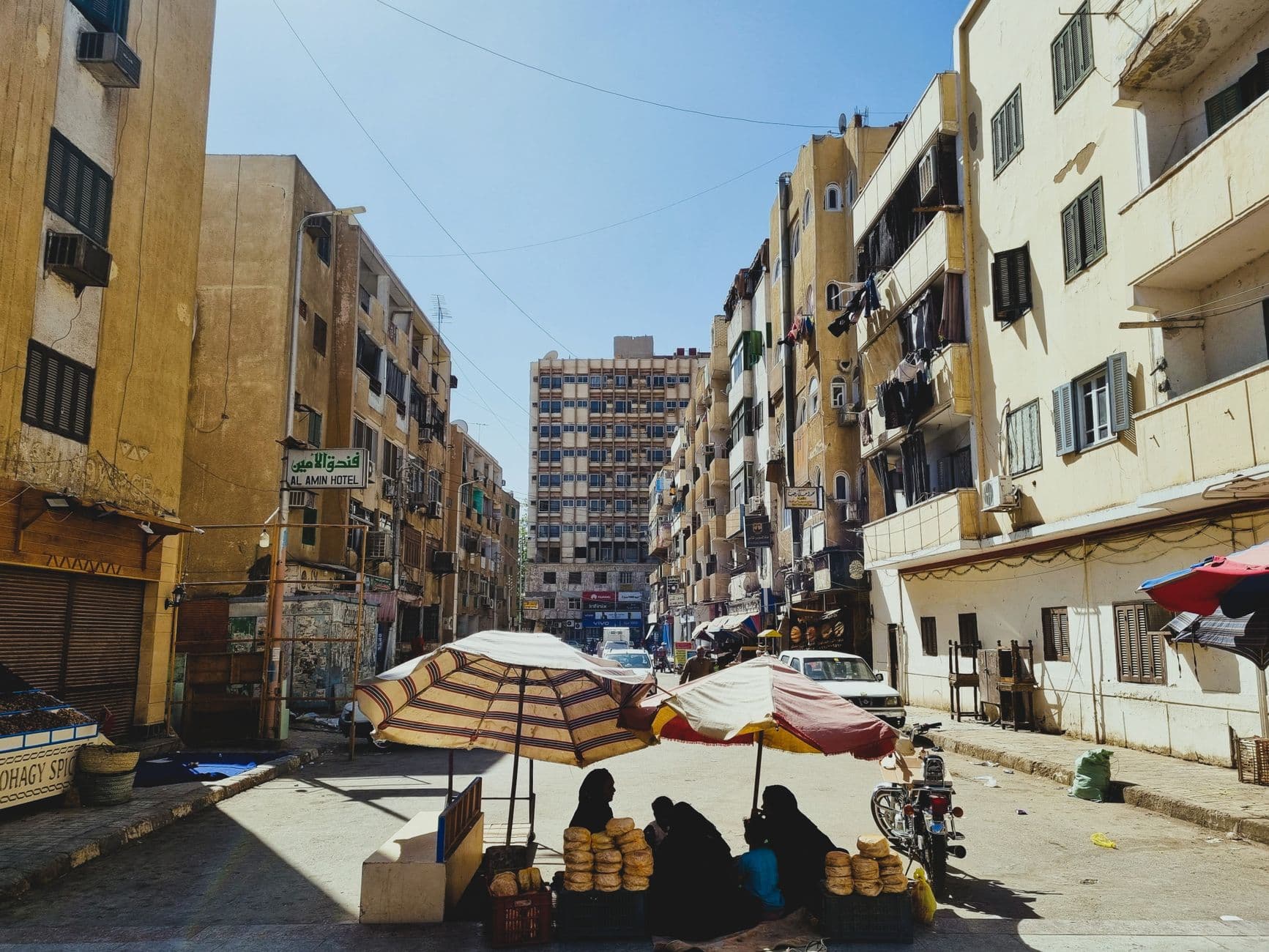
Eliyahu Hanavi is the one most visitors see. The other synagogues of Jewish Alexandria Egypt history require more effort and tell harder stories.
The Eliyahu Hanavi synagogue in the Ibrahimiyya neighborhood (distinct from the downtown one) is now used for storage. The synagogue in the Moharrem Bey district became a warehouse. The great Sephardic synagogue on Champollion Street, named after the Frenchman who deciphered the Rosetta Stone and who spent considerable time in Alexandria, is now a private building whose Jewish origins are invisible from the street. If you look at the building's bones, the high arched windows, the proportions of the facade, you can still read the form beneath the later additions.
The Karaite synagogue in the old Jewish quarter near the Attarin market is worth finding specifically because the Karaite Jews of Egypt represent one of the most unusual chapters in the history of Jewish Alexandria. The Karaites rejected rabbinic law entirely, following only the written Torah. The Egyptian Karaite community, centered mostly in Cairo's Haret al-Yahud but with a significant Alexandria branch, predated the Sephardic community by centuries and had a completely separate liturgy, calendar, and even distinct approach to dietary laws. There were, at various points, enough theological differences between the Rabbinite and Karaite communities in Alexandria that they did not formally recognize each other's marriages.
Most of the Karaite community now lives in the San Francisco Bay Area, in a neighborhood in Daly City, California, where they have rebuilt their specific liturgical tradition at a remove of twelve thousand kilometers from the city that shaped it.
The Connections: One Street, Four Religions, Three Thousand Years
The walk along Nabi Daniel Street from the synagogue toward the Attarin market is one of the most concentrated experiences of Alexandria's layered identity that you will find anywhere in the city. Within 600 meters, you pass: Eliyahu Hanavi Synagogue (Jewish, 14th century core), the Greek Orthodox Cathedral of the Evangelismos (built 1856), a Coptic church whose foundation dates to the fourth century CE, a mosque built in the Ottoman period on the site of an earlier structure, and the city's main antiquities storage facility, which sits above catacombs the Romans used, which themselves sit above Ptolemaic levels that nobody has fully excavated.
The Greek Orthodox community and the Jewish community of Alexandria were neighbors in every sense. Many Alexandrian Jewish families, particularly the Sephardic mercantile class, conducted business in Greek, spoke Greek at home, sent their children to Greek schools, and maintained social friendships with Greek Orthodox families that crossed religious lines in ways that were typical of pre-1950 Alexandria and are now largely gone.
The Greco-Roman Museum on El Mathaf El Romani Street, when it is open after its long renovation, holds artifacts that make the ancient Jewish presence in Alexandria archaeologically legible: Jewish lamps, inscriptions in Greek with Jewish names, amulets that blend Hellenistic and Jewish iconographic traditions. The Jews of Ptolemaic Alexandria did not maintain a strict visual separation from their Greek neighbors. The archaeological record shows a community that was simultaneously distinctly Jewish in practice and thoroughly Alexandrian in material culture.
Common Mistakes

Do not arrive at Eliyahu Hanavi Synagogue without coordinating your visit in advance. The caretakers are present but the gate is often locked for security. Twice, I have watched tourists photograph the exterior, shrug, and leave without understanding that the interior is what matters. Email the Jewish Community of Alexandria at least three days before you visit.
Do not hire a generic Alexandria city tour guide for this specific itinerary. Most licensed guides in Alexandria are expert in Greco-Roman and Islamic history and will give you accurate, useful information about those layers. The Jewish history is specialist knowledge. Ask specifically for a guide with expertise in Alexandria's minority communities. Several are available through the Alexandria Library cultural office.
Do not skip the Bibliotheca Alexandrina's archive floor. The modern library, built on the site of the ancient one, holds one of the most important photographic archives of pre-1952 Alexandrian Jewish life, including community records, wedding photographs, and documentation of the synagogues as they appeared before the diaspora. This is not publicized in standard tourist materials. Ask at the research center desk.
The sound and light show at various Alexandria sites covers none of this history. It costs EGP 250 to EGP 350 and tells you nothing about the city's Jewish, Greek, or Coptic communities. Skip it entirely and use that time to walk the Jewish quarter at dusk instead, when the Attarin market is winding down and the streets have a quality of light that belongs entirely to Alexandria.
Do not conflate the Jewish quarter's current appearance with its historical character. The area around Attarin and the old Jewish neighborhood was one of the wealthiest districts in early twentieth century Alexandria. The peeling buildings and narrow streets are real, but they were not always this way. Carry photographs from the Alexandria archive or from books like Robert Ilbert's photographic history of Alexandria to read the buildings correctly.
Do not visit Alexandria for only one day if Jewish history is your primary interest. The synagogue, the quarter, the Bibliotheca archive, and the Greco-Roman Museum require two full days to engage with properly.
Practical Tips
Arrange everything in advance. The Eliyahu Hanavi Synagogue contact can be reached through the Jewish Community of Alexandria, which maintains a Cairo office that coordinates visits. The community is small but genuinely welcoming of serious visitors. They are not a tourist attraction and do not want to be treated as one.
Combine your visit with a morning at the Bibliotheca Alexandrina, which opens at 9am and closes at 5pm, Saturday through Thursday. The library is ten minutes by taxi from the synagogue (EGP 25 to EGP 40).
If you read Arabic, the National Archives branch in Alexandria holds naturalization records, community tax documents, and property registrations from the Jewish community going back to the nineteenth century. Access requires a research application submitted several weeks in advance, but the documents are extraordinary primary sources.
Alexandria in winter is cooler than you expect for Egypt. Bring layers. The synagogue interior is unheated and the marble floors hold the cold.
The neighborhoods around the Jewish quarter are working residential and commercial districts. Dress modestly, move at a respectful pace, and ask permission before photographing residents or their storefronts. The caretakers and remaining community members have dealt with journalists and documentarians who treated their lives as content. Be the visitor who does not do that.
Frequently Asked Questions
The Weekly Dispatch
More on Egypt, every Friday.
Cultural depth and places most guides never mention.
No spam. Unsubscribe anytime.