Jewish Alexandria: History, Synagogues, and What Survives
Alexandria once had 80,000 Jewish residents and 57 synagogues. Today, fewer than a dozen Jews remain. The buildings are still there. So is the story.

Quick Facts
- Best time to visit
- October to April. The Mediterranean climate is mild, humidity is low, and the light in the old city is at its clearest. Avoid July and August, which are hot, humid, and crowded with domestic summer tourism.
- Entrance fee
- Free entry to Eliyahu Hanavi Synagogue. Donations to the restoration fund are appropriate. Jewish cemetery at Chatby is free and publicly accessible.
- Opening hours
- Eliyahu Hanavi Synagogue: Sunday to Thursday, 10am to 4pm. Closed Friday and Saturday. Confirm by phone before visiting as hours shift during restoration phases.
- How to get there
- AC express train from Cairo Ramses Station to Alexandria Misr Station (EGP 75 to 120, about 2 to 2.5 hours). Taxi from Misr Station to Nabi Daniel Street approximately EGP 30 to 50. Within Alexandria, taxis and ride-share apps operate reliably.
- Time needed
- 45 minutes to 1 hour for the synagogue alone. 3 to 4 hours for a full Jewish quarter walk including the Chatby cemetery and demolished synagogue sites.
- Cost range
- Budget EGP 400 to 700 per day. Mid-range EGP 1,200 to 2,000 per day including a Corniche hotel and meals at the old-establishment seafood restaurants near the port.
Quick Facts
Best time to visit: October to April, when Mediterranean humidity drops and the light over the Corniche turns the color of old amber. July and August are genuinely uncomfortable and the streets around the Jewish quarter get crowded with domestic tourists.
Entrance fees: The Eliyahu Hanavi Synagogue is free to enter, though a donation to the restoration fund is appropriate and appreciated. The Ben Ezra Synagogue in Cairo, for context, costs EGP 100 (approx $2 USD) and the comparison is useful if you are making the trip from the capital.
Opening hours: Eliyahu Hanavi Synagogue is officially open Sunday through Thursday, 10am to 4pm. Fridays and Saturdays, as with any active Jewish site, it is closed to non-Jewish visitors. Confirm by phone before visiting: hours shift without notice depending on restoration work and the availability of the synagogue's Egyptian Jewish community liaison.
How to get there: From Ramses Square in Cairo, take the AC express train to Misr Station in Alexandria (EGP 75 to 120 depending on class, roughly 2 to 2.5 hours). From Misr Station, a taxi to the Manshiyya neighborhood where the synagogue sits costs EGP 30 to 50. Do not take a tour that bundles this with the Catacombs and Pompey's Pillar. The Jewish quarter requires time and attention, not a thirty-minute stop.
Time needed: The synagogue itself takes forty-five minutes to an hour. Walking the full Jewish quarter, including the former community schools, the Jewish cemetery on the edge of Chatby, and the sites of demolished synagogues, takes three to four hours. This is a half-day minimum.
Cost range: Budget EGP 400 to 700 per day in Alexandria. Mid-range EGP 1,200 to 2,000 per day including a decent hotel near the Corniche and a proper meal at one of the old Greek-owned seafood restaurants that still operate near the port.
---
Why This Place Matters

At its peak in 1940, Alexandria's Jewish community numbered approximately 80,000 people. The city had 57 synagogues, a Jewish hospital, four Jewish schools, several social clubs, and neighborhoods where Ladino and Arabic and French mixed in the street. The community was Sephardic for the most part, descendants of Jews expelled from Spain in 1492 who moved through the Ottoman Empire and settled along the Mediterranean coast, including in Egypt under Ottoman rule. They were merchants, bankers, lawyers, poets. One of them, Edmond de Menasce, financed the construction of Eliyahu Hanavi Synagogue in 1850 on land the family had owned for generations.
Today, the official count of Jews remaining in Alexandria is somewhere between five and fifteen, depending on who is counting and how old they are. The 57 synagogues have become apartment buildings, car parks, storage facilities, and in two cases, mosques. What survives does so because of a combination of Egyptian government protection, international Jewish heritage funding, and the particular stubbornness of a few Egyptian officials who understood that erasing this history would diminish Alexandria rather than cleanse it.
This matters for a reason that goes beyond the Jewish Alexandria Egypt history narrative that most heritage guides offer. Alexandria's Jewish community was not an anomaly. It was part of a cosmopolitan Mediterranean city that also contained the largest Greek community outside Greece, a significant Italian population, Armenian traders, Syrian merchants, and Levantine families who defied categorization. The Jews were one thread in that fabric. When the community collapsed, so did much of what made Alexandria distinct from Cairo. Understanding one helps you understand the other.
---
Eliyahu Hanavi: What You Will Actually See
The synagogue sits on Nabi Daniel Street in central Alexandria, a location that is itself a layer cake of history. The street is named for the Prophet Daniel, whose supposed tomb is beneath a mosque a few blocks north. Greek Orthodox Christians, Muslims, and Jews all claimed Daniel as their own at various points, and the street named for him runs through what was once the heart of the Jewish quarter, past the site of the ancient library, above what archaeologists believe may be Alexander the Great's actual burial site. Walk slowly here.
Eliyahu Hanavi is a large, formally Italianate building with a blue-and-white interior that feels genuinely Mediterranean rather than Egyptian. The nave holds roughly 700 people. On the high holy days of 1940, it was not large enough. Today, a Friday evening service might gather eight or nine people, most of them elderly, some of them making the journey from Cairo specifically for the occasion.
The most affecting detail inside is not the chandelier or the carved wooden ark, though both are notable. It is the memorial plaques on the walls, hundreds of them, bearing names in Hebrew, French, and Arabic. These plaques were installed by families in memory of the dead, a common practice in Mediterranean Jewish communities. They document three centuries of Alexandrian Jewish life: families who intermarried with Sephardic Jews from Thessaloniki, families whose names are simultaneously Jewish and unmistakably Egyptian, families who left for Israel or France or Brazil and sent money back for a plaque because they still thought of this building as home.
The synagogue underwent a significant Egyptian government-funded restoration between 2019 and 2022. The work was done with evident care. The marble floors were relaid. The stained glass was repaired. The exterior was cleaned back to its original cream limestone. What strikes you after the restoration is how well-built the structure is. The de Menasce family spent what was necessary.
---
The Jewish Cemetery at Chatby and the Demolished Synagogues
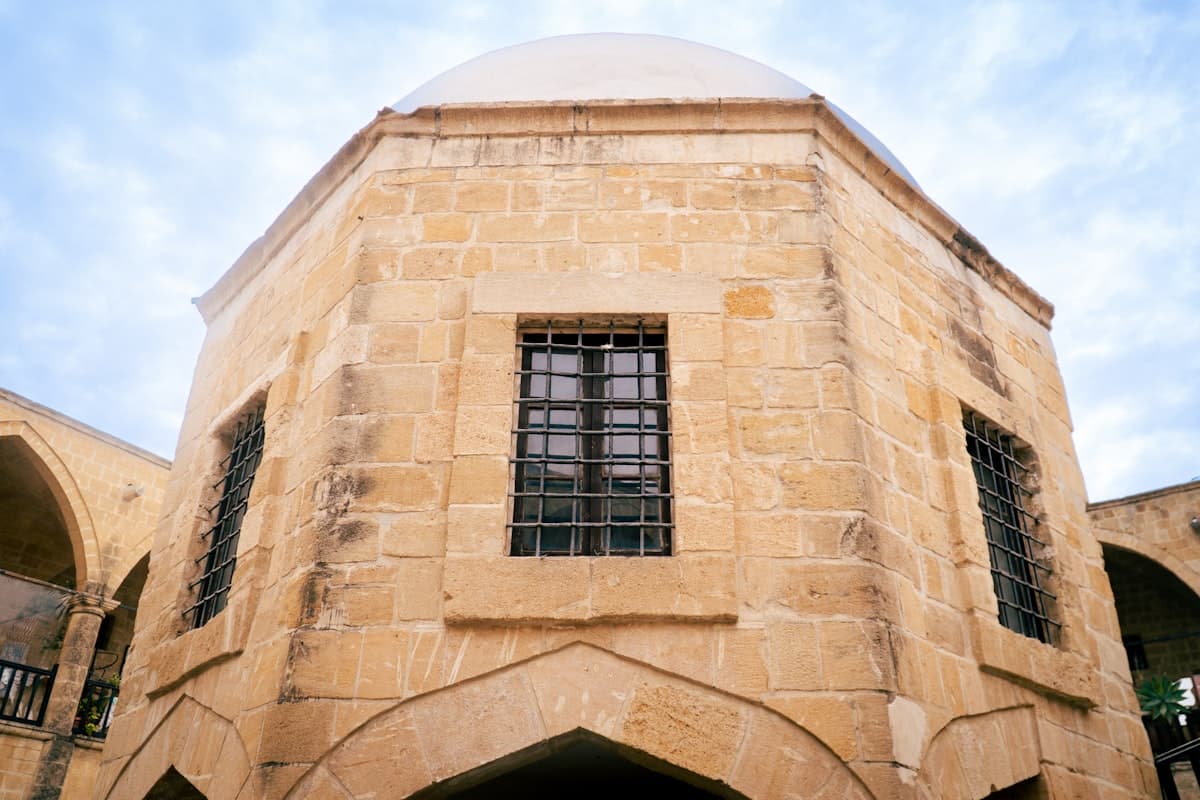
Most visitors who make the effort to visit Eliyahu Hanavi stop there and consider the job done. This is a mistake. The fuller picture of Jewish Alexandria Egypt history requires two more stops.
The first is the Jewish section of the Chatby necropolis on the eastern edge of the city. Chatby is one of Alexandria's oldest cemeteries, containing Greek, Roman, and Jewish burials that date to the 3rd century BCE, when Alexandria's Jewish community was already substantial enough to have its own burial ground. At that time, Alexandria had the largest Jewish population of any city in the world, larger even than Jerusalem. The philosopher Philo of Alexandria, who attempted to reconcile Greek philosophy with Jewish theology in the 1st century CE and whose work later influenced early Christian thought, is believed to have been buried in this area. There is no marked tomb. There is instead a quiet section of worn headstones in Hebrew and French, some dating to the 18th century, overgrown in places, kept by the Egyptian government under a heritage protection order.
The second stop is harder. The site of the former synagogue on Rue Menasce, demolished in the 1960s, is now a parking structure. The site of the Synagogue des Macchabées, which seated 1,200 people, is an apartment block. Walking these sites is not tourism in any conventional sense. It is documentation. You are bearing witness to how a community disappears: not through violence in Alexandria's case, though there was violence in Egypt during and after 1948, but through emigration, legal pressure, nationalization of Jewish-owned property under Nasser, and the steady attrition of a community that found itself politically untenable in a newly pan-Arab nationalist state.
Between 1948 and 1967, approximately 75,000 Jews left Egypt. They went to Israel, France, Brazil, the United States, and Canada. They took their Hebrew books and their French novels and their Egyptian recipes and their Arabic phrases, and they became diaspora communities that still cook kosher molokhiya and still have grandparents who dream in Alexandrian Arabic.
---
The Connections: From Philo to the Geniza
The Jewish Alexandria Egypt history story does not begin with the Ottoman period or even with the medieval community. It begins in 332 BCE, when Alexander the Great founded the city and, according to ancient sources, specifically invited Jewish settlers from the start. Within two centuries, the Jewish population of Alexandria was large enough that the Hebrew Bible was translated into Greek there. That translation, the Septuagint, is one of the most consequential documents in world history: it is the version of the Old Testament that early Christians used, which means that European Christian civilization's relationship with its foundational scripture was mediated by a Greek translation made by Alexandrian Jewish scholars around 250 BCE.
The connection to Cairo runs through the Cairo Geniza, discovered in 1896 in the Ben Ezra Synagogue in Fustat. The Geniza documents, over 300,000 manuscript fragments preserved because Jewish law forbids destroying documents that contain God's name, provide detailed records of medieval Jewish life across the Mediterranean, including extensive documentation of the Egyptian Jewish community. Cambridge scholar Solomon Schechter removed the bulk of the collection to England, where it remains at Cambridge University Library. Egypt has been asking for it back. The conversation continues.
This link between Alexandria and Cairo, between the ancient Jewish community and the medieval one, between Philo and the Geniza merchants, is what makes Jewish Alexandria more than a heritage tourism stop. It is a thread that runs through the entire history of monotheism.
---
Common Mistakes

Arriving without calling ahead. The synagogue's official hours are real but not reliable. Restoration work, religious observances, and staffing issues can close it without warning. The Egyptian Jewish Community in Alexandria maintains a contact line. Use it.
Taking a standard Alexandria day-tour that includes the synagogue. Tour operators typically allot twenty to thirty minutes here. That is enough to photograph the chandelier and leave. It is not enough to read the memorial plaques, speak with the caretaker, or understand what you are looking at. Book your own time.
Skipping the Jewish cemetery at Chatby. It is not on most tourist itineraries because it requires a separate taxi journey and the site is not manicured for visitors. Go anyway. The 3rd-century BCE Jewish burial sections are older than most of what you will see in the rest of the city.
The Jewish Alexandria walking tour offered by several agencies costs EGP 800 to 1,200 per person and covers three sites in two hours. Skip it. This article and an afternoon of your own walking will serve you better. The agencies mean well but their guides repeat the same surface narrative without engaging with the post-1948 history, which is where the story becomes genuinely complicated and genuinely interesting.
Confusing the community's departure with expulsion. The history is more layered than a simple expulsion narrative allows. Many Egyptian Jews left voluntarily in the years after 1948 for Zionist ideological reasons. Others were pressured out through property nationalization and professional exclusions under Nasser. Some were expelled outright after 1956. Reducing this to a single cause misrepresents what happened and makes it harder to understand contemporary Egyptian Jewish identity, which is itself complicated and contested.
Not visiting during a weekday morning. The streets around Nabi Daniel are quieter before noon. After 2pm, especially on weekends, the area around the synagogue becomes a transit corridor and it is harder to walk slowly and look properly.
Expecting the caretaker to speak fluent English. Bring basic Arabic phrases or a translation app. The caretaker, who has worked at the synagogue for over a decade, knows the building's history in detail. He will share it if you make the effort to meet him halfway.
---
Practical Tips
Dress conservatively. The synagogue is an active religious site, not a museum, and the community that maintains it is small and protective of the space. Covered shoulders and knees for both men and women.
Photography inside the synagogue is generally permitted in the main nave. Ask before photographing the ark or any area near the bimah. Do not photograph people without asking.
The neighborhood around Nabi Daniel Street is safe for tourists in daylight hours. Street harassment is minimal by Egyptian city standards. The area has a mixed commercial character: you will walk past a shawarma stand, a stationery shop, a mobile phone repair kiosk, and then find yourself standing in front of a 170-year-old synagogue. This is normal Alexandria.
If you are Jewish and interested in attending a service, contact the Egyptian Jewish Community organization in advance. Services do occur, particularly around the high holy days, and the community sometimes welcomes international Jewish visitors.
For broader context before your visit, read Lucette Lagnado's memoir "The Man in the White Sharkskin Suit," which documents her Sephardic Jewish family's departure from Cairo in the 1960s. And read Robert Sole's novel "The Photographer's Wife" for a fictional but historically grounded account of Alexandria's cosmopolitan community. Both will make what you see here land differently.
Frequently Asked Questions
The Weekly Dispatch
More on Egypt, every Friday.
Cultural depth and places most guides never mention.
No spam. Unsubscribe anytime.