Jewish Alexandria: The Synagogues and History of a Lost World
At its peak, Alexandria's Jewish community numbered 80,000. Today fewer than a dozen Jews live in the city. The synagogues are still there. So is everything else, frozen.

Audio Guide: Jewish Alexandria: The Synagogues and History of a Lost World
Quick Facts
- Best time to visit
- October to April. The Mediterranean climate is cool and manageable, humidity is low, and the city is not crowded with summer visitors from Cairo.
- Entrance fee
- Eliyahu Hanavi: no fixed ticket price, suggested donation EGP 100 to 200 (approx $3 to $6 USD). Jewish cemetery at Chatby: access by arrangement, no standard fee.
- Opening hours
- Eliyahu Hanavi is nominally open Saturday mornings and selected weekdays by prior arrangement. Hours are not fixed. Confirm before visiting.
- How to get there
- Spanish train from Cairo Ramses Station to Alexandria Misr Station: approximately 2 hours, EGP 90 to 180 (approx $3 to $6 USD). Taxi from Misr Station to Nabi Daniel Street: EGP 50 to 80. Tuk-tuk: EGP 20 to 30.
- Time needed
- 45 minutes to 1 hour inside the synagogue. 2 to 3 hours including the surrounding neighborhood walk. Add a half-day for the Chatby cemetery and nearby Greco-Roman necropolis.
- Cost range
- Budget EGP 400 to 600 per day including transport, food, and site access. Mid-range EGP 1,200 to 2,000 per day with a licensed guide and a proper seafood lunch.
At its peak in the 1940s, Alexandria's Jewish community numbered roughly 80,000 people. They ran cotton exchanges, published Arabic-language newspapers, built hospitals, and composed music that Egyptians still hum without knowing its origin. Today, fewer than a dozen Jews remain in the city. The synagogues have not been demolished. They have been preserved, which is its own kind of haunting.
Quick Facts
Best time to visit: October to April, when Alexandria's Mediterranean climate is cool and the light is soft. Summer is humid and the city is crowded with Egyptian tourists from Cairo.
Eliyahu Hanavi Synagogue entrance: Currently managed by the Egyptian government through the Jewish Community of Alexandria. Entry requires advance coordination; informal visits through a licensed guide or the community contact often cost EGP 100 to 200 (approximately $3 to $6 USD) in suggested donations. Confirm access before traveling specifically for this site.
Opening hours: Eliyahu Hanavi is nominally open Saturday mornings for what remains of community observance, and on selected weekdays by arrangement. Hours are not fixed. Call ahead or contact your hotel concierge to coordinate.
How to get there: Alexandria is 225km from Cairo. The Spanish train from Ramses Station takes approximately 2 hours and costs EGP 90 to 180 (about $3 to $6 USD) in air-conditioned second class. From Alexandria's Misr Station, the synagogue on Nabi Daniel Street is a 15-minute walk or a short tuk-tuk ride for EGP 20 to 30. Taxis from the station cost EGP 50 to 80.
Time needed: The synagogue itself takes 45 minutes to an hour. The surrounding neighborhood, including the street where the legendary Library of Alexandria once stood (directly beneath where Nabi Daniel Street runs today, according to most contemporary archaeological consensus), takes another hour or two if you walk it properly.
Cost range: Budget EGP 400 to 600 per day in Alexandria including transport, food, and site access. Mid-range EGP 1,200 to 2,000 per day with a licensed guide and a decent seafood lunch on the Corniche.
Why This Place Matters
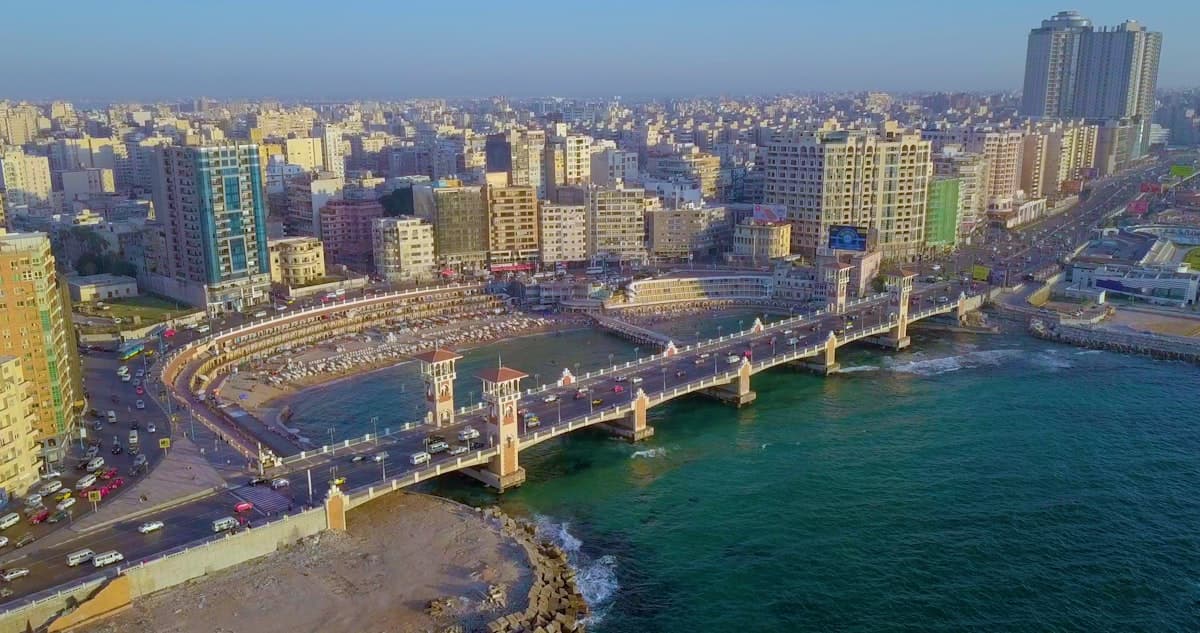
Jews have lived in Alexandria since the city's founding in 331 BC. Alexander the Great reportedly granted them the right to settle in the new city on equal terms with Macedonian Greeks, which is either historically accurate or a founding myth so persistent it functions as truth. By the first century BC, Alexandria had the largest Jewish population of any city in the ancient world, larger than Jerusalem. The philosopher Philo of Alexandria, who attempted to reconcile Greek philosophy with Jewish scripture and directly influenced early Christian theology, was born here around 20 BC. Without Alexandria's Jews, the intellectual architecture of Western religion looks fundamentally different.
The medieval period brought a different kind of Jewish Alexandria. The Cairo Geniza documents, discovered in a synagogue storeroom in Fustat in 1896, revealed that Jewish merchants operated trade networks across the Mediterranean from Alexandria for centuries, their letters describing textile prices, family disputes, and business partnerships with Muslims and Christians in a register that sounds almost entirely modern. Alexandria appears in those letters constantly, as a port, a market, a waystation between the Mediterranean world and the Indian Ocean trade.
The modern community arrived in waves: Sephardic Jews expelled from Spain in 1492, who came via the Ottoman Empire; Greek-speaking Romaniotes; later Ashkenazi Jews fleeing European persecution in the nineteenth and early twentieth centuries. By the 1920s, the Alexandrian Jewish community was cosmopolitan in the most literal sense: its members held British, French, Italian, and Greek passports alongside Egyptian ones, spoke four or five languages at the dinner table, and produced figures like the poet Constantine Cavafy, who was Greek Orthodox but whose entire imaginative world was shaped by the Jewish and Arab Alexandria around him.
The departure was not a single event. It was a slow hemorrhage across three decades. Some families left after 1948. More left after 1956, when Nasser nationalized the Suez Canal and the subsequent crisis made foreign nationals with complicated loyalties unwelcome. The final exodus came after 1967. By the 1970s, a community that had existed for 2,300 years had essentially dissolved.
Eliyahu Hanavi: What You Will Actually See
The Eliyahu Hanavi Synagogue on Nabi Daniel Street is the main surviving Jewish site in Alexandria, and it is genuinely worth the coordination required to visit. Built in its current form in 1354 and substantially renovated in 1850, it is one of the oldest continuously used synagogues in the world outside of Israel and Morocco. The 1850 renovation was funded largely by the Menasce family, one of Alexandria's great Sephardic banking dynasties, who left their name on streets, hospitals, and charitable institutions across the city before they too eventually left.
Inside, the architecture is a precise record of Alexandria's layered identity. The building follows a Sephardic floor plan, with the bimah (reading platform) in the center rather than at the front, as Ashkenazi custom would have it. The columns are Italian marble, imported at considerable expense. The stained glass is European. The wooden ark holding the Torah scrolls is inlaid with mother of pearl in a pattern indistinguishable from the woodwork you will see in nineteenth-century Cairene houses in Islamic Cairo. The craftsmen who built the finest Jewish interiors and the finest Muslim interiors in Egypt were often the same craftsmen.
The Torah scrolls that remain are under the protection of the Egyptian government. This is not a small gesture. Egypt has spent considerable money restoring Eliyahu Hanavi, a fact that surprises visitors who arrive expecting neglect. The restoration, completed in phases between 2000 and 2020, cost millions of Egyptian pounds and was overseen by the Supreme Council of Antiquities. Whether this represents genuine commitment to pluralist heritage or political optics is a conversation Alexandrians have with some frequency.
The Cemetery and What It Holds
Less visited, and in some ways more revealing, is the Jewish cemetery on Chatby Road, one of the oldest extant Jewish cemeteries in Egypt. The inscriptions on the older stones shift language across generations: Hebrew, then Judeo-Arabic, then Ladino (the Sephardic Spanish dialect preserved like a fossil from 1492), then French, then English. You can read the community's self-understanding across two centuries just by walking the rows. Some families have stones in four languages across three generations, each one a small record of assimilation and aspiration.
The cemetery is not always accessible to casual visitors. Contact the Alexandria Jewish community representative or arrange access through a local guide who works with heritage sites. It is worth the effort. The Chatby necropolis area more broadly contains some of the oldest Greek and Roman tombs in Egypt, dating to the fourth century BC, and the Jewish cemetery sits within this ancient burial landscape as though the community arrived and simply continued a conversation already underway.
The Connections
Nabi Daniel Street, where Eliyahu Hanavi stands, is named for a Muslim saint whose mosque occupies the street's northern end. The mosque sits, according to persistent local tradition, above the tomb of Alexander the Great, a claim archaeologists have been unable to confirm or definitively dismiss. So the street where Alexandria's great synagogue stands is also the street where Alexander, the city's founder and the man who first invited Jews to settle here, may be buried. The resonance is either cosmically appropriate or a coincidence that Alexandria arranged for its own mythology.
The connection to Coptic Alexandria runs through the same streets. The first Christians in Alexandria were almost certainly Jewish Christians, followers of the Jewish sect that became Christianity, and the early Coptic church was shaped by the same Alexandrian Jewish philosophical tradition that produced Philo. The Catechetical School of Alexandria, which produced theologians who defined Christian doctrine for the entire Western and Eastern church, was built on intellectual foundations laid by Jewish scholars. Origen, the third-century Christian theologian who studied here, used methods of biblical interpretation developed by Philo a century before him.
The Islamic connection is equally direct. When Arab armies took Alexandria in 641 AD, the Jewish community remained and in some periods flourished. The Fatimid caliphate, which ruled Egypt from 969 to 1171, was notably tolerant of its Jewish and Christian subjects, and Alexandria's medieval Jewish community produced merchants, physicians, and administrators who worked across religious boundaries. The documents from the Cairo Geniza show Jewish traders addressing Muslim business partners as brothers, which they sometimes meant almost literally given intermarriage at the margins of both communities.
Common Mistakes
Arriving without advance coordination. Eliyahu Hanavi is not a standard tourist site with posted hours and a ticket window. Showing up unannounced may mean a locked gate. Email or call through your hotel at least two days before your visit.
Skipping the neighborhood for the synagogue alone. Nabi Daniel Street and the surrounding blocks contain the physical memory of what was once one of the most cosmopolitan urban quarters on the Mediterranean. The buildings are still there, Art Deco facades above shops selling mobile phone cases, apartment blocks where five languages were spoken on five floors. Walking it slowly takes an hour and tells you more than any interior.
Relying on the Alexandria National Museum to fill in the Jewish history. The museum is excellent on Pharaonic and Greco-Roman Alexandria. Its coverage of the Jewish community, the Coptic community, and the cosmopolitan modern city is thin. Do not expect it to do this work for you.
Paying for a group Nile cruise that includes Alexandria as a single-day stop. You cannot do justice to Jewish Alexandria in a single day alongside Pompey's Pillar and the Catacombs and a seafood lunch. If this history interests you specifically, base yourself in Alexandria for two or three nights and move through it at the pace it demands.
The sound and light show at the Bibliotheca Alexandrina. It costs EGP 250 to 350 and tells you the broad outline of Alexandrian history in a format designed for mass audiences. The Bibliotheca itself is worth visiting in daylight for its architecture and its small but well-curated antiquities museum in the basement. The evening show adds nothing and subtracts an evening you could spend eating grilled fish at one of the seafront restaurants that have been in the same families for three generations.
Treating this as a Holocaust tourism narrative. The departure of Egypt's Jews was not genocide. It was political displacement, economic pressure, and the violence of nationalism applied to people who held complicated identities. Some families left with assets intact. Some were stripped of everything. The history demands more precision than borrowed emotional frameworks.
Assuming you need a specialist Jewish heritage tour operator. A good Alexandrian guide who knows the city's modern history is sufficient and considerably cheaper. Ask your guide specifically about the Jewish community's role in Alexandria's cotton trade, its newspapers, and its music. If they cannot speak to those things, find a different guide.
Practical Tips
Alexandria's best guides for modern and cosmopolitan history are often not the ones who advertise at the train station. Ask your hotel, or contact the Alexandria branch of the Egyptian Tourist Authority, for guides who specialize in the nineteenth and twentieth century city rather than Pharaonic and Greco-Roman sites.
The Corniche is a 30-minute walk from Eliyahu Hanavi and worth doing after your visit. The seafood restaurants between Sidi Bishr and Stanley Bridge are better and cheaper than the ones directly adjacent to the tourist sites. Lunch for two with grilled sea bass, salads, and bread costs EGP 400 to 600 at a mid-range place.
For reading before you visit: André Aciman's memoir 'Out of Egypt' is the single best account of a Jewish Alexandrian family's final years in the city, precise about streets and seasons and the texture of departure. Robert Sole's novel 'The Photographer's Wife' and Jacqueline Kahanoff's essays are also essential. Alexandria's Jewish history has produced a literature in proportion to its loss.
Photography inside Eliyahu Hanavi is generally permitted with permission from whoever is managing access on the day. Ask before you raise your camera. The exterior is freely photographable from the street.
The Jewish cemetery at Chatby is best visited in the morning, before the heat builds and before the street traffic makes the area difficult to navigate on foot. Bring water. The cemetery has no facilities.
Frequently Asked Questions
The Weekly Dispatch
More on Egypt, every Friday.
Cultural depth and places most guides never mention.
No spam. Unsubscribe anytime.