Mohamed Ali Mosque: Albanian History Egypt's Most Unlikely Ruler Left Behind
An Albanian soldier who never learned Arabic ruled Egypt for 43 years and built Cairo's most recognizable skyline. Here is the full story behind the Citadel mosque.

Quick Facts
- Best time to visit
- October to March for comfortable temperatures and clear views to the Pyramids. January gives the best light on the alabaster exterior.
- Entrance fee
- EGP 450 (approx $9 USD) for the full Citadel complex. Student discount EGP 225 with valid ISIC card. Cash only at the ticket booth.
- Opening hours
- Daily 8am to 5pm. Closes earlier during Ramadan, sometimes 3pm. The mosque opens for prayer before ticketed hours.
- How to get there
- Taxi from Tahrir Square: EGP 50 to 80. Metro to Sayyida Zeinab (Line 1, EGP 7) then microbus or tuk-tuk EGP 5 to 10. Uber from downtown: EGP 60 to 90.
- Time needed
- 2 hours for mosque and main terrace view. Half-day for full Citadel complex including Military Museum and Mosque of al-Nasir Muhammad.
- Cost range
- Budget EGP 600 to 900 per day including transport, entry, and lunch in Islamic Cairo. Mid-range EGP 1,800 to 2,500 including licensed guide.
Quick Facts
Best time to visit: October to March, when the Citadel plateau is cool enough to walk without misery. July and August between 10am and 3pm are genuinely punishing.
Entrance fee: EGP 450 (approximately $9 USD) covers the entire Citadel complex including Mohamed Ali Mosque, the Military Museum, and the Police Museum. Student discount with valid ISIC card: EGP 225.
Opening hours: Daily 8am to 5pm. During Ramadan the complex closes earlier, sometimes by 3pm. The mosque itself is accessible for prayer outside of tourist hours but the wider Citadel grounds follow ticketed hours.
How to get there: From Tahrir Square, a taxi to the Citadel gate costs EGP 50 to 80 depending on traffic and your negotiating patience. The Cairo Metro does not reach the Citadel directly. Take Line 1 to Sayyida Zeinab station (EGP 7), then a microbus or tuk-tuk up the hill for EGP 5 to 10. Uber is consistently reliable at EGP 60 to 90 from downtown.
Time needed: Two hours for the mosque and the view alone. A half-day if you intend to see the Military Museum and walk the full Citadel perimeter, which you should.
Cost range: Budget EGP 600 to 900 per day including transport, entry, and a meal in Islamic Cairo nearby. Mid-range EGP 1,800 to 2,500 if you add a guide and lunch.
---
Why This Place Matters
Mohamed Ali Pasha arrived in Egypt in 1801 as a junior officer in an Ottoman Albanian regiment, sent to help expel Napoleon's forces after the French invasion. He never left. By 1805, through a combination of political maneuvering and calculated violence, he had removed every rival and declared himself ruler. He would govern Egypt until 1848, never becoming fluent in Arabic, and transform the country from an Ottoman backwater into the most modern state in the region.
The mosque he built on the highest point of Saladin's twelfth-century Citadel was finished in 1848, the same year his mental health collapsed and he was effectively deposed by his own family. He died a year later without ever seeing it formally inaugurated. The timing is either ironic or fitting depending on your tolerance for historical tragedy.
What most visitors don't know: the mosque is not Egyptian in design, not Ottoman in the way Suleiman the Magnificent's mosques are Ottoman, and not even original in its engineering. Mohamed Ali commissioned a Greek-born Turkish architect named Yusuf Boshnak to copy the Sultan Ahmed Mosque in Istanbul almost exactly. The twin minarets, the cascading half-domes, the central courtyard with its ablution fountain: all of it is a direct quotation of a building completed 230 years earlier in Constantinople. Egypt's most iconic skyline feature is an architectural copy of a Turkish mosque designed to announce that its builder was as legitimate as any Ottoman sultan.
The alabaster that sheathes the exterior walls was quarried from Beni Suef, 120 kilometres south of Cairo. It gives the mosque its particular quality of light in the morning, when the surface seems to generate its own pale glow rather than simply reflect the sun. Stand on the Citadel's northern wall at 7am and you will understand why Cairenes call it the Alabaster Mosque.
---
The Albanian Soldier Who Remade Egypt
Mohamed Ali was born around 1769 in Kavala, then an Ottoman port city in what is now northern Greece. He was ethnically Albanian, raised in a family of tobacco merchants and tax collectors, and had no formal military training before joining the Ottoman forces. He was in his early thirties when he landed in Egypt. He spoke Turkish and Albanian. He learned enough Arabic to conduct politics but conducted most governance through translators.
The question of how a man with no indigenous base of power consolidated control over a country this size still produces arguments among historians. The answer involves several factors: the destruction of the Mamluk military class at a dinner in the Citadel in 1811, where he invited 470 Mamluk leaders and had them killed as they left (the only survivor reportedly jumped his horse from the Citadel wall, a leap that may be apocryphal but has a specific location on the northern rampart), the creation of a conscript army from Upper Egyptian peasants trained by French officers, and an aggressive modernization of agriculture that made Egypt the world's primary supplier of long-staple cotton by the 1830s.
He also abolished the tax-farming system that had bled Egyptian agriculture for centuries, nationalized land, built the first modern medical school in the Arab world at Qasr al-Aini in 1827, and sent over three hundred Egyptian students to France between 1826 and 1847 in educational missions that would shape Egyptian intellectual life for the next hundred years. One of those students was Rifaa al-Tahtawi, who returned to translate Montesquieu and became the first Egyptian to write seriously about nationalism.
The mosque was not merely a religious building. It was a political statement about permanence, legitimacy, and dynasty. Mohamed Ali had founded a royal line. He needed an architectural anchor.
---
What You Will Actually See, and What Most People Walk Past
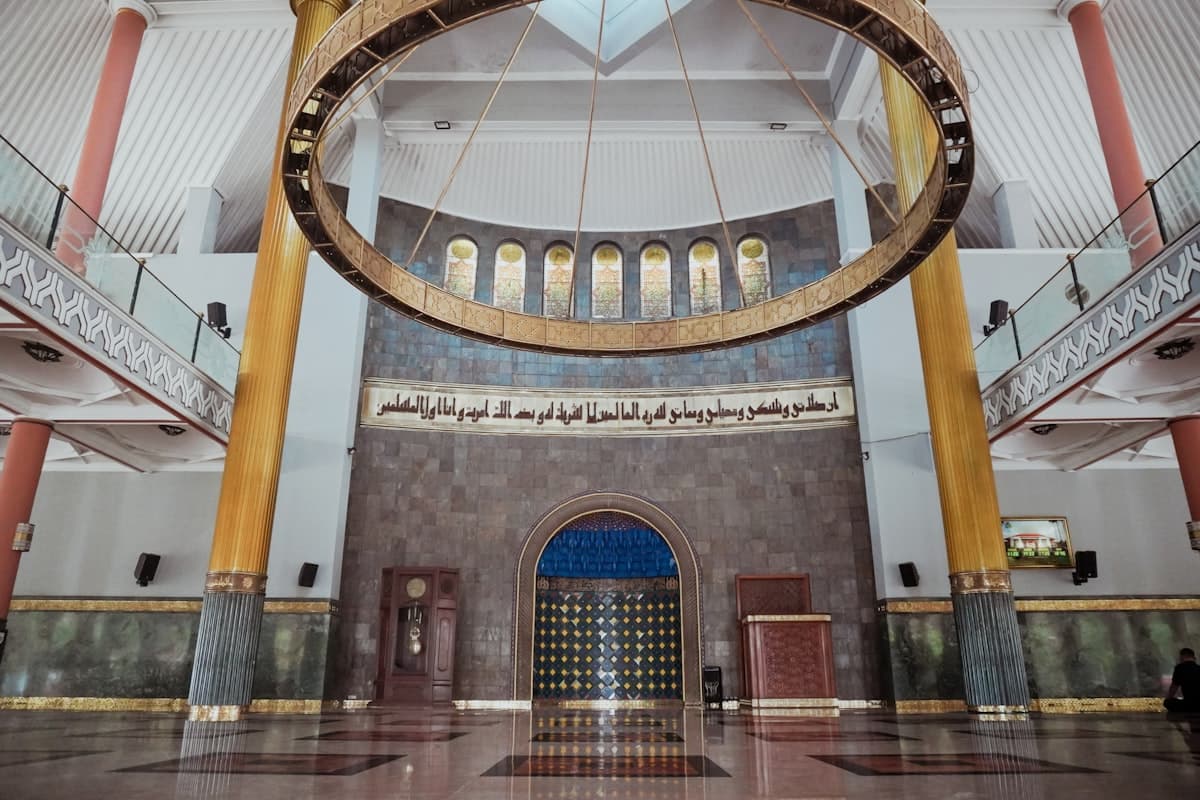
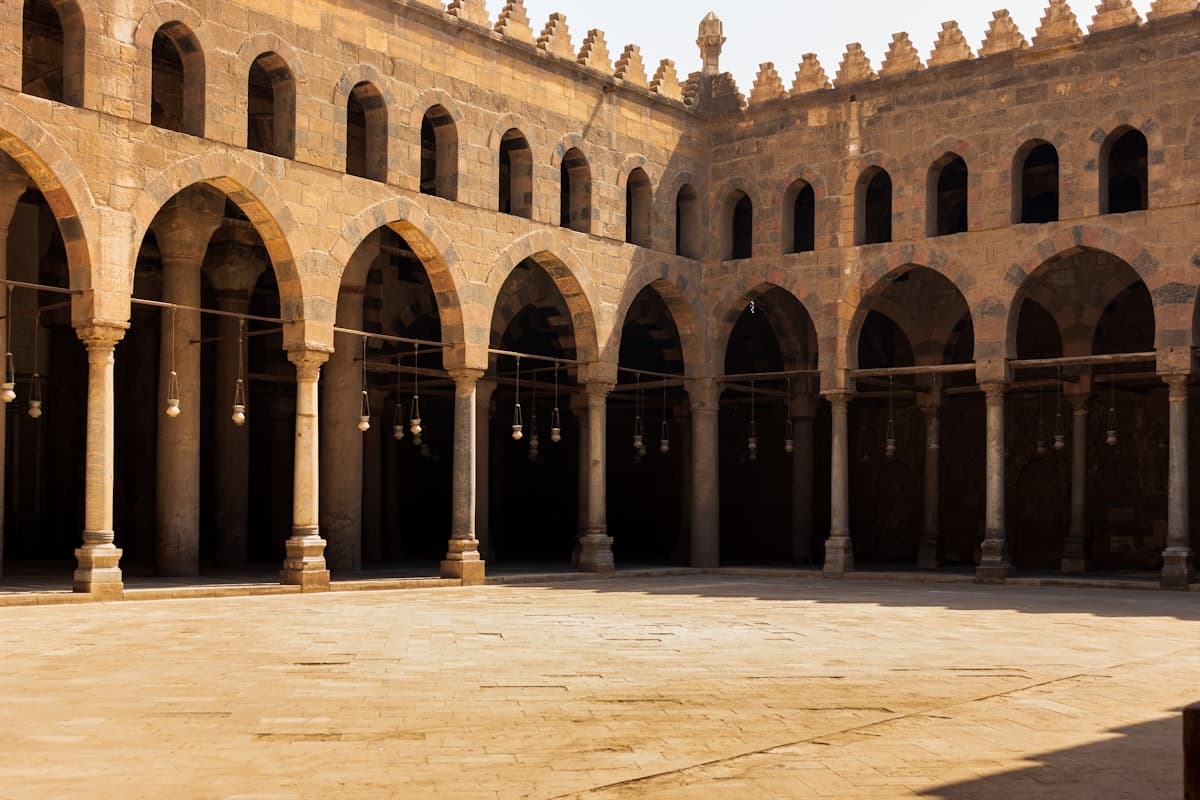
The courtyard is where you enter, and it deserves more time than most visitors give it. The central ablution fountain is a nineteenth-century clock tower gift from France, which has never worked correctly. This is a fact Mohamed Ali reportedly found embarrassing, and which Cairo finds endlessly amusing. The clock was exchanged for an obelisk: the one standing in the Place de la Concorde in Paris today was given to France by Mohamed Ali in 1833, and the clock sent in return has been broken for most of its existence.
Inside the prayer hall, the central dome reaches 52 metres. The painted interior, restored heavily in the twentieth century, tends toward the decorative over the spiritual: lots of gold, lots of hanging lamps, a quality of light that feels more ceremonial than contemplative. If you have been inside Sinan's mosques in Istanbul you will find this one louder in its decoration. If you have not, it is likely to impress.
What almost nobody stops to see: the tomb of Mohamed Ali himself, in a small white marble enclosure on the right side of the prayer hall as you enter. It is unguarded, often empty of visitors, and oddly moving. The man who conquered Sudan, who sent his son Ibrahim to defeat the Ottoman army and briefly occupy Syria, who built the Suez Canal's conceptual predecessor as a series of irrigation canals through the Delta, who is called the founder of modern Egypt by some historians and an Albanian opportunist by others: he is buried in a room most tour groups walk directly past.
From the Citadel's southern terrace you have an unobstructed view of Cairo that explains every decision about where to place this fortress. Saladin chose this escarpment in 1176 specifically because it commands sight lines in every direction. In clear conditions in winter you can see the Pyramids of Giza due west, the Pyramids of Saqqara to the southwest, and the Muqattam Hills rising behind you to the east. In summer the haze reduces this to a general sense of vastness. Come in January.
---
The Connections: Layers the Citadel Doesn't Announce
The ground under your feet at the Citadel has been occupied continuously since Saladin's Ayyubid dynasty built the first fortifications in 1176. But Saladin built on Roman foundations: a Byzantine tower stood here before the Arab conquest of 641. Medieval Arab travelers described a Pharaonic water channel running through the base of this hill. The Mamluks who followed the Ayyubids added the Mosque of al-Nasir Muhammad, which stands within the Citadel complex and is almost always empty of tourists. It was built between 1318 and 1335, predates Mohamed Ali's mosque by five centuries, and has a Gothic-influenced portico taken directly from a Crusader church in Acre after that city fell to the Mamluks in 1291. The column capitals are spoils from demolished Fatimid buildings. Nothing in Egypt is built from scratch.
Mohamed Ali's dynasty, the Muhammad Ali dynasty, ruled Egypt formally until 1952, when a military coup led by Gamal Abdel Nasser ended it. The last king, Farouk, was Mohamed Ali's great-great-grandson. The family that began with an Albanian soldier who never learned Arabic ended with a king born in Cairo who spoke better English and French than Arabic, and who spent his final years in exile in Monaco eating himself to death. The Citadel mosque is the dynasty's most visible monument. It is also, depending on how you read it, its most honest one: imported in design, built by foreign architects, paid for by the labor of Egyptian peasants who were taxed to fund it.
The area immediately below the Citadel, the neighborhood of Sayida Aisha and the street leading to the City of the Dead, was the site of Napoleon's artillery positions during the 1798 siege of Cairo. French cannonballs hit the Citadel's eastern wall. The marks were plastered over. Mohamed Ali arrived three years after Napoleon left, inheriting both the broken city and the French obsession with Egypt that the invasion had created. His alliance with French technical expertise was not coincidence. It was strategic memory.
---
Common Mistakes
Arriving at midday in summer. The Citadel plateau has almost no shade. Between 11am and 3pm from May through September it is genuinely dangerous for people who are not acclimatized. The light is also flat and unpleasant for seeing the alabaster at its best. Go early or late.
Paying for a guide at the gate. The freelance guides who approach at the Citadel entrance are inconsistent in quality and some are actively misleading. If you want a guide, book one in advance through a licensed operator or use a vetted platform. An uninformed guide at a site this historically layered is worse than no guide.
Skipping the Mosque of al-Nasir Muhammad. This is the honest contrarian take: most visitors spend an hour in Mohamed Ali's mosque and ignore the Mamluk mosque thirty metres away. The Mosque of al-Nasir Muhammad is older, stranger, more architecturally interesting, and has almost no one in it. Its Gothic portico, looted from a Crusader church, is one of the most unexpected objects in all of Egyptian architecture. The tour operators don't take you there because it requires explanation. Go on your own.
Assuming the Citadel is just the mosque. The full complex includes the Police Museum, the Military Museum, and the long northern wall with its view over Islamic Cairo's minarets. The wall walk takes twenty minutes and provides a perspective on the medieval city that no street-level visit can replicate.
The sound and light show at the Citadel. It costs EGP 300, runs infrequently, and delivers historical information in a format that feels designed for someone who finds reading difficult. Every fact it contains is available in this article. Skip it entirely.
Not dressing appropriately. The mosque is an active place of worship. Shoulders and knees must be covered. Shoe bags are provided at the entrance. Women who prefer not to borrow the site's polyester head coverings should bring their own scarf.
Rushing to the mosque and ignoring the view. The southern terrace with its Pyramids sight line is the reason Saladin put this fortress here. Five minutes standing on that terrace reorganizes your understanding of Cairo's geography in a way that no map can.
---
Practical Tips
The Citadel is most logically combined with a morning walk through Islamic Cairo: start at Khan el-Khalili at 8am when the tourists haven't arrived and the tea shops are still setting up, walk south through the Muizz Street corridor past the Mamluk architecture, and arrive at the Citadel by 10am. This gives you three distinct historical layers in one morning.
The ticket booth accepts cash only. Bring EGP. The ATMs in the immediate vicinity are unreliable.
Friday midday is the worst time to visit: the mosque fills for Friday prayer and the surrounding streets are congested. Saturday morning is the most manageable in terms of crowd density.
There is a cafe inside the Citadel complex with a reasonable view and mediocre coffee. It is useful if you need to sit. The better option is to descend to the Sayida Aisha area afterward and find one of the local tea houses on the street below, where a glass of koshary tea costs EGP 10 and nobody is trying to sell you anything.
For the Albanian history Egypt connection specifically: if you are researching Mohamed Ali's origins rather than simply visiting the mosque, the best supplementary reading is Khaled Fahmy's "All the Pasha's Men," a detailed history of the Egyptian army under Mohamed Ali that contextualizes his Albanian background and Ottoman-Albanian military culture in ways the Citadel's museum panels do not begin to approach.
Frequently Asked Questions
The Weekly Dispatch
More on Egypt, every Friday.
Cultural depth and places most guides never mention.
No spam. Unsubscribe anytime.